Mississippi Rules for a Fourteen-Year-Old Rider
A 14-year-old may be ready to ride, but age alone does not settle where or under what conditions it is legal in Mississippi. The rules depend on whether the machine is on public or private land, and riding areas can add their own requirements. Here’s how to check the basics before a young rider heads out.
What Mississippi’s age rules mean for a 14-year-old
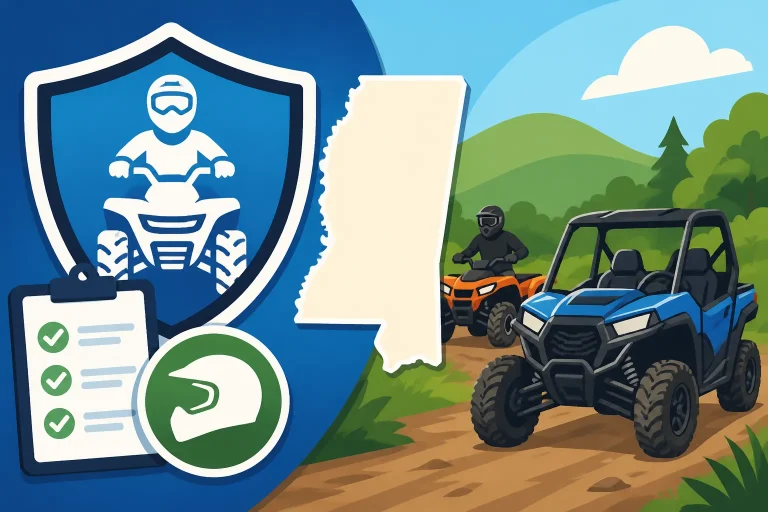
Mississippi’s rules for young ATV and UTV riders include requirements that can apply on public property, such as wearing a helmet and having the required license or safety credential. A 14-year-old should not assume that being with a parent replaces those requirements. Nor should a family assume the same rules apply at every trail, park, or private riding area.
The practical takeaway is to check three things before riding: the state rules that apply to the land, the riding area’s own rules, and the machine’s design and passenger limits. These are separate checks. A rider may meet one requirement and still be turned away for failing another.
| Question | What a 14-year-old and parent should check |
|---|---|
| Is the riding area public or private? | Identify who manages the land and which rules apply |
| Is a helmet required? | Mississippi law and the site may both set requirements |
| Does the rider need a license or safety certificate? | Confirm which credential the site accepts for a rider under 16 |
| Is the machine suitable? | Follow the manufacturer’s age, size, and passenger guidance |
| Can the machine be ridden there? | Check local restrictions, trail limits, and posted closures |
On public land, a safety certificate may be especially important for someone who is too young to hold a driver’s license. Confirm the exact credential and proof required with the managing agency or riding facility before leaving home. Requirements can differ by location, and a parent’s driver’s license does not automatically count as the young rider’s own credential.
A helmet is a basic part of the plan, not a substitute for the other rules. The age-related helmet requirement for riders under 16 is one reason to make a helmet check part of every outing. A helmet that is too large, damaged, or not designed for riding offers a poor fit for the risk. If shopping through a marketplace such as Amazon, check the manufacturer’s labeling and fit guidance rather than relying on a product title or seller description alone.
For more detail on the state’s age-related rules, see [Mississippi Rules for Riders Under 16] and Mississippi Helmet Law for Riders Under 16. If you need to understand the credential requirement, Mississippi Requires a License or a Safety Card explains the distinction.
Licenses, safety certificates, and supervision
A 14-year-old usually cannot rely on holding a regular driver’s license to satisfy a riding-area rule. Ask whether the site accepts a safety certificate for riders under 16, who approves the course, and what proof the rider must carry. A course completion document is useful only if it meets the standard the relevant agency or park requires.
Do not assume that every course labeled “ATV safety” is accepted everywhere. Ask the trail manager or park office what they recognize before enrolling or arriving. Mississippi has safety-course options associated with youth instruction, but acceptance can depend on the land manager’s rules. The details in Mississippi Safety Courses Through Extension and Which ATV Safety Courses the State Will Accept can help you identify what to ask.
Supervision is also worth checking directly. A parent riding nearby can help a young rider make safer decisions, but supervision does not necessarily replace a certificate, helmet, or other condition of access. Ask whether the site requires an adult to ride with the child, remain in sight, or be present at the location. Those are different expectations.
Before the trip, call or check the official information for the specific trail or park. Ask these questions plainly:
- Can a 14-year-old ride this type of machine here?
- Which license or safety certificate does the rider need?
- Does the rider need to carry the certificate, or is showing it at the entrance enough?
- Must a parent or other adult ride with the child?
- Are there age, engine-size, or machine-type limits?
- Does the helmet need to meet a stated standard?
- Are there current closures or other restrictions?
Keep the answers with your trip information. If a rule is unclear, ask the land manager to explain it before riding rather than relying on a general rule from another park. Mississippi Rules Riders Get Wrong and Mississippi Permit Questions Riders Ask cover common points of confusion.
Where a 14-year-old can ride
Mississippi does not make an ATV or UTV legal to ride everywhere just because the rider has the right equipment. Public roads are a separate issue: an ATV or UTV should not be taken onto a public road unless a specific law or local rule authorizes it. A short trip along a road shoulder or across a street can still create a legal and safety problem. See Mississippi Bans ATVs on Public Roads and Why a Title Does Not Open Any Roads for the difference between ownership paperwork and permission to ride.
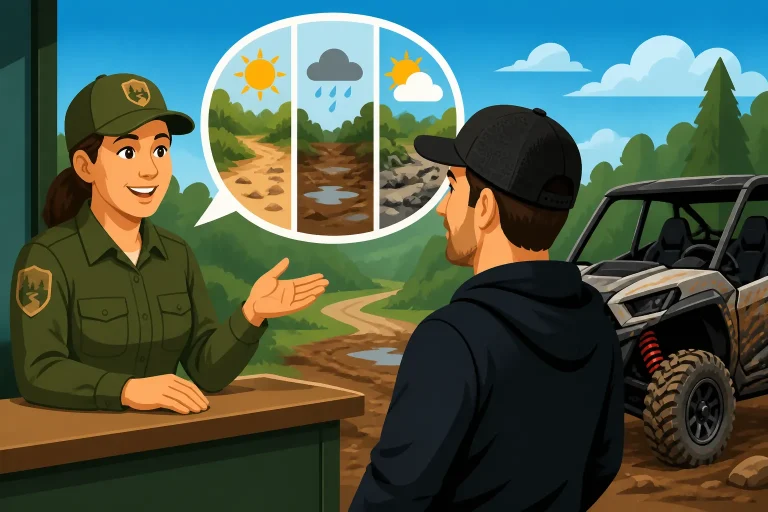
Public trails and managed lands may have their own access rules. A trail can restrict machine width, require a pass, limit riders by age, or close after rain or for another management reason. For example, a young rider’s certificate does not override a trail’s machine-width limit or a posted closure. Check the site’s current rules and conditions before loading the machine.
Private property is not an automatic free-for-all, either. Get permission from the landowner and follow any conditions they set. A hunting lease, timber road, or farm track may have gates, restricted areas, seasonal closures, or vehicle limits. Permission from one person may not cover land controlled by someone else. For more on access, see Written Permission From a Southern Landowner and What a Hunting Lease Says About ATV Use.
At a private riding park, follow the park’s entry rules even if the rider has already completed a safety course. Parks may set their own minimum ages, require a waiver signed by a parent, or restrict which machines a child may operate. Confirm rules directly with the operator; do not assume another park’s policy applies. Mississippi Private Park Age Minimums and Mississippi Private Park Waivers and Rules are useful starting points.
The machine itself matters. A 14-year-old may be physically capable of operating a particular ATV or UTV, but that does not mean it is the right size or appropriate for the rider. Follow the manufacturer’s age guidance and controls instructions. A large, heavy machine can be difficult to manage during a sudden stop, a turn, or a slippery crossing. For UTVs, check that the rider can use the controls properly and is seated and restrained as the manufacturer intends.
Passengers deserve particular care. A child should ride only in a seat designed for a passenger, and the operator should follow the machine’s passenger limits. Do not carry a second person on a single-seat ATV or let a young rider operate a machine with more occupants than it was built to carry. See Mississippi Rules for Passengers on a Quad for passenger-related details.
A practical pre-ride check for parents
A short check before departure can prevent a wasted trip and reduce avoidable risk. Make it part of the routine rather than something done only at a busy entrance.
- Confirm the location and land manager. Be clear whether the ride is on public land, a designated trail, private property, or a managed park. Check the correct rules for that location.
- Verify the rider’s credential. Ask which license or safety certificate is accepted for a 14-year-old and how the rider must show it.
- Check the helmet and protective gear. Make sure the helmet fits securely and is in good condition. Use eye protection, gloves, long clothing, and sturdy footwear appropriate to the terrain.
- Match the machine to the rider. Read the owner’s manual, check the manufacturer’s age guidance, and make sure the rider can reach and operate the controls.
- Set supervision expectations. Agree on where the adult will ride, how the group will communicate, and what the child should do if separated.
- Review the route and limits. Point out trail boundaries, closed gates, steep sections, water crossings, and places where the group must stop or turn around.
- Inspect the machine. Check the brakes, throttle, tires, lights if needed, fuel, and any protective equipment before riding.
- Carry required documents and contact details. Bring the rider’s accepted certificate or other required proof, and know who to contact if a rule or trail condition is unclear.
A 14-year-old’s first rides should favor a controlled setting and terrain that matches the child’s ability. Keep the pace manageable, build in breaks, and stop if the rider is tired or uncomfortable. Rules can tell you whether access is allowed; they cannot tell you whether the rider is ready for a particular hill, mud hole, or group pace.
Disclaimer
This article is for general informational purposes only and does not constitute professional advice. Laws, prices and regulations vary by location and change over time. Consult a qualified professional for guidance on your specific situation.