Mississippi Private Park Waivers and Rules
A waiver at a Mississippi private riding park is not just a formality at the gate. It may describe risks, set conditions for entry, and require you to follow rules that differ from one property to the next. Knowing what to read, what to ask, and what to check on your machine can help you avoid a denied entry, an unexpected restriction, or a preventable problem on the trail.
What a Private Park Waiver Means
A private off-road park controls access to its property. Before you ride, its operator may ask you to sign a liability waiver, acknowledge a rules sheet, show identification, or confirm that you understand particular hazards. Some parks handle these steps online before arrival; others complete them at the gate. The exact process is set by the property, so do not assume that a waiver you signed at another park carries over.
A waiver is generally intended to document that you understand the risks of riding and agree to certain conditions. Those risks can include uneven ground, mud, water, steep slopes, hidden obstacles, other riders, mechanical failure, and emergency response delays. A waiver may also say that you will not hold the operator responsible for certain injuries or losses. What a particular waiver means, and whether a particular provision can be enforced, depends on its language and the circumstances. Signing one should not be treated as a guarantee that the operator has no responsibilities or that you have given up every possible legal claim.
Read the form before signing. If it is a long document on a phone screen, ask for a way to review it in a readable format. Look for the parts that explain:
- Who is covered by the waiver, such as the park, property owner, staff, or event organizers.
- Which activities are covered, including riding, loading, unloading, camping, or using other facilities.
- What risks the document describes.
- Whether it includes a release of liability, an agreement to indemnify another party, or both.
- What you are confirming about your own fitness, equipment, and conduct.
- Whether the form applies to a single visit, a season, an event, or a broader period.
- How it addresses children and other riders in your group.
A release and an indemnity clause are not necessarily the same thing. A release typically concerns claims you might make; an indemnity provision may address claims or expenses involving someone else. If the wording is unclear or the potential consequences matter to you, do not rely on a quick verbal summary from a busy gate attendant. Ask the park to explain its process or get legal advice before signing.
A waiver is only one part of park entry
The waiver is not a state-issued ATV permit. It is a private park’s condition of access. A park may also require a day-use ticket, proof of payment, identification, an equipment inspection, or a separate event form. These requirements do not automatically replace public-land rules, either. A private park’s permission covers its property and the activities it allows there; it does not make a public road legal for ATV or UTV use, or authorize riding across neighboring land.
Likewise, a national forest pass or other public-land authorization does not automatically admit you to a private park. Each land manager sets its own access rules. For a broader look at the difference between park requirements and permits, see Mississippi Permit Questions Riders Ask. If you are comparing private facilities with public trail access, Mississippi Private Park Insurance Proof at a Gate can help you identify another requirement to ask about.
Do not assume signing for one person signs for everyone
A driver who checks in a group should confirm who must sign individually. Adult riders may need to complete their own forms. A parent or guardian may be asked to complete paperwork for a minor, and the park may require the child to be present or have a particular form completed before arrival. Do not assume that one adult’s signature covers every passenger or family member.
The details matter especially if the group includes a child who will ride independently, a passenger, or a young person attending an organized event. Ask the park how it handles minors, who must be present, and what documents it expects. If the park has an age rule, a waiver does not override it. Review Mississippi Private Park Age Minimums before you plan around a young rider.
What to Check Before You Sign
A waiver is only useful to you if you understand what you are agreeing to. Take a few minutes to compare the form with the way your group plans to use the property. If you intend to ride, camp, watch an event, use a facility, or bring a dog, check that the form and rules cover those activities as you expect.
Start by confirming the names and roles of the people named in the document. An operator may use a business name that differs from the property owner’s name, and an event may involve a promoter in addition to the park. You do not need to resolve every legal question at the gate, but you should understand who the form says is being released and what activity the release concerns.
Next, look for statements you are being asked to confirm. A form may ask you to certify that you are physically able to participate, that your machine is in safe operating condition, that you have the required protective equipment, or that you will follow staff instructions. Do not sign a factual statement you know is untrue. If a statement seems too broad or does not fit your situation, ask whether the park can clarify it before you proceed.
Watch for separate acknowledgments. Some parks use one document for liability and another for rules, photos, events, or camping. A digital check box may count as acceptance of a policy, so pause before clicking through a series of screens. Save or request a copy of any agreement you sign, including the rules that were in force for that visit. If a dispute later arises about what you were told, a dated copy is more useful than a memory of a conversation at the entrance.
Ask clear questions instead of guessing
If a term is unfamiliar, ask what the park means by it. For example, does “passenger” mean a person riding on a factory-installed passenger seat, or does the park allow a passenger in some other configuration? Is “closed course” limited to a marked track, or does it include designated trails? Does a safety inspection happen before unloading, or after you have entered the property?
A short list of questions can prevent a wasted drive:
- Does every rider need to complete a separate waiver?
- What is the process for minors and passengers?
- Are there machine size, width, tire, or sound restrictions?
- What safety equipment must be worn or carried?
- Are helmets required for all riders, and are there age-specific rules?
- Are there areas that close in wet weather or during events?
- Does the park require proof of insurance or ownership?
- Are camping, pets, alcohol, or overnight stays allowed?
- What happens if weather or a closure changes the visit?
- Who should you contact if a waiver or rule is unclear?
A park may not be able to change its standard form for one visitor. That does not mean you have to sign without understanding it. You can ask for clarification, decide not to participate, or seek advice before agreeing.
Keep your own record
After you complete the waiver, keep a copy where you can retrieve it. Save the park’s rules, confirmation email, and any messages that describe conditions for your visit. If the operator posts a current rule sheet online, save or print the version you relied on rather than assuming the website will remain unchanged.
This is practical, not confrontational. It helps you remember check-in details, document what was required, and share the correct instructions with everyone in your group. For a multi-day trip, keep the documents with your other travel and machine records. A waterproof document pouch from a retailer such as Amazon can help protect printed paperwork from rain and mud; a phone copy is a useful backup, not a substitute if the park asks to see a physical document.
Rules That Can Vary From Park to Park
Private parks set property-specific conditions. One may welcome a wide range of machines and riding styles, while another may limit access to certain trails, vehicle types, ages, or activities. Even nearby parks can have different policies. Use the current rules from the actual facility you plan to visit, not an old post, a friend’s recollection, or a rule sheet from a different location.
| Rule area | What the park may require | What to confirm before arrival |
|---|---|---|
| Waiver and check-in | Individual forms, online registration, identification, or a signed rules acknowledgment | Who must sign, whether minors need a guardian, and whether forms must be completed in advance |
| Age and supervision | Minimum rider age, adult supervision, or limits on independent riding | Whether the rule applies to all trails, tracks, or specific machine sizes |
| Helmet and protective gear | Helmet, eye protection, boots, or other equipment | Whether the park has a required standard or accepts a particular type of gear |
| Machine eligibility | Limits on machine type, width, tires, noise, or condition | Whether your specific ATV or UTV can access all areas you plan to ride |
| Passengers | Factory passenger seat, seat belt, or passenger-age restrictions | Whether passengers are permitted on your machine and on the trails you intend to use |
| Conduct | Speed, direction of travel, passing, alcohol, or restricted areas | Which rules apply on trails, tracks, staging areas, and campsites |
| Site use | Camping, pets, fires, quiet hours, or generators | Whether overnight facilities are open and whether reservations or separate rules apply |
| Payment and weather | Day-use process, reservation policy, or closure terms | Accepted payment methods and what happens if the park closes or conditions change |
A rule can be stricter than what you are used to at another property. That does not necessarily mean it is a statewide law; it may simply be a condition the owner sets for access. Conversely, a private park’s permission does not cancel a state or local law that applies to a rider, machine, or activity. Treat the park rule sheet and applicable law as separate things to verify.
Age, helmets, and supervision
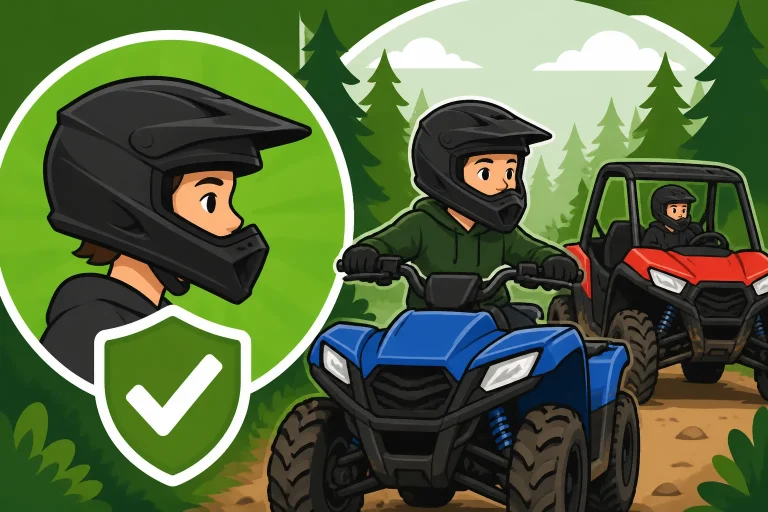
Private operators may establish their own minimum ages, supervision requirements, or protective-gear rules. A park could require a helmet for everyone even where a particular public-land or state rule applies only to younger riders. The park may also require eye protection, sturdy footwear, long sleeves, or a safety briefing. Confirm the actual policy rather than assuming that the minimum legal requirement is the park’s minimum.
Check the rule for passengers separately from the rule for drivers. A child might be allowed as a passenger only when the machine has a designated passenger seat and suitable restraints. A parent’s permission does not make an unsafe seating arrangement acceptable, and a waiver does not turn a single-rider machine into a two-person vehicle. For park-specific helmet questions, see Mississippi Private Park Helmet Rules.
Helmets and protective equipment need to fit correctly and be in good condition. Look for the certification label and manufacturer guidance; do not rely solely on a product listing or a seller’s description. If you shop through Amazon or another marketplace for replacement goggles, gloves, or protective gear, check the actual product specifications and return policy before you ride. The park may still refuse equipment that does not meet its requirements.
Alcohol, pets, and conduct away from the trail
Rules often apply beyond the riding area. A park may restrict alcohol, smoking, pets, fires, generators, or noise in its staging and camping areas. A visitor who follows trail rules but ignores the campground policy can still be asked to stop the activity or leave. Review the rules for the entire property, not just the trails. Related guidance is available in Mississippi Private Park Alcohol Rules, Mississippi Private Park Pet Rules, and Mississippi Private Park Quiet Hours.
Do not assume that a park allows alcohol because it sells or permits camping, or that an event’s social gathering changes the riding policy. Ask whether alcohol is allowed at all, where it may be consumed, and whether the rule changes during organized events. Never ride while impaired. A private property boundary does not make unsafe operation acceptable, and other laws may still apply.
Pets may be limited to certain areas, required to remain leashed, or prohibited altogether. Even when allowed, a dog near moving machines, loud engines, or crowded staging lanes can be at risk. Confirm the pet policy and plan a safe place for the animal if it cannot accompany you.
Machine Checks, Permits, and Proof to Bring
A park can screen machines for safety or eligibility before allowing them onto trails. The inspection may be a visual check by staff, a sound check, or a review of the vehicle against the park’s own limits. Some rules apply to all machines; others apply only to specific areas, events, or trail systems. If your machine is close to a stated limit, confirm the measurement method before you load it.
Ask whether the park has restrictions involving:
- Vehicle width or overall dimensions.
- Tires, tracks, or other modifications.
- Exhaust noise or spark arrestors.
- Seat belts, roll-over protection, or passenger seating.
- Lights for evening use.
- Winches, racks, or accessories that affect clearance.
- Machine condition, leaks, damaged parts, or loose equipment.
Do not assume that an ATV or UTV fits every trail simply because it is legal to own or can be driven onto the property. A trail can be narrower than a machine, and an operator may keep some routes closed to larger vehicles to protect the trail or reduce conflicts. Confirm whether restrictions apply to the entire property or only named routes. If a rule is expressed as a maximum width, ask how the park measures it and whether accessories or tires count.
Proof of ownership and insurance
The park may ask for proof that you own the machine, have permission to use it, or carry insurance. These are separate questions. A title, bill of sale, registration document, insurance card, and park waiver each serve different purposes. The operator’s policy determines what it asks visitors to show at check-in.
If you are borrowing a machine, ask whether the park wants written permission from the owner. If the machine is financed, rented, or part of a business fleet, check whether the relevant agreement permits use at an off-road park. Do not assume a lender, rental company, or insurer treats recreational park riding the same as ordinary yard or farm use.
Mississippi does not issue a universal state sticker for a machine that automatically grants entry to every private riding park. A private operator’s pass or wristband is different from a public-land authorization. Likewise, a pass for one facility generally does not transfer to another facility unless the operator explicitly says so. The safest approach is to ask the park what it requires and carry any proof it requests.
Insurance and medical coverage are not the same as a waiver
A waiver is not insurance. It does not pay your medical bills, repair your machine, or compensate another rider if you cause a collision. Your existing health, homeowners, auto, or recreational vehicle policy may have exclusions or limits for off-road use. Ask your insurer specifically about riding at a commercial or private off-road park, passenger injuries, towing, and damage to someone else’s property.
A park may require proof of liability coverage, but that requirement does not mean every policy covers every event or trail. Confirm the covered machine, riders, location, and activity with the insurer. If the park asks for a certificate or other proof, find out what form it accepts before arrival. Do not rely on a policy card that lists a vehicle but says nothing about the way you plan to use it.
For groups or organized rides, verify whether the event organizer has separate insurance or rules. A participant’s personal coverage and an event’s insurance are not interchangeable. Ask who is responsible for emergency arrangements and what the park expects participants to do after an incident.
Riding Safely and Following Park Directions
The waiver and rules sheet usually point to the park’s basic safety expectations, but it is worth planning for the ride itself. Trails can change quickly with rain, standing water, erosion, fallen branches, and heavy traffic. A route that felt manageable on a previous visit may be different on the day you arrive. Follow posted signs and staff instructions, and do not ride past barriers or through a closed gate.
At check-in, identify the trail map, emergency contact method, staging areas, and any one-way routes. Ask which trails fit your machine and skill level. If the map uses colors or difficulty ratings, confirm what those ratings mean at that specific park. A color code is not universal, and a route described as easy may still include mud, slopes, or obstacles that are challenging for a beginner.
Ride at a speed that lets you stop within the visible trail. Leave room between machines, especially in dust or mud, and use extra care near blind turns, intersections, and water crossings. Avoid following another machine so closely that you cannot react if it slows or gets stuck. Do not assume the rider ahead has seen you. Use a clear signal or stop in a safe place before communicating.
Stay on routes the park allows
Private property does not mean unrestricted property. A trail may pass near wetlands, timber, homes, maintenance areas, or land that the operator has closed to protect it. Stay on marked routes and do not cut across vegetation to go around mud or a blocked section. Shortcuts can damage the property, create a new hazard, and violate the conditions you agreed to when you signed the waiver.
Respect barriers, signs, staff directions, and temporary closures. If a trail is blocked, ask for an approved alternate route. Do not move a barrier yourself, even if another rider says the trail is open. A closed route may be unsafe, under repair, or unavailable because of an event or land-use agreement.
Some parks have specific rules for water crossings, mud holes, winching, or recovery. Ask before using a winch on a tree or attaching a strap to a structure. Use an appropriate tree-saver strap where permitted, and do not damage trees, fences, posts, or equipment. If the park does not allow recovery gear to be attached to its property, follow that policy and ask staff for assistance.
Know what to do after an incident
Before riding, find out how to contact park staff and emergency services. In a remote section, a phone may not have service. Ask whether the park has a posted emergency number, radio procedure, or designated location for help. Tell your group where you are going and agree on a check-in plan, especially if you split up.
After a crash or injury:
- Stop in a safe location and check for immediate danger.
- Call emergency services if someone has a serious injury, cannot be moved safely, or needs urgent care.
- Notify park staff as soon as possible and follow their directions.
- Keep other machines clear of the scene and warn approaching riders if you can do so safely.
- Exchange contact and insurance details with anyone involved.
- Document the location, conditions, and visible damage when it is safe.
- Follow the park’s incident-reporting process and keep a copy of any report you complete.
Do not move an injured rider unless leaving them in place creates an immediate danger. Do not assume that a park staff member’s report replaces any insurance or legal reporting obligation that may apply. If a serious event occurs, preserve relevant documents and seek professional guidance about your next steps.
A compact first-aid kit can help with minor problems, but it is not a substitute for training or emergency care. A small waterproof kit from Amazon or another retailer can be useful if it fits securely on the machine or in a support vehicle. Check its contents before the trip, replace used or expired items, and make sure at least one person in the group knows where it is.
Camping, Events, and Other Rules Beyond Riding
A private park visit may involve more than trail access. Some facilities offer camping, cabins, food service, special events, or designated spectator areas. Each activity can come with separate restrictions, fees, check-in steps, and waiver language. Confirm the details directly with the operator before making travel plans.
Ask whether lodging or camping requires advance arrangements, whether the site accommodates your vehicle and trailer, and what quiet-hour or generator rules apply. Find out whether fires are allowed and whether the park restricts them during dry conditions. Do not bring firewood, fuel containers, or cooking equipment without checking the facility’s rules. If the park has a posted camping policy, read it together with its riding rules. See Mississippi Private Park Camping Rules for related considerations.
Events can change the normal operating pattern. A park may reserve a trail, require a separate event waiver, use a different check-in area, or apply special restrictions to vendors and spectators. Confirm whether event registration covers park entry or whether you need a separate day-use pass. Ask if the event has a machine inspection, rider meeting, route assignment, or mandatory safety briefing.
Weather and closure policies
Mississippi weather can affect trail conditions, access roads, and parking areas. Rain may make a route unsafe or cause a park to close part of the property. Contact the operator before loading if conditions look uncertain, and check whether the park posts same-day updates. Do not rely on a general social media post if the closure information is not clearly current or does not name the location you are visiting.
Ask how the park handles a closure after you arrive. The policy may distinguish between a full closure, a partial trail closure, and a change in conditions that still allows some activities. Check whether a reservation can be moved, whether any credit is available, or whether the operator’s policy provides no adjustment. Do not assume a weather closure automatically means a refund; read the terms before paying or traveling.
If a park is open but conditions are poor, make your own decision about whether the ride is suitable for your group and machine. A waiver does not require you to ride. Turning back, skipping a trail, or ending the day can be the sensible choice, particularly when water is rising, visibility is low, or a machine is not equipped for the conditions.
Keep the group on the same page
Before the trip, share the park’s rules with everyone who is coming. Confirm arrival time, check-in steps, machine restrictions, and which riders must sign. A group leader should not assume that every participant has read a form simply because one person booked the visit.
Decide how the group will handle separated riders, a breakdown, or a change in trail plans. Agree on a meeting point and tell riders not to leave the property or cross onto neighboring land to find a route back. Make sure each person has a way to identify the group’s vehicles and contact the leader.
For a large group, ask the operator whether there are limits on group size, parking, or staging. A private event may have a reservation process that differs from ordinary day use. Do not arrive with more machines or riders than the booking covers without confirming the change.
A Practical Before-You-Go Checklist
Use this checklist the day before travel, then confirm any time-sensitive detail with the park. Policies can change, and a check made months earlier may no longer reflect current access conditions.
Before leaving home
- Read the park’s current waiver and rules, including camping and event policies if relevant.
- Confirm operating status, hours, check-in location, and whether advance booking is needed.
- Ask whether every rider must sign and what the park requires for minors.
- Verify machine eligibility, width limits, passenger rules, and any sound or equipment checks.
- Confirm helmet and protective-gear requirements for every rider.
- Ask whether insurance, identification, proof of ownership, or written owner permission is required.
- Check whether the park accepts your planned payment method and what its closure policy says.
- Make sure your machine is in good working condition and that loose cargo is secured.
- Tell the group the meeting point, expected schedule, and emergency plan.
- Save the waiver, confirmation, rules, and park contact information.
At the gate
- Read signs before unloading or entering the riding area.
- Complete each required waiver and rules acknowledgment honestly.
- Ask about temporary closures, wet-weather restrictions, and trail conditions.
- Confirm the correct trails for your vehicle and experience level.
- Learn how to contact staff and where to go in an emergency.
- Keep the wristband, ticket, or other proof of admission as the park directs.
- Ask staff before using a route, facility, or recovery method that is not clearly allowed.
When something is unclear
Pause before signing or riding. Ask the staff member who can answer the question, and request a written clarification when the answer affects your access or safety. If you cannot get a clear answer, the practical choices are to avoid that activity, wait for clarification, or leave without riding. A rushed decision at the gate can cost more in time and risk than taking a moment to verify the rule.
Keep in mind that a park may enforce its rules by restricting access, closing a trail, ending a visit, or asking a rider to leave. Be courteous to staff, even when you disagree. If you believe a rule was applied inconsistently or an incident was mishandled, record what happened and use the park’s stated contact or complaint process after the immediate situation is safe.
Private park waivers and rules are best treated as part of trip planning, not paperwork to skim while the group waits behind you. Read the form, verify machine and rider requirements, understand how the park handles closures, and keep public-land permissions separate from private-property access. That preparation makes it easier to focus on the ride once you are through the gate.
Disclaimer
This article is for general informational purposes only and does not constitute professional advice. Laws, prices and regulations vary by location and change over time. Consult a qualified professional for guidance on your specific situation.