Your Driver’s License Is the Permit on Mississippi Trails
Mississippi riders often hear that a driver’s license is the “permit” for ATV and UTV trails. That shorthand can save confusion, but it can also send you to a trailhead without the pass or permission you need. Here’s what a license does, what it doesn’t do, and how to check the separate rules for forests, parks, wildlife areas and private riding grounds.
What “Your Driver’s License Is the Permit” Really Means
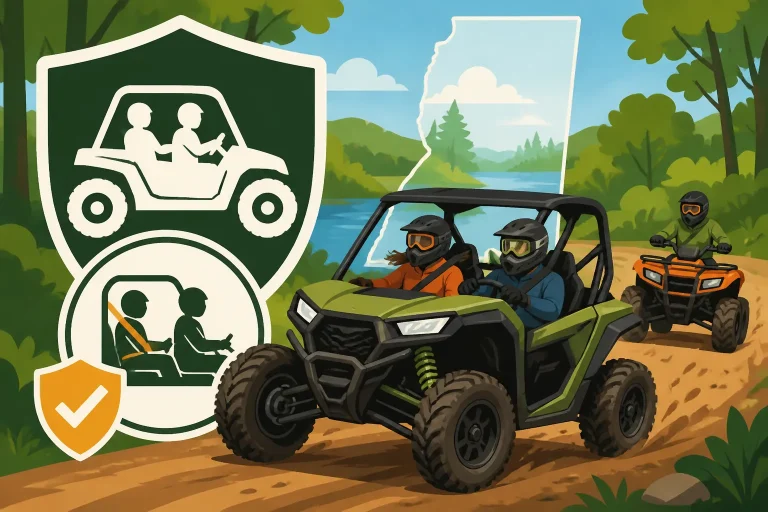
A driver’s license can be one of the credentials a rider needs to operate on certain public riding areas in Mississippi. It is not, by itself, a universal ATV or UTV permit. It does not buy access, open a closed trail, replace a land manager’s pass or give you permission to ride on private property.
Think of access as several separate questions:
- Are you qualified to operate there? The site or applicable rule may require a driver’s license or an accepted safety certificate.
- Is your machine allowed there? Width, type, equipment and other restrictions can rule out a machine even when the rider is qualified.
- Do you have the required access pass or permit? Some public trail systems require a separate pass.
- Is the route open to riding today? Closures, weather, hunting activity and posted signs can change where you may go.
- Do you have the landowner’s permission? A driver’s license never replaces it.
That distinction matters because Mississippi doesn’t issue a general state ATV registration sticker that works like a statewide trail pass. There are separate site-specific access requirements, and a pass for one riding area should not be assumed to cover another. For a broader overview of public forest access, see Mississippi National Forest OHV Passes.
| What you have | What it may satisfy | What it does not automatically provide |
|---|---|---|
| A valid driver’s license | An operator-qualification requirement at a particular public riding area | A trail pass, permission to use a closed route or permission to ride on private land |
| An accepted safety certificate | An alternative qualification where the relevant rules accept it | Automatic access to every public area |
| A forest or trail pass | Access covered by that pass, subject to the site’s rules | Permission to ride on roads or lands outside the pass’s coverage |
| A title or bill of sale | Evidence related to ownership | Trail access, a public-road license plate or a riding permit |
| Written landowner permission | Permission for the land and activity specified | Permission to cross other property or ignore posted restrictions |
The practical takeaway: don’t arrive assuming that a license alone gets you through the gate. Check both the rider requirement and the access requirement for the specific place you plan to ride.
Mississippi Has No Single Statewide ATV Trail Permit
Mississippi’s riding access is a patchwork. A national forest trail, a wildlife management area road, a state park and a private mud park can each have different rules. A document that works at one location may not satisfy the requirements at the next.
The state’s lack of a general ATV registration system does not mean riders can use every public trail without paperwork. It means the access rules are not handled through one statewide ATV registration sticker. Depending on the land and route, you may need a site pass, an operator credential, advance permission or a combination of these.
It also helps to separate ownership paperwork from riding access. A title proves ownership in situations where a title is required; it doesn’t authorize trail use. Mississippi does not issue a standard license plate for an ATV just because it has a title. Read Mississippi Has No OHV Registration to Reciprocate for the registration distinction, and Why a Title Does Not Open Any Roads for the difference between owning a machine and being allowed to ride it somewhere.
Start with the land manager
Before loading the machine, identify who manages the exact trail or road. A broad location name such as “the forest” or “the WMA” may not be enough. Different routes within the same general area can have different designations, closures or access conditions.
Check the current information from the land manager or operator, then confirm:
- Whether ATVs, side-by-sides or both are allowed
- Whether the route is an authorized riding trail or road
- Whether an access pass is required and what it covers
- Whether the driver must have a license, safety certificate or other credential
- Whether there are machine-width or equipment restrictions
- Whether the area is open on your planned day
- Whether riders need to carry or display proof of access
If a rule is unclear, ask about the exact vehicle and route. “Can I ride an ATV here?” may not answer whether a wide UTV is allowed, whether a pass is required or whether a particular road is open.
Check the machine separately
ATV and UTV are everyday labels, not guarantees that a machine qualifies for every trail. Some routes limit vehicle width or distinguish between a narrow ATV and a wider side-by-side. If you ride a UTV, measure it as the trail manager instructs rather than relying only on a model name or advertised category.
The limits for a specific pass or trail can be narrower than what a machine is legally allowed to be in the state. A vehicle that is lawful to own or operate in one setting may still be excluded from a particular trail. For examples of why dimensions matter, see Mississippi ATV Width Limit of 50 Inches and Mississippi ROV Width Limit of 65 Inches. Confirm the current width rule with the trail operator before you haul a machine to the entrance.
National Forest Trails: A License and a Pass Can Both Matter
Mississippi’s national forest riding opportunities are not all open, unrestricted trails. The forest manager designates where off-highway vehicles may go, and an access pass may be required for designated OHV trails. A driver’s license does not replace that pass.
For current pass coverage and trail access, start with Mississippi Forest Pass Coverage. Do not treat a pass as permission to ride anywhere within a national forest. It applies only to the activities and locations covered by its terms. Roads or trails outside the designated system may be closed to OHVs, even if they appear on a map or are physically wide enough for your machine.
Confirm what the pass attaches to
Pass rules can specify who must hold the pass, which machine it covers and how proof must be carried or displayed. Those details matter when a group shares a trailer or a rider swaps between machines. Read the current instructions rather than assuming that one rider’s pass covers every person or vehicle in the group.
Before you leave, make sure you can show the required proof at the trailhead or during a check. Save a digital record if the pass is issued electronically, but don’t assume a phone screenshot is accepted unless the operator says it is. If the area has poor service, download or print the information in advance.
A pass doesn’t cancel closures
Public access can change with weather, trail damage, fire conditions, maintenance or other management decisions. A pass is not a promise that every route will be open on a particular day. Before a long drive, check the current closure notices and trail conditions. Mississippi Trail Closures After a Storm explains why a trail that was open last weekend may not be open now.
Follow signs at the entrance and along the route. A closed gate, barricade or posted restriction takes precedence over the fact that you have a valid pass. Don’t ride around a closure to reach a familiar trail. If the route status is uncertain, contact the appropriate forest office or trail manager before you go.
On the ride, carry the proof the site requires, stay on designated routes and keep the pass information with the person and machine it applies to. A driver’s license, a trail pass and a current map answer different questions; having one does not make the others unnecessary.
Bethel OHV Trails: Don’t Confuse the Rider Credential With Access
Bethel OHV Trails have their own access rules. The requirement for a driver’s license on Bethel trails is why riders sometimes describe the license as “the permit.” It is better understood as an operator credential: it may establish that a rider meets the site’s qualification requirement, but it is not a substitute for whatever trail access or day-use requirements apply.
Review You Need a Driver’s License on Bethel Trails before setting out. Check the current trail information for the machine you plan to bring, too. A rider can meet the driver credential rule and still be turned away if the vehicle does not meet the trail’s restrictions or the trail is closed.
Check the trail’s machine limits
A machine that fits at one riding area may not fit at Bethel. Confirm the applicable width limit, permitted vehicle types and any other equipment rules before loading. Don’t rely on “it’s an ATV” as proof that it will be accepted; side-by-sides, youth machines and modified vehicles may need closer checking.
Bring a reliable way to verify the machine’s dimensions if you’re close to a limit. Measure at the widest point specified by the trail operator, including accessories if required. Oversized tires, wheel spacers or other modifications can make a machine wider than its stock specification.
Plan for the day’s access conditions
Check current hours, entry steps, trail notices and any proof-of-entry requirements before leaving. Save the information somewhere you can reach without cell service. A paper copy can be useful when phones lose signal, batteries run down or mud and rain make screens hard to use.
Pack responsibly, too. A small first-aid kit, tire-repair supplies, water and basic recovery gear can make a ride safer, especially when the group is spread out. Amazon may be one place to compare items such as tire plugs or compact first-aid supplies, but check that the product is suitable for your machine and your riding conditions. No piece of gear replaces following the trail rules or carrying the access documents the site requires.
Young Riders, Out-of-State Visitors and Reciprocity
A license rule for adult riders does not automatically tell you what a younger rider needs. Age, location and land-manager policy can all matter. Some public areas accept a safety certificate in place of a driver’s license under applicable rules, while a specific site may set its own requirements. Check the rule that applies to the place you are visiting, not just a general summary.
For young riders, see Mississippi Safety Certificates for Young Riders and confirm what proof the site accepts. Carry the certificate if it is required; don’t assume that a parent’s driver’s license covers a child operating a separate machine. Also check whether the child must wear a helmet, ride with supervision or stay within an age-appropriate area. Those requirements can differ between public and private facilities.
Visitors from other states
A visiting rider should not assume that a registration sticker or permit from another state will be honored as Mississippi trail access. Mississippi does not have a general state OHV registration sticker to exchange or reciprocate in the way some visitors expect. See Mississippi Has No Sticker to Honor From Another State and Mississippi Visitors Need No State Sticker.
That does not mean visitors can ride without following local access rules. You may still need a pass for a particular trail system, and the site may still require a driver’s license or accepted safety credential. Out-of-state documentation is not a substitute for a Mississippi forest pass or a park’s entry process.
If you are visiting from a neighboring state, prepare for the destination’s requirements rather than relying on what was enough at home. Bring your driver’s license, any safety certificate relevant to the rider, ownership documents if you have them and proof of the site pass or entry payment. Ask the trail manager whether a visitor needs to complete any additional steps.
A license is not road permission
A driver’s license to operate on a public riding area does not make an ATV or UTV street-legal. Trail access and public-road access are separate legal questions. In particular, a rider should not use a public road simply because a trail connects to it or because the rider has a regular driver’s license.
Before crossing or traveling on a public road, verify the applicable law and local rules. For a broader explanation of road use, see Can You Ride an ATV on the Road in Mississippi?. When in doubt, stop and find a permitted route rather than riding along a road shoulder or through a town.
Wildlife Areas, State Parks and Private Riding Grounds
A license and forest pass do not grant access to every public or private riding location. Wildlife management areas, state parks and commercial riding parks each have their own purpose and rules. Do not assume that rules for a designated OHV trail carry over to a hunting area, campground or park road.
Wildlife management areas
A WMA is not automatically an ATV trail system. Machine use may be limited to designated roads, and gates, signs or seasonal closures can restrict access. A road that appears on a map may not be open to ATVs, and a vehicle pass for another location does not give you permission to ride there. Review Mississippi WMA Designated Roads Only before planning a route through a management area.
Hunting access adds another layer. Weapon rules, retrieval rules, seasons and road closures may affect whether and how a machine can be used. Ask the managing agency about the specific WMA, road and activity. Never move a barrier or ride around a gate to get to a destination.
State parks
State parks can require their own check-in process and may set additional rules for helmets, age, passengers, noise, spark arrestors and incident reporting. A forest pass or driver’s license does not override those conditions. Read Mississippi State Park ATV Rules and contact the park about the exact area where riding is allowed.
If a park requires a waiver or proof of age or training, bring the requested documents and allow time to complete the process. Keep the waiver and any instructions with you during the visit. A park’s riding permission is limited to the park’s approved use; it does not authorize travel onto nearby roads or other public land.
Private parks and land
Private mud parks and riding areas set their own admission and safety requirements. The operator may ask riders to sign a waiver, follow an age policy, wear protective equipment or stay within marked boundaries. Ask about vehicle restrictions, hours, closures, camping and recovery assistance before you arrive.
On private property outside an organized park, get the landowner’s permission in advance. Permission should cover where you may ride and whether you may bring guests, cross gates or use a particular road. A driver’s license is not a substitute for consent. If you are riding on a hunting lease or timber property, check the written agreement and ask the person who controls access rather than relying on an old verbal understanding.
A Pre-Ride Checklist That Prevents Permit Problems
Before a trip, work through these steps in order. They help separate the question “Can I ride?” from “Can this machine ride here today?”
- Name the exact destination. Identify the specific trail, forest district, WMA, park or private facility—not just the nearest town or broad region.
- Find the current operator information. Check the land manager’s or park operator’s rules, maps, access notices and contact details.
- Confirm the rider requirement. Ask whether the operator requires a driver’s license, a safety certificate or another credential. Check requirements separately for each rider, especially children.
- Confirm the access requirement. Find out whether you need a trail pass, day-use entry, advance booking, signed waiver or written permission. A driver’s license does not replace these.
- Verify machine eligibility. Check vehicle type, width, weight or other limits that apply. Include modifications and accessories in your measurements where required.
- Check the route and its status. Use the current map and closure notices. A pass does not authorize travel on a closed road or an undesignated trail.
- Prepare proof for the trip. Carry or save the documents the operator asks to see. Keep access information available if cell service is unreliable.
- Confirm any road crossing or road travel. Trail permission is not permission to ride on a public street. Plan a legal route between staging areas and trail entrances.
- Recheck before departure. Weather, maintenance and land-use activity can change access. If you are unsure, call the office or operator rather than guessing.
A short phone call can settle the details that a general page may not answer: whether your particular UTV fits, whether a youth rider can use a certificate instead of a license, or whether a trail is currently open. Keep a note of who you spoke with and what location or route they described.
For organization, store your license, safety certificate, pass confirmation and map together. A waterproof pouch can help keep paper documents readable in wet conditions. Amazon may offer pouches, document sleeves and basic trail supplies, but choose items that close securely and can be carried without interfering with safe operation. Don’t place papers where they can fall off or distract the driver.
Common Mistakes to Avoid
The most frequent mistake is treating “license” and “permit” as interchangeable words. A license may qualify the operator; a pass may authorize access to a specific trail system; a landowner’s permission may cover private land. They serve different purposes.
Other avoidable mistakes include:
- Assuming a state sticker works everywhere. Mississippi does not have a single statewide ATV trail sticker. Check the access rules for the destination.
- Assuming an out-of-state permit is enough. Visitors still need to meet Mississippi site requirements, including any required local pass.
- Assuming a forest pass opens all forest roads. It covers only the access described by the current pass terms.
- Assuming an ATV rule also covers a UTV. Width and vehicle-category restrictions can differ.
- Assuming a title gives trail access. Ownership paperwork and riding permission are separate.
- Assuming a license makes a machine legal on public roads. Trail credentials do not grant street access.
- Relying on an old map or a friend’s recent trip. Routes and closures can change; check current notices.
- Taking a child without checking the child-specific rule. Confirm age, supervision, safety-certificate and helmet requirements for the exact site.
- Treating an open gate as permission. A gate may be open for maintenance or another authorized use. Follow posted signs and the land manager’s designated routes.
- Skipping proof because no one checked last time. A past ride without a stop does not change the requirement.
The safest interpretation is straightforward: a driver’s license may be part of what lets you operate at a particular Mississippi riding area, but it is not a universal permit. Confirm the rider credential, trail pass, machine eligibility and route status separately. Then carry the proof the specific land manager requires.
Disclaimer
This article is for general informational purposes only and does not constitute professional advice. Laws, prices and regulations vary by location and change over time. Consult a qualified professional for guidance on your specific situation.