Mississippi National Forest OHV Passes
Mississippi National Forest OHV Passes
A forest pass can feel like one more piece of paperwork when you are already loading a trailer, checking the weather and trying to figure out which roads are open. This guide explains what a Mississippi National Forest OHV pass does, where it applies, how to plan for requirements such as width limits and youth safety rules, and why a pass from another state may not replace it.
What a Mississippi National Forest OHV Pass Does
The pass is for designated riding access
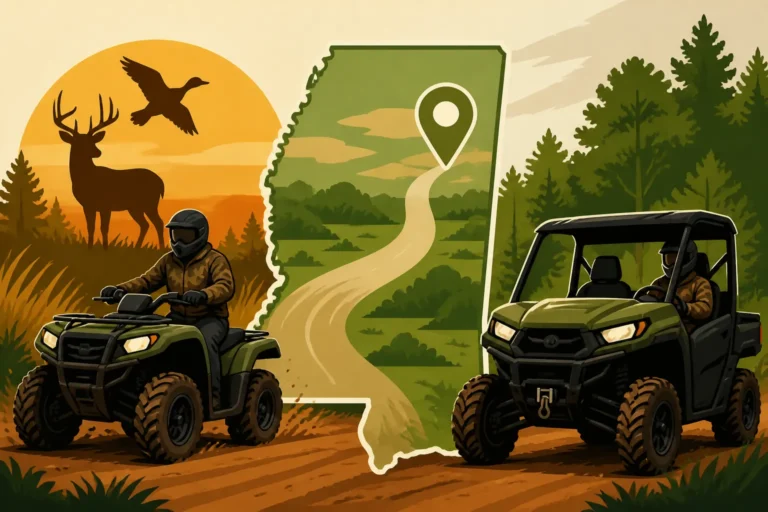
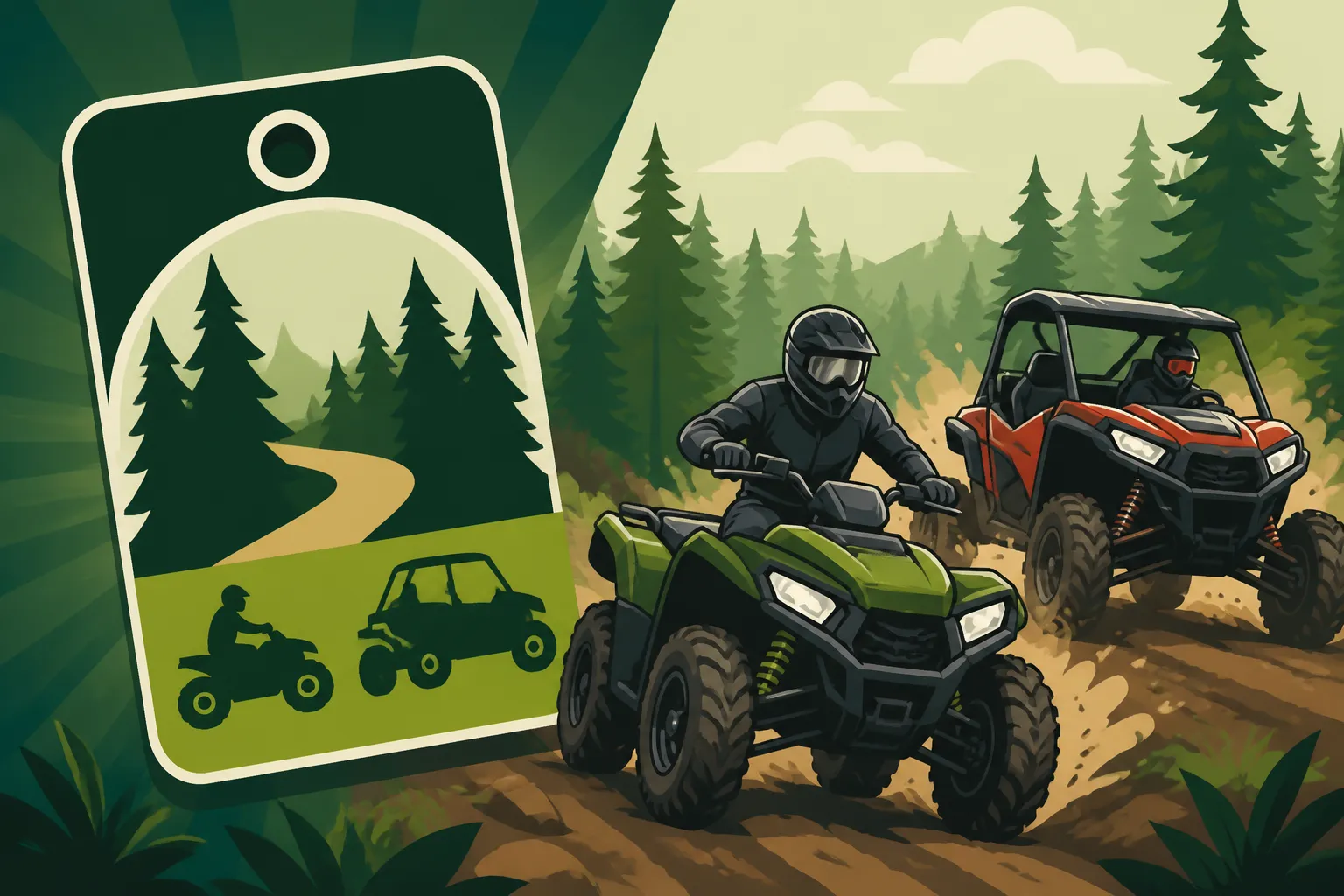
A Mississippi National Forest OHV pass is connected to riding on designated off-highway vehicle routes and areas where a pass is required. It is not a general permit to drive an ATV or UTV anywhere on national forest land. A forest can contain roads, trails, closed areas and routes intended for other users, and those categories are not interchangeable.
That distinction matters when you see a forest road on a map and assume it must be open to ATVs. A road may be closed to motorized use, restricted to certain vehicles or available only under specific conditions. A pass does not override a closure sign, gate, seasonal restriction or posted instruction. Before you head out, check the applicable forest map and the information for the specific riding area. For a broader look at how these rules fit together, see Mississippi National Forest Riding Explained.
The same caution applies when a route appears in an online map app. A line on a screen can show a road without telling you whether it is open to your machine, whether it is a designated OHV route or whether access has changed after a storm. Treat the pass as one requirement among several, not as a blanket authorization. The route’s designation, current condition, vehicle limits and posted rules still matter.
A pass does not replace ownership papers or road permission
An OHV pass and proof of ownership answer different questions. The pass concerns access to designated riding opportunities; ownership paperwork helps show that the machine belongs to you or that you have permission to use it. Keep relevant paperwork available, especially when traveling with a recently purchased, borrowed or out-of-state machine. A pass alone does not establish ownership.
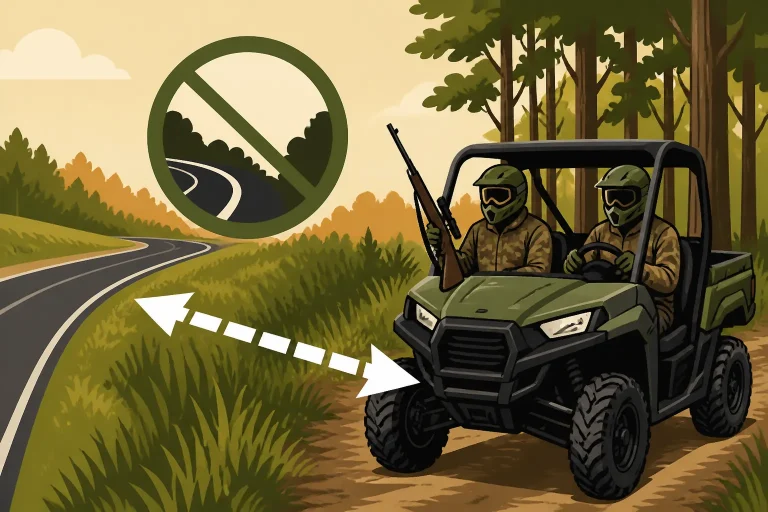
Nor does a forest pass turn an ATV or UTV into a road-legal vehicle. Riding on a designated forest trail is different from riding on a public road, and a permit for trail access does not automatically authorize travel on a county road or highway. If you need to cross or use a public road, check the applicable rules rather than assuming that the pass covers the trip. Mississippi’s road restrictions are covered separately in Mississippi Bans ATVs on Public Roads.
It is also useful to separate access permission from safety requirements. You may have a valid pass and still be turned away from a route because the vehicle does not meet the width limit, the rider lacks a required credential, or the route is closed. Thinking of these as separate checks—pass, route, machine and rider—makes it less likely that one completed task will give you a false sense that everything else is settled.
Read the pass terms before you pay
Before buying a pass, read the current information for the forest and riding system you plan to use. Confirm which routes it covers, how it must be displayed or carried, whether it is tied to a particular machine, and what proof you should keep with you. These details are easy to overlook when you are focused on getting a trip organized, but they can determine whether the pass is valid for your setup.
The pass information should also clarify whether it applies across more than one district or riding area. A pass described as forest-wide may cover designated opportunities across several districts, but that does not mean every road in every district is open to OHVs. Look for wording about trail systems and designated routes, and make sure your planned destination is among the places covered. For scope and limitations, review Mississippi Forest Pass Coverage.
If a detail is unclear, ask the relevant forest office before you leave home. It is much easier to resolve a question about a vehicle, route or pass at the planning stage than at a trailhead after a long drive. Keep a note of the answer and the office you contacted, especially if you are planning a group ride or bringing a machine with unusual dimensions.
Where the Pass Applies and Where It Does Not
Designated OHV routes are not the same as every forest road
National forests contain more than OHV trails. They may include administrative roads, hiking routes, equestrian trails, wildlife areas, closed roads and routes intended for street-legal vehicles. Seeing a track on a map does not tell you which category it falls into. Check the specific map legend and posted signs, and follow the rules for that route even when the trail looks open.
This can be frustrating when a trail looks rideable but a sign says otherwise. A dry, unobstructed road may still be closed to motor vehicles; conversely, a route may be open to a certain class of OHV even if it is rough or narrow. Do not use the machine’s ability to travel the route as evidence that riding is allowed. The route designation and the rules attached to it are what count.
The pass’s coverage is also not a substitute for route planning. Before leaving, identify the trailhead, check for closures and note which routes are allowed for your machine. If you are unfamiliar with the area, build in time to read the signs at the entrance rather than unloading in a hurry. A useful reference for understanding which locations a pass opens is Which Trails the $60 Forest Pass Opens.
A pass does not make closed land accessible
Access restrictions can exist for reasons that have nothing to do with whether you bought a pass. A route may be closed because of maintenance, unsafe conditions, weather damage, wildlife management, fire concerns or a land-management decision. Gates, barriers and signs are not obstacles to work around; they are instructions to stop or use another route.
This is especially important after heavy rain. Mississippi’s soils and low-lying areas can become soft or damaged, and riding around a closure can widen the damage or create new ruts. A trail that was open on your last visit may not be open on your next one. Check local updates before the drive, and be prepared to change plans if a route has been closed.
Do not assume that an open forest road, a nearby private trail or a wildlife management area is covered by the same pass. Each area can have its own access rules, permits and restrictions. For example, wildlife management areas may limit motorized travel to designated roads, and a national forest OHV pass does not grant permission to ride behind a closed gate. When in doubt, ask the agency responsible for the land.
National forest access is different from state registration
Mississippi does not use the same kind of statewide ATV registration sticker that some visitors may know from elsewhere. That does not mean no permit is needed anywhere. A forest pass can still be required for a specific trail system, and private parks, state parks and other public lands may set their own conditions.
This distinction catches people who have crossed state lines with the same machine and paperwork. They may have a registration decal or permit from home and assume it will satisfy every Mississippi requirement. Do not make that assumption. The rule that applies depends on the place you intend to ride, the type of pass required there and any rider or vehicle conditions attached to it. See Mississippi Has No Sticker for a Visiting Machine for the state-level distinction.
The reverse is true when you leave Mississippi. A Mississippi forest pass does not automatically provide access to trails in another state. Check that state’s rules and the specific riding area’s requirements before you go. A pass may be location-specific, vehicle-specific or tied to a particular kind of public land. For the question of cross-border recognition, see Does a Mississippi Forest Pass Work in Alabama?.
| Question | What to check | Why it matters |
|---|---|---|
| Is a pass required? | The rules for the exact trail system | Not every forest road or public riding area has the same requirements |
| Is my route open? | Current maps, notices, gates and trailhead signs | A pass does not override a closure |
| Does my machine fit? | The system’s vehicle-width and equipment rules | A valid pass does not waive vehicle limits |
| Does another state’s permit count? | The destination’s own rules | Mississippi and neighboring states may not recognize the same permits |
| Is the rider eligible? | License, safety-card, age and helmet requirements | Pass access and rider qualifications are separate checks |
Buying, Carrying and Using the Pass
Confirm the correct pass for your machine and trip
Start by identifying the machine you plan to ride: ATV, side-by-side or another OHV category. Then check the pass instructions for how the pass is assigned. Some access systems associate a pass with a particular vehicle rather than a person, so it is important to know whether you can move it between machines or whether each machine needs its own pass. Do not rely on a friend’s interpretation if the official terms answer the question directly.
The pass details should explain the purchase process, any information you need to provide and how you receive proof of purchase. Save the confirmation and any pass documents in a place you can reach at the trailhead. If the pass must be displayed on the machine, follow the stated placement instructions; if it must be carried, make sure the responsible rider has it. A screenshot may be convenient, but check whether the system accepts it as proof.
If you own more than one machine, do not assume that one pass covers them all. This is particularly easy to get wrong when a family has a quad and a side-by-side but plans to bring only one vehicle on each outing. Read the pass terms rather than trying to infer the answer from the number of riders. Who a National Forest OHV Pass Belongs To is a useful related topic when you are sorting out whether a pass follows a person or a machine.
Use the official information for current fees and purchase instructions
Pass fees and purchasing steps can change, so check the current information from the relevant forest office before budgeting or traveling. Avoid relying on an old forum post, a screenshot saved by another rider or a prior-season receipt as proof that the terms remain the same. If you are planning a weekend trip, confirm details before loading rather than waiting until you reach the forest.
The same advice applies to purchase locations and availability. If the pass can be purchased online, in person or through an authorized outlet, verify which options are offered for the riding area you plan to visit. Do not assume a nearby gas station or visitor center sells the right pass simply because it is close to the trail. Confirm the accepted payment method and whether you can buy or renew the pass on the day of your ride. See How to Buy a Mississippi Forest Pass for a focused walkthrough.
For a group, decide in advance who will handle the pass and which machines it applies to. Ask each rider to check their own vehicle dimensions and paperwork rather than treating the group leader’s pass as a catch-all. This small bit of organization avoids the awkward trailhead conversation where one rider has the pass, another has the wrong machine, and nobody is sure which rules apply.
Keep proof easy to reach
Keep pass confirmation and supporting information where you can retrieve it without unpacking the entire vehicle. A sealed document pouch, a phone folder available offline or another secure method can help. If the forest’s instructions require a visible display, use the specified method rather than hiding the pass where it cannot be checked.
A phone-only plan can fail when service is weak or the battery is low. National forest areas can have dead zones, and a long ride may drain a phone faster than expected. If the rules allow paper proof, consider carrying a printed copy as a backup. If electronic proof is required or accepted, save it offline and protect the device from water, mud and impact.
Keep ownership documents and emergency information separate from the pass itself. That way, if one document is misplaced or damaged, you are not left without everything. Riders who haul machines to a remote trailhead should also tell someone at home where they are going and when they expect to return. These habits do not replace the pass, but they make a difficult day less complicated if plans change.
Vehicle Limits and Trail Compatibility
Check width before you leave the driveway
Vehicle width is one of the most important fit checks for Mississippi forest riding. Some pass-related access is intended for machines no wider than a stated limit, and a wide side-by-side may not be allowed even if it can physically travel the trail. Measure the vehicle as configured for the trip, including any accessories that increase its width, and compare that measurement with the specific trail system’s rules.
Do not rely only on the model name or a brochure’s description. A machine can be modified with wider tires, wheel spacers, fender extensions or other accessories after purchase. A side-by-side that fit the original specification may no longer fit the system’s limit after changes. If you are close to the limit, check the applicable measurement method with the forest office rather than guessing.
A width restriction can affect your entire trip. Imagine driving from the Gulf Coast with a trailer loaded for a weekend, only to learn at the trailhead that your UTV exceeds the allowed width. That is why measuring at home is worth the few minutes it takes. The relevant detail is explored in The 50-Inch Width Limit Written Into the Pass.
Confirm weight and other vehicle conditions separately
Width is not the only vehicle specification that may matter. The applicable rules can include machine type, weight, equipment or trail-specific restrictions. Check the current information for the exact route rather than assuming that passing one measurement test means the vehicle is eligible in every other respect.
Weight limits can be confusing because a manufacturer may list several figures, including dry weight and operating weight. If the pass or trail rule gives a particular measurement standard, use that standard rather than substituting a different number. When the documentation is unclear, ask the forest office which figure it uses. It is much safer to clarify before driving than to argue from a sales brochure at the gate.
Also consider whether the vehicle is designed for the route conditions. A wide, heavy machine can damage a narrow trail, become difficult to turn around or block other users if it gets stuck. Choosing a trail that fits the machine is part of responsible riding, not just a paperwork concern. A pass authorizes access only within its terms; it does not guarantee that every permitted route is a good match for every vehicle.
Accessories can affect eligibility and safe operation
Accessories may solve practical problems without improving trail eligibility. A snorkel, winch, roof, storage box or aftermarket tire setup could make a machine more useful for mud, hunting or hauling, but it may also change dimensions, visibility or handling. Review the machine after modifications, not just when you first buy it.
A helmet is another example of equipment that should be treated as a safety requirement, not an optional add-on. When shopping for protective equipment, compare the helmet’s fit, certification details and intended use rather than choosing on appearance alone. If you use Amazon to browse options, verify the specific product information and seller details before relying on a listing to establish that a helmet meets a required standard.
Carry basic recovery and repair supplies that make sense for your route, but do not let the gear encourage you to enter a closed or unsuitable area. A winch can help recover a machine from a legitimate trail mishap; it cannot make an unauthorized route permissible. Similarly, adding lights or reflectors does not turn an off-road machine into a vehicle that may use public roads. Keep trail access, equipment and road legality separate in your planning.
Rider Requirements and Safety Rules
Understand the license and safety-card requirements
A pass is associated with the riding area, while rider qualifications apply to the person operating the machine. Mississippi forest rules may require a rider to have a driver’s license or, in some circumstances, an accepted safety certificate. Check which rule applies to the route and rider rather than assuming the pass purchaser’s credentials cover everyone in the group.
This is especially important for families. A parent may have a valid license and pass, but a younger rider still needs to meet the relevant age and training requirements. Keep each rider’s required documentation with them or with the supervising adult, according to the applicable rules. A child’s participation in a ride should not be treated as an informal exception just because the family is traveling together.
If you are unsure whether a course certificate will be accepted, check before signing up for a class or leaving for the forest. Course names can sound similar while having different recognition. The related guide Mississippi Safety Certificates for Young Riders addresses the credential question, and [Mississippi Forest Rules for Riders Under 16] focuses on youth riders in forest areas.
Follow age and supervision requirements
Youth access is not simply a matter of buying a pass for the family machine. Age, supervision, training and vehicle suitability can all affect whether a child may ride and how they must be supervised. The requirements may differ depending on whether the child is operating the machine, riding as a passenger or traveling on a particular public-land route.
A child who can manage a small quad in a yard may not be ready for a longer forest route with loose surfaces, blind corners, other vehicles and changing conditions. Choose a route and machine that match the rider’s ability, not just their enthusiasm. Explain how to stop, yield, avoid closed routes and respond if separated from the group. Keep the child close enough to supervise effectively and avoid sending young riders ahead around corners or over hills.
Passenger rules are another detail families should check. A machine’s seating arrangement matters: a rider should not assume that a second person can ride safely just because there is room to sit. Follow the vehicle’s intended seating and the applicable trail rules. Before every trip, make sure each rider understands the route plan and knows what to do if the group stops or becomes separated.
Use helmets and protective gear even when the ride feels easy
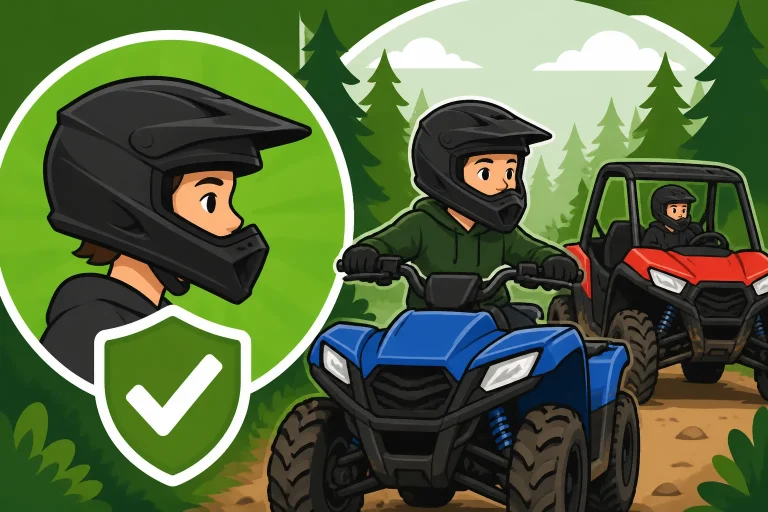
A short ride from the parking area to a trail can still involve a fall, collision or sudden change in terrain. Wear a properly fitting helmet and suitable protective clothing, and check whether the forest or park sets additional equipment standards. Under-16 requirements can be especially specific, so confirm what applies to each young rider before departure.
When considering a helmet or other safety gear, verify that it is appropriate for the activity and fits securely. A helmet that is too loose, damaged or poorly fastened can create a false sense of protection. If you are browsing products on Amazon, read the detailed specifications and inspect the item when it arrives rather than relying only on a headline or product photo.
Bring water, basic first aid and a way to communicate that does not depend entirely on strong cellular coverage. Tell someone your intended route and return time. On hot, humid days, take breaks before anyone feels exhausted or unwell. Safety planning is not separate from permit compliance: a pass gets you to an authorized riding area, but thoughtful preparation helps you use it responsibly.
Reciprocity and Riding Across State Lines
An out-of-state sticker does not automatically satisfy Mississippi rules
Riders visiting from Alabama, Louisiana, Tennessee or another state should check Mississippi’s requirements for the particular riding area. A registration decal or trail permit issued elsewhere may not serve as a substitute for a Mississippi National Forest OHV pass. Mississippi does not provide a general state OHV registration sticker that automatically reciprocates with another state’s system, so the relevant question is what the forest requires for access.
This can be confusing for a visitor who has already paid for a permit at home. The simplest approach is to treat each destination as its own rules check: identify the forest, confirm that the trail is open, find out whether a pass is required and confirm whether the visiting machine meets the route’s limits. Do not assume that a state-issued plate or sticker is enough to satisfy a federal trail-system requirement.
The same principle applies when using a borrowed machine or a rental. The person who owns the machine may have paperwork or a pass, but the rider should confirm that the authorization applies to that machine and that the rider meets the qualifications. For visitors specifically, see Mississippi Visitors Need No State Sticker, then separately confirm forest pass requirements.
Mississippi’s pass does not travel with you to another state
Reciprocity works only when the destination recognizes another jurisdiction’s permit. A Mississippi National Forest pass should not be treated as a universal pass for OHV trails in Alabama, Louisiana or elsewhere. Each state and riding area can set different requirements, including separate fees, vehicle limits, age rules and proof-of-ownership expectations.
If you are planning a multi-state riding weekend, make a short checklist for each stop. Record the destination’s official contact information, pass requirements, route conditions, trail width limits and any required rider credentials. This is more reliable than trying to remember which rule belonged to which state after a long drive.
The same care is worthwhile for a visiting rider coming into Mississippi. Explain that a state sticker from home may not be enough, and share the forest’s current instructions before the group departs. Doing that early prevents one person from arriving with a machine that is not eligible or a permit that does not apply. For a direct comparison with one nearby state, see Does a Mississippi Forest Pass Work in Alabama?.
Distinguish forest passes from park and public-land permits
A national forest pass does not automatically cover every place where people ride. Private parks can require waivers, admission or their own permits. State parks may have additional rules, and wildlife management areas can restrict machines to designated roads or approved purposes. The same vehicle and rider may face different requirements at each location.
That is why a trip itinerary should list the exact riding areas rather than just the general region. “Riding near Hattiesburg” could mean a national forest trail, a private mud park or another land type, each with its own access process. Check each stop independently, especially if you plan to move from a forest trail to a private facility on the same weekend.
Avoid carrying one pass as if it were a universal entry ticket. Keep the information for each destination separate, and confirm whether a waiver, day-use permit or other document is required in addition to the forest pass. These distinctions are easy to miss when a group is coordinating several machines and drivers, but they prevent unpleasant surprises at the gate.
Planning a Smooth Forest Ride
Check access conditions before loading the trailer
A pass can be valid while a particular trail is temporarily closed or unsuitable. Before loading, check the forest’s route information, weather-related notices and any local updates. If rain has been heavy, ask about closures or soft trail conditions rather than assuming the area is open because it was open the previous weekend.
Build flexibility into the day. If the intended route is closed, do not ride around a barrier or follow an unmarked track in search of another way through. Have a backup activity or an alternate authorized destination in mind. This is especially useful for groups traveling from far away, where a closure can otherwise turn into pressure to make a poor decision.
At the trailhead, read the signboard and compare it with the map you brought. Pay attention to arrows, boundary markers and notices about machine type or direction of travel. If signs conflict with an old printed map, follow posted instructions and ask the managing office. A quick check at the entrance can prevent a wrong turn that takes you onto a closed route.
Prepare for weak service and changing conditions
Cell service may be inconsistent in forested areas. Download maps or save essential directions before leaving a town, and consider carrying a paper map as a backup. Share your route and expected return time with someone who is not on the ride. If the group splits up, agree on a meeting point and a time to regroup before anyone loses sight of the others.
Pack for the actual ride rather than the parking lot. Water, weather-appropriate clothing, basic first aid, a charged phone and a small repair kit can make a substantial difference when the trail is longer or rougher than expected. Secure loose gear so it cannot fall onto a route or interfere with steering. If riding in a group, identify who has recovery equipment and who knows how to use it.
Keep an eye on heat, fatigue and storm conditions. Mississippi’s humidity can make a moderate ride feel much harder, especially for children and riders who are not used to outdoor activity. Stop before anyone is struggling, drink regularly and turn back if weather or visibility deteriorates. Being willing to shorten the ride is part of a good plan, not a failed outing.
Respect other users and leave the route in good condition
National forest routes may be shared with other visitors, staff or authorized vehicles. Slow down near trailheads, camps and places where people may be walking or working. Follow posted speed and travel instructions, yield appropriately and avoid creating dust or noise problems where people are close to the route.
Stay on designated trails. Cutting a corner, riding around a puddle or making a new path around a blockage can widen damage and harm nearby vegetation. A mud hole that looks like a minor obstacle may be part of a trail-management issue, so do not create a bypass without permission. If a route is damaged or blocked, report the problem rather than making it worse.
Pack out trash and leave gates, signs and trail structures as you found them. Respecting closures and shared use helps preserve access for other riders. The pass is a tool for permitted access, not a claim on the land. A careful rider leaves the trailhead and route in a condition that gives the next group a fair chance to enjoy the same ride.
A Practical Pass Checklist
Before buying
Confirm the forest or riding area you intend to visit and whether it requires an OHV pass. Check current purchase instructions, fees, pass coverage and any rule about whether the pass belongs to a person or a specific machine. If your group has multiple vehicles, confirm whether each one needs separate authorization rather than assuming one pass covers the whole trailer.
Measure the machine and compare it with the route’s width and other eligibility conditions. Check modifications such as tires, spacers, racks or fenders that may change the vehicle’s dimensions. If a rule uses a technical measurement such as dry weight or a defined width, make sure you understand how the forest applies it.
For visiting riders, check Mississippi requirements separately from the registration or permit rules in the home state. For a Mississippi rider heading elsewhere, check the destination’s rules rather than expecting the forest pass to carry across state lines. Store the current information with your trip notes so you are not searching for it while everyone waits at the trailhead.
Before leaving home
Verify the route’s status and look for closures, weather notices and special restrictions. Save a map offline or carry a paper version, and make sure every rider knows the destination and planned route. Check that the pass proof is accessible and displayed or carried in the manner required by the forest.
Review rider qualifications, age rules, helmet requirements and passenger restrictions for everyone in the group. Make sure a young rider’s credential is available and that the planned machine is appropriate for their size and experience. Do not assume that one adult’s license or pass covers another rider’s individual requirements.
Pack water, protective gear, basic first aid and supplies suited to the route. Charge devices, tell someone at home when to expect you back, and decide what you will do if a trail is closed. A flexible plan is more useful than trying to force a ride onto a route that is not available.
At the trailhead
Read the signs before unloading or starting down a route. Confirm that the machine is allowed, the route is open and the pass is valid for the riding area. Keep to designated trails, respect gates and closures, and avoid following tracks that are not clearly authorized.
If you discover that the machine is too wide, the pass does not apply or the route is closed, stop and ask before proceeding. Do not assume that another rider’s presence proves access is allowed. A quiet trail can be closed, and an open-looking road can have restrictions that are not obvious from its surface.
Keep the pass and required rider documents available throughout the ride. Follow instructions from forest staff and be considerate of other visitors. Good preparation cannot prevent every change in conditions, but it can help you respond calmly instead of making a rushed decision.
Disclaimer
This article is for general informational purposes only and does not constitute professional advice. Laws, prices and regulations vary by location and change over time. Consult a qualified professional for guidance on your specific situation.