What It Takes to Guide Riders for Pay in Mississippi
Guiding ATV or UTV rides for pay in Mississippi is not just a matter of choosing a trail and collecting a fee. The permission you need depends on who controls the land, and public-land access rules may not authorize a commercial tour. Here’s how to sort out the land approvals, rider requirements, insurance questions and practical checks before taking paying customers out.
Start with the land, not the ride plan
Mississippi does not have one permit that automatically authorizes commercial ATV guiding everywhere. A guide needs to identify the land manager first, then ask whether paid trips are allowed and what written authorization applies. Permission to ride recreationally, a trail pass or a general event approval should not be treated as permission to operate a guiding business.
| Where you plan to guide | First approval to investigate | Important distinction |
|---|---|---|
| National forest land | A commercial-use or special-use authorization from the U.S. Forest Service | A recreation pass does not, by itself, authorize a paid guiding service |
| Wildlife management area | Approval from the agency managing the area, along with applicable area rules | Access for individual riders does not necessarily include commercial use |
| State park | The park’s rules and any required written approval | A waiver or ordinary riding permission may not authorize a business |
| Private property | Written permission or a contract with the owner | Permission should expressly cover paid customers and the planned route |
| Private off-road park | The operator’s commercial-use, group, waiver and operating requirements | The park may control what outside guides can do on its property |
National forest land
Commercial trips on national forest land are different from a group of friends riding together. If customers pay you to lead, guide or organize rides on Forest Service land, contact the relevant Forest Service office before advertising or taking bookings. Ask whether the activity requires a special-use authorization, what information the application needs and whether the proposed routes and operating season are acceptable.
Be specific about your business model. Explain whether you charge per rider, collect a guiding fee, provide machines, arrange transportation or bundle a ride with lodging or another service. Payment does not have to be described as a “guide fee” for an activity to raise commercial-use questions. The land manager needs to understand what customers receive and how you are compensated.
The Mississippi National Forest OHV Passes apply to recreational riding where required, but do not assume that buying passes for customers covers your business authorization. Ask the Forest Service office about both commercial use and each rider’s access requirements. The Which Forest Office to Call About Trail Access resource can help you identify the right office to contact.
Wildlife management areas and state parks
Wildlife management areas and state parks have their own managers, access rules and operating conditions. A public access rule for an individual rider does not automatically permit a paid guide to bring customers, run a recurring service or use facilities commercially. Ask the managing agency directly whether it permits guided ATV or UTV trips at the particular area.
For wildlife management areas, confirm that the route is open to the type of machine and activity you plan to offer. Do not treat a road shown on a map, a familiar hunting route or an open gate as permission to ride. Area rules can limit machine use to designated roads or close routes seasonally. See Mississippi WMA Rules for Riders for the distinction between access and the rules that apply on a management area.
A state park may have separate procedures for group use, waivers, age checks and machine requirements. A rider’s signed liability form does not substitute for authorization to run a commercial operation. Ask the park whether it accepts outside guides at all, and get the answer in writing before making promises to customers. The Mississippi State Park Waiver Requirements explain why a waiver should be treated as one part of park compliance, not as a business permit.
Private property and private parks
Private land can offer more flexibility, but the landowner’s permission needs to match the actual use. A casual “you can ride here” may not clearly cover paid customers, repeat visits, advertising, parking, staging or recovery operations. Put the agreement in writing and identify the property, approved routes, dates or operating periods, customer limits, fees, vehicle types and any areas that are off-limits.
If you plan to guide at an established private park, speak with the operator rather than assuming you can bring customers under ordinary admission rules. The park may require its own guide approval, group booking, waivers, insurance evidence or operating conditions. Its requirements can apply even when the park is open to the public. See Mississippi Private Park Waivers and Rules for the kinds of conditions riders may encounter.
For private land, Mississippi Landowner Permission Forms may help you think through what written consent should cover. A form is not a substitute for a complete agreement or legal advice, especially if you are operating regularly or taking responsibility for customers.
Find out which approvals apply before you advertise
Once you know who controls the route, ask the land manager what approval is required for a paid guiding operation. Do this before collecting deposits, promising a particular route or telling customers that a trip is approved. A permit process may take time, and the manager may limit where, when or how a commercial activity can operate.
A focused request is easier to assess than a general question such as “Can I guide ATVs here?” Include:
- The land or trail system you want to use, with a map or route description.
- Whether the service is guided riding, instruction, a tour, an event or a combination.
- How customers are charged and whether you provide machines, transport, food or lodging.
- The expected number of riders and trips, including how often you plan to operate.
- The machines you expect to use, including their width and passenger capacity.
- How you will handle safety briefings, emergencies, vehicle breakdowns and trail closures.
- Whether you will use parking areas, campsites, buildings or other facilities.
- What insurance coverage you carry or are prepared to obtain.
Ask the manager to distinguish a permit for commercial use from other approvals. For example, an event permit may cover a one-time organized ride but not an ongoing guide business. The Mississippi Event Permits for a Ride topic is relevant when you are arranging a particular group event; it should not be assumed to cover recurring commercial trips.
Keep copies of applications, approvals, route conditions and correspondence. If a manager gives guidance by phone, follow up in writing with a short summary and ask the office to confirm or correct it. Written approval helps prevent misunderstandings about the route, activity or dates that were actually authorized.
Do not treat silence as approval. If you cannot get a clear answer, pause the plan and ask the land manager to identify the right contact or process. A guide who advertises first may have to cancel customers or refund payments if permission is denied or the proposed activity is restricted.
Check the route and riding rules separately
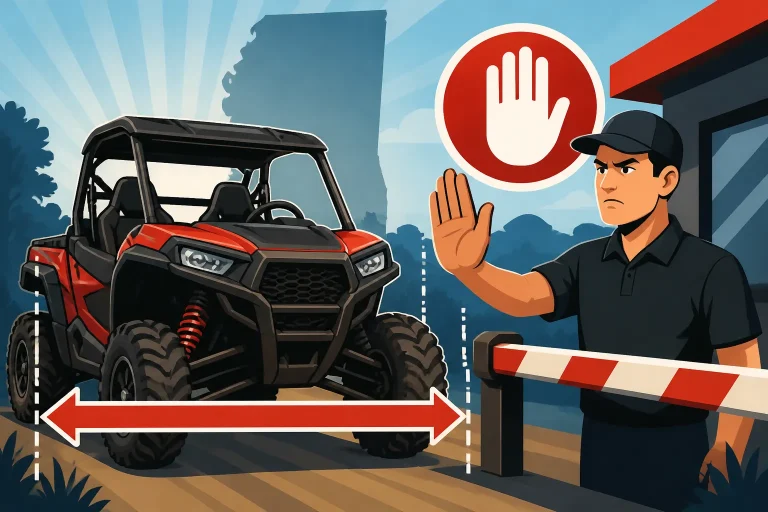
Commercial authorization does not cancel ordinary riding rules. Confirm that each route is open to your customers’ machines and that the machines fit any width, weight or other trail limits. Public-land passes can have their own conditions, and a machine that is legal to own may still be too large for a particular trail.
Mississippi’s road rules matter when planning connections between trail sections. Do not build a route around riding an ATV or UTV along a public road unless the specific road use is lawful and authorized. A route that leaves a trail system for a public street or county road can create a separate legal problem. Mississippi ATV Road Rules Under 63-31-3 provides background on the state’s off-road vehicle road restrictions.
Also confirm current closures and operating conditions before each trip. Rain, fire danger, hunting activity, maintenance or land-manager decisions can change access. A guide’s past experience on a route is not proof that it is open today. Check the land manager’s current notices, signs at the trailhead and any instructions issued with the authorization.
Set up the business and the customer experience
Land approval is only one part of a safe, workable guiding business. Before the first trip, decide what you are responsible for and what the customer must provide. A clear booking description should state the meeting location, expected ride duration, machine requirements, passenger limits, rider experience needed, cancellation terms and what happens if the route closes.
If customers bring their own machines, explain how you will confirm they are suitable for the route. If you provide machines, plan for inspection, fit, maintenance, loading and recovery. In either model, avoid promising that a route is suitable for every rider or every vehicle. A narrow forest trail, muddy section or steep obstacle can be inappropriate for a particular machine or customer even if the trail is open.
Safety planning
Create a written operating plan that matches the actual terrain and group size. At minimum, decide how you will:
- Check in riders and collect emergency contact details.
- Confirm that each rider can control the machine they will use.
- Give a briefing on spacing, hand signals, passing, stopping and staying on the approved route.
- Set a lead and sweep position so no customer is left behind.
- Handle a mechanical failure, injury, lost rider or sudden closure.
- Communicate when mobile service is unreliable.
- Decide when weather, trail conditions or a rider’s behavior make it unsafe to continue.
A waiver can document that customers received information and acknowledged certain risks, but it is not a substitute for safe practices, required approvals or insurance. Have a qualified attorney review customer documents, especially if you provide machines or regularly guide the public. Avoid relying on a downloaded form without checking whether it fits your operation and the land manager’s requirements.
Machine and rider rules still apply on public riding areas. For example, a land manager may require a driver’s license, safety certificate, helmet, pass or proof of ownership. The exact requirement depends on the rider and location. Confirm what customers must carry and how compliance will be checked. Mississippi Proof of Ownership on the Trail can help you plan what documentation riders may need to have available.
Insurance, business records and taxes
Ask an insurance professional about coverage designed for a paid off-road guiding operation. A personal ATV policy may not cover commercial guiding, paying customers, rented machines or business activities. Describe the operation accurately, including where it takes place, whether customers use your machines and whether you transport riders or vehicles. Ask the insurer to explain exclusions and what proof of coverage the land manager requires.
Do not assume that a waiver transfers every risk to the customer or protects a business from every claim. Insurance requirements may come from the land manager, a private property owner, a park operator or a contract. Those requirements can differ, and a policy that satisfies one landowner may not satisfy another.
Separate business money and records from personal spending. Keep booking records, customer payments, written permissions, permits, maintenance logs, incident reports and insurance documents organized. Ask a tax professional or the appropriate state and local offices what registrations, tax collection, business licenses or reporting duties apply to your specific operation. Requirements can depend on where the business is based, how it is structured and what services it sells.
Be particularly careful with bundles. If a customer pays one price for guiding, machine rental, transport, camping or another service, more than one rule or business obligation may apply. Describe the package to the relevant land manager and your insurer rather than assuming that only the guided ride matters.
Use a go-or-no-go checklist for every trip
A permit does not guarantee that every planned ride can go ahead. Conditions change, customers arrive on unsuitable machines, and riders may be unprepared for the terrain. A short checklist before each trip makes it easier to turn back or adjust the plan without improvising under pressure.
- Confirm land access. Check that your commercial authorization is valid for the location, date, activity and group size.
- Check closures and conditions. Review land-manager notices and trailhead signs, and ask if recent weather or maintenance has affected access.
- Match machines to the route. Verify that each machine meets the applicable trail limits and has the required equipment.
- Confirm rider requirements. Tell customers what identification, passes, safety credentials, helmets or ownership documents they need.
- Review the group. Make sure riders understand the route and can handle the expected conditions. Set expectations about passengers and riding pace.
- Check communications and emergency plans. Bring suitable communication and first-aid supplies, and know how to contact help from the area.
- Record the trip. Keep a roster, route plan, emergency contacts and a way to account for everyone at the end.
If any of those checks fails, delay, reroute within the approved area or cancel. Do not take customers onto an unapproved trail simply because a planned route is closed. Do not use a public road as an informal detour. Make the cancellation policy clear when customers book so that safety decisions do not become a last-minute dispute.
A practical sequence is to secure the land manager’s approval, confirm the route and operating conditions, arrange suitable insurance, prepare customer paperwork and then open bookings. Keep the scope of the business narrow at first: one approved area, a defined route and a manageable group are easier to supervise than a collection of loosely planned rides across different properties.
The central question is not simply whether riders are allowed on a trail. It is whether you are allowed to take paying customers there as a business, under the conditions you intend to offer. Get that answer from the land manager in writing, then build the trip around the approval and the current rules.
Disclaimer
This article is for general informational purposes only and does not constitute professional advice. Laws, prices and regulations vary by location and change over time. Consult a qualified professional for guidance on your specific situation.