Mississippi WMA Riding Behind a Gate
A closed gate on a Mississippi Wildlife Management Area can look like a minor obstacle, especially when a trail continues beyond it. But a passable road is not necessarily an open road, and riding around a barrier can turn a lawful outing into an access violation. The safest approach is to treat the closure as binding and check the area’s current rules before riding.
What a Gate Means on a Mississippi WMA
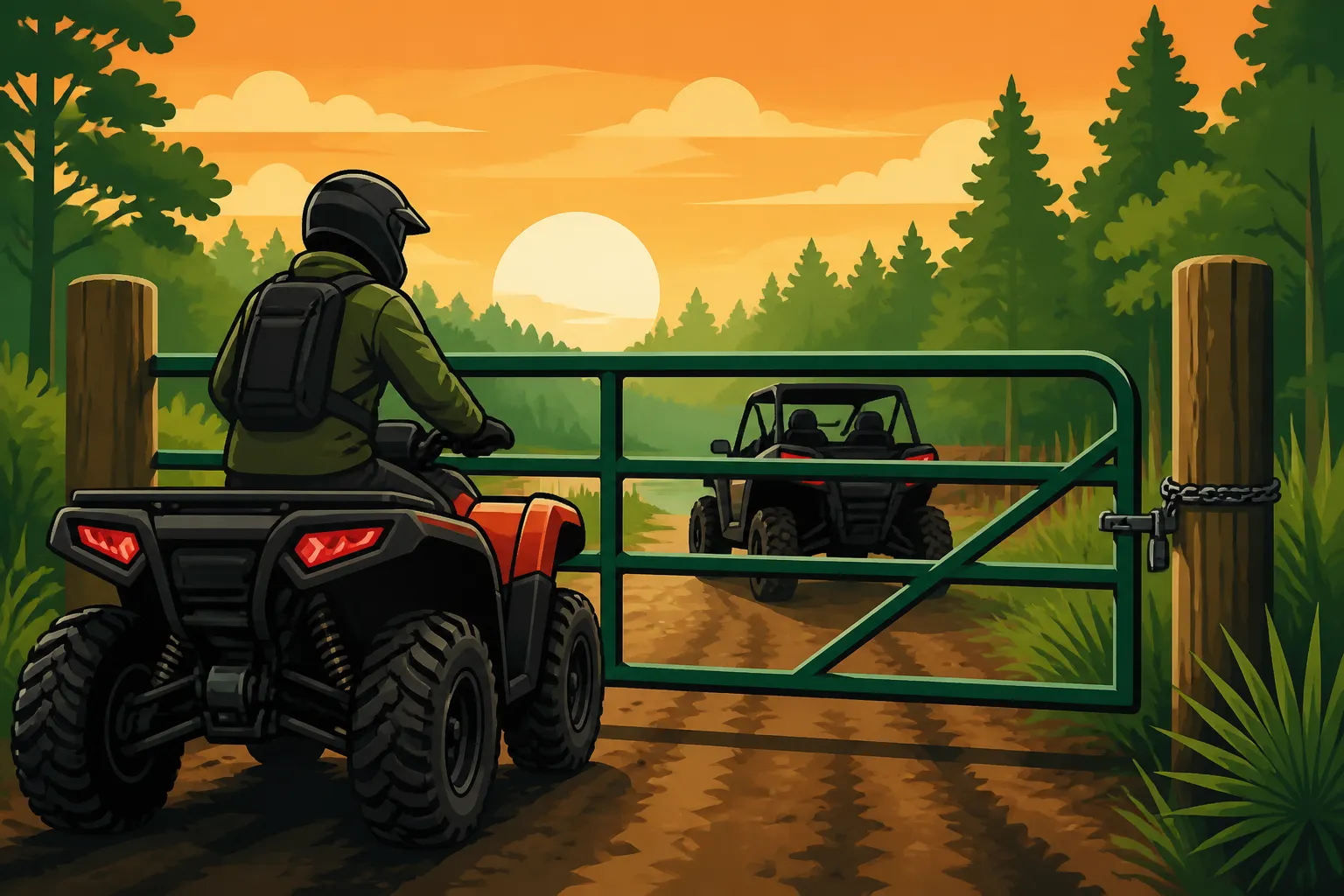
A gate, chain, cable, berm, or other barrier is a practical signal to stop. It may mark a road that is closed to vehicles, even if the road beyond it looks well-used or your machine could easily get through. Do not assume that an unlocked or open gate means the route is open to ATV or UTV traffic. The controlling question is whether the road is designated and currently authorized for vehicle use.
On a Wildlife Management Area, road access is not the same as general permission to roam across public land. A WMA may have roads that are open to certain traffic and others that are restricted or closed. Rules can differ by area and change with management needs, weather, season, or hunting activity. The details matter: one route may be open while a nearby road is closed.
That is why a gate should be treated as a boundary, not a challenge to find another way through. Do not drive around it, cut a new path, cross a berm, or enter through a gap in the brush. A barrier may protect wildlife habitat, prevent vehicle damage, separate public access from restricted land, or keep people away from an active operation. Its purpose may not be obvious from the trailhead.
| What you see | Safest interpretation | What to do |
|---|---|---|
| A closed or locked gate | Vehicle access is restricted beyond it | Turn around and use an authorized route |
| An open gate with a closure sign | The sign controls; the gate position does not cancel it | Do not enter |
| A gate with no visible sign | Access is still uncertain | Check the WMA’s current rules or ask the manager |
| A road around a gate | The route may be an unauthorized bypass | Do not use it unless it is clearly designated and open |
| A gate open on a marked, authorized road | Access may be allowed, subject to current rules | Check for additional restrictions before proceeding |
For a broader overview, see Mississippi WMA Designated Roads Only. The central point is straightforward: being on public land does not automatically make every road or track open to an ATV or UTV.
A gate also does not tell you whether a route is open to foot traffic, hunting access, or other uses. A road may have different rules for different users, so do not infer vehicle permission from seeing people walking, a parked truck, or tire tracks. Likewise, the absence of a barrier does not prove that a road is approved for riding. Follow posted signs and the area’s official road designations.
Why WMA Gates Close and How to Check Access
Closures can serve more than one purpose. A road may be closed to reduce erosion, protect sensitive habitat, limit disturbance to wildlife, allow road or forestry work, or control vehicle access during a particular season. Heavy rain can make a road vulnerable to rutting, and a route that was usable on a previous visit may be closed now. A closure can also be temporary, but that does not make it optional while it is in effect.
Signs and barriers work together. A road-closure sign is not merely a suggestion because a rider thinks the surface looks dry or the machine is light enough to cross. Conversely, a missing sign does not guarantee that an unmarked road is legal for riding. Check the applicable WMA map and current regulations before the trip, and ask the area manager or the Mississippi Department of Wildlife, Fisheries, and Parks when the information is unclear. The details for a specific area are more useful than assumptions based on another WMA.
The following checks help prevent a mistaken turn:
- Identify the exact WMA. A nearby property, forest road, or private hunting lease may have different access rules. Make sure the map and rules you are checking apply to the land you plan to enter.
- Check the current road designations. Look for maps or notices that show which roads are open to vehicles. Confirm whether ATVs and UTVs are permitted on the route, rather than assuming a road open to some traffic is open to your machine.
- Read every sign at the entrance and along the route. Restrictions may apply to a specific road, season, vehicle type, or activity.
- Check for current closures. Weather, management work, and hunting activity can affect access after a map was printed or a trip was planned.
- Ask before riding if the status is ambiguous. Give the WMA manager the area and road location, and ask whether that particular route is open to your vehicle.
The guidance in Mississippi WMA Road Closure Signs is especially useful when signs and gates seem to give mixed signals. In practice, do not let the gate’s position overrule a clear closure notice. If you cannot confirm that the road is open, choose another route.
Permits and out-of-state credentials
A permit, pass, license, or registration is not a blanket right to use every road. Any authorization applies within its stated scope and remains subject to road closures and area rules. A visitor should not assume that an out-of-state ATV registration or decal gives permission to ride behind a Mississippi WMA gate. For the separate question of state stickers and out-of-state credentials, see Mississippi Has No Sticker to Honor From Another State.
Also keep rider requirements separate from road access. A rider may need to meet applicable age, licensing, or safety requirements and still be prohibited from using a particular closed road. Review Mississippi WMA Rules for Riders for the rules that apply to riding on management areas; meeting rider requirements does not open a route that has been closed.
If you are unsure whether a pass or permit covers a specific WMA activity, ask the authority that manages that area. Do not treat a hunting license, access pass, or permission to enter the area as permission to ride anywhere within it.
What to Do When You Reach a Gate
The safest response to a closed or uncertain gate is to stop before the barrier, keep the machine on the authorized side, and turn around. Do not test whether a chain is loose, move a barrier, or look for an informal bypass. If a sign explains the closure, follow it even if another rider has gone through or the road appears to continue to a familiar destination.
If you arrive at a gate that is open, pause and check the signs nearby. An open gate may simply have been left open for staff, maintenance, or another authorized user. Look for a posted notice, road designation, or other information confirming that your machine may use the route. When there is no clear answer, do not enter on the assumption that an open gate equals public access.
If you see another rider beyond a closed gate, that is not proof that the route is authorized. Riders may have misunderstood the rule, may be there for a different permitted purpose, or may have access you do not. The same goes for tire tracks or a worn path. Neither changes the posted restriction.
When you need to report a confusing or damaged barrier, note the WMA name and the location as accurately as you can. Contact the area manager or the responsible agency rather than moving the gate yourself. A concise question is more likely to get a useful answer: identify the road, describe the sign or barrier, and ask whether ATVs or UTVs are currently allowed beyond it.
This caution is not limited to vehicle access. A route that appears to lead to a field, timber road, or hunting area may cross land with a separate access restriction. WMA rules and private-land permission are different issues. For more on how access rights and land status can affect a ride, see What Posted Land Means for Mississippi Riders and Mississippi Hunting Land Access by Machine.
Hunting and game retrieval are separate questions
A hunter’s right to access a WMA does not automatically mean an ATV or UTV may pass through a closed gate. Rules for driving a designated road, retrieving game, and carrying equipment can be different. If your reason for approaching the gate is to reach a hunting spot or retrieve an animal, check the specific area’s rules for that activity rather than assuming a general hunting privilege overrides a road closure. [Mississippi WMA Deer Retrieval Rules] covers the separate question of using a machine for retrieval.
Similarly, do not assume a hunting-related exception exists because the route is normally used by hunters. Restrictions may depend on the road, season, weapon rules, or area-specific conditions. Confirm the current requirements before the trip, and follow any posted limits even when you are carrying a valid hunting license or other authorization.
Common Mistakes and a Better Pre-Ride Routine
Several assumptions lead riders into trouble:
- “The gate is open, so the road must be open.” A gate can be open for reasons unrelated to public riding. Check the road designation and signs.
- “It is public land, so I can ride there.” Public ownership does not mean unrestricted vehicle access. WMAs can limit riding to designated roads or areas.
- “The closure is probably only for cars.” Unless the sign or current rules say otherwise, do not decide that your ATV or UTV is exempt.
- “Other people have driven through.” Another person’s actions are not confirmation of permission.
- “My permit or out-of-state registration covers it.” Credentials do not cancel a road closure or replace local access rules.
- “I can go around without damaging anything.” Bypassing a barrier can still mean entering a restricted area, even if the ground is firm and no visible damage occurs.
Before loading the machine, make a simple plan: identify the WMA, confirm the route is open to your type of vehicle, check current notices, and save the area contact information. If a gate or sign contradicts what you expected, stop and reassess instead of pressing ahead. A route change is inconvenient; an unauthorized entry can create a much bigger problem.
Keep a map available, but do not rely on an old map alone. Printed information may not reflect a temporary closure, and phone service may be unreliable in some riding areas. If you use a digital map, save the relevant information before leaving an area with coverage. A paper backup can help you retrace your route, but neither map format overrides a current sign or closure.
When no one can confirm that the road is open, choose a clearly authorized riding location instead. Mississippi ATV Trails: Where to Ride can help you look for designated places to ride, while Mississippi WMA Access for a Quad addresses the broader question of using an ATV on a management area.
Disclaimer
This article is for general informational purposes only and does not constitute professional advice. Laws, prices and regulations vary by location and change over time. Consult a qualified professional for guidance on your specific situation.