Mississippi WMA Deer Retrieval Rules
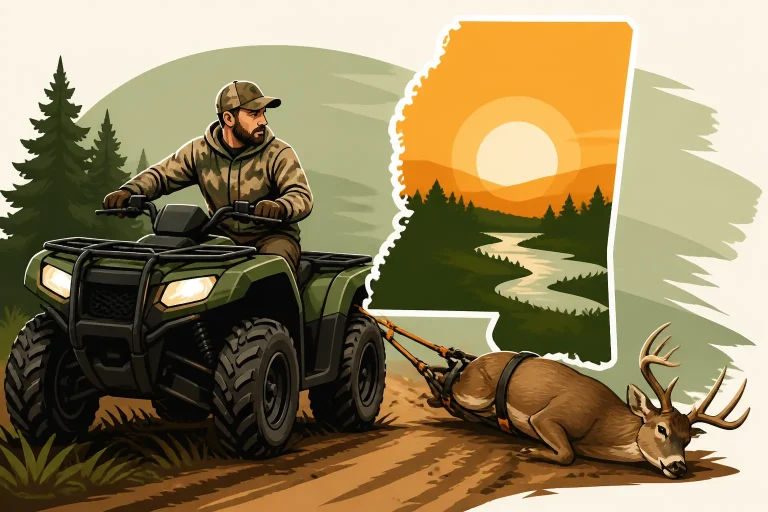
Retrieving a deer from a Mississippi Wildlife Management Area (WMA) with an ATV or UTV can save a long carry, but it does not grant permission to ride wherever you need to go. Access depends on the specific area, its current rules, and which roads are open. Check those details before hunting so a recovery trip does not become a road or access violation.
The basic rule: retrieval is not blanket riding permission
A WMA’s vehicle rules apply even when you are carrying a harvested deer. Permission to retrieve game does not automatically allow you to leave a designated route, pass a closed gate, or ride through woods to reach the animal. The route and access conditions matter as much as the reason for the trip.
Mississippi WMAs can have different road layouts, closures, and operating conditions. Some routes may be open to vehicles while others are closed, restricted, or intended for a different kind of access. Signs, gates, berms, and other barriers are important indicators: do not assume a road is open just because it appears drivable or because another rider used it earlier.
The safest approach is to treat each WMA as its own site:
- Check the current rules for the specific WMA you plan to hunt.
- Confirm whether an ATV or UTV may be used for deer retrieval there.
- Ask which roads are open to that use and whether any seasonal or temporary closures apply.
- Stay on routes the WMA identifies as open. Do not drive around a gate or barrier.
- If the deer is beyond the permitted vehicle route, plan on carrying it out or using another allowed method.
The distinction between a designated road and an off-road shortcut is central. For related guidance on where machines may travel, see Mississippi WMA Designated Roads. Rules for riding on a WMA are broader than deer recovery alone; Mississippi WMA Rules for Riders covers that wider context.
How to check a WMA’s retrieval and access rules
Do not rely only on a general statement that “ATVs are allowed” or on what happens at another management area. That wording may not tell you whether your intended use, route, machine, or hunting date is covered. Check the current WMA-specific information and ask a clear question if anything is uncertain.
A practical check looks like this:
- Identify the exact WMA. Similar names or nearby public lands can have different managers and rules. Verify that the rules you are reading apply to the area where you will hunt.
- Find the current hunting and access information. Look for vehicle restrictions, designated routes, closures, and any special rules for retrieving harvested game.
- Check for temporary changes. A road that is normally open may be closed because of weather, maintenance, management activity, or a seasonal restriction.
- Ask the area manager or responsible office if the wording is unclear. Describe your machine, the route you intend to use, and that the purpose is to retrieve a deer. Ask whether the route is open to that use.
- Check again before driving in. Conditions and access can change between planning a hunt and arriving at the gate.
When you contact an office, questions such as “Can I use my ATV?” are broad enough to invite an answer that may not cover your plan. More useful questions include:
- Is deer retrieval by ATV or UTV allowed on this WMA?
- Which named or marked roads may I use?
- Are any roads closed during my planned hunt?
- May I leave the designated route to reach a deer?
- Are there machine-size, access-hour, or other restrictions I need to know about?
Keep any answer in context: a general statement about vehicle access may not override a posted closure or a site-specific restriction. If the signs at the WMA conflict with what you expected, stop and verify before proceeding. For more on interpreting barriers and closures, see Mississippi WMA Road Closure Signs.
| Situation | Safer interpretation | What to do |
|---|---|---|
| The route is marked open to vehicle use | It may be available, subject to the WMA’s other rules | Stay on the authorized route and check for current closures |
| A gate or barrier blocks the route | Do not treat the barrier as optional | Turn around and confirm whether another route is open |
| The deer is off the designated road | Retrieval does not by itself establish off-road permission | Carry it out or ask the WMA manager about permitted options |
| You are unsure whether a road is open | Do not infer access from tire tracks or another rider’s presence | Check the map, signs, and current area rules |
| A public-land permit or pass is required | It may cover only the access or activity described by its terms | Verify what the permit covers; do not assume it authorizes every road |
Plan the recovery route before you hunt
It is easier to make a sound decision before a deer is down than when daylight is fading and the animal is difficult to move. Before you leave the parking area, identify legal vehicle routes and note where you may need to walk. A map can help you understand the layout, but use current signs and official information to confirm that a route remains open.
Consider the likely recovery distance and terrain when choosing equipment and planning the hunt. If the deer falls well away from a route where machines are permitted, the answer is not to ride farther into the area. Be ready to use a drag, game cart, or help from another person if that method is allowed and practical. Do not attach a load in a way that blocks lights, interferes with steering, or makes the machine unstable.
A few planning steps can prevent confusion:
- Save the WMA map or access information before entering an area where mobile service may be limited.
- Mark the trailhead, parking location, and routes confirmed as open.
- Tell your hunting partner which route you intend to use for recovery.
- Carry equipment suited to the distance and conditions rather than assuming the machine can reach the deer.
- Leave enough time to recover the animal without rushing near dark.
- If a route is muddy, flooded, or damaged, do not create a new track around the obstacle.
A machine can also cause damage when it leaves a road, especially on wet ground. Ruts and disturbed habitat can affect other users and may lead to tighter access restrictions. If a route is too soft to travel without damaging it, stop and choose an allowed alternative.
Hunters should also keep vehicle use separate from the act of hunting. A machine used to transport a deer is not permission to pursue wildlife, search for a wounded animal by driving across closed ground, or use a vehicle to gain an advantage prohibited by the area’s hunting rules. If you are uncertain whether a particular recovery method is allowed, ask the WMA manager before using it.
Firearms, permits, and other rules still apply
Retrieval does not suspend firearm or hunting requirements. Keep firearms handled and transported in accordance with the rules that apply to the WMA, the season, and the way the machine is being used. Do not assume that a recovered deer makes every firearm condition acceptable for the ride back.
Mississippi WMA rules may address weapon handling, road setbacks, hunting access, and other details separately from vehicle access. Review the current restrictions before the hunt. These related topics can help you identify questions to check: Mississippi WMA Weapon Restrictions and Mississippi WMA Firearm Setbacks. If you need to confirm what hunting access or documentation applies, see [Mississippi Hunting License and Land Access].
Also distinguish a permit for an activity from permission to ride a route. A hunting license, WMA permit, trail pass, or other document may apply to a specific activity or location; it should not be treated as a general vehicle-access authorization unless its terms say so. Ask the WMA office which documents apply to your hunt and whether they have any bearing on the planned retrieval route.
Use the machine carefully on any authorized road. Slow down for pedestrians, other hunters, and limited-visibility turns. Avoid blocking gates or parking where emergency or management vehicles need to pass. Secure the deer and any gear before moving, and make sure the load does not conceal signs or extend in a way that creates a hazard.
If a deputy, conservation officer, or area manager asks about your route or machine use, explain where you entered, which route you followed, and that you are retrieving harvested game. Keep any required documents accessible. Public-land vehicle rules can have separate requirements, so check whether a license or safety credential applies to your circumstances; Driver’s License or Safety Card on Public Land explains that issue.
What to do when the rules are unclear
If you cannot confirm that a route is open, do not treat silence as approval. Stop before the restricted area and contact the responsible office, or use a method that does not require taking the machine beyond a route you know is permitted. If you cannot reach anyone, the conservative option is to stay on clearly authorized roads and carry the deer out from there.
If you discover a closure after entering the WMA, turn around rather than going around the barrier. Do not follow another rider through a restricted area or assume that fresh tracks prove lawful access. A gate or closure may have been put in place recently, and other riders’ actions do not change the rule.
For a difficult recovery, ask about lawful alternatives before moving the deer with a machine. Explain where the animal is, what route is blocked, and what equipment you have. An area manager may be able to clarify the rule or tell you whether another authorized route exists. Do not use a recovery problem as a reason to damage the road, cross a closed section, or create a new path.
The practical takeaway is straightforward: confirm the WMA’s current deer-retrieval rules, use only routes open to your machine, and do not assume that retrieval authorizes off-road travel. A few calls and a route plan before the hunt can prevent a costly misunderstanding when you are trying to get a deer out.
Disclaimer
This article is for general informational purposes only and does not constitute professional advice. Laws, prices and regulations vary by location and change over time. Consult a qualified professional for guidance on your specific situation.