Mississippi WMA Firearm Setbacks
Mississippi WMA Firearm Setbacks
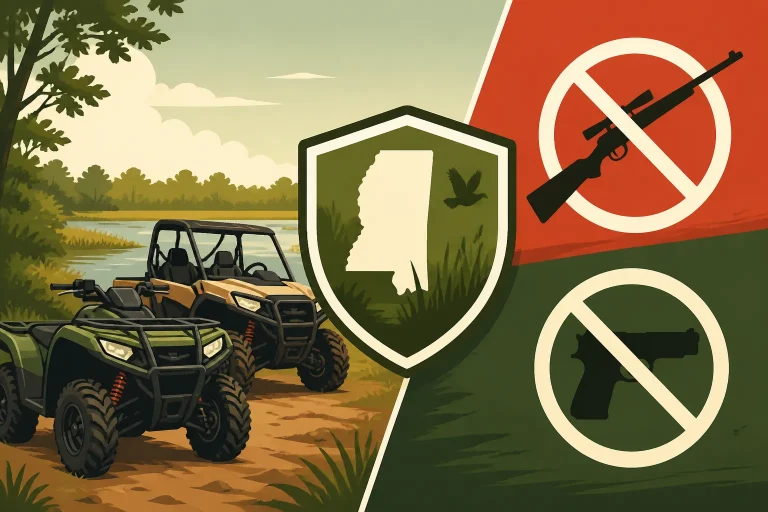
A ride through a Mississippi Wildlife Management Area can put you on roads shared with hunters, but an ATV does not change the firearm rules. The key questions are whether a road is designated and open, whether a weapon is loaded, and whether a road-distance restriction applies. This article explains how to think about setbacks, transport, and area-specific rules before you ride or hunt.
What a firearm setback means on a Mississippi WMA
A firearm setback is a minimum distance from a defined place where a person may not discharge a firearm, or where another restriction applies. On a WMA, the relevant reference point may be a road, residence, or other site named in that area’s rules. Do not assume every setback uses the same measuring point or applies in every season.
For riders, road-related firearm rules matter because ATVs and side-by-sides travel along designated routes, sometimes while hunting activity is underway. A machine may be permitted on a particular WMA road, but that does not make the road a suitable place to load, handle, or fire a weapon. Rules governing vehicle use and rules governing firearms are separate.
A commonly cited Mississippi WMA road restriction involves a 100-foot distance from a road. The exact wording and application matter: a rule may refer to the road’s centerline, a road open to public travel, or a specific type of WMA road. It may also apply in particular hunting circumstances. Before relying on a distance, read the current regulations for the WMA you plan to visit and the season in effect.
The important practical distinction is this:
- A setback can limit where you may discharge a firearm. It is not permission to shoot everywhere beyond that distance.
- A road may have separate firearm restrictions. A setback does not automatically make it lawful to fire from the road, across it, or from a moving machine.
- A hunting season can change what rules apply. Confirm the rules for the date and activity, rather than relying on a regulation remembered from another season.
- A WMA may have area-specific orders. Signs, closures, and local rules can add restrictions or limit access.
If you are planning an ATV trip primarily for access to a hunting location, start with Mississippi WMA Rules for Riders and Mississippi WMA Designated Roads Only. Those topics help explain where a machine may travel. Firearm setbacks address a different question: where a weapon may be carried, handled, or discharged.
Do not treat the distance as a hunting zone
A setback is a restriction, not a boundary that guarantees a safe or lawful shooting position. A spot beyond the minimum distance may still be unsafe because of other people, buildings, roads, trails, vehicles, or poor visibility. It may also be off-limits because the land is closed, the route is not designated for ATV use, or the weapon or hunting method is not allowed.
A firearm should never be discharged toward or across a road, trail, or area where riders or other visitors could appear. Even when a hunter believes a road is quiet, another person may be approaching from behind vegetation or around a bend. Keep the firearm pointed in a safe direction and do not use distance alone as a substitute for identifying what lies beyond the target.
The regulation itself may use a specific measurement point, while a rider’s safe operating distance should be more conservative. If you cannot identify the road boundary or confirm how the rule is measured, do not guess. Move to a location clearly away from the road and verify the rule before hunting.
The 100-foot road rule and what riders should verify
The reference to 100 feet is important, but it should not be reduced to a simple slogan such as “stay 100 feet away and you can shoot.” The written rule for the WMA and season controls. Check whether the distance is measured from the centerline or another point, which roads are covered, and whether the provision applies to firearm discharge, carrying a loaded firearm, or both.
Some WMA firearm rules address activity near a road during a particular hunting season. Others may concern loaded weapons or discharge from a vehicle. These are not interchangeable. A rule prohibiting a loaded firearm on or near a road is different from a rule setting a minimum distance for discharge. Read the actual language instead of assuming one rule answers every question.
Use this checklist before entering a WMA with a firearm:
- Identify the exact WMA and management area. Similar names or nearby parcels can have different access conditions and notices.
- Check the season and activity. Rules for a general visit may differ from rules during a firearm season, a special hunt, or a closure.
- Find the current weapon and road provisions. Look for the specific wording on loading, carrying, discharging, and distance from roads.
- Confirm what counts as a road. Determine whether the rule applies to designated WMA roads, public roads, trails, or more than one category.
- Check posted notices at the site. A gate, sign, or temporary closure can change where travel is allowed.
- Ask the responsible office if the wording is unclear. Give the name of the WMA, the road or area, and the activity you intend to do.
| Question | Why it matters | Safer approach |
|---|---|---|
| Is the road open to ATV use? | A firearm setback does not grant vehicle access. | Use only routes designated for machines and obey closures. |
| Does the rule refer to the road centerline? | The required measuring point may be defined in the regulation. | Confirm the wording rather than estimating from the shoulder. |
| Is the rule about discharge, a loaded firearm, or both? | These restrictions govern different actions. | Treat them as separate questions and follow each applicable rule. |
| Does the restriction apply during this season? | Hunting seasons and special rules may affect what is allowed. | Check the current season-specific regulations before the trip. |
| Is the area posted or temporarily closed? | Local notices may limit access beyond general rules. | Read signs at the entrance and do not bypass a closed gate. |
For more detail on road-related firearm restrictions, see Mississippi WMA Firearm Distance Rules and Loaded Rifles Stay 100 Feet From the Road. The title of a rule or summary is not a substitute for checking the current regulation that applies to the specific area and date.
The distance does not make a road a firing position
A rider may encounter a hunter while using a road, or may be tempted to stop near a road to handle a firearm. Keep the two activities separate. Do not shoot from an ATV, from a road, or across a road. Do not use a machine as a rest or platform for firing. A legal setback, where applicable, does not override general firearm-safety principles or other restrictions.
If a hunter needs to leave a road to reach a lawful location, the route off the road must itself be permitted. A rider cannot simply drive off the designated route because a hunting spot lies beyond the setback. Mississippi WMA Designated Roads Only explains why road access and off-road access should not be confused.
Carrying a firearm while riding
Transporting a firearm on an ATV or UTV calls for care even when the trip is lawful. Rough terrain, abrupt stops, mud, and vibration can shift equipment. A firearm that is loose, loaded, or within easy reach of moving parts increases the chance of an accidental discharge or injury.
For a cautious approach, carry the firearm unloaded and secured while the machine is moving. Use a case or purpose-built secure holder that keeps the firearm from falling, bouncing, or interfering with steering and passenger space. Keep ammunition separate where practical, and do not place a firearm where it can be struck by cargo or a passenger. Follow any stricter WMA rule, state requirement, or restriction that applies to the firearm and activity.
A common mistake is to treat a vehicle as a safe place to load or unload. It is not. Stop in a location where the activity is permitted, dismount if appropriate, keep the muzzle pointed in a safe direction, and handle the firearm deliberately. Do not load while moving or while another rider is maneuvering nearby. If a firearm must be unloaded before entering a road or riding area, do that before reaching the restricted area, not while moving through it.
The relevant WMA rule may specifically prohibit a loaded weapon while riding or on a road. Treat that as distinct from the setback question. Read No Loaded Weapon While Riding alongside the applicable WMA rules, and confirm whether the wording covers the machine, the road, or both.
Keep passengers and other riders clear
An ATV may have a passenger seat, but that does not mean a passenger should hold or manage a firearm while the machine is moving. Passengers need a stable seat and secure handholds. A firearm should not interfere with the driver’s control, a passenger’s balance, or the machine’s safe operation.
Before setting off:
- Secure the firearm so it cannot slide or fall.
- Make sure the muzzle points in a safe direction and is not aimed at a rider.
- Keep the firearm away from hot exhaust, moving components, and unsecured cargo.
- Do not carry a firearm in a way that blocks visibility or access to controls.
- Stop and reassess if the route becomes rough enough that the firearm cannot remain secure.
These precautions are sensible even where a particular rule does not spell out every detail. They reduce the chance that equipment movement becomes a safety emergency.
A hunting license or access permission is not a firearm exception
A hunting license, WMA access authorization, or machine-related permit does not automatically override a weapon restriction. Likewise, being allowed to ride a particular road does not mean a firearm may be loaded or discharged there. Treat each permission as covering only the activity it authorizes.
This distinction matters for visitors and residents alike. A license or permit from another state should not be assumed to satisfy Mississippi hunting or WMA requirements. Confirm the applicable hunting license, access rules, firearm restrictions, and season notices separately. If you are carrying a machine into a WMA, also check Mississippi WMA Access for a Quad and [Mississippi Hunting License and Land Access].
Designated roads, closures, and changing conditions
A setback only helps if you know which road or boundary the rule is talking about. On a WMA, a visible track is not necessarily an approved ATV route. Roads may be open to some users but closed to machines, restricted to particular seasons, or closed temporarily because of weather, maintenance, hunting activity, or resource protection.
Follow signs at entrances and junctions. A gate or berm is not an invitation to ride around it, and a route shown on an old map may no longer be open. The same caution applies when a road looks passable but carries a closure notice. A route’s physical condition does not determine whether access is permitted.
Check Mississippi WMA Road Closure Signs before planning a route. If a road is closed, do not use it to reach a hunting location or to avoid a firearm setback. The correct response is to choose an authorized route or another location, not to improvise a detour.
Do not assume a trail and a road are treated the same way
The terms “road,” “trail,” and “designated route” can have specific meanings in agency rules. A road may be maintained or signed for public access. A trail may have separate machine restrictions. A narrow track used by hunters may not be open to ATV traffic at all.
This affects both firearm compliance and travel planning. A distance measured from a designated road may not be measured from every informal path, but that does not mean a person may discharge a firearm beside an informal path without considering safety or other rules. People may still use the path, and it may be on land where access or firearm use is restricted.
When the map, sign, and regulation seem to disagree, do not choose the interpretation that gives the most access. Stop, avoid discharging or loading the firearm near the route, and seek clarification from the responsible office. Record the name of the WMA and the road or trail so the question can be answered accurately.
Seasonal traffic raises the risk
A WMA road can be quiet one day and busy the next. During a hunt, riders may meet hunters on foot, vehicles carrying equipment, or other machines approaching from a blind curve. A road-distance rule is a minimum legal boundary where it applies; it cannot account for every person who may be nearby.
Give people space and make your presence predictable. Slow down when approaching a person or parked vehicle. Do not surprise a hunter by driving close to a concealed position, and do not stop where you block the route or create a hazard. If you see a firearm being handled near the road, increase distance and avoid approaching until it is safe.
A firearm setback is not a substitute for communication, visibility, or courtesy. A rider who cannot see far enough to know whether the area is clear should not assume it is empty. Likewise, a hunter should not assume a designated road has no traffic simply because no machine is visible at that moment.
A practical plan before the ride
Good preparation makes it easier to keep vehicle access, firearm transport, and hunting activity within their separate rules. Before leaving home, identify the WMA, planned route, season, and exact activity. Then check for current regulations and closures rather than relying on a rule remembered from another property or year.
Use this short pre-ride routine:
- Confirm the route. Make sure every road you plan to use is designated and open to your machine.
- Read the firearm rules. Check the setback wording, any loaded-weapon restriction, and the rules for the season.
- Secure the firearm unloaded for travel. Use a stable holder or case and keep it clear of passengers and controls.
- Review posted notices on arrival. Follow signs, gates, and temporary directions even if your route plan says otherwise.
- Choose a lawful place to stop. Do not load, unload, or handle a firearm while riding or in a location where the rules prohibit it.
- Keep a safe buffer. Stay well clear of roads, other visitors, and areas you cannot see clearly.
- Recheck when plans change. A different road, new season, or changed access condition can mean a different rule applies.
A paper or offline map can help if phone service is unreliable, but maps do not replace current notices. If you need to ask a WMA office or land manager a question, be specific: name the area, explain whether you are riding or hunting, identify the road, and ask whether the restriction concerns carrying, loading, or discharging a firearm.
Do not rely on hearsay from a trailhead or a social media post for a legal interpretation. A statement like “the 100-foot rule applies everywhere” may omit the season, road definition, or conduct covered by the regulation. Similarly, “you can ride anywhere once you have permission” ignores designated-road requirements and posted closures.
When the applicable rule is unclear, the safest decision is straightforward: keep the firearm unloaded and secured, do not discharge it near the road, stay on an authorized route, and get an answer before proceeding. That may mean changing the day’s plan, but it avoids turning a ride into a safety or enforcement problem.
Frequently Asked Questions
Does the 100-foot setback mean I can shoot from any spot beyond 100 feet?
No. A setback is only one restriction. Other rules may govern the road, season, firearm, land access, or location. A spot beyond the stated distance is not automatically safe or lawful.
Can I carry a loaded firearm on an ATV if I am hunting?
Do not assume that you can. WMA rules may restrict loaded weapons while riding or near roads. Check the current rules for the specific area and season; the safer transport practice is to carry the firearm unloaded and secured.
Can I drive off a designated road to get beyond the setback?
Not unless off-road machine travel is expressly allowed. A firearm-distance rule does not expand ATV access. Follow designated routes and obey gates and closure signs.
Does permission to ride a WMA road let me hunt from it?
No. Permission to use a road for machine travel is not permission to discharge a firearm from the road or to hunt from it. Check the hunting and firearm rules separately.
What should I do if I cannot tell where the road boundary is measured?
Do not estimate and proceed as if you have met the requirement. Avoid handling or discharging the firearm near the road, and confirm the measurement point with the current WMA regulation or responsible office.
Disclaimer
This article is for general informational purposes only and does not constitute professional advice. Laws, prices and regulations vary by location and change over time. Consult a qualified professional for guidance on your specific situation.