Mississippi WMA Weapon Rules for Riders
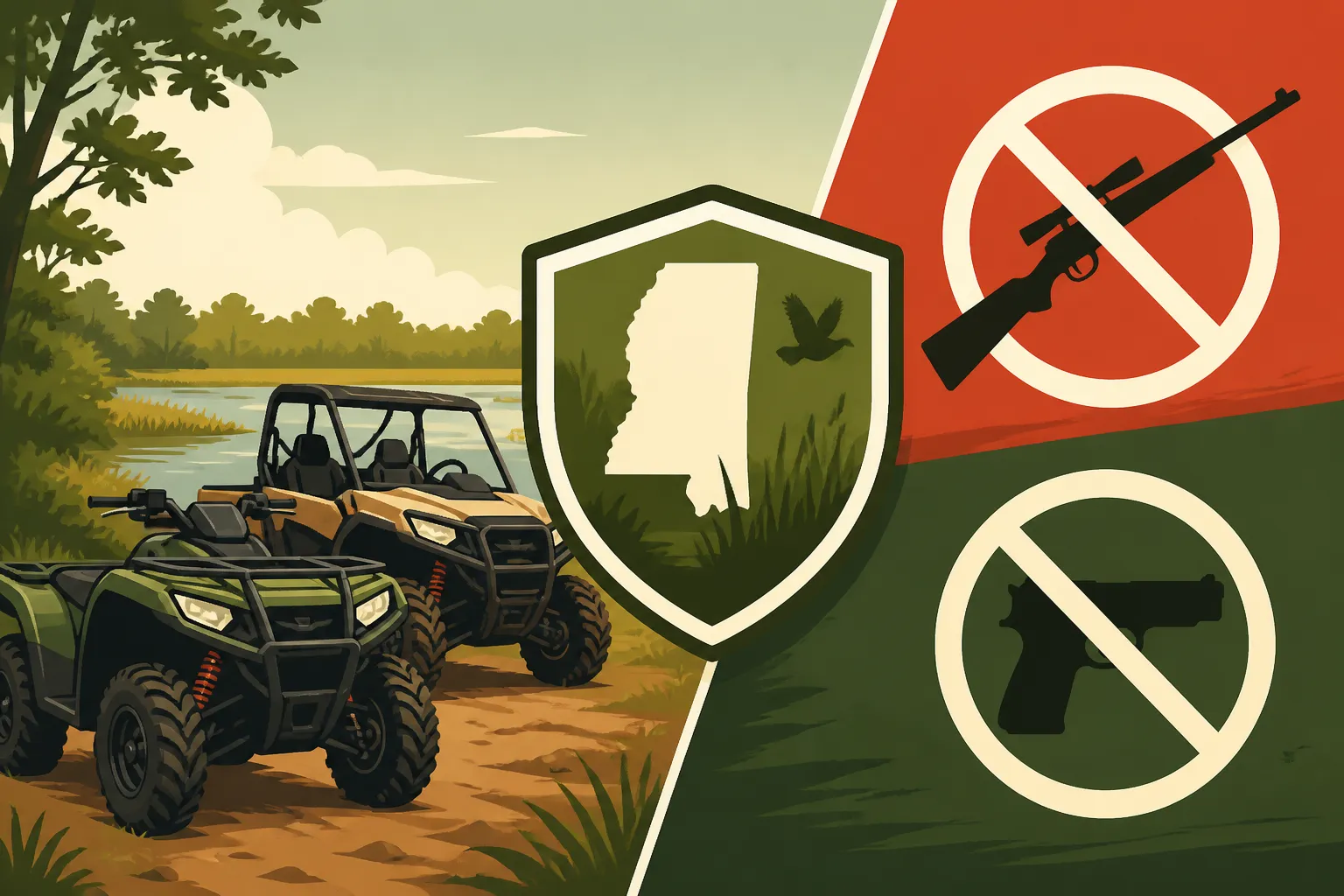
Riding an ATV or UTV on a Mississippi wildlife management area can put you near hunting activity, but a machine is not a free pass to carry or handle a weapon however you like. The rules can depend on the WMA, season, road and firearm. Here’s how to separate safe transport from hunting and shooting—and what to verify before you unload.
Start with the WMA’s rules, not assumptions
Mississippi wildlife management areas, or WMAs, have rules that can be more specific than the general rules for riding a machine. A weapon that is lawful to own or carry elsewhere may still be restricted on a particular area, during a particular season, or while you are riding.
Treat three questions separately:
- Can you possess the weapon on this WMA? Check the area’s rules and the applicable hunting regulations.
- Can you carry it loaded while riding or sitting on the machine? Do not assume that a firearm may stay loaded simply because it is your hunting firearm.
- Can you discharge it from this place? Possession does not authorize shooting from a road, vehicle or other restricted location.
These distinctions matter because “I had it with me” and “I fired it” are different situations, and the rules may address each differently. The WMA may also have restrictions on where a machine can travel, regardless of whether you are carrying a weapon. Review Mississippi WMA Rules for Riders and Mississippi WMA Designated Roads Only before planning a route.
A practical default is to transport firearms unloaded and secured, keep ammunition separate where feasible, and avoid handling a weapon while moving. That is a conservative safety approach, not a substitute for checking the rules that apply to your exact WMA and activity. If a posted sign or current WMA regulation is stricter than your usual practice, follow the stricter rule.
| Situation | Safer approach | What to verify |
|---|---|---|
| Riding to a hunting location | Transport the firearm unloaded and secured | Whether the WMA restricts a loaded firearm on a motorized vehicle |
| Traveling along a WMA road | Keep the weapon secured and do not handle or discharge it | Road-related firearm restrictions and any applicable setback |
| Stopping to hunt | Park legally, then follow the rules for the hunting location and season | Whether hunting is open there and what firearm rules apply |
| Retrieving game | Use only permitted roads and methods | WMA retrieval rules and any weapon-handling limits |
| Visiting outside a hunting plan | Do not assume ordinary carry rules cover the area | Whether possession is allowed and whether the area has special restrictions |
The table is a planning aid, not a complete statement of every area’s regulations. For a broader explanation of where riding is allowed, see Mississippi WMA Road Closure Signs as well as the area-specific materials. A road that looks passable may be closed to machines, and a route open to riders does not automatically permit hunting or shooting along it.
Loaded firearms and riding on a machine
One of the most important questions is whether a firearm may be loaded while you are riding in or on an ATV or UTV. WMA weapon rules can restrict loaded firearms on motorized vehicles. Do not assume that a side-by-side’s cab, a scabbard or a locked storage box creates an exception. The exact rule and any exceptions need to be checked in the current regulations for the area and activity.
For a straightforward, lower-risk plan, unload the firearm before getting on the machine, secure it so it cannot shift or be reached accidentally, and load it only after stopping in a location where handling and hunting are permitted. Before getting back on, unload it again. This also reduces the chance that a bump, rollover or abrupt stop will cause an injury.
A few details are easy to overlook:
- A firearm is not unloaded just because it is inside a case. Check the chamber and magazine, and follow the firearm’s safe handling instructions.
- A scabbard is storage, not permission. Its presence does not override a WMA rule about loaded firearms or riding with weapons.
- A parked machine may still be treated as a vehicle. Do not infer that stopping beside a road lets you handle or load a firearm there.
- A passenger needs to follow the same rules. Do not pass a loaded firearm between riders or leave it where a passenger can handle it casually.
- A hunting exception, if one applies, may be narrow. Confirm the exact wording rather than relying on how another rider interprets it.
The wording of a rule can matter. It may refer to possession, a loaded firearm, a motorized vehicle, a road, or the act of hunting. Those terms are not interchangeable. If you cannot determine how a rule applies to your ATV or UTV, contact the WMA manager or the relevant wildlife agency before riding with the firearm.
This is especially important when a machine has a cargo bed or enclosed cab. A firearm stored in the back may still be considered carried with the vehicle, and a firearm within reach may create additional safety concerns. Secure it so it cannot slide, fall out or be accessed unintentionally. If you use a transport case, choose one that closes securely and suits the firearm; a purchase from Amazon or any other retailer does not make the setup lawful by itself.
For broader restrictions on weapons and riders, use Mississippi WMA Weapon Restrictions as a companion topic. It is also worth checking whether the rules change between general access, hunting seasons and special hunts. Do not rely on an old sign, a past visit or a rule you remember from a different WMA.
Road buffers, shooting and where a weapon may be used
Road-related restrictions are easy to misread because riders may use roads to get to a hunting area. Being on an authorized road does not mean you can shoot from it, load a firearm beside it, or treat its shoulder as a hunting spot. Some WMA rules address loaded rifles and distance from roads, including a 100-foot buffer in relevant circumstances. Confirm how the current rule applies to your WMA, firearm and activity before you go.
Keep these separate:
- Travel: Follow the rules for which roads are open to motorized vehicles.
- Possession: Check whether a firearm may be carried or loaded in the location where you are traveling.
- Discharge: Check where firing is prohibited, including any road, trail or occupied-area restrictions.
- Hunting: Confirm that the season, species, weapon and location are all allowed.
A road buffer is not a general permission to hunt everywhere outside the buffer. The land may be closed, the season may not be open, or the firearm may not be lawful for that hunt. Likewise, moving a short distance off the road does not necessarily make shooting lawful. Use the current WMA rules to determine the boundary and the relevant activity; do not estimate a distance by eye and treat it as guaranteed compliance.
If you are riding with a firearm but are not actively hunting, avoid roadside handling altogether. Do not stop on a road to load, unload, clean or show a firearm. If you need to make the weapon safe, move only to a lawful, safe stopping place and handle it according to the applicable rules and basic firearm safety practices. Never point it toward another person, a road, a building or a machine.
A WMA road may also be closed by a gate, sign or seasonal restriction. A closed route is not a shortcut to a hunting spot, even if it appears to lead to a familiar area. Check Mississippi WMA Road Closure Signs and the area’s current map before setting out. If you are unsure whether a route is open, turn around rather than passing a barrier or riding around it.
For a firearm-specific summary, Mississippi WMA Firearm Setbacks can help you focus on the distance issue, while the current official rules remain the final check. Keep a copy of the relevant regulations accessible on your phone or as a paper printout, especially if cell service may be limited. A map and rules for the correct WMA are more useful than a general map that only shows roads.
A pre-ride check for riders carrying a weapon
Before taking an ATV or UTV onto a WMA with a firearm, make the check part of your trip planning. A few minutes spent confirming the route and weapon rules can prevent an avoidable stop or a serious safety problem.
- Identify the exact WMA. Do not use rules from a nearby area as a substitute. Similar names or adjoining public lands can have different access and hunting provisions.
- Check the current regulations and notices. Look for weapon restrictions, season-specific conditions, road buffers, closures and special-hunt rules.
- Confirm the ride is allowed. Use the designated routes and respect gates and signs. See Mississippi WMA Designated Roads Only for the riding side of the issue.
- Decide whether the firearm is for hunting or transport. If you are hunting, confirm that the activity and weapon are allowed in that place and season. If you are only transporting it, do not assume that ordinary carry rules settle the WMA question.
- Unload and secure it before riding. Check the chamber and magazine, secure the firearm against movement, and keep it inaccessible to casual handling.
- Plan where you will stop. Do not plan to load or handle a firearm on a road or in a location where stopping is prohibited.
- Know how game retrieval works. Rules for moving a machine to retrieve an animal may differ from rules for ordinary riding. Review Mississippi WMA Game Retrieval Rules and Mississippi WMA Deer Retrieval Rules if those situations could apply.
- Ask before you go if a detail is unclear. Give the WMA manager the specific facts: the machine type, firearm, intended route and whether you will be hunting. Ask for the applicable rule rather than relying on a general answer about carrying weapons.
These checks are useful even when you have visited the area before. Open routes, hunting access and special restrictions can change. A familiar trail can be closed for a season, and a rule that applied to one type of hunting may not apply to another.
Do not use a weapon as a reason to ride beyond a permitted route or enter a closed area. If you need to reach a hunting location, plan a lawful route and keep your machine on roads open to riders. If an animal is down, follow the area’s retrieval rules rather than assuming you can cross a gate or leave a designated route.
The safest working rule is simple: keep the firearm unloaded and secured while riding, do not handle or discharge it on a road, and verify any WMA-specific restriction before leaving home. If the regulations are ambiguous, get clarification from the area’s responsible office instead of relying on a guess.
Disclaimer
This article is for general informational purposes only and does not constitute professional advice. Laws, prices and regulations vary by location and change over time. Consult a qualified professional for guidance on your specific situation.