Mississippi Landowner Permission Forms
Getting permission to ride an ATV or UTV on private land in Mississippi can feel simple until a gate is locked, a leaseholder says no, or someone asks who authorized you to be there. A clear written permission form helps prevent misunderstandings by recording who may ride, where and when they may ride, and what limits apply. It does not replace public-land or road rules.
When a Permission Form Helps
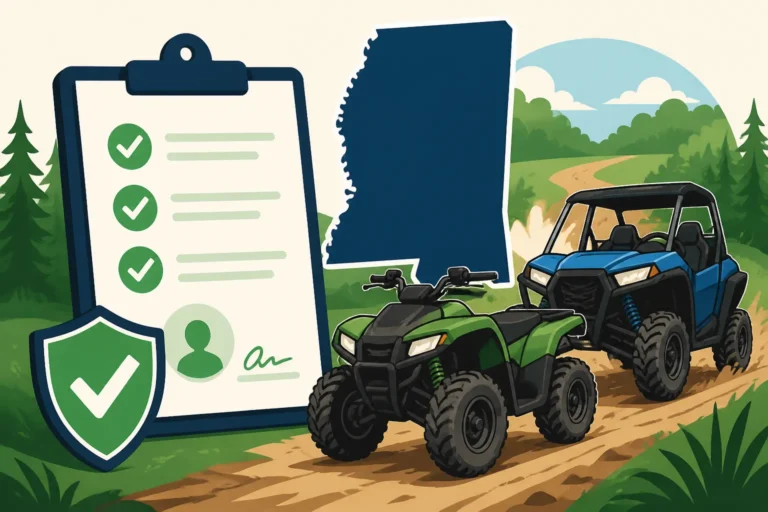
A permission form is a written record of an owner’s consent to use specified property for specified purposes. It can help both the landowner and riders remember what was agreed, especially when permission covers more than one person, multiple visits, or a large property with areas that are off limits.
A form is particularly useful when:
- A group plans to ride rather than a single guest.
- Permission applies only to certain dates, trails, fields, or access points.
- The property is managed by someone other than its owner.
- Riding is connected to hunting, work, or use of a camp.
- The landowner wants to set conditions about passengers, speed, noise, gates, or cleanup.
A signed form is not automatically required for every private-property ride, and a written document does not make otherwise prohibited riding legal. Its practical value is clarity: it can help show what the landowner agreed to and the boundaries of that agreement.
There may not be a single form that fits every property or situation. A short written agreement can be enough for a straightforward arrangement, while a larger group, recurring access, commercial activity, or organized event may call for advice from a qualified professional. If you are unsure whether the person offering access has authority to do so, confirm that before riding.
Written consent also has limits. It does not give permission to cross neighboring land, use a public road unlawfully, or ignore posted restrictions. It cannot substitute for a forest pass, park waiver, or other requirement that applies at a designated riding area. For a closer look at the basics of written consent, see Written Permission From a Southern Landowner.
What to Put in the Form
Aim for a form that is specific enough to prevent disputes without burying the important points in legal-sounding language. Both sides should be able to tell, at a glance, who has permission and what the permission covers.
| Form detail | What to record | Why it matters |
|---|---|---|
| Landowner or authorized manager | Name and contact information | Identifies who granted permission and who to contact |
| Rider or group | Names of riders, or a clearly described group | Avoids assuming permission extends to unlisted guests |
| Property | Address, parcel description, map, or marked boundaries | Helps riders find the correct land and stay within it |
| Dates and times | Start and end dates, or permitted days and hours | Makes clear whether access is one-time or ongoing |
| Machines | ATVs, UTVs, or other allowed off-road vehicles | Clarifies which types of machines are covered |
| Activities | Trail riding, access to a camp, farm work, or another purpose | Prevents one kind of access being mistaken for another |
| Conditions | Speed, passengers, gates, noise, alcohol, fire, or cleanup rules | Makes important restrictions visible |
| Signatures | Landowner or authorized representative and riders | Records that both sides saw and accepted the terms |
Identify the people and the property
Write the landowner’s name and the names of the riders who will use the property. If permission is for a family, club, or work crew, list the people where practical or explain clearly who is included. Avoid vague wording such as “friends may ride” if the owner expects to approve guests individually.
Describe the property so there is little room for confusion. A street address may help, but it may not identify the permitted boundaries on a large rural parcel. A simple map can show the entrance, allowed trails, restricted areas, parking, and any neighboring land that riders must not enter. Attach it to the form and make sure both sides refer to the same version.
Define the dates, machines, and purpose
State whether permission covers one visit, a season, or a recurring arrangement, and include any hours or days when riding is allowed. If the owner has agreed to ATV and UTV access but not dirt bikes or trucks, say so. Explain whether the permission covers recreational riding, reaching a hunting camp, farm work, or another specific use.
Do not treat a broad phrase such as “use of the property” as a substitute for discussing the activity. Riding across a field to reach a camp may not mean permission to explore every trail or operate a machine near livestock, crops, buildings, or equipment.
Make conditions easy to follow
Put the most important rules in plain language. For example, specify which gates may be opened and whether they must be closed afterward. Set out any no-ride areas, speed expectations, passenger limits, parking instructions, or requirements to stay on marked routes. If the owner does not allow alcohol, overnight stays, fires, or guests, include those restrictions.
Have everyone sign and keep a copy available. A paper copy in a document pouch can be useful where a phone battery, reception, or weather is an issue; some riders use an inexpensive pouch from Amazon. A digital copy can work too, as long as riders can access it and it remains readable. The brand is just one way to find a storage option, not a substitute for clear permission.
Confirm Who Can Grant Access and What It Covers
The person who owns the land may not be the only person involved in controlling access. A farm manager, tenant, hunting club, timber company, or leaseholder may have some authority, but the extent of that authority can depend on the arrangement. Do not assume that someone who uses the property can grant permission for ATV or UTV riding.
Ask the person offering access to confirm that they are authorized to allow the specific use you have in mind. If a hunting lease or other agreement controls the property, check whether it restricts motorized use or gives permission authority to someone else. The conditions in a lease may matter even when a landowner has previously allowed access. See What a Hunting Lease Says About ATV Use for more context.
It also helps to ask whether anyone else needs to approve the arrangement. A landowner may want other family members, a property manager, or a leaseholder to confirm access. For group rides, identify who is responsible for communicating the rules to participants and making sure everyone stays within the agreed area.
A permission form should describe both the allowed area and the boundaries riders must respect. That includes adjacent parcels, posted areas, closed gates, and any route that crosses someone else’s land. A landowner’s consent applies only within the authority they have and the property they control. For more on signs and boundaries, read What Posted Land Means for Mississippi Riders.
Before setting out, check that the permission is still current. A change in ownership, lease terms, dates, property conditions, or the owner’s wishes can affect whether access is still allowed. If anything is unclear, pause and ask rather than relying on an old text message or a previous season’s arrangement.
Keep Private Permission Separate From Public Rules
A private-land permission form is not a general riding permit. It does not authorize ATV or UTV use on a Mississippi public road, and it does not make a road crossing lawful by itself. It also does not replace rules set by a national forest, wildlife management area, state park, or private riding park.
Mississippi’s public-land rules can depend on the specific place and the type of route. A wildlife management area, for example, may restrict riding to designated roads and may close routes at certain times. A landowner’s permission cannot open a closed public route or override agency restrictions. Check Mississippi WMA Designated Roads Only if your plan involves a wildlife management area.
Likewise, a private field road is not automatically open to riders just because it looks like a route. Confirm whether it is on the property covered by the permission and whether the owner has authorized its use. For help thinking through that distinction, see Mississippi Rules for Riding a Field Road. And remember that a title establishes ownership paperwork; it does not grant access to land or roads. Why a Title Does Not Open Any Roads explains that difference.
If a ride involves public roads, a trail system, or an event, confirm the separate rules with the agency or property operator responsible for that place. Do not use a private permission form as proof that you have satisfied those requirements. A useful way to avoid confusion is to keep the documents separate: the landowner’s permission for private property, plus any pass, waiver, or other paperwork required for the public or managed area.
Before riding, make a quick check:
- Confirm the person granting permission is authorized to do so.
- Check the form’s dates, rider list, machine types, and boundaries.
- Review the owner’s rules with every rider in the group.
- Verify whether any part of the route leaves the private property.
- Check the applicable public-land, park, or road rules separately.
- Stop and ask if signs, gates, or changed conditions conflict with the written permission.
A clear form makes it easier to respect the landowner’s terms and avoid misunderstandings. The safest arrangement is one where both sides know exactly what access is allowed, when it applies, and what is off limits.
Disclaimer
This article is for general informational purposes only and does not constitute professional advice. Laws, prices and regulations vary by location and change over time. Consult a qualified professional for guidance on your specific situation.