Mississippi Timber Company Land Access
Timber company land can look like an open network of woods roads, but a visible trail or open gate does not necessarily mean you may ride there. In Mississippi, access depends on who controls the property and what permission they have granted. Here’s how to confirm access, understand restrictions, and avoid mistaking a riding permit for permission to enter private land.
Timber company land is not automatically open to riders
A timber company may own land, manage land for another owner, or hire contractors to work there. Hunting clubs and other leaseholders may also have specific access rights. The name on a gate or sign may not tell you who can authorize recreational riding, so confirm both who controls the property and who is allowed to grant permission.
A gravel road through timberland is not necessarily a public road. Nor does a track used by loggers, hunters, or utility crews automatically become a route for recreational ATVs and UTVs. Even if a route appears on a map or has tire tracks, that alone does not establish that you may ride it.
Mississippi does not have a general ATV permit that grants access to private timber company property. A permit, pass, registration, or safety credential for another place does not replace the land controller’s authorization. Likewise, permission to hunt or visit a property does not automatically include permission to operate an off-road vehicle.
Before riding, treat the land as private unless you have confirmed otherwise. These points are useful starting checks:
- Find out who owns or manages the parcel. The company whose name appears on a gate may be a manager rather than the landowner.
- Ask who can authorize recreational ATV or UTV use. A hunting club member, contractor, or neighboring landowner may not have that authority.
- Confirm the specific routes and boundaries you may use. Permission for one tract or road does not necessarily cover adjoining land.
- Ask whether access is allowed on the day you plan to ride. Timber work, weather, fire risk, hunting activity, or a temporary closure can change conditions.
- Keep a copy of the permission and any conditions with you.
For background on permission and land boundaries, see Written Permission From a Southern Landowner and What Posted Land Means for Mississippi Riders. Permission should be clear enough that you can explain who authorized your ride and where you are allowed to go.
How to request and confirm permission
Contact the timber company or land manager through an official channel, such as its public office or published contact information. If the property is managed by a hunting club, ask the company whether the club can authorize ATV access and whether the club’s permission covers the routes you want to use. Do not assume that a person who has a hunting lease can approve every kind of motorized use.
Make the request specific. “Can I ride on your land?” can leave important details unresolved. Explain what machine you plan to use, when you want to ride, how many people will be with you, and which roads or areas you hope to access. Ask about any restrictions on passengers, speed, hours, trail crossings, or travel during active logging.
Whenever possible, get the answer in writing. A text or email can help you remember the approved dates and routes, but follow the company’s required process if it uses a formal permit or written release. If approval is given by phone, record the contact’s name, role, date, and the exact limits described, then ask for written confirmation.
| What to confirm | Why it matters |
|---|---|
| Who is authorizing access | The person responding may not control the parcel or have authority to approve riding |
| Property and route boundaries | Permission on one tract may not extend to another tract or adjoining road |
| Dates and hours | Access can be limited or suspended for work, weather, hunting, or other reasons |
| Allowed machines and riders | Conditions may differ for an ATV, side-by-side, guests, or passengers |
| Closed roads and work areas | Timber operations and temporary hazards can make a route unsafe or off-limits |
| Required documents or conditions | The land manager may require a written permit, release, or proof of insurance |
Ask whether the authorization applies only to you or also to your guests. A friend cannot necessarily rely on permission issued to another rider. If you are organizing a group ride, list the riders and machines in the request and ask whether the group needs separate approval.
If permission is part of a hunting lease, read the document closely. A lease might authorize hunting access while limiting vehicle use to particular roads, times, or purposes. It may prohibit recreational riding altogether. See What a Hunting Lease Says About ATV Use and Mississippi Landowner Permission Forms for related questions to raise before you go.
An Amazon waterproof document pouch can be one way to keep a printed permit or permission note from getting soaked, but carrying the paper does not broaden the access it grants. Keep the original message or document available, and make sure its terms match the property and ride.
Gates, signs, logging roads, and changing conditions
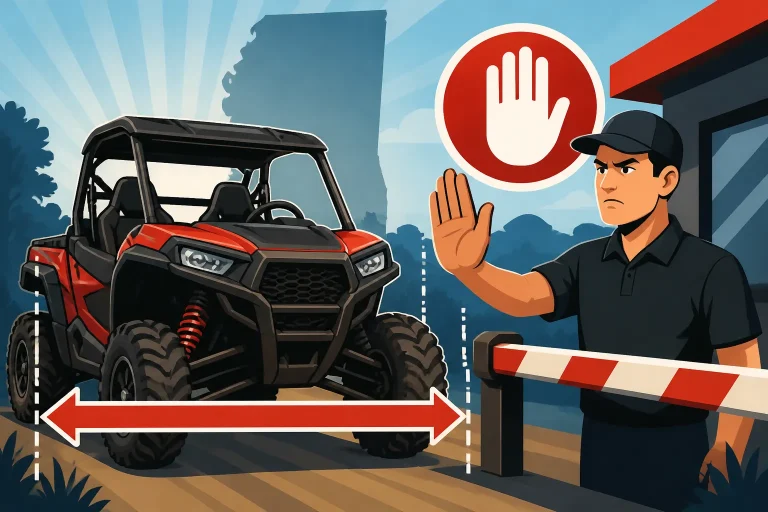
A gate is a boundary or control point, not an invitation to ride through. An open gate may have been left open for a work vehicle or may be used by someone who has separate authorization. A closed gate, posted sign, berm, or other barrier should be treated as a clear reason to stop and verify access. Never force a gate, bypass a barrier, or cut a lock.
Do not assume that a route remains open because you rode it previously. A company may close an area for harvesting, road repair, fire danger, hunting activity, or another operational reason. Permission can be limited or withdrawn under its terms. Check for updates before each ride, especially after storms or when logging activity is underway.
Timber roads can also be active work areas. Loaded log trucks may be heavy, have limited sightlines, and need room to turn or stop. A rider may be difficult to see through dust, vegetation, or terrain changes. If you encounter logging equipment, give it ample space, follow any directions from workers, and leave the area if the route is unsafe or closed. More on this risk: Sharing a Gravel Road With Loaded Log Trucks and Gates on a Southern Timber Road.
Stay on the roads and trails specifically approved for your ride. Do not turn onto a skid trail, fire lane, pipeline cut, utility corridor, or another track just because it looks passable. It may cross a different parcel, be reserved for work, or be closed to recreational vehicles. Keep away from newly planted areas, equipment, timber stacks, and active harvest sites. Avoid making ruts or damaging drainage features, even if the ground looks firm.
A simple field routine can prevent misunderstandings:
- Check the written permission and confirm the date, property, and approved routes.
- Read signs at the entrance and stop at any barrier or closure.
- Stay with the approved route and group; do not explore adjoining roads.
- Yield to workers and other authorized users, and leave if work or conditions make access unsafe.
- Close a gate only as instructed, and report a gate, sign, or road condition that appears damaged.
- Leave the property if permission is unclear or someone with apparent authority directs you to leave.
A map or phone location can help you stay oriented, but it is not proof that a route is open. Property lines and access boundaries may not match the roads shown on a map. If you are unsure whether you have crossed onto another tract, stop and contact the authorizing party rather than continuing to explore.
Permits, reciprocity, and what to carry
Riders sometimes confuse three different things: permission to enter land, permission to use a particular trail system, and credentials required by a specific riding area. They are not interchangeable. A pass for designated public-land trails does not grant entry to nearby private timberland. A permit from another state or riding facility does not authorize access to Mississippi timber company property. A title or bill of sale establishes a different kind of record; it does not grant land access.
If your route includes a public trail or other managed area, check that site’s rules separately. For example, Mississippi Hunting Land Access by Machine explains why access rules can depend on the particular land and purpose. On private company land, the company’s authorization and conditions are central. Do not rely on another rider’s permit or past experience as proof that your own route is approved.
Carry the documents the land manager requires. Depending on the arrangement, that may include written permission, a lease-related authorization, a release, or information about the riders and machines. Keep a phone number for the person or office that approved access. If a land manager, worker, or law enforcement officer questions your presence, stay calm, show the relevant documentation, and follow directions while the issue is clarified.
Insurance is a separate question from permission. A land manager may set its own conditions, and an ATV policy may limit coverage based on where or how the machine is used. Check your policy and ask the company what documentation it expects rather than assuming that a permit includes insurance or liability protection.
When permission cannot be verified, do not ride onto the property. Ask the company or manager for clarification, or choose an established riding area whose access rules are published. If you suspect a road is public, verify its status with the appropriate local authority rather than treating its appearance or use by other vehicles as proof. For broader trespass considerations, see Mississippi Trespass Law for Riders.
The safest rule is straightforward: get clear authorization for the specific property, machine, route, and date; follow every restriction; and turn back when access is uncertain. That approach protects the rider, respects the land manager’s operations, and avoids turning an ordinary trail ride into a property dispute.
Disclaimer
This article is for general informational purposes only and does not constitute professional advice. Laws, prices and regulations vary by location and change over time. Consult a qualified professional for guidance on your specific situation.