Mississippi WMA Riding on Designated Roads
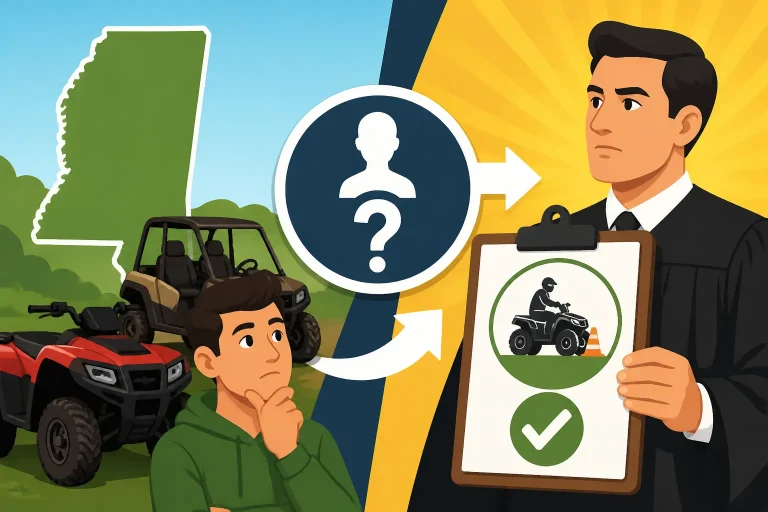
A Wildlife Management Area is not an open ATV trail system. In Mississippi, riding a quad or side-by-side on a WMA depends on whether that area allows motorized travel on the particular road, and whether it is open at the time you arrive. Check the area’s current rules before unloading; a gate, seasonal closure, or retrieval-only restriction can change what is permitted.
What “designated roads” means on a WMA
A designated road is a route the area’s rules identify as open to the type of motorized travel allowed there. It is not a general invitation to ride anywhere that looks like a road. A track through timber, a firebreak, a field road, or a route visible on a phone map does not automatically qualify.
The key question is not simply, “Is there a road?” It is, “Is this road designated and open for this machine, purpose, and date?” WMA-specific regulations and posted signs help answer that. If the area map, signboard, gate, or current notice indicates a closure, treat it as closed even if a tire track continues past it.
| What you see or hear | What it tells you | What to do |
|---|---|---|
| A road listed or marked as open for motorized use | That route may be available under the area’s rules | Check the permitted machine type, dates, and purpose |
| A closed gate, berm, or closure sign | Access is restricted at that point | Do not go around, under, or beyond the barrier |
| An unmarked track or old logging road | Its appearance alone does not establish permission | Confirm it on the current area map or with the managing office |
| A route allowed only for game retrieval | Permission is limited to the stated retrieval activity | Do not treat it as a general recreational trail |
| A road on a map but a closure notice at the entrance | The route may have been closed or conditions may have changed | Follow the current closure notice |
WMA access is managed area by area. A road that is open on one WMA may be closed on another, and the same route may have different restrictions during different seasons or management activities. Some areas may limit motorized travel to particular roads, dates, uses, or vehicle types. Others may not allow the ride you have in mind at all.
The distinction between riding on a designated road and riding off-road matters. Do not leave the authorized route to cut across a field, follow a creek, get around a muddy section, or reach a hunting spot unless the area’s rules expressly allow it. A road can be muddy or inconvenient without becoming permission to make a new route.
For a broader overview of the rules that apply to these areas, see Mississippi WMA Riding Rules and Mississippi WMA Designated Roads. Those rules do not replace the current regulations for the specific WMA you plan to visit.
Check the area rules before you load
Before making the drive, identify the exact WMA and check its current regulations, map, notices, and access conditions. Do not rely only on a map app, an old printed map, a social media post, or what is allowed at a neighboring area. Maps can help you plan, but the managing agency’s current information and signs determine whether a road is open.
Use this process:
- Confirm the WMA name and entrance. Some areas have multiple entrances or sections. Make sure you are checking information for the parcel you will actually enter.
- Look for the current area map and regulations. Find the roads specifically identified for motorized access, and check any notes about vehicle type, season, activity, or access method.
- Check for temporary closures. Weather, hunting activity, road conditions, habitat work, or other management needs can affect access. A route that was open on a previous visit may not be open now.
- Read the entrance signs. Signs at a gate or trailhead may show local restrictions that are not obvious from a general map.
- Call the managing office if anything is unclear. Ask whether your machine may use the road you plan to ride, whether access is open on your intended date, and whether a permit or other condition applies.
A road marked for a particular purpose should not be treated as open for every purpose. For example, permission to use a route for game retrieval is narrower than permission to ride for recreation. If the rules allow a trip only to retrieve harvested game, riding around the area for sightseeing or general trail use is not the same activity.
The same caution applies to road names and map symbols. A WMA map may show a road for orientation or management purposes without saying that ATVs or UTVs may use it. Look for the actual access rule, not just the line on the map. If the map legend, sign, and written regulation seem to conflict, ask the area office before riding.
Closures deserve particular attention. Do not move a barrier, ride around a gate, or assume a closed road is open because another vehicle has passed through. Mississippi WMA Road Closure Signs explains why a visible route can still be off-limits. A closed route may protect wildlife, prevent damage, or reflect an access restriction that applies even when the ground looks firm.
Permits, licenses, and rider requirements
A designated road is only one part of lawful access. Depending on the WMA, your activity, and your circumstances, additional rules may apply. Check whether you need an access permit, a hunting license, proof of eligibility, or another authorization. Do not assume that permission to enter an area for one activity automatically authorizes a different activity.
A hunting license and permission to ride are not interchangeable. A license may be relevant to hunting or other regulated activities, but it does not by itself open every WMA road to a machine. Conversely, a route that is open to motorized use does not automatically authorize hunting. Check the rules for both the activity and the road. [Mississippi Hunting License and Land Access] covers the distinction between a hunting license and access to land.
Also, do not confuse WMA access with an off-highway vehicle pass for another public land system. A pass for National Forest riding does not establish that a WMA road is open, and a WMA authorization should not be treated as a pass for a forest trail. The areas have separate managers and may have different rules, access procedures, and closures.
Age and safety requirements can matter, too. Review the applicable Mississippi rules for the rider’s age and the place where the machine will be operated. Depending on the situation, a young rider may need to meet a safety-certificate requirement, and helmet rules may apply. See [Mississippi Rules for Riders Under 16] and Mississippi Safety Certificates for Young Riders before bringing a child onto public land.
Carry the information you may need to show that you are using the area appropriately. That can include the relevant permit or license, a current map, and proof of ownership for the machine. Requirements vary, so confirm what applies to your visit rather than assuming that a title or registration document is a substitute for an area permit. For practical ownership-document guidance, see Mississippi Proof of Ownership on the Trail.
If you plan to carry a firearm, hunt, or retrieve game, check the rules for those activities separately. Restrictions may apply to loaded weapons, where a machine can travel, and how a harvested animal may be retrieved. A riding rule does not cancel a hunting rule, and a hunting rule does not expand the roads open to your machine. Review [Mississippi WMA Weapon Rules for Riders] and Mississippi WMA Game Retrieval Rules if either issue is part of your trip.
Ride only within the permission you have
Once you arrive, keep the machine on the road that the area has authorized. Stay within any marked boundaries and follow posted speed, equipment, and access conditions. Avoid widening a narrow route or creating ruts by repeatedly riding around a wet section. A route that is technically open can still be damaged by careless use, and surface conditions can change quickly after rain.
A practical pre-ride check helps avoid the common mistake of treating access as all-or-nothing:
- Confirm the machine is allowed. A rule that applies to one kind of ATV may not cover a wider UTV or side-by-side. Do not assume a machine fits an area’s limits simply because it is off-road.
- Confirm the purpose. Recreational riding, hunting access, and game retrieval may have different permissions.
- Confirm the route. Know which road is open and where the authorized route ends.
- Check gates and signs as you go. Conditions or closures may be posted at an entrance or junction.
- Stay out of restricted areas. Do not bypass a closed road or use a trail that is not listed as open.
- Keep a map available. Cell service may be unreliable, and a map can help you avoid turning onto an unmarked route.
- Leave the area as you found it. Pack out trash and avoid damaging roads, gates, signs, or habitat.
If you are unsure whether a road is designated, stop and verify before continuing. A route that appears to connect two open roads may cross a restricted section. If there is no clear confirmation, turn around rather than trying to infer permission from tire tracks or another rider’s choices.
A useful call to an area office is specific. Instead of asking only, “Can I ride there?” give the WMA name, the date, the type of machine, the road or entrance you intend to use, and whether you are riding for recreation, hunting access, or game retrieval. Ask whether any permit or age-related rule applies and whether the road is currently open. Keeping the answer and the current map with you can make the trip easier to manage, but posted closures still take priority.
The safest assumption is that access is limited to the roads and activities the WMA expressly allows. A machine’s title, an out-of-state permit, or a pass for another public land area does not make a closed WMA road open. Confirm the local rules, follow the signs, and turn around when permission is uncertain.
Disclaimer
This article is for general informational purposes only and does not constitute professional advice. Laws, prices and regulations vary by location and change over time. Consult a qualified professional for guidance on your specific situation.