Mississippi Safety Certificates for Young Riders
A young rider may be ready for the trail before the paperwork is clear. In Mississippi, a safety certificate can matter when a minor rides on public land, but it is not a universal pass to ride anywhere. This guide explains when the certificate comes into play, how to find a suitable course, what to carry, and which other rules still apply.
When a young rider needs a safety certificate
Mississippi’s public-land riding requirements make a safety certificate important for riders under 16. In situations where a valid driver’s license or an approved ATV safety certificate is required, a young rider will generally need the certificate rather than relying on a driver’s license. Check the rule for the particular trail, forest, or park before you go: a facility may have additional entry conditions beyond the general state requirement.
The key point is that age, riding location, and facility rules all matter. A certificate does not automatically qualify a child to operate every machine or enter every riding area. Nor does having a certificate make an otherwise prohibited ride legal. For the broader rules that apply to minors, see [Mississippi Rules for Riders Under 16].
| Situation | What to check |
|---|---|
| Riding on public land | Whether an approved safety certificate or another accepted credential is required |
| Riding at a public trail or park | The facility’s current age, supervision, helmet, and machine rules |
| Riding on private property | The landowner’s rules, permission, and any applicable state requirements |
| Crossing or riding on a public road | Road-use rules; a certificate does not authorize an ATV or UTV road ride |
| Riding a side-by-side | Whether the rider is old enough and permitted to operate that specific machine under the site’s rules |
Do not assume that a certificate requirement applies only to a particular style of riding. A family might think of a forest road as different from a trail, or a short trip across a public area as different from a full day out. The relevant question is whether the place and activity fall under rules that require proof of a license or safety training. Ask the land manager or park office if the answer is not clear.
Likewise, do not assume that private property is a loophole. A landowner may set strict conditions, and riding without permission can create a trespass problem. Public-land rules and private-land rules are not interchangeable. For help sorting out where a ride is allowed, see Mississippi ATV Trails: Where to Ride and What Posted Land Means for Mississippi Riders.
A certificate is not the same as permission to ride
A safety certificate shows that a rider completed an accepted course. It does not grant access to a trail, substitute for a required forest pass, or override a closure sign. If a riding area requires a pass or day-use ticket, the rider still needs to meet that separate condition. For example, the public-land credential and trail access requirements are separate questions; see The $60 Annual Pass for National Forest Trails and Mississippi State Park Waiver Requirements.
The certificate also does not make public-road riding legal. Mississippi’s road rules are a separate issue, and a training card does not convert an ATV or UTV into a street-legal vehicle. Before planning a route that touches a road, review Can You Ride an ATV on the Road in Mississippi? and confirm the applicable local rules.
A useful way to think about it is that the certificate addresses the rider’s training credential. It does not answer all the other questions: Is this land open to the machine? Is the machine within the site’s width limit? Does the rider meet the age requirement? Is a helmet required? Is an adult required to supervise? You need to satisfy each applicable rule, not just show one card.
How to find a course and confirm it counts
Mississippi safety-course information is associated with the state’s Extension Service and youth-oriented instruction. Course availability, registration details, and accepted proof can vary, so contact an Extension office or the relevant riding facility before signing up. Ask directly whether a course is accepted for the land where the child plans to ride. The state-related course options and approval questions are covered in Mississippi Safety Courses Through Extension and Which ATV Safety Courses the State Will Accept.
The word “certificate” can mean different things in casual conversation. A completion certificate from a general online class may not be the credential a particular public-land operator accepts. Before enrolling, verify these points:
- Who provides or recognizes the course? Ask whether the provider is accepted for the intended use in Mississippi.
- What age group is the course designed for? A course intended for one age range may not fit a younger child’s needs.
- What proof does the student receive? Confirm whether the rider receives a certificate, card, or other record, and how it can be replaced if lost.
- Does the riding area accept that proof? Ask the land manager or park office, not just the course provider.
- Are there other entry requirements? The site may separately require a driver’s license for older riders, supervision, a waiver, or equipment checks.
If the family plans to ride at several locations, make a short list of them before enrolling. Call each one and ask the same question: “Will you accept this specific certificate for a rider of this age?” That prevents a frustrating surprise at the gate. A course can be worthwhile for skills and judgment even when a site’s paperwork rules differ, but you should know what the certificate will and will not satisfy.
Keep proof accessible
Once the rider completes a course, keep the original certificate or card in a known place and make a legible copy. A phone photo can be a useful backup, but do not assume a digital image will be accepted in place of the original. Check with the riding area about what form of proof it wants.
For a family that rides often, a small waterproof document sleeve can help keep the card from being soaked, muddy, or misplaced. Amazon is one place families may look for a basic sleeve, but a simple sealed pouch works too. The important part is that the document stays readable and is easy to produce when staff ask to see it.
Store a backup copy with the family’s trip information rather than leaving the only copy in the machine. A card in a wet glove box or under a seat can disappear or become unreadable. If the certificate is lost, contact the course provider or issuing organization to ask how to obtain replacement proof before the next ride.
What the certificate does not replace
A certificate is only one part of a young rider’s preparation. Mississippi rules and individual riding areas may also address age, helmets, passengers, supervision, machine type, and operating conditions. A rider can have a valid certificate and still be turned away for not meeting a separate rule.
Age, supervision, and the machine
Do not assume that a young rider’s training card settles whether that child may operate a particular ATV or side-by-side. Some facilities set their own minimum ages, require an adult to accompany younger riders, or restrict which machines a child may use. A youth quad and a full-size UTV are not interchangeable simply because the rider has completed a course.
The adult responsible for the trip should check the site’s rules for the child’s exact age and the machine’s type. If the child will ride a side-by-side, check both the driver requirement and the passenger policy. Some locations restrict passengers to factory-designed seats, and a safety certificate does not make an improvised seat acceptable. See Mississippi Rules for a Side-by-Side Driver and Passengers Only on a Factory Two-Seat Machine for related issues.
Supervision also deserves a specific question. “An adult will be nearby” may not meet a facility’s definition of supervision. Ask whether the adult must be on the same machine, riding alongside, or within a specified area. Do not rely on what another family was told at a different park; conditions can differ by location.
Helmets and protective equipment
A course is not a substitute for protective gear. Mississippi has helmet rules for younger riders, and public parks or land managers may impose additional conditions. Confirm the rule for the specific location and make sure the helmet fits the child properly. Review Mississippi ATV Helmet Law Age and Mississippi Helmet Standards for Young Riders before riding.
A helmet that is too loose, sits at an angle, or has a damaged strap is not a safe fit. Have the rider try it on before the trip, fasten the chin strap, and check that it stays in place when the child moves their head. A parent should also inspect the helmet for cracks or damage after a fall or impact.
Other practical gear includes eye protection, gloves, long sleeves, sturdy pants, and boots that protect the feet and ankles. For young riders, clothing should fit closely enough that it will not snag on controls or moving parts. Amazon can be useful for comparing basic protective gear, but check sizing carefully and verify that any helmet meets the standard required by the riding location. A low price or attractive listing is not proof that equipment fits or qualifies.
Passes, waivers, and machine restrictions
A certificate does not replace an access pass, a signed waiver, or a required day-use ticket. Some sites may ask an adult to complete paperwork for a minor, so bring identification and allow time to handle the entry process. Ask in advance what the adult must sign and whether the child needs to be present at check-in.
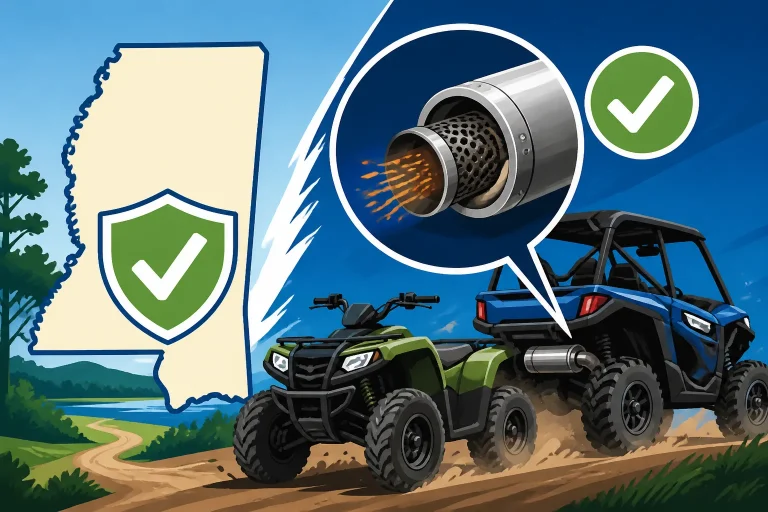
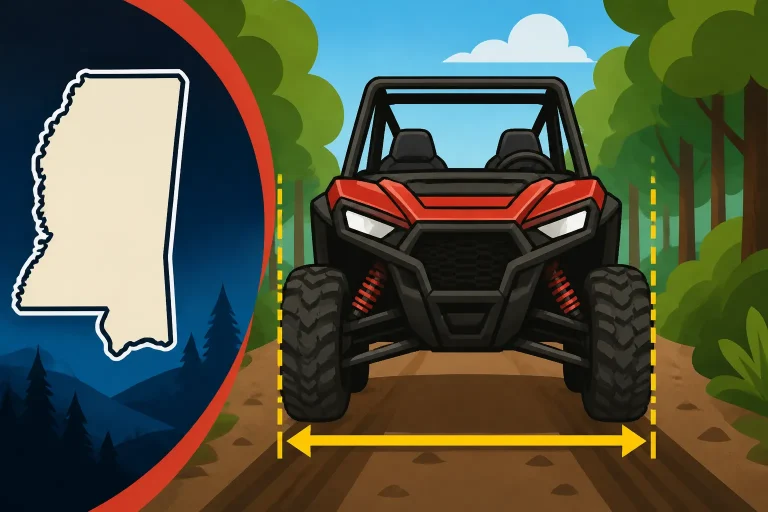
A site may also have machine restrictions. Width limits, sound limits, spark-arrestor requirements, and trail closures can apply regardless of the rider’s training. A child with a certificate cannot take a machine onto a route that excludes its size or type. For public-land details, see The 50-Inch Width Limit Written Into the Pass and [Mississippi Spark Arrestor Requirements].
Before leaving home, check the whole set of requirements rather than focusing only on the certificate. It is especially useful to confirm rules after heavy rain, during hunting seasons, or when a park has recently changed its access conditions. A phone call to the office can save a long drive and a turned-away child.
Planning a safe ride with a young rider
Training is most useful when adults reinforce it with sensible choices on the day of the ride. A child may remember the course material but still become tired, excited, or distracted on a busy trail. Set expectations before unloading, choose a route suitable for the rider’s experience, and be prepared to end the ride early.
Match the ride to the child
Start with terrain the child can handle, not the most challenging trail the machine can manage. A short, familiar route gives a new rider a chance to practice smooth throttle control, braking, turning, and stopping on command. Avoid treating a child’s first ride as a test of courage. Confidence develops through repetition, not pressure.
Explain a few clear rules before the engine starts:
- Stay where the adult can see or hear you.
- Stop when the adult signals.
- Leave space between machines.
- Do not pass another rider without permission.
- Slow down near blind corners, people, and other trail users.
- Never ride through a closed gate or around a closure marker.
- Tell an adult if the machine feels wrong or the rider feels tired.
Keep the group pace slow enough for the least experienced rider. If the adult rides far ahead, the child may speed up to catch up or take an unfamiliar turn. Ride in a way that lets the adult supervise without creating pressure to keep up.
Check the machine before the child rides
A quick pre-ride inspection is worthwhile, particularly for a youth machine that has been stored or used by several family members. Check tires, brakes, throttle return, controls, lights if needed, and visible leaks. Confirm that the child can reach the controls comfortably and can stop the machine reliably.
Review the machine’s owner information for age and size guidance. Do not assume that a smaller engine automatically makes a machine appropriate. Seat height, weight, braking, and the child’s ability to control the throttle matter as well. The rider should be able to operate controls without stretching or shifting into an unsafe position.
For a side-by-side, check seat belts and doors or restraints, and make sure every occupant uses the intended seat. A passenger should not ride on a cargo bed, lap, or improvised seat. The operator should understand how the machine handles before taking a child along, especially on uneven ground or slopes.
Carry what you need and have a stop plan
Bring water, basic first aid supplies, a charged phone, and the documents the facility requires. Cell service can be unreliable in wooded areas, so tell another adult where you are riding and when you expect to return. If a park publishes a trail map or closure notice, review it before the group sets out.
A practical checklist for a young rider includes:
- Accepted safety certificate or other required credential
- Required pass, ticket, and waiver paperwork
- Properly fitting helmet and protective clothing
- Water and a plan for rest breaks
- A suitable machine in working condition
- A route that fits the rider’s ability
- A meeting point in case the group becomes separated
Amazon may offer convenient options for a small first-aid kit, water bottle, or document pouch, but make sure the items are practical for the trip and stored securely. Avoid putting loose gear where it can interfere with controls or fall off the machine.
If the rider is becoming tired, overheated, upset, or overwhelmed, stop. Fatigue can make a child less able to judge distance and speed. A shorter ride that ends safely is better than pushing through one more loop because the group planned to stay out longer. For hot-weather preparation, see Mississippi Riding in Summer Heat and Hydration at a Southern Mud Park.
A simple before-you-go check
Use this sequence before taking a young rider out:
- Choose the riding location first. Confirm that the land is open to the machine and that the route is appropriate.
- Ask what credential is accepted. Verify whether the rider needs a safety certificate, a license, or another form of proof.
- Confirm age and supervision rules. Ask about the rider’s exact age and whether an adult must accompany them in a particular way.
- Check the machine rules. Confirm permitted machine types, size limits, passenger rules, and any equipment requirements.
- Complete separate entry steps. Arrange passes, tickets, and waivers as required.
- Pack and inspect. Bring the certificate and protective gear, then check the machine and the planned route.
- Set expectations with the child. Agree on signals, spacing, speed, and when to stop.
If a park employee, ranger, or land manager gives a rule that differs from what you expected, ask for clarification before riding. Avoid arguing at the trailhead or assuming that a certificate overrides the site’s conditions. If you are still unsure, choose another location until you can confirm the requirement.
A safety certificate is valuable because it gives a young rider a foundation in safe operation and may meet a public-land credential requirement. But it works best as one part of a broader plan: the rider must be allowed to operate that machine, the location must be open to it, and the family must follow the site’s access and safety rules. Check those pieces together, and the certificate becomes useful preparation rather than a document that creates false confidence.
Disclaimer
This article is for general informational purposes only and does not constitute professional advice. Laws, prices and regulations vary by location and change over time. Consult a qualified professional for guidance on your specific situation.