Mississippi Extension Office Course Schedules
Finding a Mississippi ATV safety course can take more than a quick search: classes may be offered locally and not on a uniform statewide schedule. The practical approach is to contact the Extension office serving your area, ask whether a course is currently planned, and confirm in advance that its certificate meets the requirement for the rider and riding location.
Why Mississippi Extension course schedules can vary
An Extension course schedule is not necessarily a single statewide calendar of recurring ATV classes. Local offices may share information about classes they host or coordinate, but availability can depend on local instructors, demand, and the time of year. A county office may have a class coming up, while another may not have a date to offer.
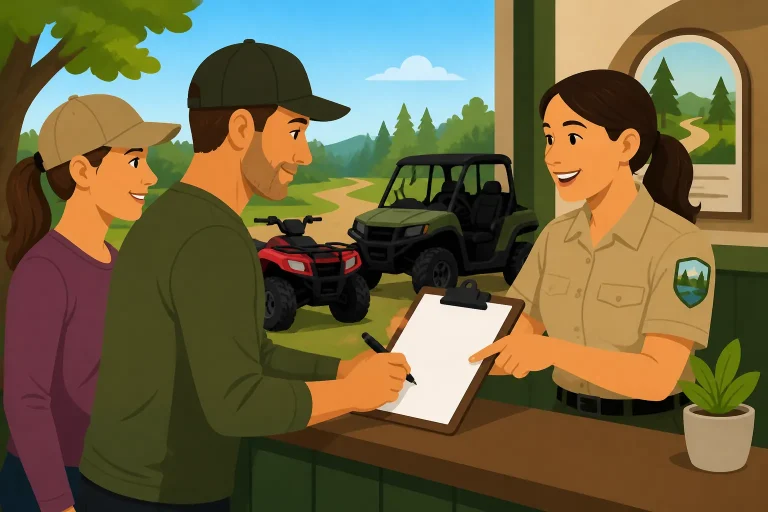
Start with the Mississippi State University Extension Service office for the county where you live or plan to attend. Check its local events information, then contact the office directly if you do not see an ATV safety course listed. A general events calendar can be useful, but it may not show every class or reflect the latest availability.
It also helps to distinguish a course schedule from a riding permit. A safety certificate is not automatically a trail pass, land-access permission, or authorization to ride on public roads. For example, a course may help a young rider meet a safety requirement, while a separate pass or site-specific permission may still be needed for a riding area. Review Mississippi Permit Questions Riders Ask and the rules for the land you intend to use before you travel.
When you ask about a class, be clear about the rider’s age and intended use. Requirements can differ according to the place and circumstances of riding. The guidance in Mississippi Riders Under 16 Need a Safety Certificate is a useful starting point, but verify the current rule for the specific public land or facility you plan to visit.
A local class listing may also use broad language such as “ATV safety” without explaining whether it provides a certificate accepted for your purpose. Treat the listing as an invitation to ask questions, not as final proof that the course will satisfy a particular agency’s requirement.
How to find and confirm a class
Use a short contact process rather than relying on an old listing or assuming that a course is offered on a fixed schedule.
- Identify the right county office. Look up the Extension office serving the county where you plan to take the class. If the online calendar has no listing, contact the office and ask whether it knows of any upcoming ATV safety courses nearby.
- Ask about current availability. Find out whether a class is scheduled, whether registration is open, and whether the office maintains a notice list for future offerings. Ask whether another county office or partner organization is coordinating classes if none are planned locally.
- Describe the rider and the need. Give the rider’s age and explain where the certificate is expected to be used. Say whether the goal is to meet a public-land requirement, a park rule, or another specific condition.
- Verify acceptance before enrolling. Ask the office what certificate the class provides and who recognizes it. If acceptance depends on a state agency or land manager, confirm with that authority as well. Information about Mississippi Courses Approved by Public Safety can help frame that question.
- Confirm practical details. Ask about eligibility, registration steps, the class location, what the rider needs to bring, whether a parent or guardian must attend, and how completion is recorded. Confirm any cost directly with the organizer, since details can change.
- Keep the completion record. Ask when and how the certificate will be issued. Save the document and any registration or completion confirmation where you can retrieve them before a ride.
The county Extension office is a useful first contact, but it may not be the final authority on whether a certificate qualifies for a specific requirement. If the office cannot answer that question, ask which agency or land manager can. The overview Which ATV Safety Courses the State Will Accept can help you identify what needs to be confirmed.
| Contact or source | What to ask | Why it matters |
|---|---|---|
| County Extension office | Is a class scheduled, and how do I register? | Local offices may know about local offerings even when a calendar has no listing. |
| Course organizer | Who teaches the class, and what proof of completion is provided? | A course listing does not always describe the certificate or record issued. |
| Relevant state agency | Does this particular course satisfy the requirement I need to meet? | Acceptance may depend on the intended use and the current rule. |
| Trail, park, or land manager | What documents must the rider carry at this location? | A safety certificate may not replace a site pass or other access requirement. |
If an office says it does not have a course scheduled, ask whether it expects to post future dates or can direct you to another local contact. That is more reliable than assuming a course is unavailable statewide because it is not listed in one county.
Do not rely only on a search result, social media post, or older calendar screenshot. Those can help you find a lead, but they may not show whether registration is still open or whether the class is still being held. Confirm the date and location with the organizer before making travel plans.
What to check before relying on a certificate
Course content, teaching arrangements, and certificate recognition are separate questions. A class may use established youth-safety materials, but that alone does not prove that every agency will accept its completion record for every purpose. If the listing mentions 4-H materials, ask whether the class provides a certificate and what organization issues it. A Course Taught With 4-H Materials offers useful context, but the receiving authority should confirm whether the credential meets its rule.
Ask for specific answers rather than relying on general assurances. For example:
- Is this course intended for the rider’s age group?
- Does the class issue a safety certificate or another kind of completion record?
- Who provides or signs the certificate?
- Which requirement is the course designed to satisfy?
- Will the riding location accept this certificate?
- Does the rider need to carry the certificate while riding, or is another form of proof accepted?
If the certificate is needed for a particular public riding area, check with that area’s manager before the class. A location can have rules beyond a general state requirement. Confirm whether riders need a permit, pass, signed waiver, or additional documents, too. See Mississippi Safety Course Certificates for related certificate questions and Mississippi Forest Rules for Riders Under 16 for a public-land example.
Parents and guardians should also ask who must attend and how the course handles minors. Do not assume that a young rider can register independently or that an adult’s attendance is optional. Those details are set by the course organizer, so confirm them when registering.
If an online course is suggested, ask the agency or land manager that will check the certificate whether that specific format is accepted. A course can be legitimate educational material without being the particular course required for a given setting. The same caution applies to a certificate earned outside Mississippi: check acceptance rather than assuming that it transfers automatically.
Plan ahead and keep the paperwork accessible
Once you find a suitable course, treat registration and certificate storage as part of ride preparation. Keep the organizer’s confirmation, the completion certificate, and any related instructions together. If the certificate arrives electronically, save a copy somewhere accessible and consider keeping a printed copy with the rider’s other documents.
Before leaving for a trail or park, review the location’s current rules. Confirm that the area is open to the machine, that the rider meets its age and supervision requirements, and that any separate access pass or waiver is handled. A completed course does not make an otherwise restricted road or trail legal to ride. For broader context, Mississippi National Forest Riding Explained covers why access rules depend on the specific riding area.
If a ranger, park employee, or other official asks for proof, having the certificate readily available can prevent confusion. Keep it in a secure place rather than loose where it could get wet or damaged. If the land manager accepts a digital copy, make sure it can be opened without relying on a weak cell connection.
When the course date is uncertain, call again before making a long trip. Ask whether the class is still scheduled and whether anything has changed about registration or location. If the office has no offering, ask which local contact handles safety courses or whether it recommends checking back later.
The essential point is simple: use the county Extension office to locate a possible class, but verify the course, certificate, and riding-location rules before relying on it. That small check can save a trip and help ensure the rider has the right documentation for the place they plan to ride.
Disclaimer
This article is for general informational purposes only and does not constitute professional advice. Laws, prices and regulations vary by location and change over time. Consult a qualified professional for guidance on your specific situation.