Which ATV Safety Courses the State Will Accept
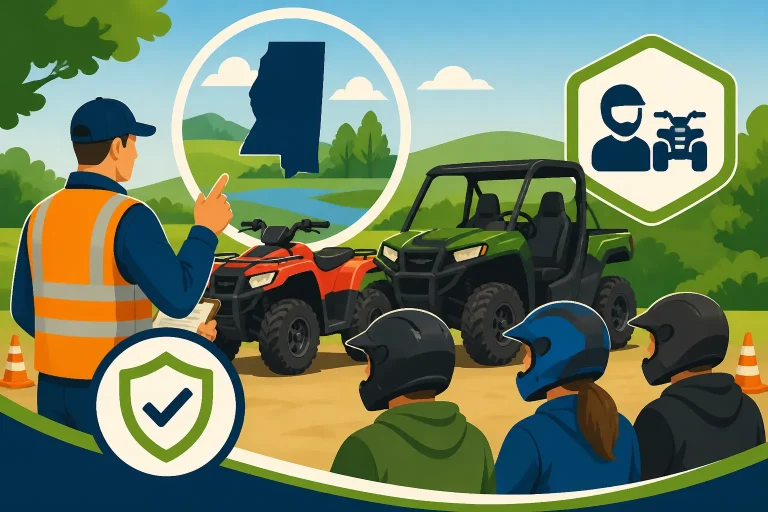
A safety card is useful only if the authority checking it accepts the course that issued it. In Mississippi, that can depend on where you plan to ride and which rule applies, so a generic ATV training certificate may not answer every question. Here’s how to verify a course before enrolling, what proof to keep, and how to avoid confusing a safety certificate with permission to ride.
The short answer: verify the course for the place you’ll ride
Mississippi riders should not assume that every ATV safety course or completion card is accepted for every purpose. The important questions are who requires the certificate, what kind of course that authority recognizes, and what proof it expects you to carry.
A course can be worthwhile training without automatically satisfying a particular land manager’s requirement. For example, a private instructor’s card, a national provider’s certificate, and a course offered through a local organization may all document training, but that does not make them interchangeable under every rule.
Start by identifying the place where the rider will operate the machine:
- A National Forest trail: Check the applicable forest and trail rules, including requirements for young riders. A course requirement for public-land access may be separate from state rules.
- A Wildlife Management Area: Check the area’s current riding and access rules. A safety certificate does not authorize travel on a closed road or outside designated routes.
- A state park: Ask the park what it requires for the rider’s age and what documents it will accept at the gate. Park rules may add requirements beyond a general state rule.
- Private property or a private riding park: The owner or operator may set its own age, training, helmet, and supervision rules.
- A public road: A safety certificate does not make an ATV or UTV legal to ride on a public road. Mississippi’s road rules are a separate issue; see Mississippi ATV Road Rules Under 63-31-3 and Mississippi Bans ATVs on Public Roads.
This distinction matters because “the state accepts this course” can mean several different things. A certificate might meet a requirement for a particular kind of public-land riding, satisfy a park’s check-in procedure, or simply show that the rider completed training. Those are not necessarily the same result.
For a young rider, ask the authority that controls the riding location before signing up. Give it the course provider’s name and the exact course title, and ask whether that credential meets the rule in question. If the provider offers more than one course format, ask about the specific format too. Keep the answer with your ride-planning notes.
What kinds of courses should you ask about?
A useful first step is to find out whether the authority wants a formal safety certificate, proof of a particular approved course, or something else. Do not rely on a course description that only says “ATV safety training” or “nationally recognized.” Those phrases may describe the course, but they do not establish that a specific Mississippi agency or riding area accepts its certificate for a specific requirement.
Mississippi State University Extension is one place riders may encounter ATV safety education. Before enrolling in an Extension course, or any other course, confirm what the class covers, what documentation it issues, and whether the relevant authority accepts that documentation for your planned use. The article Mississippi Safety Courses Through Extension covers the Extension option in more detail.
Use this comparison as a starting point, not as an official list of approved credentials:
| Course or proof type | What it may provide | What to verify before relying on it |
|---|---|---|
| Course offered through Mississippi State University Extension | Safety instruction and course documentation, depending on the offering | Whether the specific class and certificate meet the requirement at your riding location |
| Course from a national ATV training provider | Training and a provider-issued completion record | Whether the agency or property manager accepts that provider’s course and the particular course format |
| Training offered by a riding park, club, dealer, or instructor | Local instruction or an attendance record | Whether it is only the operator’s own requirement or also satisfies the rule you are checking |
| Online course | Convenient instruction and a completion record | Whether online-only training is accepted, or whether the requirement calls for another format or practical component |
| Parent’s statement or informal lesson | Familiarity with the machine and riding area | Whether the rule requires a certificate; informal instruction usually is not a substitute for required documentation |
The table deliberately does not label any course “accepted everywhere.” Acceptance can depend on the rider, the location, the rule being applied, and the actual document issued. A course provider may accurately describe its training as recognized or comprehensive without being able to promise that every land manager will treat its certificate as sufficient.
Ask about the certificate, not just the course
When you contact a provider, ask what the student receives after completing the class. Is it a certificate, wallet card, digital record, or simple attendance confirmation? Does it show the rider’s name, course title, date, provider, and any certificate or student number? Can the provider replace the document if it is lost?
Then give those details to the agency or site manager. “Will you accept an ATV safety course?” is a broad question. A more useful question is: “Will you accept the certificate issued for this specific course, for a rider of this age, at this location?”
If you are choosing among courses, compare the curriculum and training format as well as acceptance. A course with hands-on instruction may offer practical value even where an online course would satisfy a paperwork requirement. Conversely, a long trip for a class does not make sense if the site only needs a different kind of documentation. Confirm the requirement first, then choose training that fits the rider and the setting.
How to confirm that a specific course qualifies
The most reliable approach is to identify the rule before selecting a class. Do not begin with a certificate you already have and assume it will be accepted everywhere. Work from the riding location and the rider’s circumstances toward the course.
- Identify who controls access. Write down the exact forest, management area, park, or private property. If the ride includes more than one place, check each one separately.
- Describe the rider. Note the rider’s age, whether the rider will operate alone or under supervision, and whether the machine is an ATV or a side-by-side. Requirements can differ by location and rider category.
- Ask which rule calls for a certificate. Find out whether the requirement comes from state law, a land-management agency, a park policy, or a private operator. Ask what the rule requires, rather than relying on a secondhand summary.
- Name the exact course. Provide the course title, provider, delivery format, and the type of proof the student receives. If the provider’s website lists several classes, be specific.
- Ask for the accepted document and any conditions. Confirm whether the certificate must be carried, shown at check-in, or kept with another record. Ask whether there are age limits, supervision conditions, or renewal requirements.
- Save the answer. Keep an email or note with the office’s name, the date of the conversation, and the guidance it gave. This is helpful if a different employee checks the rider later.
- Carry the documentation the site requests. Keep a readable paper or digital copy, as appropriate, and make sure the name on it matches the rider’s identification or other records if the site requires that.
For a course offered by Mississippi State University Extension, ask the Extension office what the class covers and what proof of completion it issues. Then confirm with the land manager or park that the proof meets the specific requirement. The provider can explain its own course; the authority responsible for access is the one to ask about acceptance at that location.
For a course offered by a national organization or private provider, use the same process. A recognized provider’s reputation can be reassuring about instruction quality, but it does not replace confirmation from the authority enforcing a particular rule. If a provider claims a course is “state approved,” ask which Mississippi rule or agency approval that refers to, and whether the claim applies to the exact course format you plan to take.
If you cannot reach the relevant office before registering, consider waiting rather than paying for a course that may not meet the requirement. If that is not practical, keep the provider’s course description and completion records, and contact the agency as soon as you can. Avoid treating a payment receipt or registration email as proof of completion.
A safety certificate does not replace other riding rules
A safety course can build skills and may satisfy a specific certificate requirement, but it does not replace other rules that apply to the rider, machine, or location. It is not a general permit for public land, a road-use authorization, a substitute for a driver’s license where one is required, or proof that a trail is open.
For example, a rider can have a valid course card and still be barred from a road, trail, or management-area route. A land manager can limit which roads are open, set age or supervision rules, or require other documents. Private parks can have their own operating requirements as well. Check each rule separately instead of assuming one certificate covers them all.
Young riders may face additional conditions
Parents and guardians should confirm requirements for the child’s age before each type of ride. A safety certificate may be one part of the rules, but the rider may also need supervision, a properly sized machine, a helmet, or other protective equipment. Requirements can vary between public land, a state park, and private property.
For information focused on young riders, see Mississippi Safety Certificates for Young Riders, [Mississippi Rules for Riders Under 16], and Do Mississippi Kids Need a Permit?. These topics address different parts of the question; do not treat a course card as a universal replacement for the other requirements.
Before going to a forest trail, check the relevant forest rules for the rider’s age and the particular route. For a park visit, call the park or check its current instructions. Some sites ask to see documents at an office or gate, and a parent may need to stay with the child. A course certificate does not establish that the child meets every age, supervision, or equipment rule.
Public-land access and course completion are separate questions
A safety course may help prepare a rider for public-land use, but access rules still control where and how the machine can be operated. On a National Forest trail, for instance, check trail designations, machine width limits, permits, and any age-related requirements separately. Mississippi Forest Rules for Riders Under 16 and You Need a Driver’s License on Bethel Trails discuss requirements that should not be confused with course acceptance.
Likewise, a Wildlife Management Area may allow machine use only on designated roads or under specific conditions. A safety card cannot turn a closed route into an open one. It also does not grant permission to ride on private land. If you are planning a hunting trip, review the area’s machine-access rules before setting out.
A certificate does not authorize public-road riding
Course completion is not road registration, a license plate, or permission to ride on a public street. Mississippi’s rules for ATV and UTV use on public roads are separate from safety-course requirements. For a broader explanation of the road issue, see Can You Ride an ATV on the Road in Mississippi? and Mississippi’s Thin Off-Road Vehicle Chapter.
That distinction is important when a route includes a short road connection between trails, a road crossing, or travel from a parking area. Do not assume that training, a helmet, lights, or a safety card makes the ride legal. Check the specific road and location rules before using the machine there.
What to carry and how to handle a disputed certificate
Once the course and requirement are confirmed, make the documentation easy to show. Riders can be turned around or delayed if they have completed the training but cannot produce the proof the site asks for.
Keep the following information together:
- The rider’s certificate or course completion record.
- The course title and provider’s contact information.
- Any written confirmation from the agency or property manager.
- Any other documents the site separately requires, such as identification or a permit.
- A backup copy stored somewhere that is accessible without relying on a single phone or email account.
Do not alter a certificate or present another person’s card as the rider’s own. If a name is misspelled or the document is missing a detail, contact the course provider and ask it to correct or reissue the record. If the rider’s name has changed, ask both the provider and the site manager what documentation they need to match the records.
If a staff member says a certificate is not accepted, stay calm and ask which requirement is not met. It could be the wrong course, a missing completion detail, the rider’s age, a location-specific condition, or a rule unrelated to the certificate. Ask whether the site can point you to the responsible agency or the written rule. A certificate that another park accepted may not settle the issue at a different site.
If there is disagreement between a course provider and a land manager, the land manager’s access decision controls whether the rider can use that property at that time. Ask the provider to clarify any statement that its course is approved, and ask the property manager to explain what credential it accepts. Keep the responses for future visits, but recheck if the rules or course offering change.
Course completion is still worthwhile even when it is not required. Training can help riders understand controls, braking, terrain, protective equipment, and how to respond to common hazards. For a young rider, instruction should be matched to the machine and followed by age-appropriate supervision. A certificate is evidence of training, not evidence that the rider has mastered every trail condition.
Before purchasing any training, use this quick checklist:
- Do I know exactly where the rider will operate the machine?
- Have I asked the authority that controls that location?
- Did I give it the exact course title and provider?
- Did I confirm whether the course format is acceptable?
- Do I know what document the student receives?
- Have I checked age, supervision, helmet, permit, and route rules separately?
- Can I show the certificate when the site asks for it?
If you can answer those questions, you are much less likely to pay for a course that does not meet the requirement you had in mind. For the bigger picture on permits and site rules, see Mississippi Permit Questions Riders Ask.
Frequently Asked Questions
Does Mississippi accept every ATV safety course?
Do not assume so. Acceptance can depend on the specific rule and riding location. Confirm the exact course and certificate with the authority responsible for that location before relying on it.
Is an online ATV safety course enough?
It may be useful training, but whether an online certificate meets a particular requirement must be confirmed. Ask the agency or site manager whether it accepts that provider and course format.
Does an ATV safety certificate let a child ride without an adult?
Not automatically. Supervision and age requirements are separate from course completion and can vary by location. Check the rules for the specific property or trail.
Can a safety course make an ATV legal on a Mississippi road?
No. Course completion does not grant road-use permission. Check Mississippi road rules separately before riding on or across a public road.
Disclaimer
This article is for general informational purposes only and does not constitute professional advice. Laws, prices and regulations vary by location and change over time. Consult a qualified professional for guidance on your specific situation.