When a Mud Park Can Send You Home
A day at a Mississippi mud park can end early if a rider ignores a posted rule, rides unsafely, or creates a problem for other guests. Knowing what can lead to removal—and what to do if staff raises a concern—helps you avoid a preventable turn-away and plan your ride with fewer surprises.
Why a Mississippi mud park can remove a rider
A private riding park can set conditions for entering and staying on its property. Those conditions may appear on the park’s website, at the gate, in a waiver, or on signs around the property. Buying admission or signing a waiver does not mean you can disregard the rules; staff may enforce them by stopping a ride or asking a guest to leave.
The exact rules differ from park to park. A place that allows deep mud riding may still prohibit alcohol while operating, require helmets, limit passenger ages, or close certain areas. Do not assume that a rule at one park applies at another. Check the park’s current requirements before you load your machine, and read any posted instructions when you arrive.
A signed waiver generally documents that a participant understands certain risks and agrees to the park’s conditions. It should not be treated as permission to ignore safety requirements or conduct rules. For a closer look at the documents and conditions a park may use, see Mississippi Private Park Waivers and Rules.
Common reasons a park may ask someone to stop riding or leave include:
- Operating an ATV or UTV in a closed area, outside designated trails, or through a gate marked as off-limits.
- Riding recklessly, racing where it is not allowed, or putting other visitors at risk.
- Carrying more passengers than the machine is designed or approved to carry.
- Failing to follow an age, helmet, or supervision rule.
- Riding while impaired or behaving in a way that threatens other guests.
- Bringing a prohibited item or animal onto the property.
- Repeatedly ignoring staff instructions or posted quiet hours.
- Damaging park property or refusing to follow a rule tied to admission.
Removal is not necessarily the same as a police citation. A park’s staff may enforce its own property rules even when a particular action is not a separate criminal offense. Conversely, a park’s rules do not authorize a rider to break state law. The park can decide who may stay on its land, while public laws and other property restrictions still apply.
| Situation | Why staff may intervene | What to check before riding |
|---|---|---|
| Unsafe or reckless operation | A rider may endanger other guests, staff, or property | Speed limits, trail direction, passing rules, and closed areas |
| Helmet or age issue | The park may set safety requirements beyond a rider’s expectations | The park’s current helmet, age, and supervision rules |
| Too many passengers | A machine may not be designed for the number of people aboard | The manufacturer’s seating capacity and park passenger policy |
| Alcohol or impairment | Operating a machine while impaired can create serious safety risks | The park’s alcohol policy and who may operate a machine |
| Noise or late-night activity | Other guests may be affected by excessive noise or failure to observe quiet hours | Posted quiet hours and campground rules |
| Animal or pet issue | Animals may be restricted or subject to control requirements | The park’s pet policy and any leash or access limits |
The practical point is simple: a mud park’s admission rules are part of the day’s riding conditions. If a rule is unclear, ask before unloading or starting the machine rather than waiting for a disagreement on the trail.
Safety, passenger, and conduct rules that can end a visit
Riding in a closed or restricted area
Mud parks often have a mix of trails, pits, water crossings, staging areas, and places that are temporarily off-limits. A route can be closed because of maintenance, weather, an event, or a safety concern. A rider who crosses a barrier or ignores a closure sign may be stopped even if the route was open on a previous visit.
Pay attention to staff directions as well as signs. If a route looks passable but is marked closed, do not assume the sign is optional. Conditions can change quickly, and staff may be managing hazards that are not obvious from the entrance. If you are unsure where your machine is allowed, check with the gate or park office.
Unsafe operation and machine capacity
A park may take action when a rider’s speed, passing, or handling creates a risk. Mud, standing water, ruts, and blind corners can make it harder to see or stop. Riding in a way that throws mud at other guests, cuts across a busy staging area, or ignores traffic flow can also draw staff attention.
Passenger capacity matters, too. A UTV with factory seating for multiple people is different from a single-seat ATV with someone riding on a rack or fender. A park’s passenger rules may be stricter than a rider expects, and a machine’s actual seating design matters more than whether a passenger can physically hold on. Check the park’s requirements and the manufacturer’s guidance before carrying anyone.
For location-specific concerns about the rules private parks may set for children and younger guests, review Mississippi Private Park Age Minimums. If the question is whether a passenger is permitted on a particular machine, do not rely on another rider’s setup as proof that it is allowed.
Helmets and other protective gear
A park may require helmets even when a visitor believes state rules do not apply to the situation. Staff may also set gear expectations for particular trails, events, or age groups. Confirm the park’s requirements before arrival, and do not wait until the gate to find out that a rider lacks required equipment.
The park’s rule may apply to everyone or only to certain riders, machines, or areas. Check its current policy rather than assuming that an adult rider is exempt. [Mississippi Private Park Helmet Rules] offers more context on the kinds of requirements to verify.
Alcohol, arguments, and failure to follow directions
A rider who appears impaired, is operating unsafely, or is creating a conflict with staff or other guests may be told to stop riding or leave. A park can also enforce a no-alcohol rule or restrict alcohol to particular areas. Having a passenger or friend operate the machine does not make it safe to keep riding if staff has raised a safety concern.
If staff gives an instruction, pause and ask a calm, specific question if you need clarification. Arguing in a busy staging area or continuing to ride after being told to stop can turn a manageable misunderstanding into a reason for removal. If you disagree with a decision, discuss it away from active trails and without blocking other guests.
What to do if staff tells you to leave
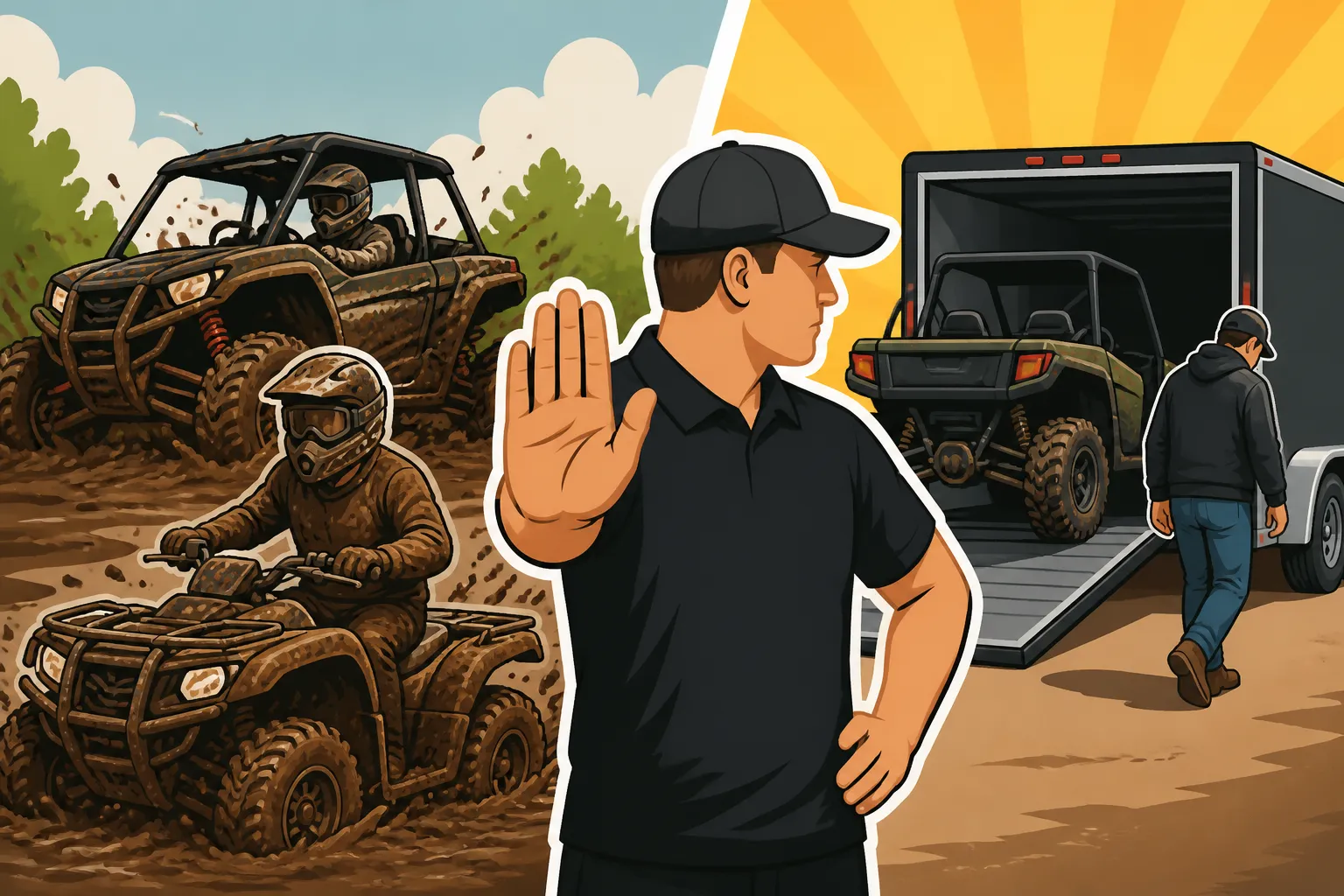
First, stop riding and move the machine to the area staff directs you to use. Do not ride off to another trail, continue through a closed section, or try to settle the disagreement while operating. If a staff member identifies a specific rule, ask where it is posted or how it applies to your situation. Keep the conversation respectful and brief.
Then take these steps:
- Clarify the decision. Ask whether the issue is a warning, a temporary stop, or a requirement to leave the property. Make sure you understand what you are being asked to do.
- Ask what rule applies. Request the relevant sign, written policy, or admission condition. A clear explanation can help identify whether you misunderstood a rule or whether staff has mistaken your machine or conduct for a violation.
- Do not escalate. Avoid threats, insults, or refusing a direct request to leave. If you believe the decision is unfair, record your concern after you are safely off the riding area.
- Secure the machine and passengers. Follow the park’s directions for returning to the staging area or loading zone. Do not let children or passengers wander into active riding areas while the issue is being discussed.
- Keep useful records. Save your admission receipt and any written messages, and note the date, location, staff explanation, and names of witnesses if available. Do not record people in a way that violates park rules or creates another confrontation.
- Ask about admission or camping arrangements. If you paid for time or services you will not use, ask staff whether any refund, credit, or other remedy is available. Do not assume that payment guarantees a refund after removal; the park’s policy and the circumstances matter.
A request to leave a private park does not automatically mean a person is being cited by law enforcement. But refusing to leave can create a more serious problem. If staff says the visit is over, prioritize leaving safely. A later conversation with park management is usually more productive than a dispute at the gate.
If there is an immediate safety issue or someone is injured, focus on getting help. Follow the park’s emergency instructions and share accurate information with staff. Do not conceal a collision or damage simply because you are worried about losing admission. Reporting rules and park procedures may apply, and prompt communication can help staff respond.
Refund questions are separate from whether a park can enforce its rules. Review the admission terms and ask for the park’s policy in writing if the answer is unclear. Avoid assuming that a waiver or receipt resolves every dispute; those documents may address different issues.
How to avoid a preventable turn-away
Most avoidable problems start before the machine reaches the trail. Check the park’s current rules, especially if you are visiting for the first time, bringing children, traveling with a group, or using a machine that differs from what the park commonly allows. Requirements can include age limits, passenger restrictions, helmets, pets, quiet hours, camping conditions, or proof of insurance.
A quick pre-trip check can prevent a wasted drive:
- Confirm that the park is open and that your machine type is allowed.
- Ask whether trails or riding areas are closed or limited.
- Review helmet and age requirements for every rider.
- Check whether passengers are allowed and whether each machine has approved seating.
- Read the park’s alcohol, pet, and quiet-hours policies.
- Ask what documents, waivers, or insurance proof may be required at the gate.
- Make sure all riders understand speed, trail, and staging-area rules.
- Bring the protective equipment the park requires, even if you expect to ride only briefly.
- Agree on a group plan for keeping riders together and responding to staff instructions.
Policies that seem minor can still affect your visit. For example, a park may have a pet restriction even if an animal stays near the campsite, or quiet hours may apply to generators and vehicle noise as well as music. See Mississippi Private Park Pet Rules, Mississippi Private Park Quiet Hours, and Mississippi Private Park Camping Rules when those details matter to your plans.
If you are uncertain whether a park’s policy applies to your situation, contact the park before leaving home. Describe the machine, the riders, and the planned activity clearly. For example, ask whether a two-seat UTV may carry a child passenger, whether a particular safety item is required, or whether a pet may be kept at a campsite. A direct answer is more useful than relying on a general social media comment or another visitor’s experience.
At the gate, listen to the safety briefing and keep the rules in mind throughout the day. Conditions can change, and staff may close an area after you have arrived. Treat signs and instructions as current unless staff tells you otherwise. If you are asked to stop, stop first and resolve the question safely.
Disclaimer
This article is for general informational purposes only and does not constitute professional advice. Laws, prices and regulations vary by location and change over time. Consult a qualified professional for guidance on your specific situation.