Does a Mississippi Forest Pass Work in Alabama?
A Mississippi Forest Pass is not a statewide ATV registration or a multistate permit. If you are planning to ride in Alabama, the key question is whether the specific trail system accepts that pass. In general, it does not: the pass is for eligible Mississippi National Forest trails, while Alabama riding areas set their own access and permit rules.
Does a Mississippi Forest Pass Work in Alabama?
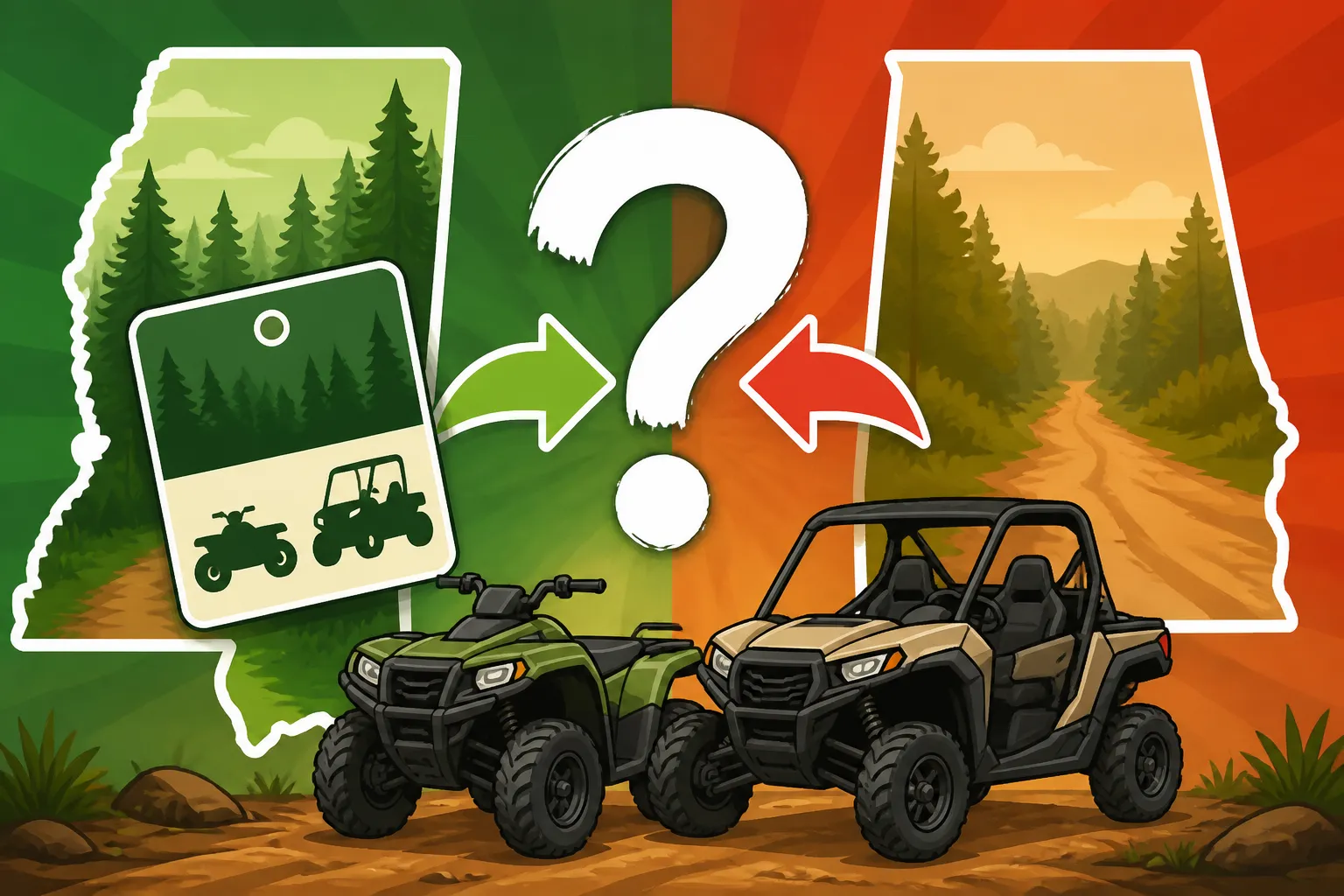
No. A Mississippi Forest Pass does not grant riding access in Alabama. It applies to eligible trail riding in Mississippi, not to trails or off-highway vehicle areas managed across the state line.
That distinction matters because a forest pass is an access permit, not a registration sticker that follows your ATV or UTV everywhere. Paying for access to one trail system does not automatically pay the fee or meet the permit requirements at another. Even if both riding areas are on public land, they may have different managing offices, trail rules, passes, and closures.
Mississippi’s pass is intended for the eligible National Forest trails covered by the state’s pass program. Check Mississippi Forest Pass Coverage and Which Trails the $60 Forest Pass Opens before relying on it for a particular Mississippi ride. Neither coverage nor payment transfers to Alabama.
| What you have or want to do | What to expect |
|---|---|
| Use a Mississippi Forest Pass in Mississippi | It may cover eligible Mississippi National Forest trail access, subject to the pass rules and trail status. |
| Use the Mississippi pass in Alabama | It does not provide Alabama trail access. Check the Alabama destination for its own requirements. |
| Bring an Alabama machine to Mississippi | Mississippi does not require an out-of-state OHV registration sticker as a general statewide reciprocity document, but the trail or park can still have its own rules. |
| Ride at a private park in either state | Follow that park’s admission, waiver, age, equipment, and operating rules. |
A pass also does not make an otherwise closed route legal to ride. Trail access can depend on the specific route being open, the machine meeting any width or equipment limits, and the rider following posted instructions. A pass is one part of planning, not permission to ride anywhere in a forest.
For more on the limited role of the Mississippi pass system, see Mississippi Has No OHV Registration to Reciprocate. The important takeaway is simple: do not assume a permit from one state will be recognized by another state’s trail managers.
What the Mississippi Pass Covers—and What It Does Not
The Mississippi Forest Pass is tied to eligible trail use in Mississippi, not to the machine’s home address or the rider’s state of residence. If you bought the pass for a Mississippi ride, its value depends on whether your destination is among the areas it covers and whether that area is open to your machine.
The pass does not function as:
- A universal permit for every public or private riding area in Mississippi
- An Alabama trail pass
- A title, registration, or proof of ownership
- Permission to ride on roads, closed forest routes, or land where you lack access
- A replacement for a park’s waiver, day-use ticket, or separate admission requirement
If the machine is registered in another state—or has no state OHV registration sticker—that alone does not answer whether it can use a particular trail. Mississippi does not have an OHV registration system that would automatically create a pass to exchange with Alabama. Likewise, the Mississippi pass should not be treated as a sticker Alabama must honor. No Sticker to Honor From Another State explains the basic reciprocity issue.
The reverse situation is similar. A rider visiting Mississippi from Alabama should not assume that an Alabama permit, registration, or local access document substitutes for a Mississippi Forest Pass where one is required. For trip-specific details, see Mississippi Rules for a Visiting Alabama Rider.
Pass, registration, title, and admission are different things
These terms are easy to mix up, but they solve different problems:
- A pass or permit may authorize access to a particular trail system or riding area.
- Registration is a government record or credential for a vehicle, where required.
- A title establishes ownership under the applicable titling rules.
- Admission or a day-use ticket is permission to enter a specific park or facility, often under that operator’s own conditions.
One document rarely does all four jobs. A Mississippi Forest Pass does not prove ownership, make a machine street legal, or provide entry to an Alabama park. For Mississippi public-land access and permits, start with Mississippi National Forest OHV Passes. If you are unsure which Mississippi trails are included, ask the relevant forest office before loading up.
The pass also does not override local restrictions. A trail may have a width limit, age rule, helmet requirement, or temporary closure. A machine that fits the pass program’s general purpose may still be barred from a particular route. Confirm the current rules for your planned trail rather than treating the pass as an all-access credential.
How to Plan an Alabama Ride
Alabama is not a single riding area with one permit that can be assumed to cover every destination. Public trails, parks, private riding areas, and managed lands can have separate entry procedures. Before leaving Mississippi, identify the exact place you plan to ride and ask its operator or managing office what an out-of-state rider must bring.
Use this process:
- Choose the destination first. Get the official name and address of the trail system or park. A nearby forest or recreation area may not allow ATV or UTV trail riding at all.
- Ask who manages access. Find out whether the site is operated by a public agency, a private park, or another land manager. The answer determines whose pass and rules apply.
- Ask whether a permit is required. Do not ask only whether “an ATV sticker” is accepted. Be specific: does the destination require a day pass, annual permit, registration, proof of ownership, or some combination?
- Check machine limits. Confirm whether the trail accepts your machine’s width, type, and passenger setup. A UTV may be subject to different limits than a quad.
- Confirm rider requirements. Ask about age limits, helmets, licenses or safety certificates, supervision, waivers, and passenger rules.
- Check current operating conditions. Rain, maintenance, hunting activity, or other temporary restrictions can affect access even when you have the right permit.
- Save the answer and carry required documents. Keep confirmation details, passes, receipts, waivers, and any requested ownership or identity documents accessible during the trip.
Avoid relying on a social media post or an old trip report for current access rules. A rider may describe a different trail, a past permit system, or a private property arrangement that does not apply to your destination. If the website is unclear, call the managing office and ask directly whether the Mississippi pass is accepted. The expected answer is no, but asking about the destination’s own permit prevents confusion over what you need to buy or show.
Also ask whether the pass is attached to the rider, the machine, or the vehicle used to transport it. A site may have specific rules about transfer, display, or proof of payment. Do not assume an annual pass can be moved between machines or shared by a group unless the issuing office confirms that.
For Mississippi trips, the same habit is useful: verify which trail system the pass covers and whether the route is currently open. Checking Trail Conditions Before You Load the Trailer and Mississippi Trail Phone Numbers Worth Saving can help you make those checks before a long drive.
Crossing the State Line Does Not Change Road Rules
A forest or trail pass is about access to a particular riding area. It does not grant permission to ride an ATV or UTV on public roads in either state. Do not treat a pass, title, or out-of-state registration document as road-use authorization.
When a route requires crossing or traveling along a public road, check the laws and local rules that apply to that exact road. The trail operator may also prohibit road riding even where a short connection appears convenient. Use a trailer to move the machine between riding areas unless the relevant authorities confirm that the road use is allowed.
The same caution applies to a trailhead reached by a county road or an access road through private land. A map route does not prove that the route is open to off-road vehicles. Follow signs, gates, and written access conditions. If the land manager says a road or trail is closed, a permit does not override that closure.
For an Alabama trip, keep the planning questions separate:
- Does the Alabama destination permit ATV or UTV riding?
- What access pass or admission does it require?
- Does the machine meet the destination’s limits?
- Are the intended trails open?
- Is any road segment legally available to the machine?
For a Mississippi trip, ask those same access questions and then check whether the Forest Pass applies to the specific trail. A Mississippi pass cannot answer the Alabama questions for you, and an Alabama permit cannot be presumed to satisfy Mississippi requirements.
If you are planning several stops, make a short checklist for each one rather than assuming that a pass purchased at the first destination covers the rest. This is especially important when the trip includes a public forest trail followed by a private park: each site can have its own fees, paperwork, and safety rules.
The practical rule is to buy access for the riding area you will actually use. Treat the Mississippi Forest Pass as a Mississippi trail-access credential, not as a regional pass. Before riding in Alabama, contact the destination directly, confirm its current requirements, and carry only the documents it asks for.
Disclaimer
This article is for general informational purposes only and does not constitute professional advice. Laws, prices and regulations vary by location and change over time. Consult a qualified professional for guidance on your specific situation.