Speed Limits Inside a Southern Park
A posted speed limit inside a Southern riding park is only part of the picture. The park may also set lower speeds around campsites, gates, pedestrians, or trail intersections, and conditions can make even the posted limit too fast. Here’s how to read park rules, ride responsibly, and avoid assuming one park’s limits apply everywhere.
There Is No One Speed Limit for Every Mississippi Riding Park
A speed limit inside a park is usually set by the park operator or land manager, not by a single statewide rule that applies to every trail, campground, and facility. The limit may appear on entrance signs, trailhead boards, maps, or signs beside a road or trail. It can also change by area: a campground loop may have a different posted limit from an open trail.
That distinction matters because “park” can mean several different things. A private mud park, a state park, and a National Forest trail system may all have different rules and enforcement procedures. A machine permitted in one place may not be allowed in another, and a pass or waiver for one property does not override the rules at a different property. Check the specific property’s requirements before unloading; Mississippi Private Park Waivers and Rules and Mississippi State Park ATV Rules cover some of the differences to look for.
Follow the signs on the property even if you have ridden there before. Operators may change a route or restrict an area because of wet ground, maintenance, an event, or other conditions. A speed limit posted at the entrance is not permission to ride at that speed in every setting. A lower sign farther along the route, a staff instruction, or a temporary closure takes priority for that location.
| Where you are riding | What to check | Why the limit may be lower |
|---|---|---|
| Entrance and staging area | Posted facility speed and staff directions | Riders, trailers, and pedestrians may be moving in close quarters |
| Campground or cabin loop | Local signs and quiet-hour rules | People may be walking between sites or resting nearby |
| Trail junction or blind corner | Signs, sight lines, and traffic from other routes | You may not be able to see an approaching rider |
| Mud pit or water crossing | Park rules and visibility beyond the obstacle | Water, spray, and stuck machines can obscure hazards |
| Open trail or forest route | Route-specific signs and allowed machine types | Trail width, surface, and permitted vehicle class vary |
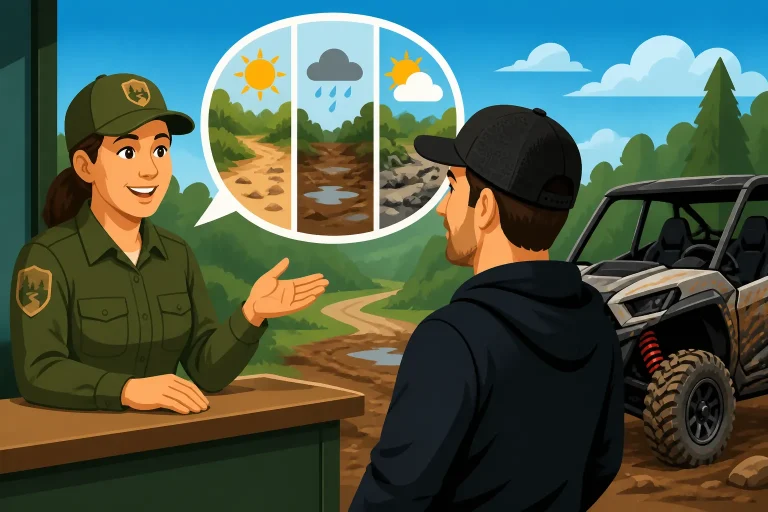
If there is no sign where you expect one, don’t treat the silence as permission to ride quickly. Ask the gate attendant or park manager what limit applies and whether it differs by area. A simple question before the ride is better than guessing after a complaint or incident.
Posted Speed Is a Maximum, Not a Target
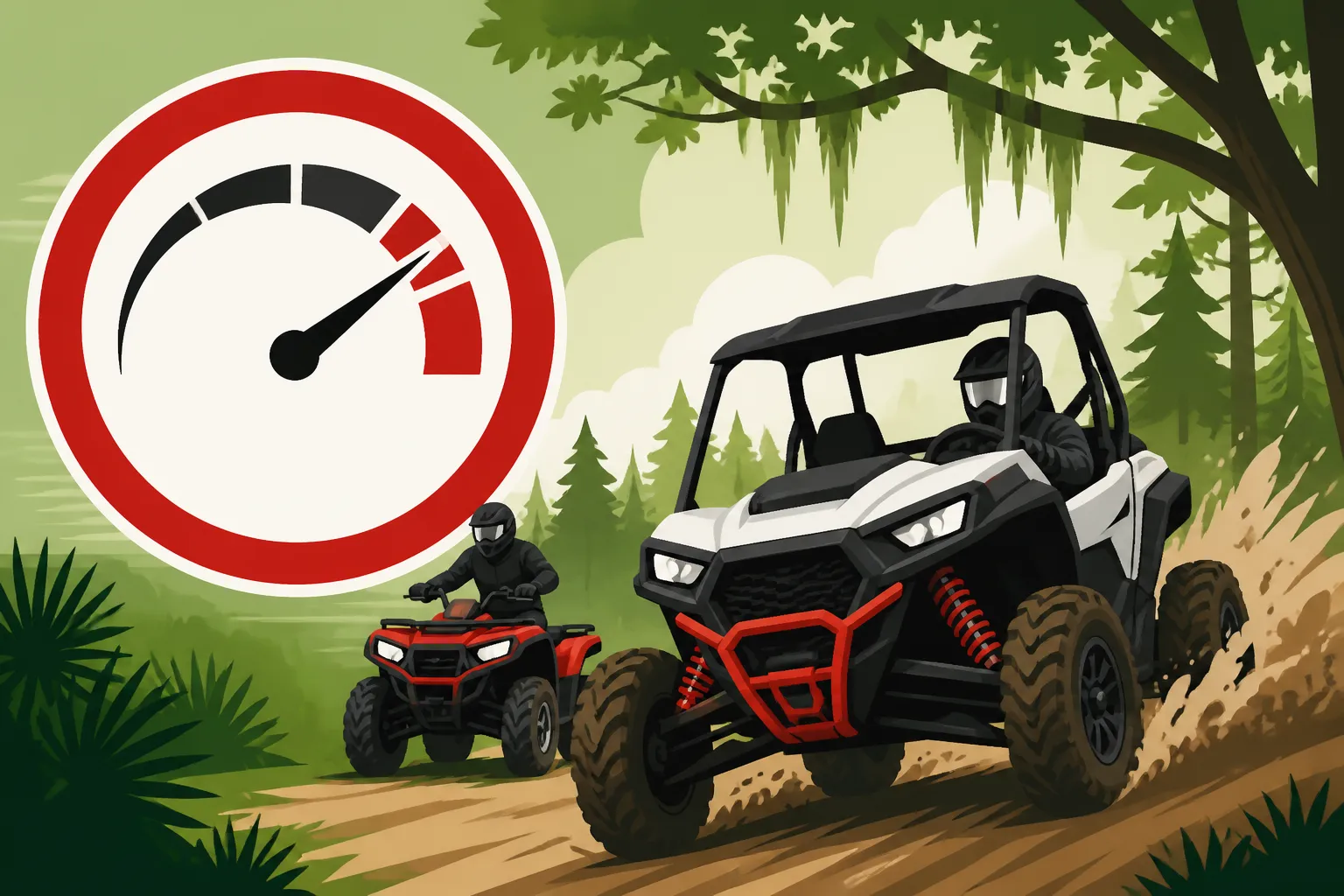
Even where a park posts a maximum speed, it is not a recommendation to travel that fast in all conditions. Riders need enough time and space to stop for a person, animal, stalled machine, washout, or unexpected turn. A number on a sign cannot account for every trail’s surface, weather, visibility, or traffic.
Choose a pace that lets you control the machine and stop within the clear distance ahead. Slow down when the trail narrows, bends, becomes rutted, or passes near campsites and staging areas. Ease off before crests and corners where you cannot see what is on the other side. In a group, ride at a speed that allows the person behind to react without crowding the rider ahead.
This is particularly important on Southern trails after rain. Soft ground, standing water, slick roots, and deep ruts can make steering and braking less predictable. Riding fast through mud can also throw debris toward other people, make it harder to see, and damage a trail. Check current conditions and closures before setting out; Mississippi Trail Conditions After Rain explains why wet-weather status can change a riding plan.
A useful rule of thumb is to slow down before the hazard, not while you are already in it. Braking or turning sharply on a slippery surface may make the machine harder to control. If you cannot see far enough ahead to stop safely, reduce speed until you can.
Places where a cautious pace matters most
- Near the entrance: People may be checking in, unloading, walking between vehicles, or looking for directions.
- At trail intersections: Riders may arrive from more than one direction, sometimes with little warning.
- Around campsites and cabins: Children, pets, and people carrying gear may step onto a road or track.
- At blind corners and hill crests: You may not see a stopped rider, oncoming traffic, or an obstacle until late.
- Near water and mud obstacles: Spray and splashing can obscure visibility, while another machine may be stopped just beyond the crossing.
- When passing: Leave room, pass only when you can see that it is safe, and follow park rules about passing and direction of travel.
Park staff may expect riders to travel slowly in busy areas even if a general trail limit is higher. If the facility gives a lower speed verbally or posts a temporary notice, obey it. A manager’s direction is also a good reason to stop and clarify if you are unsure whether a route is open or whether a sign applies to your machine.
What Changes Between Private Parks, State Parks, and Forest Trails
The name of the property affects who sets the rules and how you find them. Don’t assume that a speed sign at one kind of riding area establishes the rule at another.
A private park generally sets its own operating rules for the property. The rules may be presented during check-in, included with a waiver, printed on a map, or posted at the entrance and along routes. Ask about speed expectations in staging areas, campsites, mud sections, and event zones. If the park has separate tracks or trails, each area may have different instructions. The park can also close a route or require riders to leave for unsafe conduct, regardless of whether a rider is under the posted maximum. For more on what to check before riding at a private facility, see Riding Etiquette at a Southern Mud Park.
At a state park, the property’s rules and access requirements matter in addition to any general riding advice. Confirm that the park permits your type of machine in the area you plan to use. Follow its signs, staff directions, equipment requirements, and any instructions provided during check-in. State-park rules may cover more than speed, including helmets, passengers, noise, and reporting incidents. Mississippi State Park Noise Limits is relevant because riding responsibly includes respecting noise rules as well as speed instructions.
On National Forest land, distinguish an open road or trail from an area where motorized use is prohibited. A forest pass or other access requirement does not mean every road is open to every machine, and it does not waive posted restrictions. Follow the route signs and land-manager instructions. If you need help understanding the route system, How to Read a Forest Service Trail Map can help you identify what a map communicates; confirm current conditions and access with the appropriate local office before traveling.
The following table is a practical comparison, not a statement that every property uses the same process:
| Property type | Where rules may be provided | What to verify before riding |
|---|---|---|
| Private riding park | Gate, waiver, map, trail signs, or staff instructions | Speed zones, allowed routes, closures, and conduct rules |
| State park | Park signage, check-in instructions, or park staff | Whether your machine and intended riding area are permitted |
| National Forest route | Road or trail signs, maps, and land-manager information | Open routes, machine restrictions, pass requirements, and temporary closures |
| Event or organized ride | Event instructions and signs along the route | Any temporary speed, direction, staging, or group rules |
If the information conflicts, stop and ask the person responsible for the property. Do not choose whichever limit is more convenient. An entrance sign may describe a general maximum, while a section-specific sign or event notice sets a lower one for a particular area.
Ride for Conditions and Keep the Group Under Control
A safe pace is a shared responsibility when several machines are riding together. The lead rider should not set a pace that leaves less experienced riders struggling to keep up. The last rider should not be pressured to accelerate to close a gap. Leave enough space to avoid dust, spray, and sudden braking, and use designated stopping places rather than stopping just past a blind corner.
Before the ride, agree on a pace that works for the least experienced rider and make sure everyone understands the park’s route and passing rules. If someone falls behind, stop at a safe, visible place where the group will not block a trail. Avoid turning around in a narrow section without checking for oncoming riders. For broader trail behavior and passing etiquette, see Mississippi Trail Etiquette Locals Expect.
Weather and traffic can change what is reasonable over the course of a day. A quiet route may become busy when more riders arrive. Rain may change a firm trail into slick clay or standing water. Hunting activity, maintenance equipment, or a temporary closure may require a different route or slower travel. Check for updates before leaving home and again at the entrance when signs are posted. Mississippi Trail Closures After a Storm covers why a familiar route may not be available after severe weather.
A quick pre-ride check
- Read the entrance board and ask about any rules that are not clear.
- Check whether the posted speed changes in campsites, staging zones, or trail sections.
- Confirm that your machine is permitted on the route you intend to ride.
- Look for temporary closures, wet-weather notices, or event instructions.
- Set a group pace that allows everyone to stop safely and stay together.
- Slow down whenever visibility, traction, traffic, or trail width makes the posted maximum unsafe.
Children and newer riders need extra room and time to react. Make sure they understand the park’s rules, stay within their ability, and can control their machine before entering busy routes. Rules for young riders may differ depending on where they are riding; [Mississippi Rules for Riders Under 16] provides additional context. A speed limit does not replace supervision, appropriate safety gear, or a route suited to the rider’s experience.
If a rider is stopped or corrected by park staff, cooperate and ask what rule applies if the instruction is unclear. Do not argue from another property’s signs or from what a friend recalls. A different park may have a different limit, and a temporary direction may apply only to the current area or conditions. Getting clarification helps everyone continue the day safely.
The practical takeaway is straightforward: read the signs at the property you are visiting, follow any lower or temporary instruction, and ride slowly enough to stop within the space you can see. A posted maximum is not a promise that the same pace is safe on every trail.
Disclaimer
This article is for general informational purposes only and does not constitute professional advice. Laws, prices and regulations vary by location and change over time. Consult a qualified professional for guidance on your specific situation.