Asking a Park Manager About Trail Conditions
Trail conditions can change between the day you plan a ride and the day you reach the gate. Before hauling an ATV or UTV across Mississippi, ask the park manager the right questions: whether trails are open, whether your machine fits the rules, and what permit or proof you need to ride.
Start With the Right Contact
“Is the trail open?” is a useful first question, but it may not get you the complete answer. A trail system can include routes with different access rules, and a wet-weather closure may affect only part of the property. The person who answers the phone may also be able to confirm gate procedures, permits, and machine restrictions.
First identify who manages the place you plan to ride. In Mississippi, that may be a private park operator, a public land office, or the staff responsible for a particular riding area. A park manager can explain that property’s conditions and rules, but may not be able to answer for nearby roads, another landowner, or a separate public-land system.
For a private park, use the phone number or contact method listed by the park itself. For National Forest riding, contact the relevant Forest Service district office or the trail contact listed for that area. For a state-managed property, ask the office responsible for the specific park or riding facility. If you are unsure which office handles the trail, ask directly before relying on an answer from a different location.
It helps to have the following details ready:
- The name of the riding area and the trail or section you plan to use
- Your intended riding date and approximate arrival time
- Whether you are bringing an ATV, side-by-side, dirt bike, or more than one machine
- The machine’s width, especially if it is close to a posted limit
- The number and ages of riders in your group
- Whether you need to buy a permit, pass, or day-use ticket
Be specific about the machine. “I have a UTV” may not tell the manager enough to confirm whether it can use a particular trail. Give the machine’s width and, if relevant, its seating arrangement. A trail system that accommodates one class of machine may not allow a wider side-by-side.
The distinction between public and private access matters. A pass or permit for one location does not automatically authorize riding somewhere else. Mississippi’s National Forest OHV access, for example, has its own pass and trail rules; a private park’s admission or waiver covers that park’s property, not nearby public land. For more background, see Mississippi National Forest Riding Explained and Mississippi Private Park Waivers and Rules.
Questions to Ask About Conditions
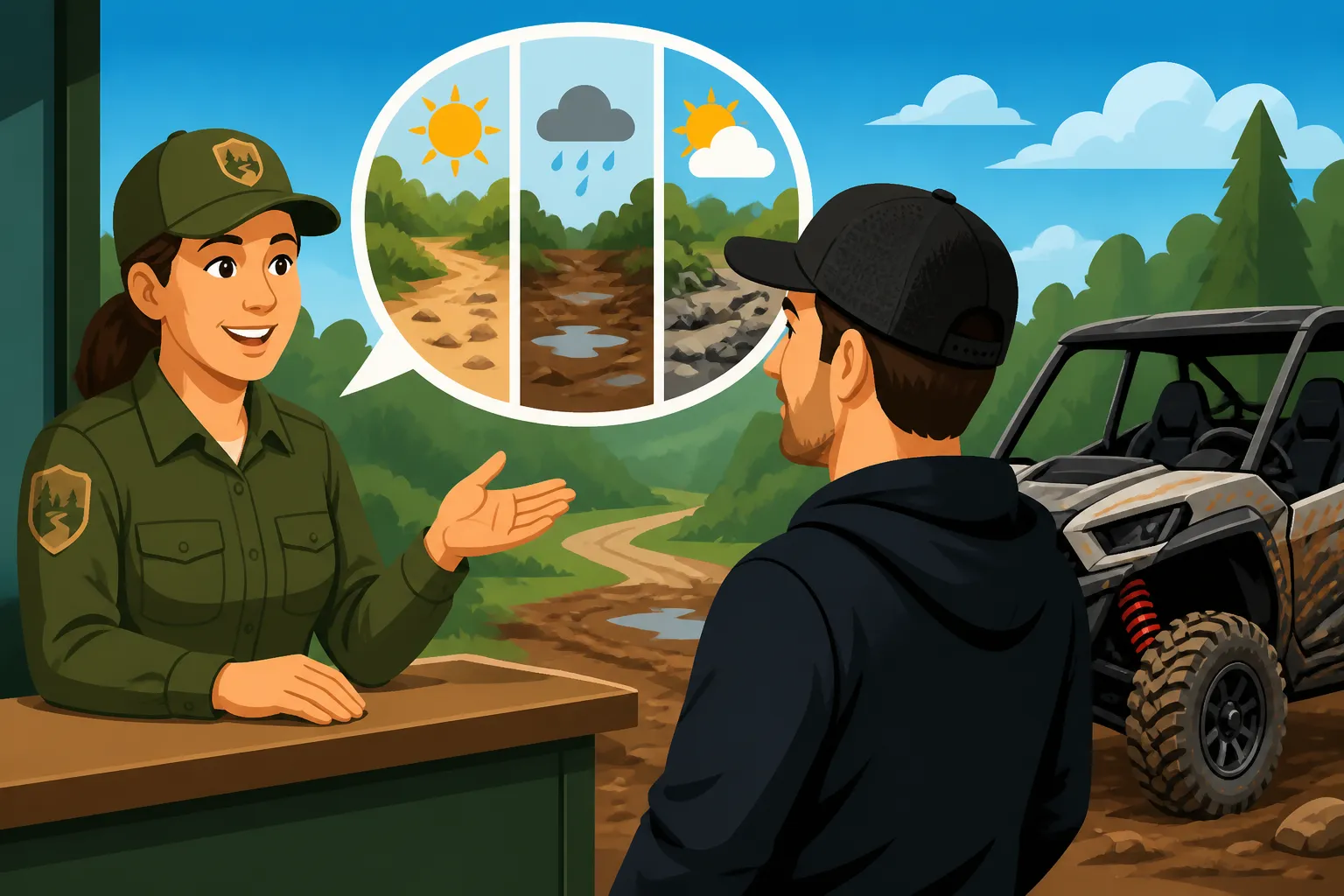
Trail conditions are more than a simple open-or-closed status. Rain, maintenance, hunting activity, downed trees, and changes to access can affect which routes are usable. Ask about the specific areas you hope to ride, and confirm whether the information applies to your visit date.
| Ask the manager | Why it matters | Useful follow-up |
|---|---|---|
| Are the trails open on my planned date? | A property may close all or part of its trails. | Is the whole system open, or only certain sections? |
| Has recent rain affected access? | Mud, standing water, and soft ground may change which routes are safe or permitted. | Are there closures, detours, or areas riders should avoid? |
| Are there maintenance or event closures? | Work or an organized event may limit access even when the park is otherwise open. | Which trails are affected, and when will they reopen? |
| Are there current machine limits? | Width, vehicle type, or other restrictions can rule out a planned route. | Can you confirm the limit for the trail I intend to ride? |
| What permit or pass do I need? | Access requirements depend on the location and can differ between properties. | Does each rider or machine need separate proof? |
| Are there temporary safety concerns? | Washouts, fallen trees, or damaged crossings may make a route unsuitable. | Is there an alternate route or a place to check for updates? |
Ask when the conditions were last checked. “Open” may mean the gate is open, not that every trail is passable for every vehicle. If the manager says a route is open but warns that it is wet, ask whether that means normal riding is still allowed, whether certain sections are closed, or whether riders are being advised to stay away to prevent damage.
A rain-related answer should not be treated as permission to ride wherever the ground looks firm. Follow posted signs and any instructions from staff. If a trail has a closed gate, barrier, or closure notice, do not bypass it because another section appears accessible. When in doubt, call again or choose a different riding area.
For a National Forest trip, ask which trails are currently designated for motorized use and whether any temporary closures apply. A forest road or path on a map is not necessarily an ATV route. Managers can help you understand which map or trail information applies, but riders should still check the official signs and posted notices at the trailhead. See How to Read a Forest Service Trail Map and Checking Trail Conditions Before You Load the Trailer.
Confirm Permits, Machine Limits, and Group Rules
Trail conditions and access requirements are connected. A route can be physically open but unavailable to your machine because of a width restriction, permit requirement, or property rule. Do not assume that a title, registration document, or permit from another state substitutes for the access requirements at the riding area.
Ask the manager to confirm the complete access procedure:
- Find out what authorization applies. Ask whether you need a trail pass, day-use ticket, admission, waiver, or other permission. Confirm whether it is issued online, at an office, or at the entrance.
- Check who or what the authorization covers. Ask whether the pass is tied to a rider, a machine, or a particular vehicle. If you are carrying several machines or bringing another rider, ask whether each needs separate proof.
- Confirm the machine limits. Give the manager the machine’s width and type. Do not rely on a general answer about “ATVs” if you are bringing a wide UTV.
- Ask what to bring to the gate. This may include proof of purchase or a pass, identification, a signed waiver, or a safety certificate when the property requires one. Ask the manager rather than assuming every location uses the same process.
- Check rules for your group. Ask about age requirements, supervision, passengers, and any required safety equipment. These can differ by property and by the type of land.
- Ask what changes if weather closes the trail. Find out how the property posts closures and whether a reservation or admission can be moved if access is unavailable.
Machine width is worth confirming before you leave home. For example, the Bethel OHV Trail system is associated with a 50-inch machine limit. If your machine is close to that width—or if it has aftermarket accessories that make it wider—ask the trail office to confirm how the limit is measured and which routes the machine may use. A measurement that includes tires or accessories could affect whether you qualify. The manager’s current instructions and posted trail rules should control your decision.
A permit answer should be just as precise. Mississippi does not use one universal ATV sticker that automatically grants access to all riding areas. A forest pass, a private park admission, and a property-specific permit serve different purposes. If you plan to ride more than one location on the same trip, ask each manager separately. For public-land requirements, Mississippi National Forest OHV Passes explains the distinction between a pass and the trails it covers, while Mississippi Has No Sticker for a Visiting Machine is useful for riders coming from another state.
Ask whether proof needs to be carried on the trail or merely shown at the entrance. If the answer is unclear, keep the receipt or confirmation accessible and follow the property’s directions. A phone screenshot can be useful, but it is sensible to ask whether the site has reliable reception and whether paper proof is preferred.
Make a Reliable Plan for Ride Day
A good phone call gives you a plan, not a guarantee that conditions will stay the same. Weather can change, maintenance work can begin, and a closure can be posted after you have loaded the trailer. Check the manager’s official updates again before departure, especially if rain or severe weather is in the forecast.
Keep the important details together: the contact number, the trail map or directions, the permit instructions, and any closure notice. If you are visiting a large public-land area, save the correct district office contact rather than relying on a general number that may not handle trail access. If a manager recommends calling again on the morning of your ride, do so.
When you arrive, read the signs at the entrance and trailhead. They may reflect a more recent closure or restriction than the information you received earlier. Do not treat an open gate as proof that every route is open. Respect marked closures, barriers, and staff instructions, even if another rider tells you a route is passable.
If conditions do not match what you were told, pause before unloading or entering the trail. Ask a staff member to clarify the current status. On public land, contact the responsible office if there is no on-site manager. If you cannot confirm that your machine and route are allowed, choose an option with clear access rules rather than guessing.
A few practical habits make the call more useful:
- Call during the property’s posted business hours when possible.
- Describe the exact machine, not just the brand or engine size.
- Ask for the name or role of the office that handles updates, rather than depending on an informal answer.
- Repeat back the trail, date, machine limit, and permit instructions to catch misunderstandings.
- Ask where official updates will appear if conditions change.
- Avoid relying solely on an old social media post, a third-party map, or a previous visit.
The most useful answer is one that tells you what is open, what your specific machine may use, what authorization you need, and where to verify changes. If you cannot get all four, treat the remaining uncertainty as part of the trip plan. A short confirmation before you haul can prevent a long drive to a closed trail or an avoidable problem at the gate.
For broader trip planning, Mississippi Trail Conditions After Rain covers weather-related considerations, and Which Trails the $60 Forest Pass Opens can help clarify the difference between buying access and confirming that a particular route is available.
Disclaimer
This article is for general informational purposes only and does not constitute professional advice. Laws, prices and regulations vary by location and change over time. Consult a qualified professional for guidance on your specific situation.