Mississippi Forest License Requirements
Mississippi riders often hear that they need a “forest license” before unloading an ATV or UTV, but that phrase can mean several different things. The practical answer is to separate a state driver’s license, a youth safety certificate, and a forest trail pass. This guide explains what each does, when it matters, and what to confirm before you ride.
What Mississippi Forest License Requirements Actually Mean
There is no single document called a Mississippi forest license that gives you blanket permission to ride any ATV or UTV on public land. In practice, riders need to distinguish three things:
- A driver’s license or safety certificate: A document that may be required for a rider using a machine on public property.
- An OHV trail pass or permit: A pass required for certain designated off-highway vehicle trails.
- Permission to use a specific route: The route must be open to the type of machine you are riding, and you must follow posted restrictions.
Those requirements solve different problems. A driver’s license does not pay a trail fee. A trail pass does not authorize you to ride a closed road. And neither one replaces permission from a private landowner.
A good starting point is to ask where the machine will be operated. A national forest road, a designated OHV trail, a wildlife management area road, a state park, and a private riding park can all have different rules. Requirements may also depend on the rider’s age, the machine’s size, and the route’s posted restrictions.
Mississippi does not use a statewide ATV registration sticker that gives riders access to forest trails. The absence of a state sticker does not mean every public route is free to use. Some designated trails have their own permit requirements, and federal or state land managers can close or restrict routes. The broader distinction is covered in Mississippi Has No Sticker for a Visiting Machine and Mississippi National Forest OHV Passes.
It also helps to separate a forest trail permit from road legality. A pass for an OHV trail does not make an ATV street-legal and does not create permission to ride a public road. Mississippi’s road rules are a separate issue; see Mississippi ATV Road Rules Under 63-31-3 before planning any route that uses a public road.
Use this table as a quick sorting tool, then confirm the rules for the particular riding area:
| Requirement | What it generally addresses | What it does not do |
|---|---|---|
| Driver’s license | Whether a rider meets the applicable requirement for operating on public property | Pay for a trail pass or open a closed route |
| Youth safety certificate | An alternative credential that may apply to a younger rider under the relevant rules | Replace supervision, helmet rules, or a trail permit |
| Forest OHV pass | Access to a designated trail or area that requires that pass | Grant access to every road or trail in the forest |
| Posted route permission | Whether a particular road or trail is open to the machine and activity | Replace the rider’s required credentials |
| Private landowner permission | Authorization to ride on private property | Override public-land restrictions or safety rules |
The most useful rule of thumb is this: confirm the rider credential, the machine’s pass, and the route separately. A rider who has one of the three may still be missing the other two.
When You Need a Forest OHV Pass
A forest pass is generally tied to riding on designated OHV trails or areas where the land manager requires one. It is not the same as a state vehicle registration and should not be treated as a general permit for the entire national forest.
Before you buy a pass, identify the actual trail system you plan to use. A forest may contain open roads, closed roads, hiking routes, horse trails, and OHV routes. Only some of those may be open to ATVs or UTVs, and a pass requirement may apply to a specific trail system rather than every route within the forest boundary.
Mississippi has a forest-wide OHV pass program described in Mississippi’s $60 Forest-Wide Pass. The pass fee and coverage details can change, so confirm the current requirements with the official Forest Service information for your intended destination. In particular, check:
- Whether your intended riding area is covered by the pass.
- Whether the pass is required for every machine or issued under different terms.
- How the pass must be displayed or carried.
- Whether an additional day-use ticket, waiver, or local permit is required.
- Whether the trail is currently open.
- Whether your machine meets the trail’s width, weight, or other restrictions.
Do not assume a pass is transferable between machines or riders. If you are bringing more than one ATV or UTV, check whether each machine needs its own pass. The same goes for a group arriving in separate vehicles: one rider’s pass should not be assumed to cover the whole group. For more on that distinction, see [Mississippi Forest Pass for a Second Machine] and Who a National Forest OHV Pass Belongs To.
A pass from another state also does not automatically satisfy Mississippi’s trail requirements. Some states issue OHV registration stickers or permits, but Mississippi does not have a state sticker to reciprocate with. The land manager’s rules for the Mississippi trail are what matter. Visitors can review Mississippi Has No OHV Registration to Reciprocate and Mississippi Visitors Need No State Sticker for the state-level distinction.
Do not treat the pass as a forest-wide road permit
One common mistake is to buy a trail pass and assume that any road inside a national forest is now available for ATV or UTV riding. A pass does not open roads that are closed to motor vehicles, and it does not turn a hiking or horse trail into an OHV route. Follow the route signs and the official travel map for the riding area.
If a gate is closed, a sign prohibits motorized use, or a route is not designated for OHVs, do not ride around the barrier. A machine’s ability to fit through a gap is not evidence that the route is open. Rules for management areas can be different again; Mississippi WMA Designated Roads Only explains why a route that looks rideable may still be off-limits.
Confirm coverage before paying
Check the current official pass information before you travel, rather than relying on an old receipt, a forum post, or a listing from a retail website. If you are unsure whether a particular trail is included, contact the relevant ranger district or trail office and give them the exact trail name and machine type.
A retail marketplace such as Amazon may offer maps, document holders, or other riding supplies, but it is not the authority on whether a forest trail is open or which pass it requires. Use the land manager’s current information for access rules and use retailers only for equipment.
Driver’s License and Safety Certificate Rules
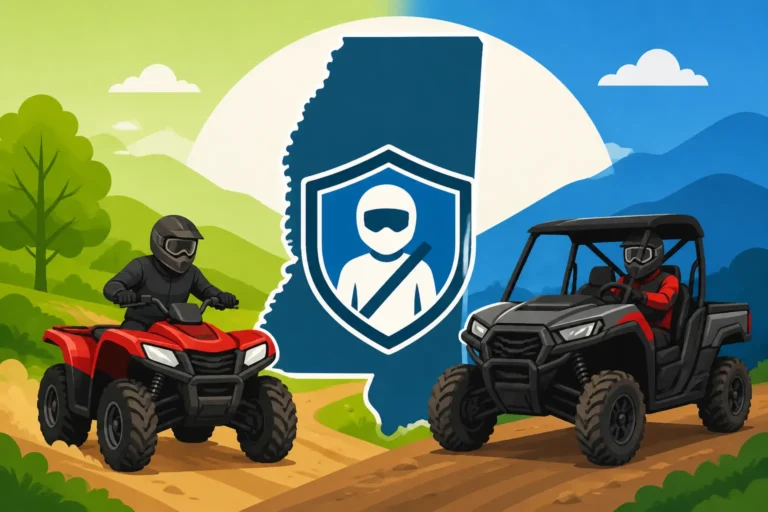
A trail pass is not the same as the rider’s qualification to operate a machine. Mississippi’s public-property requirements can involve a driver’s license or an accepted safety certificate, with age affecting which credential applies. Requirements can differ between public land, private land, and a privately operated riding park, so do not assume that a rule at one place applies everywhere.
For a rider planning to use a national forest trail, verify the rule for that specific trail system. The references for Your Driver’s License Is the Permit on Mississippi Trails and Mississippi Riders Under 16 Need a Safety Certificate explain the distinction between an adult credential and a youth safety credential.
A safety certificate is not simply a parent’s permission slip. If the rider is required to carry or show a certificate, make sure the certificate is the type accepted for that use and that the rider can produce it when asked. For a young rider, check the applicable age rule, supervision requirement, helmet requirement, and any site-specific minimum age separately. More detail is available in Which ATV Safety Courses the State Will Accept and Mississippi Supervision on Public Land.
Keep proof accessible
If a rider needs to show a license or certificate, make it easy to access. A credential buried in a truck console or left at home is not helpful if a ranger or other authorized official asks to see it. Keep it protected from water and mud, but do not rely on a phone photo as a substitute unless the relevant authority confirms that a digital copy is accepted.
For youth riders, carry the certificate in a secure, waterproof holder and make sure the accompanying adult knows where it is. A store such as Amazon can be useful for finding a small waterproof document pouch, but the pouch itself does not establish that the certificate meets the rule. Verify the credential’s acceptance with the official source before the trip.
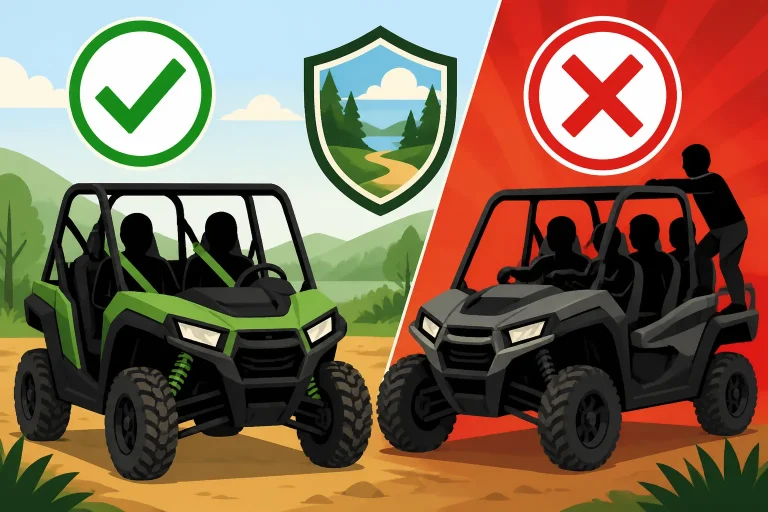
Also remember that a rider credential does not make an unsafe setup acceptable. A child should not be placed on a machine that is too large or powerful for their ability, and a passenger should not ride on a seat that was not designed for one. Forest and park requirements may add helmet, passenger, sound, or equipment rules. Review [Mississippi Rules for Riders Under 16] and [Mississippi Private Park Helmet Rules] if you are comparing public land with a commercial park.
Check the Machine and Route, Not Just the Paperwork
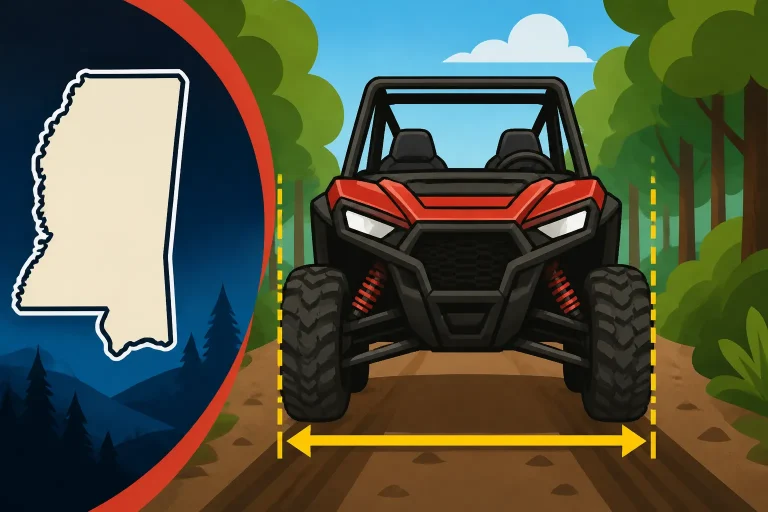
Even when the rider has the right credential and the machine has the required pass, the route may not allow that machine. Width restrictions are especially important for UTV owners. A trail built for narrow ATVs may exclude a wider side-by-side, even if the UTV is otherwise properly equipped.
Bethel OHV trails, for example, have restrictions that riders should check before hauling a machine there. Confirm the current allowed width and other vehicle limits directly with the trail’s official information. The references Bethel’s Width Limit in Mississippi and The 50-Inch Width Limit Written Into the Pass point to an important practical issue: possessing the pass does not waive a machine-size limit.
Use the machine’s actual specifications rather than guessing from its model name or appearance. If you have added wider tires, wheels, fenders, or other accessories, ask how the trail measures width and whether the modification affects eligibility. A UTV that is close to a limit can be turned away at the trailhead, so this is worth checking before loading.
Other route-specific conditions may include:
- Seasonal closures or closures after heavy rain.
- One-way trail sections or restricted riding directions.
- Sound or spark-arrestor requirements.
- Rules for passengers.
- Restrictions on riding outside marked routes.
- Special use rules during hunting seasons or events.
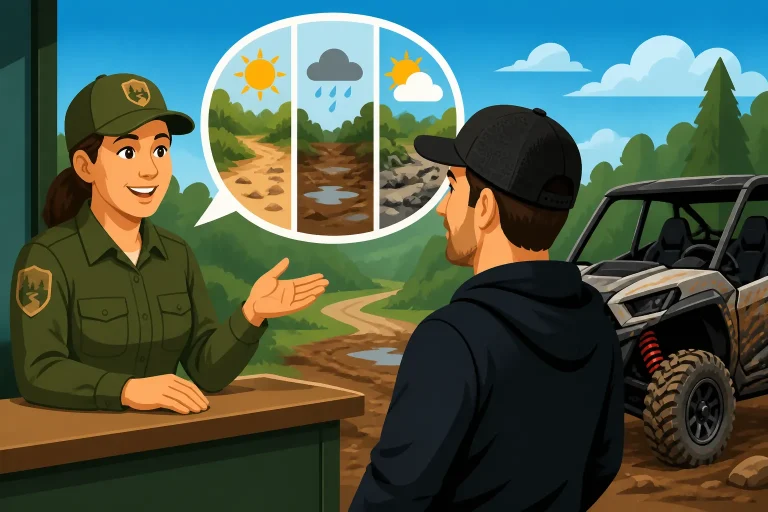
Trail conditions change. A route that was open last weekend might be closed today because of rain, maintenance, fire danger, or another land-management decision. Check the official trail status shortly before leaving, and again if your trip involves a long drive. Checking Trail Conditions Before You Load the Trailer covers the practical checks that help prevent a wasted trip.
National forest access also does not mean unrestricted access to all public land nearby. A wildlife management area may permit motorized travel only on designated roads, and gates or closure signs matter. A state park may require separate paperwork or a waiver. A private OHV park may set its own age, equipment, and admission rules. Ask the manager of the land you will actually ride on, not just someone familiar with another trail in the same county.
A Practical Checklist Before You Leave
A little preparation can prevent the most common problems at a forest entrance: the wrong pass, an ineligible machine, a missing youth certificate, or a closed trail. Use this checklist for each riding trip.
- Name the exact riding area. Do not plan around “the national forest” generally. Identify the trail system, entrance, and intended route.
- Check whether the route is open to OHVs. Use current official maps and closure information. Do not infer access from the presence of a road or tire tracks.
- Confirm the pass requirement. Ask whether the area requires a forest OHV pass, an additional ticket, or another permit.
- Check the pass rules for every machine. Confirm whether each ATV or UTV needs its own pass and how the pass must be displayed.
- Confirm rider credentials. Check whether the rider needs a driver’s license or an accepted safety certificate, especially for anyone under 16.
- Check the machine’s dimensions and equipment. Verify width restrictions and any sound, spark-arrestor, passenger, or safety rules.
- Review temporary closures and weather conditions. A pass does not guarantee that a trail is open on the day you arrive.
- Bring proof in a usable format. Carry required credentials and pass documentation where they can be found without unloading the machine.
- Plan for the return trip. Make sure the route you use to reach the trailhead does not require riding illegally on a public road.
A quick call can be useful when the official information is unclear. Be specific: tell the staff member the trail name, machine type, machine width, rider age, and whether you already hold a pass from another state. “Can I ride in the forest?” is harder to answer accurately than “Is this UTV allowed on this named trail, and what pass and rider documents must we have?”
If the rules are still unclear, do not treat uncertainty as permission. Ask the ranger district, park office, or land manager for a direct answer, and note the date and name of the trail information you checked. If rules or trail conditions change before your arrival, the latest posted instruction controls. For a broader overview of permits and requirements on public land, see Mississippi Permit Questions Riders Ask.
Common Mistakes to Avoid
Confusing a state credential with a trail permit
A state-level driver’s license or safety certificate addresses the rider. A forest OHV pass addresses access to a particular trail or area. One does not automatically replace the other.
Assuming a pass from home works in Mississippi
A permit or registration sticker issued elsewhere may not be recognized as a Mississippi forest pass. Confirm with the local land manager rather than relying on reciprocity assumptions.
Treating every national forest road as an ATV trail
Forests contain routes with different uses and restrictions. Follow designated OHV routes and posted closures. Do not ride around a gate or barrier because a map appears to show a connection beyond it.
Bringing a UTV without checking width
A side-by-side may be too wide for a trail that allows smaller ATVs. Check the actual measurement and the trail’s measurement method before the trip.
Assuming the rules are identical at all public sites
Forest trails, wildlife management areas, state parks, and private parks can have different permit and equipment requirements. A pass bought for one riding area is not a universal admission ticket.
Waiting until the trailhead to find out
A trailhead is a poor place to discover that a pass must be bought elsewhere, a certificate is missing, or the route is closed. Check requirements before loading the trailer. When using Amazon or another retailer to prepare, treat product descriptions as information about the item—not as confirmation of legal access.
Disclaimer
This article is for general informational purposes only and does not constitute professional advice. Laws, prices and regulations vary by location and change over time. Consult a qualified professional for guidance on your specific situation.