Riding a Levee on Public Hunting Land
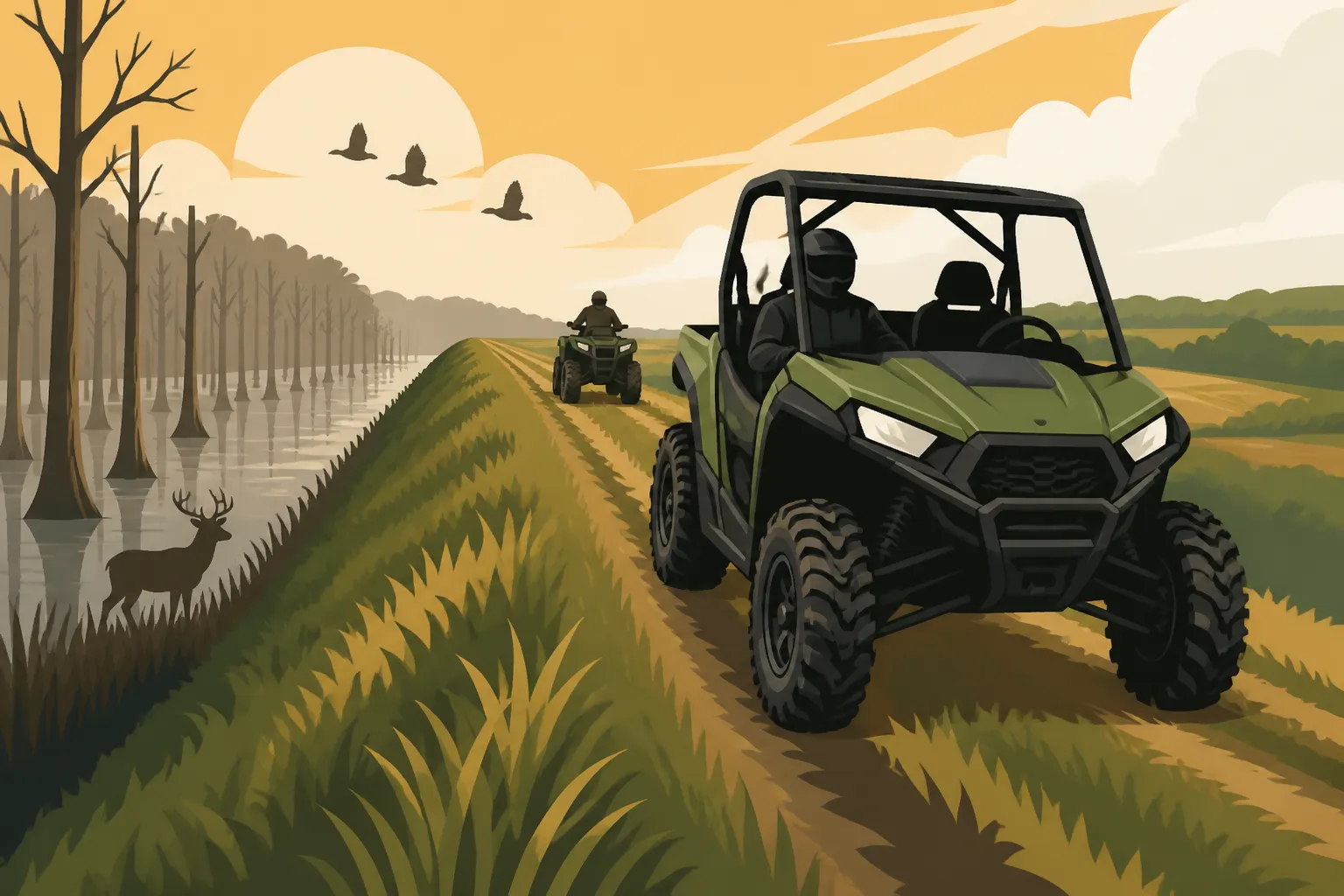
Riding a levee on public hunting land in Mississippi can look like a straightforward way to reach a hunting spot, but public access does not automatically include permission to ride. Levee rules and hunting-area rules may come from different authorities. Here’s how to check both, understand what a permit does and does not allow, and avoid mistaking a passable road for an approved ATV route.
Public hunting access does not automatically include levee access
A Wildlife Management Area (WMA) or other public hunting area may allow certain kinds of access without allowing ATVs on every road, trail, or levee within its boundaries. A levee can be managed separately from the surrounding hunting land, and the authority responsible for the levee may restrict motorized traffic to protect the structure and maintain access for its own work.
That distinction matters even when a levee road appears open, has tire tracks, or connects two public areas. A visible track is not proof that riding is allowed. Nor does a public hunting designation mean that every piece of infrastructure inside or alongside the area is open to recreational vehicle use.
In Mississippi, riders should treat levees as closed to ATV and UTV riding unless the authority responsible for the specific levee has clearly confirmed otherwise. Levee riding is not a use to assume is permitted just because the route crosses public land. See Mississippi Levee Riding Is Prohibited and Mississippi Levee Board Rules for the broader restrictions and the role of levee authorities.
A hunting area can also have its own access rules. On a WMA, riding may be limited to roads specifically designated for that use, and a road can be closed seasonally or by a gate, sign, or other restriction. Mississippi WMA Designated Roads Only explains why following the marked route matters.
A boundary on a map may not show who controls the road
Public hunting land and levee property do not always have the same boundaries. A road may run along a levee, cross a management area, or sit next to public land without being an approved ATV route for that land. Online maps and trail apps can help with orientation, but they may not show current closures or establish the legal status of a route.
If you cannot tell who manages a road, ask before riding. The land manager can clarify whether the route is designated for motorized use; the levee authority can clarify whether vehicles may travel on the levee itself. When the two answers differ, follow the restriction that applies to the specific part of the route you plan to use.
Do not rely on a gate being open, an unmarked entrance, or a route that another rider says is “usually fine.” Conditions and permissions can change, and one person’s access does not necessarily extend to other riders.
Hunting rules and riding rules answer different questions
WMA rules may address vehicle access, hunting seasons, weapon restrictions, game retrieval, and road closures. Those rules do not necessarily grant permission to ride a levee. Likewise, having permission to ride on a designated road does not automatically settle whether you may hunt, carry a firearm, retrieve game, or enter a nearby restricted area.
Before the trip, check the current rules for the specific property and activity. Mississippi WMA Riding Rules is a useful starting point for understanding the separate rules that apply to riding on WMAs. If you are going to hunt, check the applicable hunting requirements as well; do not treat a vehicle pass or road designation as a hunting authorization.
What permits and passes do and do not authorize
A permit or pass is only useful for the place and activity it covers. It does not override a road closure, a posted restriction, or a levee authority’s rules. Nor should riders assume that a permit used for one public riding area grants access to another.
Mississippi does not use a general state ATV registration sticker that automatically grants access to public hunting land or levees. Visitors should not assume that a sticker from another state will be accepted as permission to ride in Mississippi. Mississippi Has No Sticker for a Visiting Machine explains this point. A lack of a state sticker requirement, however, is not the same as permission to ride wherever a machine can travel.
For example, a National Forest pass is tied to the forest riding opportunities and requirements it covers. It does not authorize riding on a WMA road that is closed to ATVs, and it does not grant permission to ride on a levee. If your plans include a National Forest, check the separate access rules in Mississippi National Forest Riding Explained.
| What you have or see | What it may establish | What it does not establish |
|---|---|---|
| Public hunting access | Permission to enter or use a property for activities allowed by its rules | Permission to ride every road, levee, or service route |
| A hunting license or area authorization | Eligibility to hunt under the applicable rules | ATV access to a closed or undesignated route |
| A forest riding pass | Access to the forest riding areas covered by that pass, subject to their rules | Access to a WMA or levee outside that coverage |
| An open gate or visible tire tracks | Only that the route is physically passable or has been used | That public ATV use is authorized |
| Verbal advice from another rider | A lead about where to ask or what to check | Current, official permission for your machine and route |
| Written permission for private land | Permission within the terms and boundaries of that permission | Permission to continue onto a levee or separate public property |
A permit can also come with conditions: approved routes, operating times, machine limits, safety requirements, or seasonal restrictions. Read the terms for the particular area rather than assuming that a pass is a general license to ride. If a permit document is unclear about levees or connector roads, ask the issuing office and the levee authority before unloading.
Visitors should check Mississippi rules, not just home-state credentials
A visitor’s out-of-state registration, decal, or trail pass may be relevant in the state where it was issued, but it does not create permission to use a Mississippi levee. Check Mississippi’s rules for the specific public land and riding area. A permit that works elsewhere may have no effect on access here.
That is especially important when a route crosses more than one kind of property. A rider might begin on a permitted trail, reach a WMA boundary, then encounter a levee road. Each segment can have a different manager and a different access rule. Confirm the whole route, not just the trailhead.
How to verify a route before unloading
A reliable check involves the land manager and, when a levee is part of the route, the levee authority. Start with the exact area name and the road or levee segment you want to ride. General questions such as “Are ATVs allowed around here?” may not resolve whether the specific crossing or bank road is open.
Use this process:
- Identify the property and route. Find the name of the WMA, public hunting area, forest, or other property, and note the road, gate, or levee segment. A map pin or written route description can help avoid confusion.
- Check current area rules and maps. Look for designated motorized routes, seasonal closures, machine restrictions, and signs at the entrance. Do not treat a hunting map as an ATV trail map unless it specifically identifies routes open to riding.
- Ask the land manager about the riding segment. Confirm whether ATVs or UTVs may use that particular road, not merely whether vehicles can enter the property. Ask about temporary closures and the dates they apply.
- Ask the levee authority separately. If the route travels on top of, along, or across a levee, confirm whether public recreational riding is allowed there. A land manager’s approval for a nearby road may not cover the levee.
- Check the answer against signs and closures on site. A current posted closure or gate takes priority over an old map or a previous trip’s conditions. If signs conflict with what you were told, stop and resolve the conflict before riding.
- Keep any permission and route information available. If written approval is provided, keep a copy and stay within its boundaries and conditions. Permission for one entrance or segment should not be stretched to cover a different route.
When contacting an office, be specific. Ask whether a rider may use the named road on an ATV or UTV, whether the route crosses or follows a levee, whether the route is open during the planned dates, and whether any machine or rider restrictions apply. If the person answering is unsure who controls the levee, ask which authority can confirm its status.
You can also ask whether the route is open to recreational riding or only to land-management, maintenance, or emergency vehicles. A road used by staff and contractors is not necessarily open to the public. Similarly, a public road that runs near a levee does not mean the levee itself is open for recreational travel.
For questions about boundaries and permission on land that is not clearly public, What Posted Land Means for Mississippi Riders and Written Permission From a Southern Landowner offer useful context. Permission from a neighboring landowner cannot authorize riding on land or infrastructure controlled by someone else.
Do not use a pass as a substitute for route approval
A pass usually answers a limited question: whether you have met an entry or use requirement for a particular area. It does not necessarily answer whether the route is open today or whether a separate levee segment is included. Keep these questions separate:
- Do I have the required permit or pass for this riding area?
- Is this exact road designated for ATV or UTV use?
- Is the levee open to public recreational riding?
- Is the route open on the date I plan to go?
- Do rider, machine, or seasonal rules limit how I can use it?
If any answer is uncertain, do not ride the levee while waiting to find out. Choose a confirmed route instead. That may mean leaving the machine on the trailer, taking a legal detour, or planning the trip around a riding area with clearly designated trails.
Safer options when the route includes a levee
The most practical alternative is to avoid the levee and ride only a route that the responsible manager has identified as open to ATVs or UTVs. This can require changing your access plan, especially if you hoped to use the levee as a shortcut to a hunting location. A longer approved route is preferable to an uncertain one.
If you are hunting, check whether the property allows vehicle use for game retrieval and what limits apply. Retrieval rules, where provided, are not blanket permission to travel on every road or levee. Confirm the designated route and any seasonal conditions before relying on a machine to reach or recover game. The rules may distinguish between getting to a site, traveling during a hunting season, and retrieving an animal.
When a legal route is confirmed, stay on it. Avoid riding around a closed gate, cutting across a bank, or using a narrow service track as an unofficial trail. Levees protect surrounding land from flooding, and unauthorized traffic can damage surfaces or interfere with maintenance. Even where a route is open to some vehicles, the allowed use may not include recreational riding.
Before leaving home, make a simple trip record with:
- The name of the public area and the manager you contacted
- The road or trail identified as open to riding
- Any required pass or permit
- Current closure information and the date you checked
- A backup riding location if the area closes or access is unclear
At the site, follow posted signs and turn back if the route differs from what you confirmed. A closure may be temporary, and conditions after heavy rain or maintenance work can change access. Do not assume a machine can safely cross a soft, eroded, or water-covered section of a levee just because another vehicle has done so.
The key rule is simple: public hunting land does not automatically make its levees open to ATV or UTV riding. Check the hunting-area rules, verify that the road is designated for riding, and get separate confirmation from the authority responsible for the levee. A pass can satisfy an entry requirement, but it cannot replace route permission.
Disclaimer
This article is for general informational purposes only and does not constitute professional advice. Laws, prices and regulations vary by location and change over time. Consult a qualified professional for guidance on your specific situation.