Mississippi Rules for a Ten-Year-Old Rider
A ten-year-old may be ready to ride, but age alone does not answer whether a particular ATV, trail or public riding area is allowed. Mississippi rules can depend on the rider’s age, required safety credentials and the land where the machine is used. Here’s how to check the main requirements and avoid treating private-property permission as permission to ride anywhere.
Mississippi rules that matter for a ten-year-old
A ten-year-old is under 16, so the under-16 requirements are the first things to check. Mississippi has rules concerning helmets and safety credentials, particularly when riding on public land. The exact requirements can depend on the riding area, so confirm them with the agency or property manager responsible for the location.
For a young rider, the practical starting point is:
- Helmet: Have the child wear a suitable protective helmet every time they ride. Public-land rules may require one for riders under 16, and individual parks can impose their own helmet rules.
- Safety credential: A child who is too young to hold a driver’s license may need an accepted ATV safety certificate to meet a public-land requirement. Check that the specific land manager accepts that credential, and ask what proof the rider must carry.
- Site rules: A park, trail system or land manager can set additional requirements, such as an age minimum, supervision condition, equipment rule or waiver.
- Machine fit: Choose a machine the child can control, not merely one that appears to fit within a legal definition or has a seat marked for a child.
The distinction between a legal requirement and a safety recommendation matters. A parent or land manager may expect close adult supervision even where a statewide rule does not specify a particular supervision arrangement. Regardless, a ten-year-old should ride only with an attentive adult nearby and within the child’s ability.
For more detail on helmets and credentials, see Mississippi Helmet Law for Riders Under 16, Mississippi Safety Certificates for Young Riders and Mississippi Requires a License or a Safety Card. Those requirements do not automatically grant access to a trail or make every machine suitable for a child.
| Question | What to check for a ten-year-old |
|---|---|
| Is a helmet required? | Check Mississippi’s under-16 rules and the specific riding area’s helmet policy. |
| Is a license enough? | A ten-year-old is generally too young for a driver’s license; ask whether an accepted safety certificate is required or accepted at that location. |
| Can the child ride any ATV? | No. Consider the machine’s size, power, controls and the child’s ability to operate it safely. |
| Can the child ride on public roads? | Do not assume so. Mississippi generally bars ATVs from public roads; a trail permit or safety certificate does not authorize road riding. |
| Can the child ride on private land? | Only with the landowner’s permission, and any applicable laws and safety rules still matter. |
Do not treat “under 16” as a single permission category. A child’s age may trigger protective requirements, while the individual site may have a stricter age limit or different credential rule. If a rule or sign is unclear, get an answer from the relevant land manager before unloading.
Where a ten-year-old may ride
The location can change the answer. Public roads, national forest trails, wildlife management areas, state parks, private parks and private property are not interchangeable. Permission to ride in one place does not carry over to another.
Public roads
Mississippi’s ATV road rules are a separate issue from a child’s age or safety certificate. A helmet, training certificate, title or permission from a private landowner does not make an ATV legal to operate on a public road. Mississippi generally prohibits ATVs on public roads, with narrow issues around specific local rules and machine classifications that should be checked before a ride. See Mississippi Bans ATVs on Public Roads and Mississippi Local Ordinances Are the Only Path.
For a ten-year-old, the safe approach is not to use a road as a route between trails, even for a short distance. Do not assume that a gravel road, a road through a hunting area or a road near a riding park is private. Confirm who controls it and whether it is open to ATV use. A short connection can still create a legal and serious safety problem.
National forest trails and other public riding areas
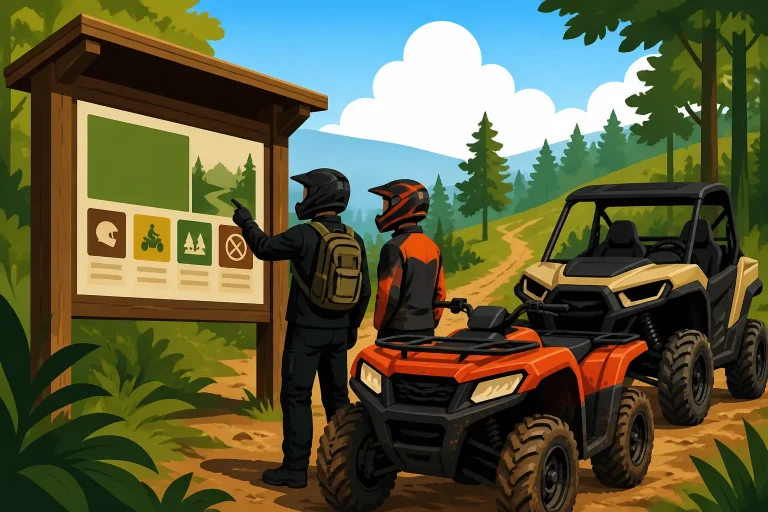
Public-land access usually comes with land-specific rules. A forest trail may require a permit, a driver’s license or an accepted safety credential, and compliance with age, helmet and machine restrictions. A wildlife management area may limit riding to designated roads or close routes at certain times. A state park or private riding facility can have its own check-in process.
This is where a ten-year-old should not rely on a broad statement such as “kids can ride there.” Before leaving home, ask the site:
- Is a ten-year-old allowed to operate an ATV there?
- Does the rider need a safety certificate, and which certificates are accepted?
- Must a parent or other adult ride with the child, or remain in a particular area?
- Does the site require a helmet or other protective equipment?
- Are there machine-width, noise, passenger or route restrictions?
For forest access, review Mississippi National Forest Riding Explained and Mississippi Forest Rules for Riders Under 16. If you plan to use Bethel OHV Trails, check its current rider and trail requirements directly; a rule that applies on one public trail system may not apply on another. The same goes for wildlife management areas: Mississippi WMA Riding Rules is a useful starting point, but signs and local closures still control where riding is allowed.
State parks and private riding parks
A state park or private park may require an adult to complete a waiver, present identification or show a child’s safety certificate. It may also require helmets for all riders, restrict passengers to factory-designated seats, or turn away machines that do not meet its rules.
A waiver is not a substitute for permission to ride every trail. Ask whether the child is allowed to operate the machine, not just whether children may enter the park. If the child is riding as a passenger, check that the machine is designed and equipped for a passenger. A rack, fender or improvised seat is not a safe substitute for a proper passenger seat and handholds.
Private land
A landowner can allow riding on private property, but permission is limited to that property and does not override other applicable law. Ask where the child may ride, whether any gates or roads are off limits, and whether the landowner permits other riders or vehicles in the same area.
A private property ride also needs a clear boundary. A trail that reaches a county road, public land or another owner’s parcel is not automatically open beyond the property line. For more on permission and access, see Written Permission From a Southern Landowner.
Choosing a machine and supervising the ride
Legal access is only one part of the decision. A machine that is too powerful, heavy or difficult to control can be unsafe even when a child meets the location’s paperwork requirements. Do not use engine size alone to decide whether an ATV is suitable.
The child should be able to reach and use the controls, sit in a stable position and understand how to stop the machine. They also need enough strength and coordination to steer and control it over the ground where they will ride. A machine that feels manageable on a smooth driveway may be much harder to handle in mud, sand, ruts or on a slope.
Before a ride, check that the child can demonstrate the basic actions in a controlled area:
- Start and stop without rushing.
- Use the brakes and throttle correctly.
- Steer through a gradual turn without losing control.
- Stop when an adult signals.
- Explain what to do if the machine stalls or becomes stuck.
If the child cannot perform these tasks calmly, do not move to a more demanding trail. Consider a smaller or less powerful machine, more practice in a safe area, or waiting until the child is ready. A safety certificate teaches important skills, but it does not guarantee that a rider can control every machine or terrain.
Supervision should match the terrain
For a ten-year-old, close supervision is the sensible default. An adult should be able to see the child, communicate clearly and respond quickly. Riding far ahead, sending a child out of sight or relying on a phone in an area with weak service is not a good supervision plan.
Choose terrain that leaves room for mistakes. Start on a familiar, low-speed route without steep drop-offs, deep water, heavy traffic or difficult obstacles. Avoid following experienced adults at a pace the child cannot maintain. On a group ride, agree on a pace and regrouping points before starting so the child is not pressured to keep up.
Explain simple trail expectations in advance:
- Stay on routes that are open to the machine.
- Slow down near other riders, walkers, campsites and road crossings.
- Stop and wait if the child loses sight of the adult.
- Do not race or attempt jumps, steep climbs or water crossings without adult approval.
- Leave enough space between machines to avoid collisions and dust.
Protective gear is part of the plan, not an optional extra to consider after arrival. In addition to a helmet, use clothing and footwear suitable for the terrain, and check the riding area’s rules for any required gear. Make sure the helmet fits securely and does not obstruct the child’s vision or hearing.
Passengers need a separate check
A child operating an ATV and a child riding as a passenger are different situations. Many ATVs are designed for one rider. Do not carry a passenger on a single-rider machine, even if the passenger is small or the trip is short. Use only a machine designed by its manufacturer for the number of people riding, with proper seating and handholds.
A side-by-side may have passenger seating, but that does not make every seat appropriate for every child or remove the need for restraints. Follow the manufacturer’s instructions and the park’s rules. Keep the child seated and belted as directed, and do not let passengers ride in cargo areas or on external racks.
A pre-ride checklist for parents
Use this checklist before each ride, especially when visiting a new place. Rules can differ between properties, and a prior visit does not guarantee that the same route or requirement applies now.
- Confirm the land and route. Identify who manages the property and whether the exact route is open to ATVs. Do not rely on a map pin, an old social media post or a trail someone rode in the past.
- Ask about age and credentials. Tell the manager the rider is ten. Ask whether the child may operate the machine, what safety certificate is accepted and whether the adult must accompany the child.
- Check equipment rules. Confirm helmet requirements, passenger rules, sound restrictions, machine-width limits and any required permits or passes.
- Inspect the machine. Check brakes, throttle, tires, steering, lights and controls. Make sure the machine is in suitable working condition and that the child can reach and use its controls.
- Dress for the ride. Use a properly fitting helmet and protective clothing and footwear. Carry any documents the riding area requires, including the child’s safety credential if applicable.
- Set the boundaries. Explain where the child may ride, what signals mean stop and where the group will meet if separated.
- Recheck conditions. Trails may close after rain, during hunting activity or for maintenance. Call or check the responsible property’s current information before driving there.
If the intended ride involves a road crossing or a route that may use a public road, clarify the rules before the trip. A riding pass is not road permission, and a private property route cannot be assumed to continue across a public road. For general road restrictions, see Mississippi Rules for Riding a County Road.
The simplest rule for a ten-year-old is to treat every riding location as a separate decision: confirm the child’s credentials, confirm the machine is appropriate, and confirm that the exact place permits the ride. When a site cannot clearly explain its requirements, choose a location with rules you can verify rather than guessing at the gate.
Disclaimer
This article is for general informational purposes only and does not constitute professional advice. Laws, prices and regulations vary by location and change over time. Consult a qualified professional for guidance on your specific situation.