The Safety Certificate a Young Rider Must Carry
A young rider may be asked to show proof of ATV safety training before riding on public land in Mississippi. That can be confusing when a child does not have a driver’s license, or when the family is visiting from another state. Here’s when the certificate matters, what to carry, and what to confirm before unloading.
When a young rider needs a safety certificate
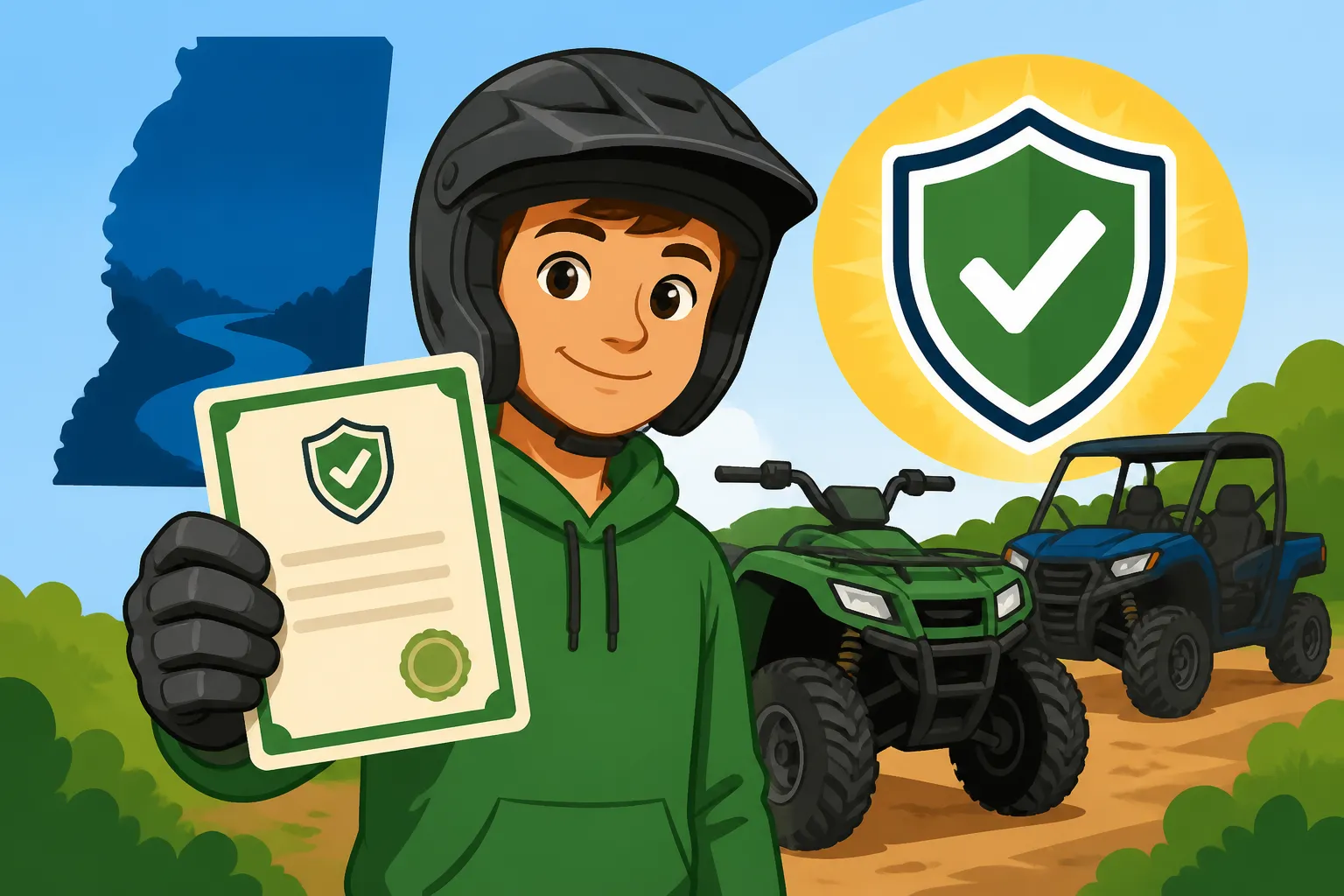
Mississippi’s public-property rules make a safety certificate important for riders under 16. A driver’s license or an accepted safety certificate may be required as proof of qualification, and a young rider who is not licensed will generally need the certificate option. The certificate is evidence of completed safety training; it is not a permit to ride anywhere.
The requirement applies to riding on public property, not simply to owning or transporting an ATV or UTV. Rules can differ between public land, a state park, a private riding park, and private property. A child who can ride on a family’s land should not assume that the same permission automatically applies on a forest trail or other public riding area.
The certificate also does not override other requirements. A rider may still need to follow age, supervision, helmet, machine-width, trail, and site-specific rules. For background on the age-related requirements, see [Mississippi Rules for Riders Under 16]. Riders under 16 should also check the separate helmet rules described in Mississippi Helmet Law for Riders Under 16.
| Riding situation | Why the certificate matters | What to check before riding |
|---|---|---|
| Public land or a designated public trail | A young rider may need a safety certificate if they do not have a driver’s license | Whether the specific site accepts the certificate and what proof must be carried |
| National forest trail | The rider may need to meet the state safety requirement as well as the forest’s access rules | Trail access, machine limits, pass requirements, and age rules |
| State park | Park rules may add steps beyond the general state requirement | Whether the park requires a waiver, proof of age, or a particular certificate |
| Private riding park | The operator sets site rules, which can differ from public-land rules | Minimum age, supervision, accepted proof, and equipment requirements |
| Private property | The public-property requirement may not apply in the same way | Owner permission, safe supervision, and any other applicable rules |
The key question is not just, “Does the child have a certificate?” It is also, “Does this place require one, and does it accept the proof we plan to bring?” Check the rules for the actual riding location before you travel.
What the certificate proves and what it does not
A safety certificate shows that the rider completed a qualifying safety course. It is different from a trail pass, a title, a registration, or a sticker. Mississippi does not issue a general ATV registration sticker that replaces the rider’s safety qualification; the certificate relates to the person, not the machine.
That distinction matters when families carry paperwork. A title or bill of sale can help establish ownership, but it does not show that a young rider completed safety training. A forest pass may provide access under the pass rules, but it does not necessarily satisfy the rider qualification rule. Likewise, having an adult with a driver’s license nearby does not automatically mean the child’s own documentation requirement is met.
A certificate also does not authorize road riding. Mississippi’s public-road rules are separate from the safety-course requirement. A rider should not treat the card as permission to use a county road, city street, or highway. For the road restrictions, see Mississippi Bans ATVs on Public Roads.
When planning a ride, keep these distinctions clear:
- The certificate is proof about the rider. It shows qualifying safety training, subject to the rules of the place where the rider will operate.
- A pass or entry document is about access. It may be required for a trail system or park but does not replace a rider qualification.
- Ownership paperwork is about the machine. A title or other ownership record does not prove that a child has taken a safety course.
- Permission is location-specific. A certificate does not open closed trails, bypass a park’s age limits, or replace permission to ride on private land.
This is why it helps to treat the certificate as one part of a pre-ride checklist rather than as a universal riding permit. The rider must satisfy the applicable rules for the machine, the location, and their age.
Getting training and carrying proof
Mississippi offers safety-course options through the Extension Service. Because not every course or card should be assumed to qualify for every riding location, confirm that the course is accepted for the young rider’s intended use before enrolling. The course details and schedules may vary, so check current information through the appropriate official channel. See Mississippi Extension Service Courses and Which ATV Safety Courses the State Will Accept for related information.
A practical process is:
- Identify where the child will ride. The rules at a national forest, state park, wildlife area, or private park may not be identical.
- Ask what proof the site accepts. Confirm whether the rider needs a certificate, whether a particular course must be completed, and whether the site accepts an out-of-state card.
- Choose a qualifying course. Check the course provider and completion requirements before signing up.
- Keep the certificate available. Carry the card or other official proof in a secure place while riding, and keep a backup copy separately.
- Recheck site rules before each trip. Access conditions and local requirements can change, and a certificate does not guarantee that a trail is open.
For a child, “carry it” should mean the proof can be produced if a ranger, park employee, or other authorized official asks to see it. A parent’s phone may be useful for a backup image, but do not assume a photo or digital copy will be accepted in place of the official certificate. Ask the course provider and riding site what form of proof they recognize.
A small waterproof document pouch can help keep a card legible around mud and water. If you use one, store it where the rider or supervising adult can reach it without leaving the machine unattended. Keep a second copy with the trip paperwork at camp or in the tow vehicle, rather than relying on one easily lost card. A product listing on Amazon may help you compare document pouches, but the pouch itself has no official status and does not replace the certificate.
Adults should also make sure the rider understands the basics the training is meant to reinforce: use the machine as designed, wear suitable protective gear, avoid riding beyond skill level, and follow the trail’s posted rules. A certificate is not a substitute for supervision, sound judgment, or an age-appropriate machine.
Visiting riders and site-by-site checks
Families visiting Mississippi should not assume that a safety card from another state is automatically accepted everywhere, or that a Mississippi certificate will meet every neighboring state’s requirements. Reciprocity can depend on the land manager, park, or other applicable rules. Before traveling, contact the place where you plan to ride and ask whether it accepts the rider’s specific certificate and what documentation the child should carry.
This is especially useful when the trip involves more than one type of riding area. A certificate accepted at one public trail may not meet a separate state park’s paperwork or age requirements. The site might also require a waiver or proof of age. If you are visiting from a neighboring state, the general visitor information for Mississippi Visitors From Alabama may help you identify other questions to ask, but the riding location is the best place to confirm its current entry requirements.
For a national forest trip, check more than the certificate rule. Verify that the route is open to the type and width of machine you plan to bring, whether a pass is needed, and whether there are additional restrictions for young riders. The information in Mississippi Forest Rules for Riders Under 16 can help frame those questions. Then check the current rules with the relevant forest office or site manager before loading the trailer.
A quick call or message before the trip can prevent a frustrating arrival. Ask:
- Does this location require a safety certificate for a rider under 16?
- Which courses or certificates does it accept?
- Is an out-of-state certificate accepted?
- Must the young rider carry the original card, or is another form of proof allowed?
- Are there separate helmet, supervision, passenger, or machine-size requirements?
- Are the trails open to this kind of ATV or UTV on the planned date?
The safest approach is to carry the rider’s official proof, keep a backup, and confirm acceptance with the specific riding site. That avoids treating a safety certificate as a pass or assuming one location’s rules apply everywhere in Mississippi.
Disclaimer
This article is for general informational purposes only and does not constitute professional advice. Laws, prices and regulations vary by location and change over time. Consult a qualified professional for guidance on your specific situation.