Closed Gates on a Wildlife Management Area Road
A closed gate on a Mississippi Wildlife Management Area road is a clear reason to stop, even if the road looks passable or your machine can fit through. WMA access does not mean every road is open to ATVs and UTVs. Here’s how to read the closure, check the rules and avoid turning a ride into a trespass or enforcement problem.
What a Closed Gate Means on a WMA Road
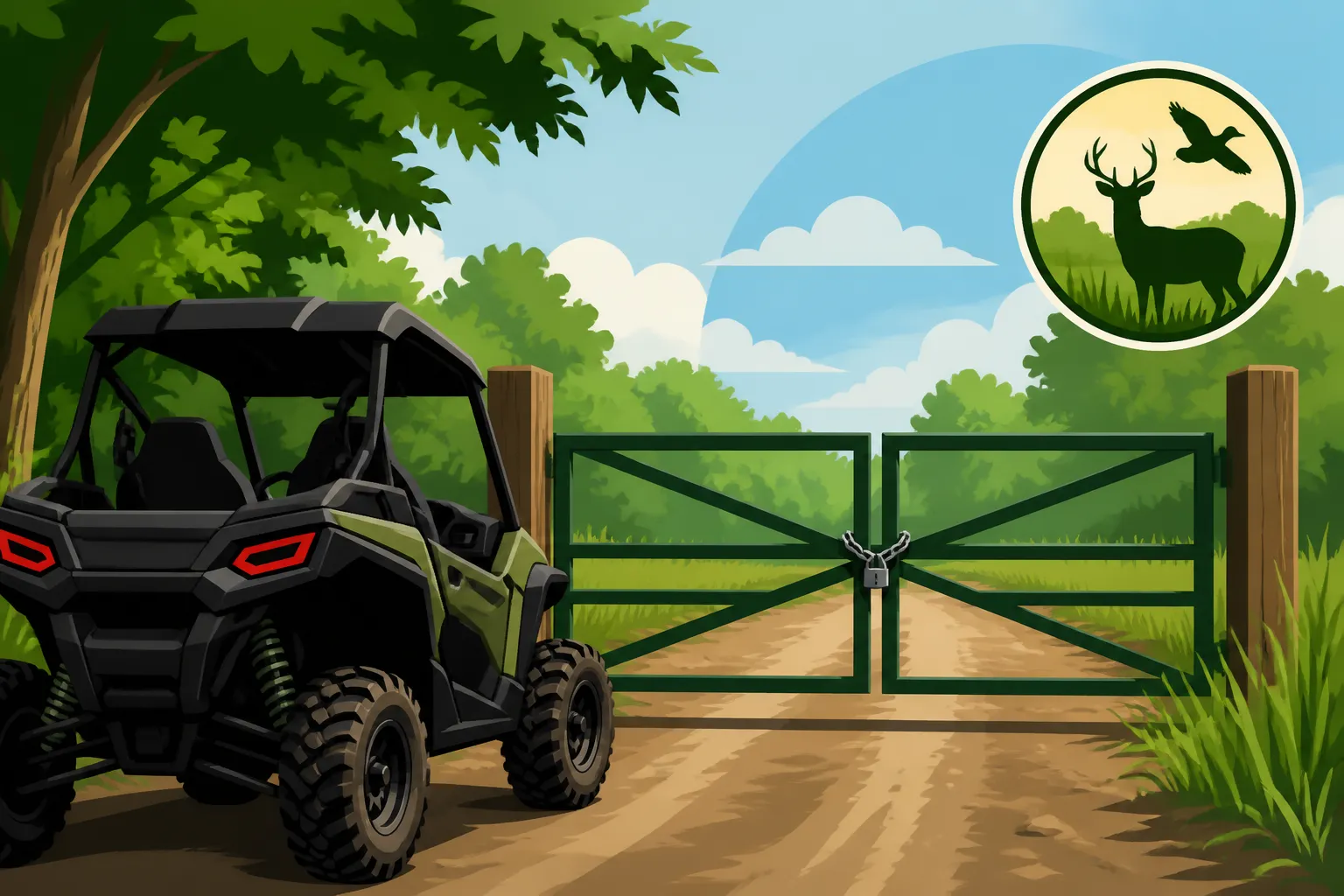
Treat a closed gate as a boundary, not an obstacle to work around. Do not lift it, drive around it, squeeze through a gap or follow a track that appears to go around the barrier. A road can be physically passable and still be closed to riders.
A gate may be there because a road is closed to motorized use, because conditions have changed, or because the land manager is protecting an area or managing access. The reason may not be obvious from the trailhead. It might relate to hunting activity, road damage, erosion, timber operations or another site-specific concern. You do not need to know the reason to follow the closure.
This distinction matters on Wildlife Management Areas because access and vehicle use are not the same thing. Being on public hunting land does not automatically authorize riding wherever there is a road. Mississippi WMA riding is limited to designated roads, and a road that is gated or posted closed should not be treated as an alternate route. For an overview, see Mississippi WMA Rules for Riders and Mississippi WMA Designated Roads Only.
A gate also does not become optional because you have a permit, hunting license, out-of-state registration or safety certificate. Those documents may matter for other parts of your visit, but they do not cancel a road closure. Likewise, a gate being open does not, by itself, prove that the road is open to ATVs or UTVs. Look for the current signs and rules for that WMA and the road you intend to use.
| What you see | A careful interpretation |
|---|---|
| A closed gate across the road | Stop. Do not pass it or go around it. |
| A road sign says closed | Follow the posted closure, even if the road appears usable. |
| An open gate with no clear access information | Do not assume it authorizes ATV or UTV use; check the WMA’s rules. |
| Tire tracks beyond a gate | Tracks are not proof that riding is currently allowed. |
| A gate or berm with no sign nearby | Treat it as a barrier and ask the managing office before proceeding. |
A barrier may be paired with a sign, but it does not have to be. A gate, earthen berm or other physical obstruction can signal that motorized access is restricted. The references Closed Gates on a Wildlife Management Area Road and Earthen Berms Blocking Roads on Public Land address the same practical point: do not mistake a route’s physical appearance for permission to ride it.
Check the Road Before You Unload
The safest time to resolve a road-access question is before the machine comes off the trailer. WMA road access can be affected by location, signs, current management decisions and seasonal conditions. A map may help you plan, but it cannot guarantee that a particular road is open today.
Start with the official information for the specific WMA you plan to visit. Check its posted notices, maps and current regulations, and contact the appropriate office if a road or gate is unclear. Do not rely only on an old map, a saved route, a social media post or directions from another rider. The road may have closed after that information was shared.
When you check, describe the exact place as clearly as possible. Give the WMA name, the road or trail name if known, the nearest entrance or landmark, and what you see at the gate. Ask whether ATVs or UTVs may use that road now, not just whether the area is open to the public. If a local office cannot confirm access, choose a route that is clearly designated and open rather than guessing.
Use this process before riding:
- Identify the exact WMA and entrance. Make sure your map or directions refer to the area you are actually visiting.
- Check current rules and notices. Look for road closures, seasonal restrictions and instructions about designated roads.
- Ask about the specific road. If signs are missing or confusing, contact the managing office before you ride.
- Review the route with your group. Make sure everyone knows which roads are allowed and where to turn back.
- Recheck at the trailhead. New signs, gates or barriers take priority over an older plan.
For practical help with interpreting access restrictions, see Mississippi WMA Road Closure Signs and Which Public Land Trails Are Closed to ATVs. If you are unsure which office to call, Which Forest Office to Call About Trail Access can help you think through the right kind of access question, though a WMA may have its own contact point.
A phone map is useful, but do not make it your only navigation tool. A downloaded map may show a road without showing a current closure, and phone service may be unreliable in some riding areas. Carry a map that covers the area and know how to return to your entrance. A waterproof map case, including one available through Amazon, can help protect a paper map from rain and mud; it does not replace current access information.
Permits Do Not Override a Road Closure
Riders sometimes confuse a general access credential with permission to use every road. Keep those questions separate. A pass, license or other required document may let you meet one requirement for visiting or riding in an area. It does not mean that every road, gate or trail is open to motorized travel.
Mississippi also does not provide an ATV registration sticker that automatically grants access across public lands. A visiting rider should not assume that a sticker or registration from another state will substitute for Mississippi land-use rules. The relevant information is covered in Mississippi Has No Sticker for a Visiting Machine and Mississippi Has Nothing to Reciprocate. Always check the requirements that apply to the particular WMA and the activity you plan to do.
The same caution applies to hunting-related access. A hunting license or permission to be on a WMA does not turn a closed road into an open ATV route. Rules for riding, parking, game retrieval and weapons can be distinct. If the purpose of your trip is to retrieve game, confirm what the WMA allows and where machine use is permitted. Do not use a closed road as a shortcut because the ride is connected to hunting.
A simple pre-trip check can prevent crossed wires:
- Confirm whether the WMA allows the kind of machine you plan to bring.
- Find out which roads are designated for motorized use.
- Check whether any required pass, license, waiver or safety document applies to your trip.
- Ask whether the road you want to use is currently open, including any seasonal or temporary closure.
- Carry any required documents, but do not treat them as permission to ignore a gate or sign.
For broader access details, review Mississippi WMA Access for a Quad and Mississippi WMA Riding on Designated Roads. If you are visiting from another state, also check Mississippi Rules for a Visiting Alabama Rider, Mississippi Rules for a Visiting Louisiana Rider or the page for your home state. Reciprocity questions and road access are related, but they are not interchangeable.
What to Do When You Reach the Gate
When a gate is closed, stop before the barrier and keep your machine on the permitted side. Do not park in a way that blocks the road, gate or access for land managers and other authorized users. If your group arrives together, make sure every rider understands that the route ends there; one person going around the gate can create a problem for the whole group.
Do not open the gate to see what lies beyond it. Even if it appears unlocked, moving it could interfere with the land manager’s access controls or lead other riders to believe the road is open. If the sign says to contact someone, follow the instructions. If the closure is unclear, record the location and contact the managing office from a safe place. A photo of the sign or gate can help you describe what you encountered, but do not cross the barrier to take it.
Then choose a route that is clearly open and designated. If no suitable route is available, turn around or leave the area. That may be frustrating after a long drive, but it is safer than relying on tire tracks, assumptions about public land or a route someone used in the past. For more on what to do around a barrier, see Riding Only Designated Roads on a Management Area and Closed Gates on a Wildlife Management Area Road.
If you believe a sign is damaged, missing or inconsistent with information you received, do not decide on the spot that riding is allowed. Contact the relevant office and explain the discrepancy. Until you receive a clear answer, use another route. Keep any confirmation with your trip information, but remember that a verbal answer about one road or date may not apply to a different road or a later visit.
Before leaving home, make a backup plan: identify an alternate legal riding location, check current access information and tell your group that a closed gate means the route is off limits. Respecting the barrier protects the area, avoids unnecessary conflict and gives you a clear decision when the road ahead is uncertain.
Disclaimer
This article is for general informational purposes only and does not constitute professional advice. Laws, prices and regulations vary by location and change over time. Consult a qualified professional for guidance on your specific situation.