Mississippi Lighting Rules on a Machine
One of the trickiest things about riding ATVs and UTVs in Mississippi is the sheer lack of clear, comprehensive state laws. This often leaves riders scratching their heads, especially when it comes to things like lighting. You want to be safe, you want to be legal, but when the state law is practically silent, what’s a rider to do? This guide will cut through the confusion and help you understand the practical realities and best practices for lighting your machine in Mississippi, whether you're navigating dense trails or just trying to be seen.
The Core Rule: Mississippi Bans ATVs on Public Roads
Let's start with the elephant in the room that dictates so much about ATV laws here in Mississippi: the state's very firm stance on where these machines can and cannot be ridden. For all intents and purposes, [Mississippi Law Flatly Bars ATVs From Public Roads]. This isn't just a suggestion; it's the foundation upon which almost all other regulations (or lack thereof) are built.
What This Means for Lighting on Roads
Because your ATV or UTV is generally prohibited from being on public roads, the state of Mississippi doesn't have a specific, detailed code outlining required headlights, taillights, turn signals, or reflectors for ATVs to be "street legal." And honestly, that's where a lot of the confusion comes from. If the machine isn't supposed to be on the road, why would there be laws about its road-specific lighting? It makes perfect sense in a logical vacuum, but it doesn't help you much when you're trying to figure out if your rig is properly equipped.
This doesn't mean you'll never briefly cross a road or use a short section of shoulder to get from one section of private land to another. In these fleeting moments, visibility becomes paramount, even if state law isn't explicitly mandating a certain type of bulb. You might not need a high-beam headlight to drive down Highway 49, but you absolutely need something to make yourself visible if you're just trying to get across a county road. The frustration is real because what's legally required and what's practically safe are two very different things in this scenario.
The Exceptions: Private Land and Local Ordinances
So, if state law isn't dictating your lighting, who is? Primarily, it boils down to the rules of the land you're riding on. If you're on private property, the landowner sets the rules. They might require certain lighting if you're riding at night for safety reasons or just to keep things orderly. This is incredibly common for hunting clubs or large acreage where night riding might happen during hunting season or for general property maintenance.
Beyond private land, local municipalities can pass ordinances that govern ATV use within their city limits. However, when it comes to ATVs, [Mississippi Towns That Refuse ATVs on Streets] are far more common than towns that embrace them. While some cities might have specific rules for golf carts or low-speed vehicles, these rarely extend to ATVs or UTVs, and even more rarely do they specify lighting requirements for ATVs unless they're outlining a very limited, specific road-crossing scenario. You might find a town that allows a golf cart to cross certain streets and requires a headlight for that, but that almost never translates to your quad. It’s a patchwork, and it’s up to you to check.
Essential Lighting for Off-Road Riding Safety
Even without explicit state mandates, any experienced rider will tell you that proper lighting is absolutely non-negotiable for safe and enjoyable off-road adventures. The sun goes down, weather changes, and dense woods get dark quickly.
Headlights: Seeing and Being Seen
Your machine's headlights are your primary tool for navigating in low-light conditions. Factory headlights are a good starting point, but they often leave a lot to be desired, especially if you're venturing into truly dark terrain or riding at speed. Think about riding down a tight trail after a long day of hunting, when the light is fading fast. A dim, yellow factory beam isn't going to cut it when a deer could dart out or a fallen log could be hidden in the shadows.
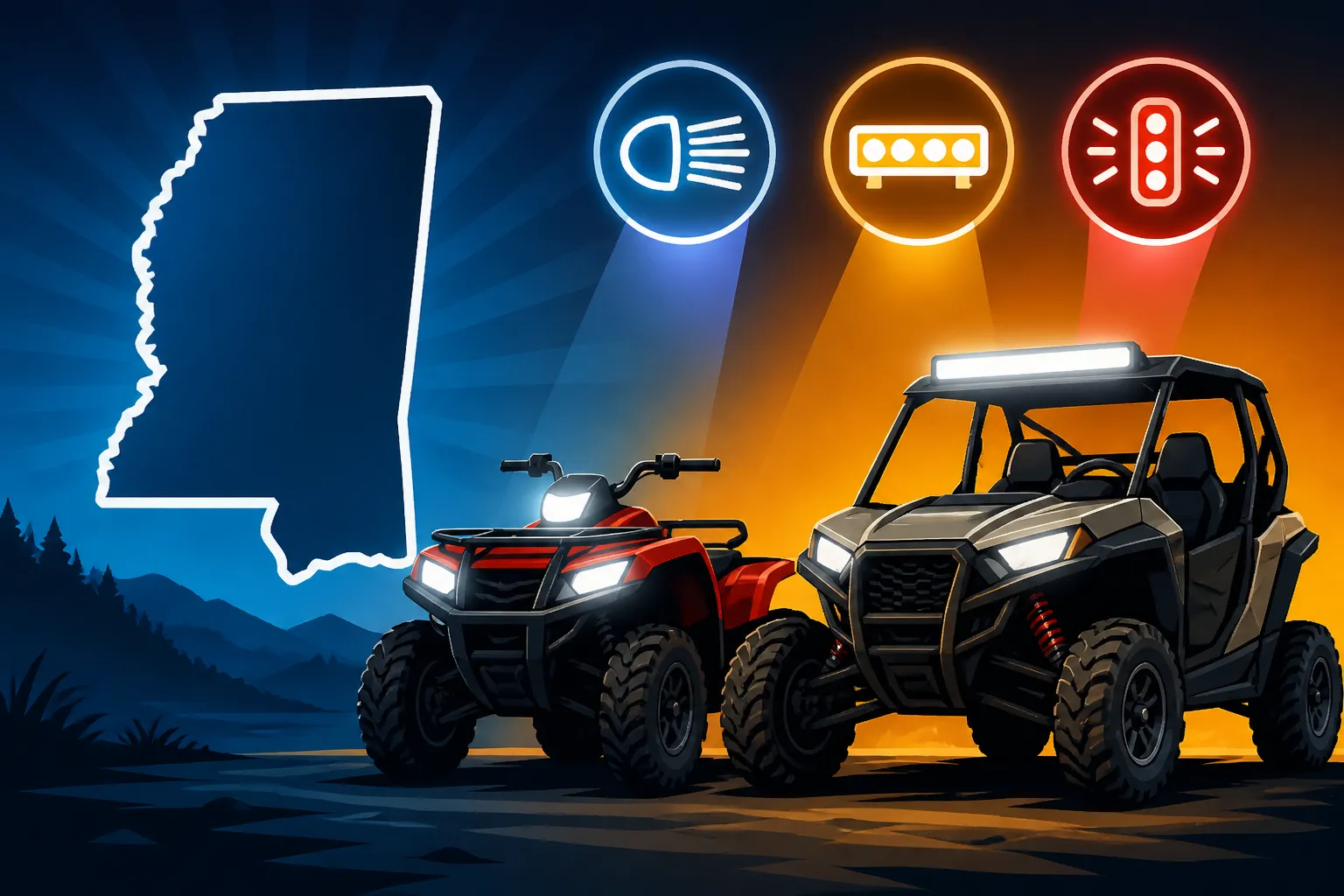
Many riders choose to upgrade their headlights or add auxiliary light bars to cast a wider, brighter beam. These upgrades aren't about being street-legal; they're about preventing accidents and improving your riding experience. You'll find options ranging from focused spot beams that cut through the darkness far ahead to wide floodlights that illuminate the entire trail and its surroundings. Brands like SuperATV offer a range of aftermarket LED light bars and pod lights that can make a huge difference in your night vision and overall confidence on the trail.
Taillights and Brake Lights: Crucial for Group Rides
While headlights help you see, taillights and brake lights help others see you. This is especially critical when you're riding in a group. Imagine following a buddy through a cloud of dust on a gravel road or navigating a tight section of trail where visibility is already poor. A bright taillight, and especially a functioning brake light, provides crucial information to the riders behind you, letting them know if you're slowing down or stopping. This prevents rear-end collisions and keeps the whole group safer.
Even if you primarily ride alone, having a functioning taillight adds a layer of safety. Should you ever find yourself needing assistance or crossing a very brief section near a public area (even unintentionally), being visible from the rear can make all the difference. This isn't just about avoiding a citation; it's about common sense and looking out for yourself and others.
Auxiliary Lighting: Light Bars, Rock Lights, and Whips
The world of aftermarket ATV and UTV lighting goes far beyond basic headlights and taillights. Many riders outfit their machines with a variety of auxiliary lights for specific purposes:
- Light Bars: We've already touched on these, but they deserve a special mention. Mounted on the roof, bumper, or A-pillars, these can turn night into day, offering massive illumination for high-speed trail riding or scouting large areas.
- Rock Lights: These small, powerful LED lights are typically mounted underneath the machine or in the wheel wells. They illuminate the terrain directly beneath your tires, which is invaluable for technical rock crawling or navigating deep ruts where precise wheel placement is key.
- LED Whips: Often seen at [Mississippi Private Mud Parks] or large riding events, LED whips are tall, flexible poles with built-in LEDs that make your machine highly visible from a distance, even over hills or through dusty conditions. They're especially popular for night rides, adding both safety and a bit of flair. Many parks might even require them for night riding for safety reasons.
Adding these types of lights isn't just about aesthetics; it's about truly enhancing your safety, capability, and the sheer enjoyment of riding in diverse conditions.
| Light Type | Primary Purpose | Best Use Case | Common Features |
|---|---|---|---|
| Headlights | Basic forward illumination | General trail riding, dawn/dusk | High/low beam, LED or Halogen, integrated |
| Taillights | Rear visibility | Group riding, dusty conditions, parking | Red, integrated or surface mount |
| Brake Lights | Signify deceleration | Group riding, preventing rear-end collisions | Brighter red when brakes applied, integrated |
| Light Bars | High-intensity, wide-area illumination | High-speed trails, open fields, night exploration | LED, various lengths, flood/spot/combo beams |
| Pod Lights | Focused, compact illumination | A-pillar mounts, reverse lights, specific spots | LED, small form factor, spot/flood options |
| Rock Lights | Under-body terrain illumination | Technical crawling, deep ruts, night maintenance | Small LED, waterproof, wide angle |
| LED Whips | High-visibility marker | Mud parks, large events, open desert at night | Tall, flexible, multi-color LEDs, often remote-controlled |
Understanding Local Ordinances and Park Rules
Given the state's hands-off approach to ATV road-use lighting, the real "rules" you need to pay attention to often come from a more localized level.
When Local Rules Override State Silence
While Mississippi state law doesn't provide specific lighting mandates for ATVs, local governments (cities and counties) do have the authority to pass their own ordinances. The trick is, most of these ordinances tend to focus on prohibiting ATVs from public roads rather than regulating their equipment. However, in the rare instance that a local jurisdiction allows very specific, limited ATV use on public roads (for example, crossing a particular street or moving between farm fields on a short section of county road), they might include a requirement for basic lighting, such as a functional headlight and taillight, to ensure visibility during these brief traversals.
It's absolutely critical to understand that these local allowances are exceptions, not the rule, and they can vary wildly from one town to the next. You can't assume that just because one town has a golf cart ordinance, it applies to your side-by-side. Before you even think about putting a tire on a paved surface in a new area, you need to conduct [Mississippi Ordinance Lookups Before You Ride]. It’s your responsibility to know what applies in that specific jurisdiction.
Park-Specific Lighting Requirements
Beyond city limits, the rules of private riding parks and public trail systems are where you'll most often encounter explicit lighting requirements. Places like [Red Creek Off-Road in Mississippi] or public lands like [Bethel OHV Trails in Mississippi] often have their own specific rules for machines entering their property, especially if they allow night riding.
For example, a mud park might require a bright white headlight and a red taillight for any machine operating after dark. Some might even mandate LED whips for increased visibility across large, open areas, or during particularly dusty conditions. These rules are put in place for everyone's safety, helping to prevent collisions and ensure that all riders can see and be seen. Always check the park's website or call ahead to confirm their specific regulations before you load up your machine. Ignoring these rules could not only lead to a fine or expulsion but could also put you and others in harm's way.
Practical Tips for ATV/UTV Lighting in Mississippi
Since there's no overarching state guidance, taking a proactive and common-sense approach to your ATV or UTV's lighting is the smartest way to ensure safety and avoid potential headaches.
Pre-Ride Checks and Maintenance
Just like checking your tires and fluids, making sure your lights are in working order should be part of your routine pre-ride inspection. It doesn't matter how many fancy light bars you have if they don't turn on! Before every ride, especially if you anticipate being out at dawn, dusk, or after dark, take a few minutes to:
- Test all lights: Headlights (high/low beam), taillights, brake lights, and any auxiliary lights.
- Clean lenses: Mud, dust, and grime can drastically reduce light output. Keep them clean for maximum visibility.
- Check wiring: Ensure all connections are secure and free from corrosion or damage, especially after a rough or wet ride. [Mississippi Trail Conditions After Rain] can be brutal on electrical components, so a quick visual inspection can save you a lot of trouble.
- Carry spares (if applicable): If your machine uses traditional bulbs, having a spare headlight or taillight bulb can be a lifesaver on a long trip. For LED systems, this is less common, but carrying tools for a quick wire repair is always a good idea.
Functional lighting is more than just an accessory; it’s a critical safety system that deserves regular attention.
Choosing the Right Lighting for Your Needs
The "best" lighting setup really depends on where and how you ride. If you primarily stick to open fields during daylight hours, your factory lights might be perfectly adequate. But if you're exploring deep woods, tackling challenging terrain, or participating in night rides, you'll want to invest in more robust solutions.
Consider the following when choosing your lighting:
- Riding environment: Dense woods require more flood lighting to see obstacles close up, while open trails might benefit from a spot beam to see further ahead. Mud pits often demand very bright, waterproof lights.
- Power draw: Be mindful of your machine's electrical system capacity. Adding too many high-wattage lights can overload your stator or battery. LED lights are generally much more efficient than old-school halogen.
- Durability: Off-road riding is tough on equipment. Look for lights that are waterproof (IP67 or IP68 rated), shock-resistant, and have robust housings. Again, brands like SuperATV are known for building products that can stand up to the rigors of the trail.
- Beam pattern: Do you need a wide flood, a focused spot, or a combination? Many light bars offer hybrid patterns for versatility.
- Visibility vs. Illumination: Some lights are designed to make you more visible to others (like LED whips or bright taillights), while others are meant to help you see the trail (like powerful headlights or light bars). Balance these needs based on your typical riding.
When in Doubt, Light It Up!
Here’s the simplest, most practical advice for ATV and UTV lighting in Mississippi: if you’re unsure, always err on the side of having more and better lighting. Even when there isn't a specific law demanding it, having functional, bright lights enhances your safety and the safety of those around you. You'll see obstacles sooner, you'll be seen by other riders, hunters, or even a local deputy if you're near a public road.
The state might be quiet on the topic, but common sense and personal safety should never be. Whether it's to navigate a tricky section of trail after sunset, to be seen by other vehicles during a brief road crossing, or simply to ensure you're visible at a busy riding park, making sure your machine is well-lit is a smart move for any Mississippi rider.
Disclaimer
This article is for general informational purposes only and does not constitute professional advice. Laws, prices and regulations vary by location and change over time. Consult a qualified professional for guidance on your specific situation.