Who Pays When a Rider Hits a Timberland Gate
Few things can make your heart sink faster than realizing you've just damaged someone else's property while out enjoying a ride, especially something as sturdy and unforgiving as a timberland gate. Whether it was an accidental bump, a misjudgment of speed, or simply not seeing it until it was too late, that moment of impact can quickly turn a fun day into a headache of worry, leaving you wondering, "Who on earth is going to pay for this?" This guide is here to walk you through the often-confusing aftermath of such an incident in Mississippi, helping you understand the liabilities, responsibilities, and practical steps when an ATV or UTV meets a timberland gate.
The Unexpected Encounter: Why Timberland Gates Are There
Riding ATVs and UTVs in Mississippi is a beloved pastime, offering miles of beautiful scenery and thrilling adventures. However, many riders find themselves on or near privately owned timberland, which is often crisscrossed with gates. Understanding why these gates are there is the first step in appreciating the potential legal and financial ramifications of damaging one.
The Purpose of Private Land Gates
Timber companies, private landowners, and even hunting clubs invest heavily in their properties, and those gates are more than just a decorative entryway. They serve crucial functions, primarily revolving around security and access management. For timber companies, gates protect valuable assets like logging equipment, freshly cut timber, and even young saplings from theft or vandalism. They also control access to ensure worker safety during active logging operations and to prevent unauthorized entry that could lead to liability issues. For private landowners, gates are about protecting their privacy, deterring trespassers, and securing their property from illegal dumping, poaching, or property damage. Imagine someone driving a heavy vehicle over freshly graded logging roads during a rainy season, ruining the surface for the next logging operation. These gates are there to prevent exactly that kind of costly interference.
Many of these gates are robust, built to withstand heavy use and deter determined trespassers. They might be simple chain-and-post setups, heavy-duty metal swing gates, or even electronic access gates. The cost of these gates, especially custom-built ones designed for commercial timber operations, can be significant. Damage to these gates isn't just a minor repair; it often involves specialized welding, heavy-duty hardware replacement, or even complete reconstruction, leading to substantial costs for the landowner. They're not just a barrier; they're an integral part of property management and security.
The Hidden Risks of Riding Unfamiliar Land
One of the biggest pitfalls for riders in Mississippi is venturing onto land without explicit permission. It's easy to assume that if a trail looks open or unmaintained, it's fair game, but that's a dangerous assumption. Many timber roads and old logging paths might seem like public access, but they are almost always on private property. [Mississippi Trespass Law for Riders] is clear: riding on private land without permission is trespassing, regardless of whether there are "No Trespassing" signs. A gate, even an open one, is a strong indicator of private property.
The risks go beyond just legal trouble. Unfamiliar timberland can hide a multitude of hazards: downed trees, sharp stumps, deep ruts, hidden ditches, or even active logging operations. These are all things that can contribute to an accident, especially when combined with high speeds or inattention. An unexpected turn or a sudden obstacle can easily send a machine veering off course, directly into a gate. Furthermore, many gates are positioned after a bend or a rise in the trail, making them difficult to see until the last moment, particularly if you're riding too fast for conditions or are distracted. It's crucial for every rider to know exactly where they are permitted to ride and to always be prepared for the unexpected, especially when the terrain isn't familiar.
Determining Liability: Who's on the Hook?
When a timberland gate is damaged by an ATV or UTV, the question of who pays quickly becomes the central concern. In most cases, the answer boils down to responsibility and legal precedent.
The Rider's Responsibility
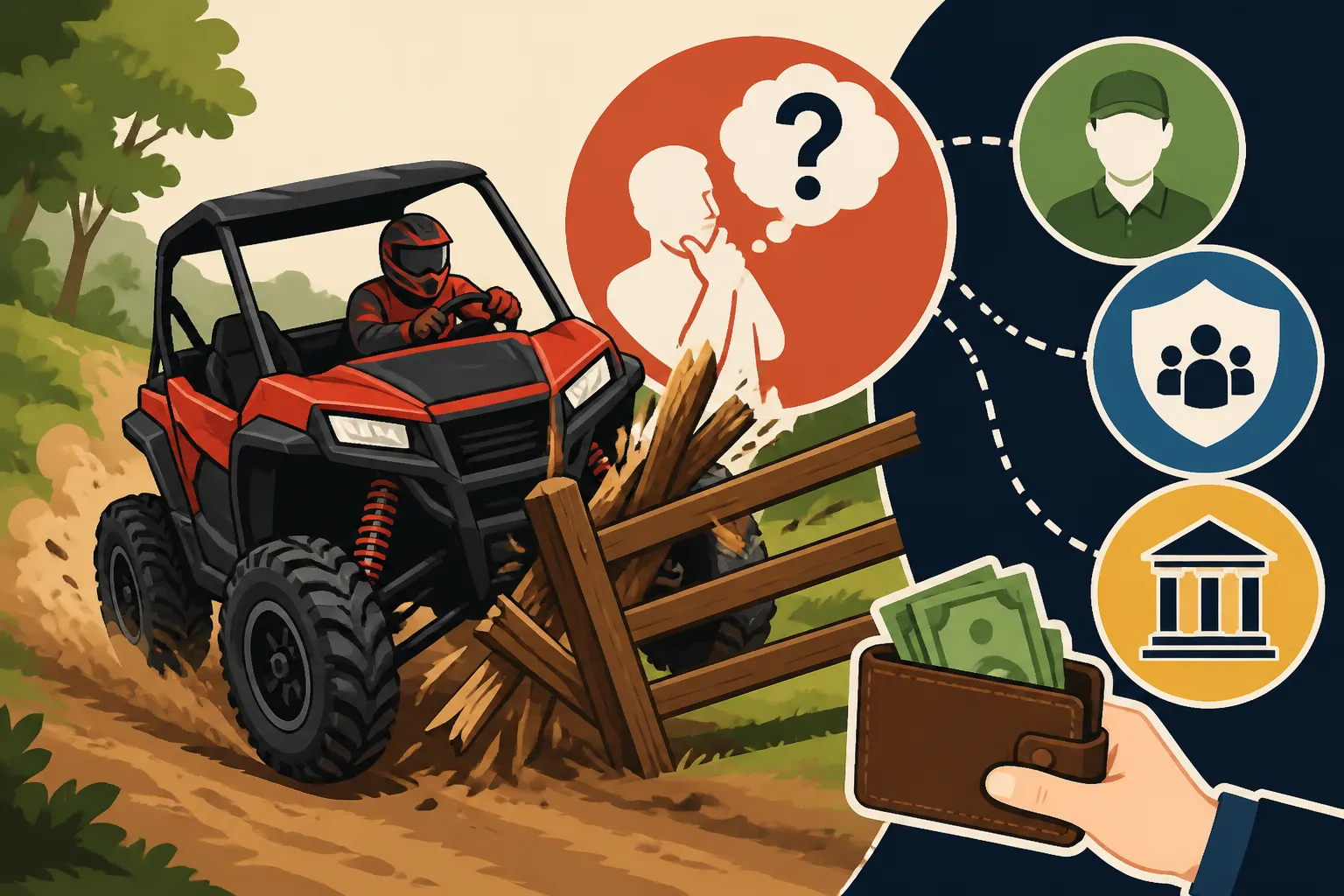
In almost all scenarios where a rider hits and damages a timberland gate, the primary liability for the damage falls squarely on the rider. This is fundamental civil law: if you damage someone else's property, you are responsible for making them whole, meaning you must cover the cost of repairs or replacement. This holds true whether the damage was intentional or accidental. For example, if you misjudged a turn on a wet logging road and slid into a gate, you're responsible. If you were attempting to bypass a closed gate and accidentally drove into it, you're responsible. Even if you argue the gate was poorly placed or difficult to see, the onus is on the operator of the vehicle to maintain control and be aware of their surroundings.
The landowner, in this situation, is the aggrieved party. They have suffered a financial loss due to the damage to their property. Their immediate concern will be getting the gate repaired or replaced so they can continue to secure their land and manage access. They will expect the responsible party—you, the rider—to cover these costs. This isn't just about the physical gate; it can also include any associated costs like temporary security measures, administrative fees for arranging repairs, or even loss of revenue if the gate damage affects their ability to conduct business, though this is less common for a simple gate strike.
Trespass and Aggravated Damages
The situation becomes significantly more serious if the rider was trespassing when the incident occurred. As mentioned, riding on private timberland without explicit permission is illegal in Mississippi. When property damage occurs during an act of trespass, the legal consequences can be far more severe than simple civil liability. Not only would you be responsible for the cost of repairing the gate, but you could also face criminal charges for trespassing and potentially for property damage, depending on the extent and nature of the damage.
In some cases, the landowner might pursue "aggravated damages," especially if there's evidence that the rider was attempting to force entry, intentionally bypass the gate, or if the damage was extensive. Trespassing can turn a simple accident into a more contentious legal battle, potentially involving court fees, fines, and even a criminal record. It really underscores the importance of only riding on designated trails or with explicit, written [Mississippi Landowner Permission Forms]. The best advice is always to respect private property boundaries to avoid these compounded legal and financial headaches.
Factors Influencing the Cost
The actual cost of a damaged timberland gate can vary widely depending on several factors. The type of gate plays a huge role. A simple barbed wire gate might only cost a few hundred dollars to repair, involving new wire and posts. However, a heavy-duty steel pipe gate, especially one that's custom fabricated for a wide timber road, could easily run into thousands of dollars for materials and specialized labor. If the gate was electronic or had integrated security features, the costs would escalate even further, possibly requiring specialized technicians.
Beyond the gate itself, the cost can also be influenced by any damage to surrounding property. Did the incident damage a fence line attached to the gate? Was there any environmental impact, like fluid leaks from the ATV that need remediation? Also, don't forget labor costs. A landowner might have to hire a crew to transport and install a new gate, which adds significantly to the bill. Sometimes, they might even seek compensation for the inconvenience or lost time managing the repairs. It's not just the materials; it's the entire process of getting the gate back to its original condition. For any repair, you might consider if aftermarket parts from companies like SuperATV could be used, but ultimately, the landowner specifies what they deem acceptable for their property.
| Factor | Impact on Cost (Generally) | Example Scenario |
|---|---|---|
| Type of Gate | Low for simple, High for heavy-duty/electronic | Chain & posts vs. custom steel gate with automated opener |
| Extent of Damage | Low for minor repairs, High for full replacement | Bent hinge vs. completely demolished gate and posts |
| Labor Costs | Adds significantly, especially for skilled trades | Landowner repairs themselves vs. hiring professional welders/installers |
| Associated Damages | Increases if fences, landscaping, or utilities are affected | Damaged fence posts alongside the gate, broken conduit for gate opener |
| Property Type | Timberland often has robust, costly gates | Rural residential driveway gate vs. industrial-grade timber road gate |
| Remote Location | Can increase labor and transport costs | Easy access from paved road vs. miles deep into a forest on unpaved roads |
The Role of Insurance: Will Your Policy Help?
When faced with a repair bill for a damaged timberland gate, the natural thought turns to insurance. However, the world of ATV/UTV insurance can be a bit nuanced, and it's important to understand what your policy might and might not cover in these specific circumstances.
ATV/UTV Insurance
Many responsible riders in Mississippi carry ATV or UTV insurance, even though it's not legally mandated for off-road use. If you have liability coverage on your ATV or UTV policy, it might offer some protection in this scenario. Liability insurance is designed to cover damages you cause to other people's property or injuries you cause to others. So, in theory, if your machine accidentally hits a gate, your liability coverage could kick in to pay for the repairs. However, there are crucial caveats.
Most insurance policies have specific exclusions. For instance, if the damage occurred while you were intentionally trespassing, many policies will deny the claim. Insurance companies generally don't cover damages resulting from illegal activities. There might also be exclusions for gross negligence or reckless behavior. It's vital to review your specific policy documents or speak directly with your insurance agent to understand the exact terms and conditions. Don't assume anything. [Mississippi Comprehensive Coverage for a Quad] often includes liability, but the circumstances of the incident are key.
Homeowner's or Renter's Insurance
Some people wonder if their homeowner's or renter's insurance policy might provide coverage. Generally, this is unlikely for an incident involving an ATV or UTV. Most homeowner's policies have exclusions for motor vehicles, especially those designed for off-road use. While a homeowner's policy might cover liability if, for example, a guest tripped over something on your property, it typically won't extend to incidents caused by your off-road vehicle away from your home.
There might be very specific, rare instances where a personal liability umbrella policy could offer a thin layer of protection beyond your primary ATV policy, but even those often have similar exclusions for illegal acts or motor vehicles. Again, it's absolutely essential to consult your specific policy and speak with your insurance provider. You don't want to find out after the fact that you're entirely on the hook because of a policy exclusion you weren't aware of.
Consequences of Riding Uninsured
If you don't have ATV/UTV insurance, or if your policy denies the claim due to exclusions (like trespassing), then the entire financial burden of repairing or replacing the timberland gate falls directly on you. This means out-of-pocket expenses that could range from a few hundred to several thousand dollars, depending on the severity of the damage. For many riders, this can be a significant unexpected expense, highlighting [What Southern Owners Wish They Budgeted] for potential incidents.
Beyond the direct financial cost, riding uninsured means you're completely exposed to legal action. The landowner could sue you in civil court to recover their damages. If they win, you could be ordered to pay not only the repair costs but also court fees and potentially legal fees incurred by the landowner. This can lead to wage garnishment, liens on your property, or other collection efforts, turning a single unfortunate incident into a long-term financial nightmare. It reinforces the importance of being fully prepared, both in terms of legal access to land and adequate insurance coverage, before you even start your engine.
What to Do If It Happens: Practical Steps
Discovering you've hit a timberland gate is a stressful experience, but how you handle the immediate aftermath can significantly influence the outcome. Taking the right steps can mitigate further issues and help you work towards a resolution.
Stopping and Assessing the Damage
First and foremost, do not leave the scene. This is critical. Fleeing the scene of property damage, especially if it's significant, can lead to much more serious legal consequences, potentially elevating a civil issue into a criminal one, similar to a hit-and-run. Stop your machine in a safe location, turn off the engine, and take a deep breath.
Next, carefully and safely assess the damage to both the gate and your machine. Are you or any passengers injured? Prioritize safety. Once you've ensured no one is hurt, examine the gate closely. What type of gate is it? What exactly is damaged (posts, hinges, chain, lock, electronic components)? How severe is the damage? Is your ATV or UTV also damaged? This initial assessment is crucial for the next steps. Ignoring the situation or trying to fix it yourself without reporting it could lead to accusations of further damage or even theft if you remove parts of the gate.
Documenting the Incident
Documentation is your best friend in situations like this. Use your smartphone to take clear, comprehensive photos and videos of everything. Start with wide shots that show the overall scene, including the approach to the gate, the gate's position, and the surrounding area. Then, get close-up photos of all the damage to the gate from multiple angles. Capture any specific hardware, bent metal, broken wood, or snapped chains. Also, take photos of your ATV or UTV, especially any damage sustained by your machine, as this can help corroborate your story.
Note the exact location (GPS coordinates if your phone has them, or clear landmarks), the date, and the time of the incident. If there were any witnesses, gather their contact information. This detailed documentation will be invaluable if you need to file an insurance claim, speak with the landowner, or potentially deal with law enforcement. It provides objective evidence of the scene as it was immediately after the incident. If you ever have to report an accident, even off-road, having all this information ready will make the process much smoother. [Mississippi Accident Reporting for an ATV Crash] may apply to certain situations, so being prepared is key.
Contacting the Landowner
This is arguably the most difficult but essential step. You must attempt to contact the landowner. If it's a timber company, look for signs with contact information. If it's private land, you might have to do some research with county property records, which are often public. The county tax assessor's office can typically provide landowner information for a specific parcel.
When you make contact, be honest and upfront. Explain what happened, express your regret, and offer to make things right. Avoid making excuses or trying to shift blame. Your candor and willingness to take responsibility can go a long way in de-escalating the situation and fostering a more cooperative resolution. Provide them with the documentation you gathered. They will likely want to come inspect the damage themselves, and being cooperative during this process is crucial.
Working Towards a Resolution
Once you've made contact with the landowner, the goal is to work towards a fair resolution. This typically involves paying for the repairs or replacement of the gate. If you have liability insurance and the claim is approved, your insurance company will handle the negotiation and payment with the landowner. If you're paying out-of-pocket, you'll need to agree on a cost. The landowner might get quotes from contractors, or you might mutually agree on a fair price based on your assessment and their knowledge of the gate's value.
Be prepared for the possibility of a legal challenge, especially if the damage is substantial or if you were trespassing. The landowner has every right to pursue legal action if you don't cooperate or pay for the damages. Resolving the issue amicably and quickly is almost always in your best interest to avoid further legal fees and stress. If trespassing was involved, there could also be fines or citations. Remember, a straightforward approach and a genuine willingness to rectify the situation are often the best path forward, saving you from more severe consequences like those detailed in [What Happens When a Deputy Stops You Riding].
Disclaimer
This article is for general informational purposes only and does not constitute professional advice. Laws, prices and regulations vary by location and change over time. Consult a qualified professional for guidance on your specific situation.