How to Check If Your Town Has an Ordinance
A ride that starts on a trail can quickly turn into a legal headache if the route crosses a town street. Mississippi ATV and UTV rules do not make every local road open to off-road machines, and a golf-cart ordinance may not cover your vehicle. This guide shows you how to find, read, and confirm the local ordinance before you ride.
Start With the Difference Between State and Local Rules
Do not assume a town ordinance overrides every road restriction
Mississippi’s statewide rules set important limits on where an ATV or UTV may be operated. A town ordinance may address certain vehicles or streets, but its existence does not automatically mean every ATV or side-by-side can use public roads. Start by understanding the general state framework, then check whether your specific municipality has a valid rule that applies to your machine and intended route.
For a broader explanation of the state-level framework, see [Mississippi ATV Road Rules Under 63-31-3] and [Mississippi Bans ATVs on Public Roads]. The practical point is simple: treat public-road riding as prohibited unless you have confirmed that a clearly applicable rule allows the specific use you have in mind. Do not rely on a neighbor’s routine, a social-media post, or the fact that a machine has lights and mirrors.
Local rules can also be narrower than riders expect. An ordinance may cover golf carts or low-speed vehicles but not ATVs, or it may allow only certain streets, crossings, hours, or vehicle types. That is why [Mississippi Local Ordinances Are the Only Path] is a useful companion topic: the wording and scope of the local rule matter, not just the fact that a town has passed an ordinance.
Confirm whether you are inside the town’s limits
A mailing address does not always tell you whether a property or road is inside municipal boundaries. Someone may say they live “in town” because their address uses the town name, while the actual property sits outside the incorporated area. Conversely, a short stretch of road that feels rural may lie within city limits.
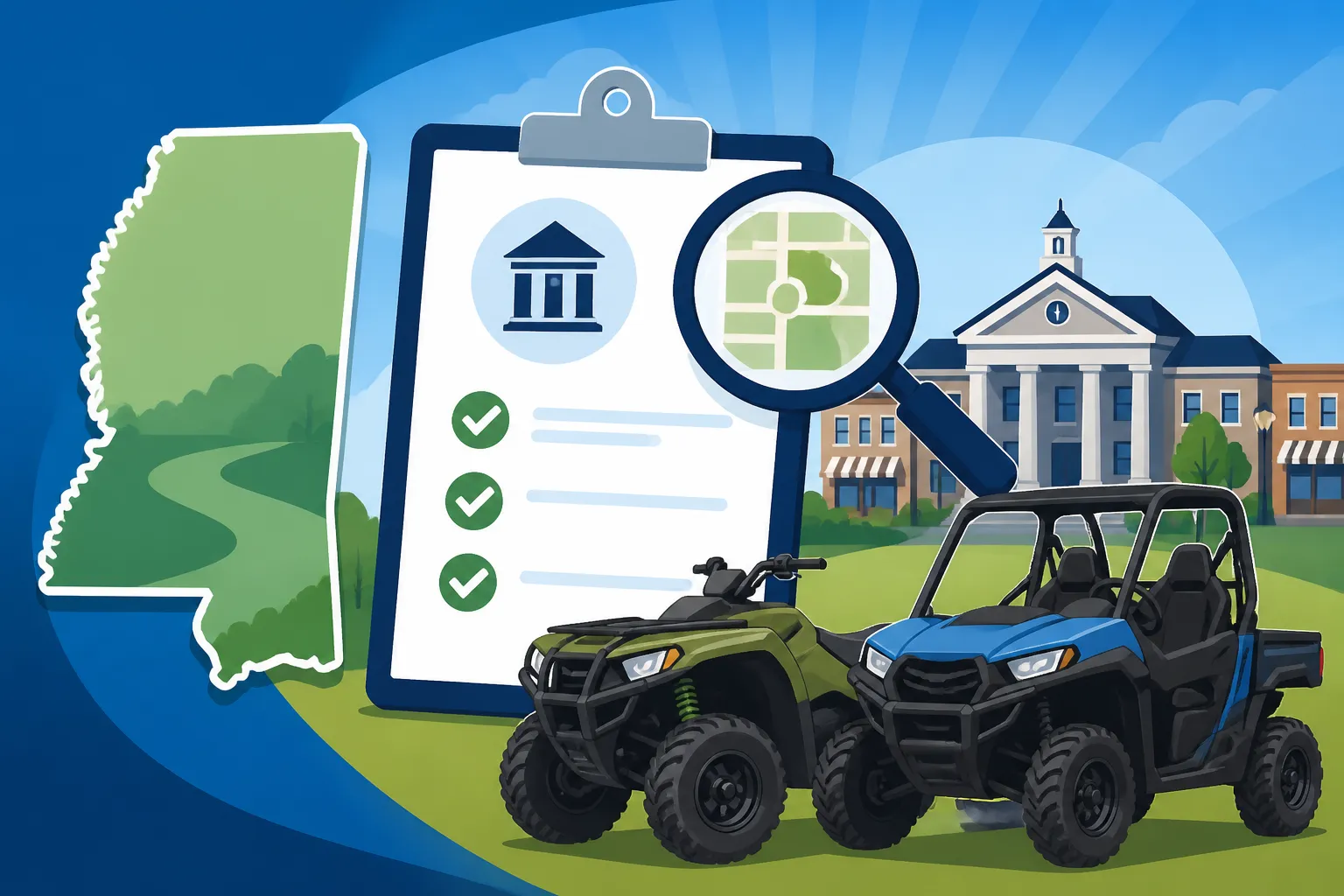
Check the municipality’s official boundary map, planning or zoning map, or ask the town clerk to confirm the location. If you want to ride from your driveway to a trail, identify the entire route—not just your starting point. A route may pass through town limits, leave them, then enter another municipality. Each section can have a different authority and set of rules.
Keep the road names and intersections handy when you ask. “Can I ride near my house?” is hard to answer accurately. “Does the ordinance allow this type of machine on Pine Street between the county road and the trail entrance?” gives the clerk a concrete question to investigate.
Separate public streets, private roads, and trails
The word “road” is used casually for very different places: a public city street, a county road, a private subdivision lane, a logging road, a trail, or a path across private property. The legal rules may differ depending on who owns or controls the route.
Ask who maintains the road and whether it is public or private. A private road is not automatically open to everyone, and permission from one landowner does not necessarily authorize riding on a public road. Likewise, a trail on private land may have its own owner’s conditions, posted restrictions, or park rules.
Before planning a ride, write down the route and classify each section as best you can. If you cannot determine whether a road is public, private, or inside municipal limits, pause and ask the appropriate town, county, landowner, or land manager. A few minutes of checking can prevent a costly misunderstanding later.
Find the Ordinance in Official Local Records
Search the municipality’s website with specific terms
Start with the official website for the town or city, not a general search result or an online discussion. Look for pages labeled “Code of Ordinances,” “Municipal Code,” “City Clerk,” “Board of Aldermen,” or “Public Records.” Use search terms such as “ATV,” “all-terrain vehicle,” “off-highway vehicle,” “UTV,” “side-by-side,” “golf cart,” and “low-speed vehicle.”
Try searching the municipality’s name alongside the vehicle term. If the result points to a third-party code library, confirm that it is the town’s official code or that the municipality identifies it as its current code. An old meeting agenda, draft ordinance, or news article may describe a proposal that never took effect.
If an online search turns up nothing, that does not prove no ordinance exists. The code may use a different term, be available only through the clerk’s office, or be organized under traffic, motor vehicles, public safety, or street use. Use [Mississippi Ordinance Lookups Before You Ride] as a reminder to verify the actual rule rather than stopping at the first search result.
Call or email the town clerk with a precise question
When the code is hard to navigate, contact the town clerk or municipal office. Ask whether the municipality has an ordinance that authorizes ATVs or UTVs on public streets, and request the ordinance number, text, or official link. If the answer is that “golf carts are allowed,” ask specifically whether that language includes your type of vehicle.
A useful message might read: “I have a two-seat side-by-side classified by its manufacturer as an off-highway vehicle. Does the town have a current ordinance allowing this vehicle on public streets? If so, could you point me to the ordinance and any street, equipment, permit, or time restrictions?” Add the street names if you are asking about one route.
Keep the response and any code copy with your ride paperwork. If the clerk says the issue is handled by the police department or a board, ask who can provide the official interpretation. The goal is not to pressure someone into giving you a casual yes; it is to identify the written rule and the right office to clarify it.
Check for adoption, amendments, and effective dates
An ordinance can be proposed, adopted, amended, or repealed. A meeting agenda may show that officials discussed a change, but discussion is not the same as an effective rule. Look for the adopted ordinance, its date, and any amendments listed in the municipal code.
If the code page appears outdated or the wording conflicts with a newer notice, ask the clerk which version is currently in force. Make a note of the date you checked and the name or office of the person who directed you to the rule. This is especially helpful if you are planning a group ride or advising family members who may use the same route.
Do not assume that an ordinance in one Mississippi municipality applies in another. Riders in Hattiesburg, Ocean Springs, Jackson, or a smaller town need to check the local rules for the exact place where they plan to ride. [Mississippi Towns That Refuse ATVs on Streets] also illustrates why it is risky to generalize from one town’s policy to another.
Read the Ordinance for Your Vehicle and Route
Check the definitions before relying on the word “cart”
The most important section may be the definitions, not the headline or summary. An ordinance that says “golf carts” may define that term narrowly. It may use separate definitions for low-speed vehicles, utility vehicles, all-terrain vehicles, or off-highway vehicles. A UTV does not become a golf cart simply because it has a steering wheel, seats, and a roof.
Read the defined terms and compare them with your vehicle’s manufacturer description and identification label. If the ordinance uses a category that is unclear, ask the clerk or law-enforcement agency to explain how that category is applied. For a closer look at this common source of confusion, see [Why a Cart Ordinance Does Not Cover a UTV] and [Mississippi Golf Cart and LSV Ordinances].
| Ordinance detail to check | What to look for | Why it matters |
|---|---|---|
| Vehicle definition | ATV, UTV, side-by-side, golf cart, or low-speed vehicle | Your machine must fit the category the rule actually covers |
| Allowed location | Named streets, designated zones, or specified crossings | Permission may not apply citywide |
| Operator requirements | License, age, or other eligibility conditions | The vehicle may be allowed only for qualified drivers |
| Equipment | Lighting, mirrors, restraints, or other required items | A missing requirement may make an otherwise permitted trip unlawful |
| Time and conditions | Daylight, weather, speed, or traffic restrictions | Permission can be limited to particular circumstances |
| Permit or inspection | Registration, decal, inspection, or local approval | You may need to complete a local step before riding |
| Exceptions and enforcement | Excluded roads, penalties, or suspension rules | A narrow exception may not cover your route |
Map every street and crossing you plan to use
Look for wording that limits where a vehicle may travel. A local ordinance might name particular streets, exclude roads with certain traffic conditions, limit travel to a designated area, or allow only a direct crossing at a specified intersection. “Allowed in town” is not a safe interpretation unless the text actually says that and no other conditions narrow it.
Mark the full route on a map and compare it with the ordinance’s street list or boundary description. Include the short stretch between your driveway and the permitted area, any intersection crossing, and the road leading to your destination. Riders often focus on the main part of a route and overlook the one block that is not included.
If the ordinance refers to a map, schedule, or separate permit, obtain that document too. Ask whether later amendments changed the listed streets. When a route crosses from a town street to a county road, do not assume the town’s permission continues beyond municipal jurisdiction. Check with the authority responsible for the next road segment.
Treat equipment rules as requirements, not proof of permission
An ordinance may list equipment or operating conditions. Read each requirement closely and confirm what applies to your vehicle. A machine that has headlights, turn signals, mirrors, or a slow-moving-vehicle emblem is not automatically street legal; equipment cannot substitute for an ordinance that does not authorize that class of vehicle.
If you are considering accessories, remember that aftermarket equipment is only one part of the question. SuperATV products or equipment from another supplier cannot establish that a town permits road use. Check the local rule first, then confirm that any changes you make satisfy the applicable requirements without creating a separate safety or compliance issue.
Keep receipts, product information, and installation records if you have added equipment, but do not present them as a substitute for municipal approval. If a rule calls for a specific feature and you are unsure whether your setup meets it, ask the responsible office what standard it uses. [Mississippi Lighting Rules on a Machine] can help you think through the difference between equipment questions and permission to use a public road.
Confirm the Answer Before You Ride
Ask the right office the same question in writing
A town clerk is a good starting point for locating the ordinance, but the clerk may refer you to the police department, municipal attorney, or board of aldermen for interpretation. If you contact another office, repeat the exact vehicle description and route. A general question about “an ATV” can produce an answer that does not fit a wide UTV or a golf-cart-style vehicle.
When possible, ask for a written response or a link to the ordinance. Be courteous and specific: the aim is to understand the rule, not to seek an informal exception. If you receive conflicting answers, ask which office is responsible for enforcing the ordinance and request the current written text before riding.
For roads outside city limits, contact the relevant county office or law-enforcement agency to identify the road authority and applicable restrictions. [Asking Your County Supervisor Where You Can Ride] and [Asking the Sheriff's Office About Road Riding] offer useful next steps when the issue falls beyond a town’s jurisdiction. A sheriff’s office can help explain enforcement concerns, but the ordinance itself remains the document to verify.
Keep a practical record of what you checked
Save the ordinance, official map, emails, and any permit or approval related to your ride. Write down the date you checked the information and the office that confirmed it. If you organize a group ride, share the actual rule and route restrictions with everyone rather than passing along a short verbal summary.
Rules and road conditions can change. Recheck before a major ride, particularly if the town has amended its code, your route has changed, or you have heard that a local restriction is under review. If an officer or town employee gives you a direction that conflicts with your understanding, do not argue roadside; ask later for the specific ordinance section and clarification.
A careful paper trail will not make an unlawful trip lawful, but it can help you avoid relying on hearsay and recognize when a rule is unclear. For more on a roadside stop, see [What Happens When a Deputy Stops You Riding]. When the answer is uncertain, the safest option is to transport the machine to a legal riding area instead of testing the boundary on a public street.
Recheck after changing the machine or the route
A different machine can change the answer. The ordinance may treat an ATV, a two-seat UTV, and a golf cart as distinct vehicle classes, even if they look similar from the road. Likewise, an approved route for one vehicle type may not apply to another. Confirm the classification and coverage again if you replace your machine or borrow a friend’s.
The route can change the answer too. A town may allow use on specific streets but not on connecting county roads, or it may limit access to a designated area. A detour around construction can take you onto a road that was never included in the local permission. Check the route before departing rather than improvising once you reach an intersection.
SuperATV accessories may help tailor a machine for its intended off-road use, but adding road-oriented parts should not be treated as a legal workaround. SuperATV equipment does not expand an ordinance’s vehicle definitions or geographic scope. Confirm the ordinance first, and only then decide whether any equipment changes make sense for the machine’s lawful use.
Disclaimer
This article is for general informational purposes only and does not constitute professional advice. Laws, prices and regulations vary by location and change over time. Consult a qualified professional for guidance on your specific situation.