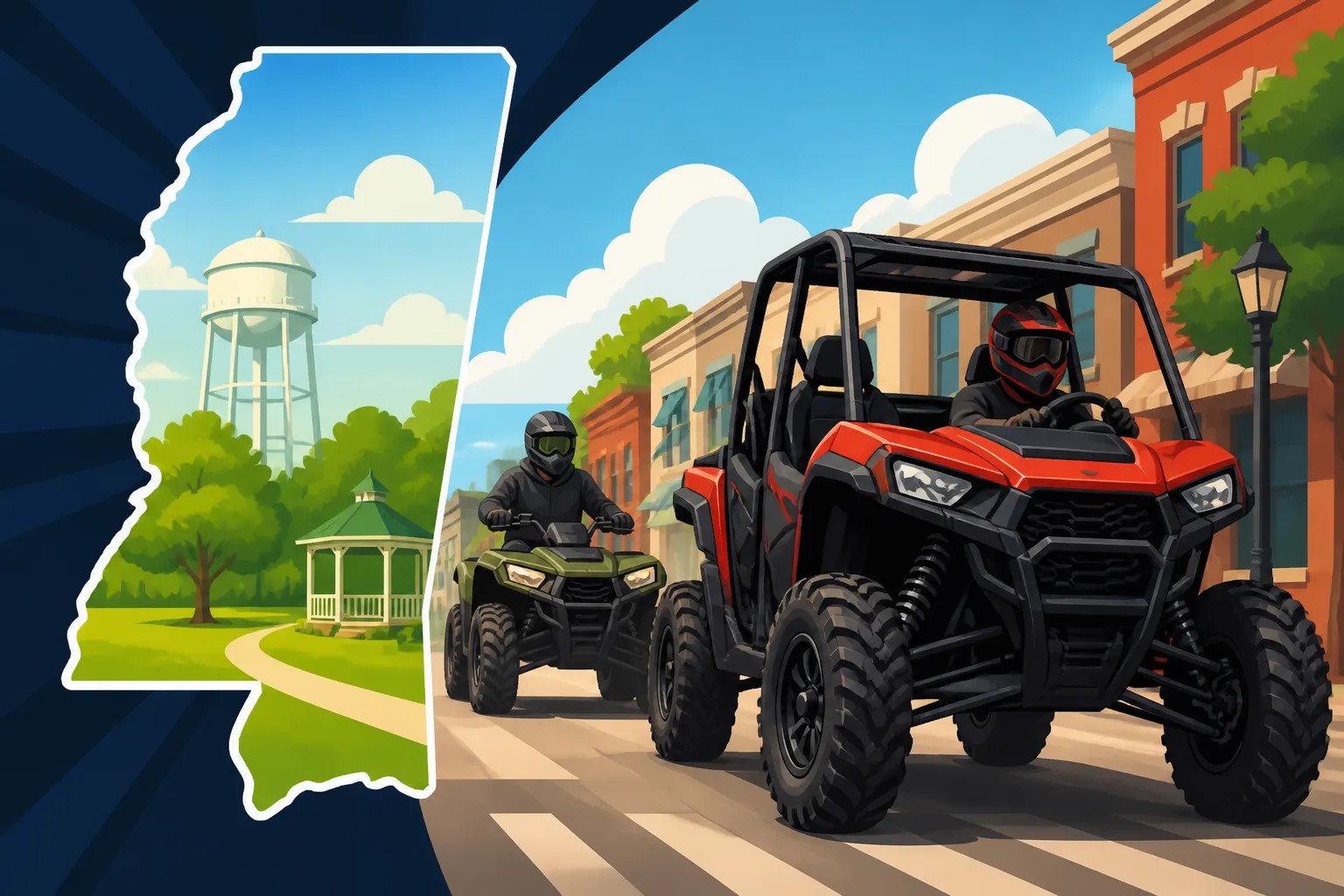
Riding in a Town That Wrote No Ordinance
It’s a scenario many of us in Mississippi have encountered: you're driving through a small town, maybe visiting family or on your way to a hunting camp, and you see someone cruising down a street on their ATV or UTV. You think to yourself, "If they can do it, why can't I?" Often, the confusion stems from the lack of a clear, published ordinance about off-road vehicles. This guide aims to clear up that ambiguity, explaining the state's default position and what "no ordinance" truly means for riders.
Understanding Mississippi's Default Stance on ATVs on Roads
The world of off-road vehicle laws can feel like a labyrinth, especially when you're trying to figure out what's allowed in a specific town. It’s easy to get frustrated when the rules aren't clearly laid out, but it's crucial to understand the foundational law in Mississippi before making any assumptions.
The Statewide Prohibition
Let's cut right to the chase: Mississippi state law generally prohibits the operation of ATVs and UTVs on public roads and highways. This isn't a suggestion; it's a rule. Specifically, Mississippi Code Section 63-31-3 lays out these restrictions quite plainly. This means that, by default, if you’re riding your machine on a paved public road, a gravel county road, or even across a short stretch of blacktop to get to another trail, you could be breaking the law. Many riders assume that because their machine is street-legal in some other states, it must have some leeway here, but that’s simply not the case in the Magnolia State. The law broadly applies to nearly all public roads, from busy highways to quiet residential streets. There are very few exceptions, and those are usually tied to agricultural work or crossing, not recreational riding. So, the silence of a local town isn't an invitation; it's an echo of the statewide ban. You can dive deeper into this topic by reading [Mississippi Bans ATVs on Public Roads].
Why Local Ordinances Matter and Why Silence Doesn't Help
Now, here's where the nuance (and the frustration) comes in. While the state law sets a broad prohibition, it also gives local municipalities—cities, towns, and even counties—the ability to create their own ordinances that might allow ATVs or UTVs on certain roads within their jurisdiction. This is why you see places like Hattiesburg with specific golf cart rules or some communities allowing low-speed vehicles. However, and this is the critical part, if a town hasn't explicitly passed such an ordinance, the state law remains firmly in effect.
This is a common point of confusion for riders. Many believe that if a town hasn't issued a specific ban, then it must be permissible. This line of thinking, while understandable, is incorrect. Think of it like this: the state law is the default "no." A local ordinance is the only way to get to a "yes" for specific roads or areas. If there's no local ordinance, there's no "yes," and the default "no" from the state stands. It's a frustrating reality because it means you can't rely on simply not seeing a sign or not hearing about a ban. You have to actively confirm that an exception has been made. If you're looking for more details on this, check out [Mississippi Local Ordinances Are the Only Path].
Navigating the Grey Area: What to Do When There's No Ordinance
So, you're in a town that hasn't written a specific law about ATVs or UTVs on its streets. What's your next move? It's not as simple as just "going for it." Navigating this silent space requires caution and proactive investigation.
Don't Assume Permission
The biggest mistake a rider can make in Mississippi is assuming that the absence of a local ordinance means it’s okay to ride your off-road machine on public roads. It's not. The state's general prohibition still applies. This can be especially confusing in rural areas where people might regularly use ATVs to get to neighbors' houses or local stores, seemingly without issue. However, "everyone else is doing it" is never a valid legal defense. Law enforcement officers, whether city police or county deputies, are primarily bound by state law. If they see you operating an ATV on a public road, even a quiet residential one, they are within their rights to issue a citation, regardless of whether the town has a specific ordinance or not.
Imagine you're visiting a small town in the Delta for the weekend, and you brought your side-by-side to explore some private land. You see a small general store just a mile down a paved road from your campsite, and you figure a quick trip won't hurt since there are no "No ATV" signs. A deputy, however, might see this as a clear violation of state law, leading to an unexpected and unwelcome stop. This situation is precisely why it's crucial to never assume permission. For a comprehensive look at the overall legality, read [Can You Ride an ATV on the Road in Mississippi?].
The Importance of Proactive Inquiry
Given the ambiguity, your best course of action is always to inquire directly with local authorities. This might feel like a chore, but it's far better than facing fines or other penalties. You'll want to reach out to a few specific contacts:
- The City Clerk's Office: This is often the first stop for understanding local ordinances. They can tell you if any laws pertaining to ATVs, UTVs, or even golf carts have been passed.
- The Local Police Department (for city streets): If the town has its own police force, they're the ones who would be enforcing any local rules (or the state rules if no local ordinance exists).
- The County Sheriff's Office (for county roads or areas without city police): For unincorporated areas or towns without their own police, the Sheriff's office is the primary law enforcement agency.
When you call, be polite and specific. Ask, "Does the City of [Town Name] have any ordinances regarding the use of ATVs or UTVs on public streets or roads within city limits?" If they say no, then you default back to the state law, which prohibits such use. Don't push or argue; simply gather the information. It can be frustrating to get different answers from different people, but persistence and clarity in your questions are key. Consulting [Asking Your County Supervisor Where You Can Ride] or [Asking the Sheriff's Office About Road Riding] can give you further guidance on who to contact.
Here's a quick guide on who to contact and what information to seek:
| Authority to Contact | Jurisdiction | What to Ask | Key Information to Obtain |
|---|---|---|---|
| City/Town Clerk's Office | City/Town Limits | "Are there any ordinances about ATV/UTV use on public roads?" | Existence of ordinance, specific rules, road designations |
| Local Police Department | City/Town Limits | "How does your department interpret state law regarding ATV use on roads?" | Enforcement practices, common violations, contact for clarification |
| County Sheriff's Office | Unincorporated County Areas | "Are there any county ordinances regarding ATV/UTV use on county roads?" | County-level rules, enforcement policies, contact for specific roads |
Practical Considerations and Risks
Beyond the letter of the law, there are very real practical risks and considerations to keep in mind when even contemplating riding your ATV or UTV on a public road in Mississippi, especially when no specific local ordinance gives you the green light.
Enforcement and Penalties
Let's be clear: riding illegally on a public road can lead to consequences. The penalties for operating an ATV or UTV on a public road in Mississippi, where prohibited, can include citations and fines. While some might think a "small" fine isn't a big deal, the hassle of dealing with court, potential court costs, and the time lost can add up quickly. More seriously, in some instances, law enforcement has the authority to impound your machine. Imagine having your prized side-by-side towed away, incurring impound fees on top of fines, and then having to navigate the process to retrieve it. This isn't just an inconvenience; it can be a significant financial burden and a major disruption. Even if the immediate fine isn't massive, the long-term impact on your time, wallet, and peace of mind can be substantial. For more details on what you might face, look into [Mississippi Penalties for an Illegal Road Ride] and [Mississippi Fine Ranges for Road Riding], or even [When an ATV Gets Impounded After a Stop].
Safety and Liability
Putting aside the legal ramifications for a moment, there are inherent safety concerns with operating off-road vehicles on paved public roads. ATVs and UTVs are designed for rough, uneven terrain, not smooth asphalt. Their suspension, tires, and steering are optimized for off-road performance, which can make them unstable and unpredictable on hard surfaces. They lack many of the safety features found on street-legal vehicles, such as turn signals, brake lights, and side mirrors (unless you've added an aftermarket kit, perhaps from a reputable brand like SuperATV, known for its extensive range of UTV and ATV accessories, including street-legal kits). This makes them less visible to other drivers, and their handling characteristics mean they don't stop or corner like a car.
Furthermore, even though Mississippi does not mandate insurance for ATVs or UTVs used off-road, if you're involved in an accident on a public road where your machine is illegally operated, your personal insurance policy might not cover damages or injuries. This could leave you personally liable for significant costs. A simple fender-bender with a car could result in thousands of dollars in repairs, medical bills, and legal fees. Even if you have a great off-road machine, perhaps decked out with SuperATV lift kits and heavy-duty axles for the trails, those modifications don't make it safe or legal for the street. Always remember that even without a state mandate, getting [Insurance for a Mississippi ATV Crossing a Public Road] is a smart choice, especially if you plan to ever cross public roads, even legally. You can learn more about general insurance rules in [Mississippi Has No Insurance Mandate].
Advocating for Change and Riding Alternatives
It’s completely understandable to feel frustrated by the limitations placed on ATV and UTV use on public roads in Mississippi. However, instead of pushing the boundaries of the law, there are more productive ways to either influence change or find legal and safe places to ride.
Engaging Local Government
If you genuinely believe that ATVs and UTVs could be safely integrated into certain aspects of your community's road network—perhaps for access to specific recreational areas, for local business commutes, or to bridge gaps between trail systems—the most effective path forward is through proactive engagement with your local government. This isn't a quick fix, but it's how change happens.
Consider organizing with other local riders. A unified voice is always stronger than an individual complaint. Attend town council or board of aldermen meetings. Present a well-reasoned case that addresses not just the desire to ride, but also the safety concerns, potential economic benefits, and how responsible riders can mitigate risks. Point to examples of towns that have successfully implemented golf cart ordinances (though remember, golf carts and ATVs are different in the eyes of the law). Be prepared to discuss specific roads, speed limits, and safety requirements. It's an uphill battle, but demonstrating community support and a commitment to safety and responsibility can make a difference. For tips on how to approach your local officials, read [Bringing an ATV Question to Your Board of Aldermen] or [When One Neighbor's Complaint Changes a Town Rule].
Legal Riding Options in Mississippi
While the road situation might be restrictive, Mississippi offers fantastic opportunities for legal and exhilarating off-road riding. Instead of focusing on what you can't do, explore the many places where you can truly enjoy your machine without fear of legal trouble.
- Designated OHV Trails in National Forests: The De Soto National Forest, for example, offers the Bethel OHV Trails, providing miles of marked paths designed specifically for off-road vehicles. These are well-maintained and offer a variety of terrains. You'll want to ensure your machine is equipped for these trails, perhaps with robust aftermarket parts from SuperATV to handle the diverse conditions.
- Private Mud Parks and Off-Road Parks: Mississippi boasts several popular private parks that cater specifically to ATV and UTV enthusiasts. Places like Red Creek Off-Road or Meridian OHV Park offer hundreds, sometimes thousands, of acres of trails, mud pits, and challenging terrain. These parks are often equipped with amenities like wash stations, camping, and even cabins, making for a perfect weekend getaway. They operate on their own rules, which typically focus on safety and responsible riding within their boundaries.
- Private Land with Permission: If you own private land, or have explicit, written permission from a landowner, you can ride to your heart's content within those boundaries. This is one of the most common ways Mississippians enjoy their ATVs and UTVs, whether for recreation, hunting, or farm work.
Focusing on these legal avenues allows you to enjoy your off-road machine to its fullest potential, often in environments specifically designed for their capabilities. You can find more information about where to ride legally by checking out [Mississippi ATV Trails: Where to Ride] and [Mississippi Private Mud Parks]. Specific information about [Red Creek Off-Road in Mississippi] and [Bethel OHV Trails in Mississippi] is also available.
Disclaimer
This article is for general informational purposes only and does not constitute professional advice. Laws, prices and regulations vary by location and change over time. Consult a qualified professional for guidance on your specific situation.