Mississippi Permit Questions Forests Hear
Mississippi riders often ask whether a state sticker, an out-of-state permit, or a National Forest pass is needed before unloading an ATV or UTV. The answer depends on where you plan to ride: a forest trail pass is not the same as state registration, and it does not open every road or trail. Here’s what to check before you go.
What permit do Mississippi forests require?
Mississippi does not issue a statewide ATV registration sticker that riders need to display simply to operate an off-road machine. That does not mean every riding area is permit-free. National Forest OHV trails can have their own pass requirements, and a site may set additional conditions for access.
Think of a forest pass as permission for a particular kind of recreation in a particular area. It is not a license plate, proof that a machine is street legal, or permission to ride wherever a forest road happens to go. The pass rules can depend on the trail system, the machine, and the way the pass is issued.
| Question | Practical answer | What to verify |
|---|---|---|
| Do I need a Mississippi ATV registration sticker? | Mississippi does not have a statewide ATV registration sticker for riders to rely on as a general forest permit. | Whether the specific trail or recreation site requires its own pass |
| Does a National Forest pass cover every forest road? | No. A pass does not make closed roads or undesignated routes open to OHVs. | The current trail map, closures, and rules for the district |
| Does an out-of-state permit count in Mississippi? | Do not assume it does. Mississippi has no general state sticker to reciprocate, and local site rules still apply. | The pass rules for the exact Mississippi riding area |
| Is a forest pass the same as a title? | No. A title establishes ownership records; a recreation pass relates to access. | Any separate proof-of-ownership requirement |
| Can I use one pass for any machine or rider? | Pass terms may specify what it covers. Do not assume it transfers or covers multiple machines. | The pass conditions before buying or arriving |
For a broader explanation of the distinction between registration and trail access, see Mississippi National Forest OHV Passes and Mississippi Has No OHV Registration to Reciprocate. Visitors often make the same mistake: an ATV sticker or permit from home may not satisfy Mississippi site rules. Check Mississippi Has No Sticker for a Visiting Machine before relying on paperwork from another state.
The key is to identify the actual riding area first. “Riding in a national forest” is not specific enough. A forest may contain designated OHV trails, ordinary forest roads, restricted roads, campgrounds, wildlife areas, and private inholdings. Rules can differ among them, even when they sit within the same broad forest boundary.
If a pass is required, confirm the current cost, where it can be purchased, what it covers, and whether you need to display or carry proof of it. Fees and purchase arrangements can change, so use the current information from the forest office or official recreation source rather than an old forum post or a previous season’s pass.
Where does a forest pass let me ride?
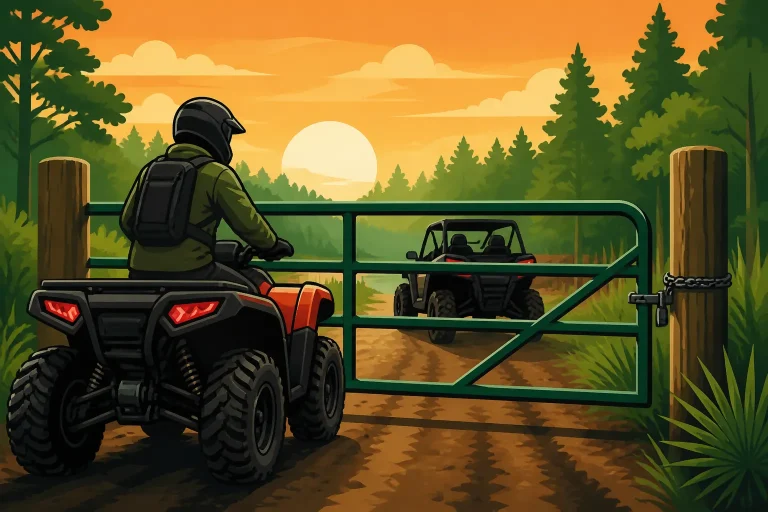
A pass generally applies to the recreation access described in its terms, not to every route inside a National Forest. The trail map and signs determine where OHV use is allowed. If a road is closed, gated, or not designated for your vehicle type, a pass does not override that restriction.
This distinction matters because forest roads can look rideable without being open to recreational ATV or UTV traffic. Some routes serve maintenance, timber operations, emergency access, or other uses. A route’s appearance is not reliable evidence that it is open. Follow signs and posted closures, and check the current map before setting off.
The Mississippi Forest Pass Coverage information and Which Trails the $60 Forest Pass Opens can help you understand the difference between having a pass and having access to a particular route. Treat trail maps as operational documents, not just navigation aids: look for vehicle restrictions, seasonal closures, and any warnings about trail conditions. If you need a map on the ride, keep a downloaded or printed copy available in case cell service drops. A waterproof map case, including one available through Amazon, can protect a paper map from rain and mud, but it cannot replace the official trail map.
Check machine limits before you load
A trail can have a width limit that excludes a side-by-side even if the machine is otherwise suitable for off-road use. Bethel’s public OHV trails, for example, are associated with a 50-inch width limit. That is not a blanket limit for every trail in Mississippi; it is a reason to check the rules for the specific route. See Mississippi ATV Width Limit of 50 Inches and Bethel’s Width Limit in Mississippi for more on that distinction.
Measure the machine as the trail authority defines width, and do not rely on a model’s marketing description. Accessories, wheel offsets, or other modifications may affect the actual measurement. If you are close to the posted limit, ask the managing office how width is measured and whether your setup qualifies before making the drive.
A pass also does not make an otherwise restricted machine eligible. Check any requirements for tires, noise, spark arrestors, or other equipment that the area may impose. These conditions can vary by location, so do not treat one trailhead’s rules as proof that another site has the same requirements.
Do not confuse forest access with public-land access
Wildlife Management Areas have their own rules. A National Forest OHV pass should not be treated as permission to ride on a WMA, and WMA access may be limited to designated roads or particular uses. Review Mississippi WMA Riding Rules if your route crosses or borders a management area.
Likewise, a pass does not authorize riding on private land, a levee, or a closed route. Land ownership and managing authority can change along a ride. When a boundary or sign is unclear, stop and check rather than assuming that one permit covers the entire route.
What do riders need to carry, including visitors and young riders?
A permit question is often really a paperwork question: what must be shown at the gate or during a check? Start with the exact site’s requirements. A forest pass may be only one part of the picture. Riders may also need to meet age, helmet, or driver qualification rules, and the rules for a managed trail may differ from those on private property.
On Bethel trails, riders should check the site’s driver-license requirement before arriving. The forest or trail authority may also have requirements for younger riders. Mississippi’s public-land rules include safety-card requirements for some riders under 16; see Mississippi Riders Under 16 Need a Safety Certificate and Mississippi Forest Rules for Riders Under 16. A child’s age, the location, and the type of riding area matter, so confirm which rule applies rather than assuming that adult requirements cover the whole group.
Helmet requirements can apply independently of a pass. Mississippi has rules for riders under 16, and particular public riding areas can set additional requirements. Bring properly fitted helmets for young riders and check whether the site requires helmets for everyone, not just children. For age-specific details, see Mississippi ATV Helmet Law Age.
Visitors from another state should not assume that a home-state sticker or registration document is a substitute for a Mississippi forest pass. At the same time, a lack of a Mississippi statewide registration sticker does not waive a local pass requirement. If you are travelling from Alabama, Louisiana, Tennessee, or another state, check the destination’s current rules and keep any useful ownership documents with you. The visitor guidance at Mississippi Visitors Need No State Sticker explains why reciprocity is not a substitute for checking the site rules.
Proof of ownership is another separate issue. A title, bill of sale, or other ownership record does not automatically serve as a trail permit. Conversely, a trail pass does not establish that you own the machine. Carry the paperwork the site asks for and keep it protected from water and mud; do not assume that a phone photograph will be accepted in place of a required document.
If the machine is borrowed, rented, or part of a group, ask who must obtain the pass and whether it is associated with an individual, a vehicle, or a specific machine. Do not guess based on a pass you used at another park. The terms printed on the pass or posted by the managing agency control.
How can I avoid a permit problem at the trailhead?
A few checks before departure can prevent a long drive from ending at a closed gate. Rules, access, and trail conditions can change, so confirm details close to your ride rather than relying on an old saved page or another rider’s memory.
- Name the exact riding area. Find out whether your destination is a National Forest OHV trail, Bethel, a WMA, a state park, or a private park. Similar-sounding locations may have different operators and requirements.
- Check current access and closures. Review official trail information and call the relevant office if the map or notice is unclear. Rain, maintenance, hunting activity, or other conditions may affect access.
- Confirm the pass requirement. Ask whether a pass is needed, which trails it covers, how to obtain it, and what proof you must carry or display. Confirm current fees and purchase arrangements with the official source.
- Check the machine’s eligibility. Verify width and any equipment requirements. A pass does not override a trail limit or open a route closed to your vehicle type.
- Check every rider’s requirements. Confirm driver qualification, age, helmet, and safety-certificate rules for the exact site. Do not assume the adult rider’s paperwork covers a child.
- Keep access documents handy. Carry the pass or proof of purchase as directed, plus any ownership documents the site requires. Protect paper copies from wet conditions.
- Recheck signs when you arrive. Follow posted directions and closures even if your map shows a route. A pass is not permission to ignore a gate or sign.
For route planning and current conditions, Mississippi ATV Trail Map Downloads and Checking Trail Conditions Before You Load the Trailer are useful starting points. When information conflicts, contact the office responsible for that specific trail or land unit. Ask clear questions: “Does this pass cover this trail?” “Is my machine within the width limit?” and “What must each rider carry?” Those answers are more useful than asking only whether ATVs are allowed in the forest.
Keep the basic distinction in mind: a permit or pass may give access to a designated riding area, while other rules determine where you can ride and what riders and machines must meet. Confirm both before leaving home, and treat the trailhead signs and current official information as the final word.
Disclaimer
This article is for general informational purposes only and does not constitute professional advice. Laws, prices and regulations vary by location and change over time. Consult a qualified professional for guidance on your specific situation.