Mississippi Insurance Proof at a Gate
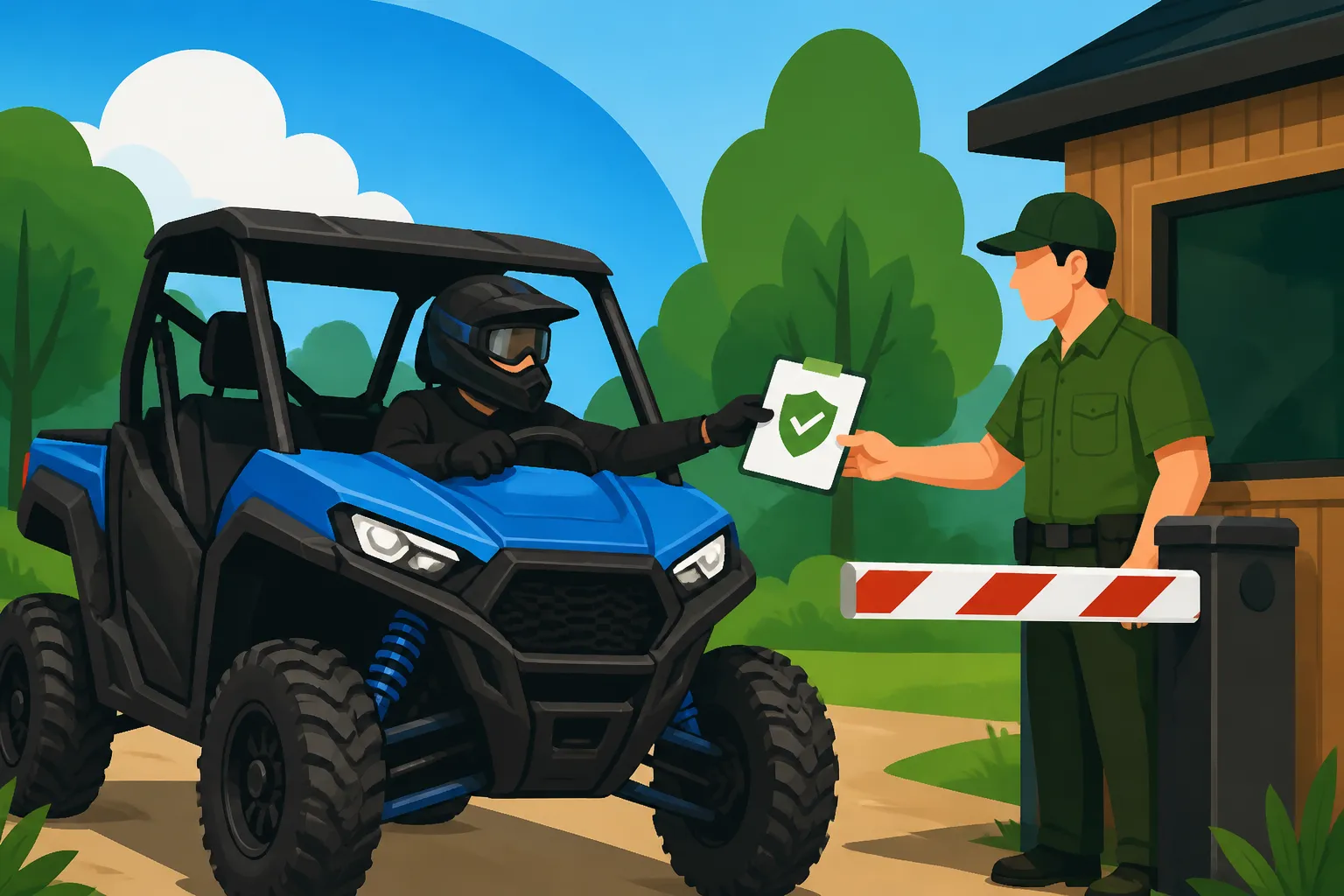
A gate attendant asking for insurance proof can catch a Mississippi ATV or UTV rider off guard, especially when the state does not require every machine to carry a policy. The key is that a trail’s or park’s entry rules may be different from statewide requirements. Here’s what proof may mean, what to bring, and how to avoid arriving with the wrong paperwork.
What insurance proof at a gate means
Mississippi does not have a general statewide insurance mandate for ATVs and UTVs. That does not mean every riding area must let an uninsured machine in. A private park, event organizer, landowner, or other site operator may set entry conditions, including asking riders to show coverage. The requirement can depend on the property and the activity, so there is no single answer for every gate.
At a gate, “insurance proof” usually means a document that shows a policy is active and identifies the policyholder. It might be an insurance card, a declarations page, or a letter from the insurer. If a site requires coverage for a specific machine, the attendant may also need to see the vehicle identified on the paperwork. Ask what the site accepts instead of assuming a standard auto insurance card will be enough.
It also helps to separate insurance from other documents. A pass, permit, waiver, proof of ownership, and insurance record do different jobs:
| Document | What it generally demonstrates | What it does not demonstrate |
|---|---|---|
| Insurance card or policy document | An insurance policy is in force, subject to its terms | Permission to ride on the property |
| Trail pass or permit | The required access authorization has been obtained | That the machine is insured |
| Waiver | The rider has acknowledged the site’s stated risks and conditions | That the rider has insurance |
| Title, bill of sale, or other ownership record | A connection between the rider and the machine | That the rider has permission to use the trail |
An insurance document is not a substitute for a required pass or waiver. Likewise, having a pass does not automatically satisfy a site’s insurance condition. For a general overview of why owners may choose coverage even when it is not mandated statewide, see Why Mississippi Riders Still Buy ATV Insurance. The related explanation of Mississippi Has No Insurance Mandate can help distinguish a state requirement from a property’s own entry policy.
A gate request may also be part of an event’s or park’s liability procedures rather than a rule that applies to all Mississippi riding. A site could ask for proof from every participant, only from a group leader, or from a business that is hosting or guiding a ride. It may instead require a signed waiver without requiring insurance proof. These details can change by location and event, so confirm them with the operator before making the trip.
If the attendant asks for proof, stay calm and ask what specific document is missing. “Insurance” can mean a current card, evidence of liability coverage, or proof that the machine itself is scheduled on the policy. Those are not always interchangeable. A precise question can save time: “Do you need an active policy card, a declarations page, or proof for this specific ATV?”
What to bring and how to show it
Before leaving home, check the riding location’s current entry instructions and assemble documents for the machine and the riders. A short phone call or message to the park or event organizer is often more useful than relying on a general rule for Mississippi. Ask whether proof is required, what forms are accepted, and whether the document must identify the ATV or UTV.
A practical document set includes:
- A current insurance card or insurer-issued proof of coverage, if you have a policy.
- A declarations page or coverage letter if the card does not identify the machine or show the information the site requests.
- The machine’s make, model, and vehicle identification number, if the site needs to match it to the policy.
- Any required trail pass, permit, reservation confirmation, or waiver.
- Proof of ownership or purchase paperwork if the property asks riders to establish a connection to the machine.
- A photo ID, when required by the site.
- The contact information for your insurance company or agent.
Do not assume that the name on the policy must match the rider’s name, or that a policy covering one machine automatically covers every ATV in a group. The operator may have a specific rule about who must be insured and which machines must appear on the evidence. Ask how the rule applies if the vehicle belongs to a family member, an employer, a rental business, or another person in your riding group.
Likewise, do not assume an auto policy covers an off-road machine just because the ATV is listed somewhere in your insurance documents. Coverage depends on the policy language and the type of claim. If you are unsure what your policy covers, ask the insurer or a qualified insurance professional to explain it. A site’s entry requirement is not a guarantee that a particular incident will be covered.
For documents stored on a phone, save the file before you reach the gate. A screenshot or downloaded PDF may be easier to access than an email attachment that requires a signal or account login. Keep the original document available when possible, and make sure a digital version is readable. A paper copy is a useful backup, especially at remote trailheads where cell service may be unreliable.
Protect both paper and digital documents from water, mud, and heat. A simple waterproof document pouch can keep a printed card or pass legible in a glove box or riding bag; similar organizers are available from outdoor retailers and Amazon. Avoid leaving personal information visible when you are not checking in. You usually need to show only what the attendant requests, not hand over unrelated financial or identity records.
If the policy card does not list the ATV or UTV, contact the insurer before the ride. Ask for a document that accurately explains the applicable coverage and identifies the machine if that is available. Do not edit a card, alter a policy document, or present coverage for a different machine as though it were proof for yours. If the insurer cannot provide the documentation the site requires, ask the site whether it accepts another form of evidence.
Ownership paperwork is a separate issue. Some places may ask for it as part of their entry process, while other places may not. The distinction matters: a title or bill of sale does not prove insurance, and an insurance card does not prove ownership. Mississippi Proof of Ownership on the Trail covers that separate question.
How gate rules differ by riding location
A gate can belong to a public trail system, a state-managed recreation area, a private park, or an event hosted on someone else’s land. Each may have a different process. Do not treat a request made at one location as a statewide rule, and do not assume that a rule at one park applies at another.
National Forest trails: Access requirements are tied to the specific trail and land-management rules. A forest pass may be required for designated OHV routes, but a pass and an insurance policy are separate things. Check the current information for the specific forest and trail before loading the machine. Mississippi National Forest OHV Passes explains the pass question, while What a Mississippi Forest Pass Does Not Cover is useful for understanding its limits. If a gate or staff member asks for insurance proof, ask whether that request is a site-specific condition, an event requirement, or a requirement tied to your particular use.
Wildlife management areas: Access and riding may be limited to designated roads or other specified areas, and rules can change with closures and management needs. An insurance card does not give permission to ride a closed road or an undesignated route. Confirm the location’s current access conditions and read posted signs. A request for insurance at a particular entrance should be treated separately from the rules about where machines may travel.
State parks: A park may have its own check-in, waiver, equipment, or rider requirements. A waiver is not insurance proof, and signing one does not change the coverage provided by a policy. Contact the park about its current process before traveling; Mississippi State Park Waiver Requirements covers the waiver side of the visit.
Private parks and organized rides: These are the places where it is especially important to ask the operator directly. A private property owner or organizer may set conditions for entry or participation. The conditions may differ for individual visitors, a group, a guided outing, or a commercial activity. Review the park’s written rules and ask whether each rider must show proof, whether a policy must cover each machine, and what kinds of documents will be accepted. For related entry conditions, see Mississippi Private Park Waivers and Rules.
Visitors from another state: Do not confuse insurance reciprocity with riding permission. Mississippi’s lack of a general ATV insurance mandate does not mean a visiting rider can ignore the host site’s entry requirements. A visitor may not need a Mississippi state sticker simply because the machine is registered or based elsewhere, but that does not replace a trail pass or a private park’s own conditions. See Mississippi Visitors Need No State Sticker for the sticker question, and verify the current rules with the specific place you plan to ride.
Before a trip, ask the site these questions:
- Is insurance proof required for individual riders, the machine, or the group?
- Does the document need to show a particular type of coverage?
- Will you accept a digital card, or do you require printed evidence?
- Does the machine need to be named or identified on the document?
- Are there separate pass, waiver, ownership, or ID requirements?
- Do the rules differ for out-of-state riders, rentals, or organized groups?
A quick check is particularly worthwhile when you are traveling with several machines. One person may be carrying the group’s reservation or pass, but that does not necessarily satisfy a request for insurance information for each vehicle or rider.
If your proof is missing or rejected
If you reach the gate and cannot show the requested document, ask the attendant to explain exactly what is required and whether there is an accepted alternative. If the issue is that your phone has no signal, try a saved file or printed copy. If the document does not identify the machine, call your insurer or agent and ask whether they can send appropriate proof directly. Do not assume the gate can make an exception.
If you cannot meet the requirement, the safest option is to pause and resolve it before riding. The site may refuse entry, ask you to return with the correct document, or offer another process; only the operator can tell you what it allows. Do not ride onto the property without permission just because the state does not impose a general insurance mandate.
If the site’s request seems inconsistent with information you received earlier, show the written instructions or confirmation you relied on and ask for clarification. The operator’s current entry conditions may differ from a general webpage, an old social media post, or what another rider was told. Keep the conversation factual and polite. If necessary, contact the park office or event organizer rather than arguing at the gate.
If your insurance has lapsed, or you are unsure whether the machine is covered, contact the insurer before riding. A gate attendant cannot interpret your policy for you, and a waiver does not create insurance coverage. Do not rely on a verbal assurance from another rider in place of confirmation from the insurer.
For rides that involve crossing or using a public road, consider the issue separately from trail entry. Road use can raise additional legal and liability questions, and a trail pass does not authorize road riding. Insurance for a Mississippi ATV Crossing a Public Road addresses that distinct situation.
A simple routine prevents most gate delays: check the site’s rules, confirm what proof it accepts, save a readable copy offline, and carry a backup. Keep insurance documents with the machine’s other paperwork, but do not treat any one document as a universal riding permit. The right proof depends on the location and the condition the operator has set.
Disclaimer
This article is for general informational purposes only and does not constitute professional advice. Laws, prices and regulations vary by location and change over time. Consult a qualified professional for guidance on your specific situation.