Questions Worth Asking a Southern Forest Office
Before loading an ATV or UTV, it helps to know which office can answer questions about the land you plan to ride and what permission your machine needs. Mississippi forest access can depend on the specific trail, vehicle, rider and current closures. These practical questions help you get useful answers from a forest office before making the drive.
Start with the right office and the right riding area
“Can I ride in the forest?” is usually too broad to get a useful answer. National forests contain different kinds of roads and recreation areas, and access for an ATV or UTV may be limited to designated routes or trails. A route that is open to regular vehicles is not automatically open to off-highway machines. Likewise, being on public land does not mean you can ride wherever there is a visible track.
Before calling, identify the forest or district, the nearest trailhead or road, and the route you hope to ride. If you have a map or trail name, keep it in front of you during the call. Ask the office to confirm that the route is currently open to your type of machine—not just whether the general area is open.
The right contact depends on the land. A National Forest office can answer questions about Forest Service land and its trail rules. It may not be able to confirm access on a Wildlife Management Area, a state park, a county road or privately owned timberland. If the boundary or land manager is unclear, ask who manages the exact trailhead and route before you rely on an answer.
| Question to settle | What to ask the office | Why it matters |
|---|---|---|
| Land manager | “Who manages this trail or road?” | Rules differ between national forest, state and private land. |
| Route access | “Is this specific route open to ATVs or UTVs?” | General forest access does not mean every road is open. |
| Permit | “What pass or permit is required for this route?” | A pass may apply only to particular trail systems. |
| Machine fit | “What width, vehicle or equipment limits apply?” | A machine that is legal elsewhere may not fit a trail’s rules. |
| Current status | “Is the route open today, and are there temporary closures?” | Weather, maintenance, fire conditions and other restrictions can change access. |
If you are unsure which Mississippi trail system you have in mind, compare the location with Mississippi National Forest Riding Explained and Mississippi ATV Trails: Where to Ride. For a public trail with its own access details, Bethel OHV Trails in Mississippi can help you identify questions to confirm before leaving home. Do not assume that a pass or answer for one trail system applies throughout a forest.
A useful opening for the call is: “I’m planning to ride an ATV or UTV at this trailhead, and I want to confirm the route, pass and current conditions.” Then give the office the trailhead name, your machine type and the date you expect to ride. If the person answering needs to direct you elsewhere, ask for the right district or land manager rather than relying on a guess.
Ask exactly what permit or pass you need
Ask whether the route requires a National Forest OHV pass, another permit, or no pass at all. If a pass is required, confirm how to obtain it, what it covers and when it must be displayed or carried. Fees and purchase methods can change, so check current details with the responsible office or official pass provider. Mississippi National Forest OHV Passes and How to Buy a Mississippi Forest Pass are useful background, but the office can help confirm whether the pass applies to the particular route you plan to use.
A pass is not a general license to ride anywhere in a national forest. Ask which specific trails it covers and whether the route is designated for your machine. Also confirm whether the pass is tied to a rider, a machine, a vehicle or another form of identification. That detail matters when a group has several machines, a family is sharing a pass, or a visiting rider brings a second ATV.
Here are practical follow-up questions:
- Does every machine in our group need its own pass?
- Does the pass cover both ATVs and UTVs on this route?
- Is there a width or other vehicle limit?
- Must the pass be displayed on the machine, or should the rider carry proof?
- Can I buy or validate the pass at the trailhead, or should I arrange it before arrival?
- If I already have a pass from another state or riding area, does it count here?
- Are there separate fees for parking, camping or other recreation?
Do not treat a pass issued by another state as interchangeable with a Mississippi or federal forest permit. Mississippi has no state OHV registration sticker to offer as a universal credential for other jurisdictions; the forest office can tell you what its own trail system requires. For the distinction, see Mississippi Has No OHV Registration to Reciprocate and No Sticker to Honor From Another State.
If the answer is “you need a pass,” ask the office to describe the coverage in plain terms. “A pass is required” does not tell you whether it covers the route you want, whether it applies to each machine or whether there are additional requirements. If you receive a verbal answer, write down the date, the office or district you contacted, the person’s name if offered, and the route discussed. That record will not override posted rules, but it can help you remember what was confirmed and whom to contact if details remain unclear.
Visitors should ask about their residency and machine paperwork separately. A state sticker, registration document or permit from home may not be relevant to federal trail access. Ask whether the trail requires proof of ownership or any other document at a check, rather than assuming that a vehicle title, bill of sale or state registration substitutes for the required pass. Mississippi Proof of Ownership on the Trail is a useful related topic, but the responsible office should confirm what applies to its route.
Confirm machine and rider requirements before the trip
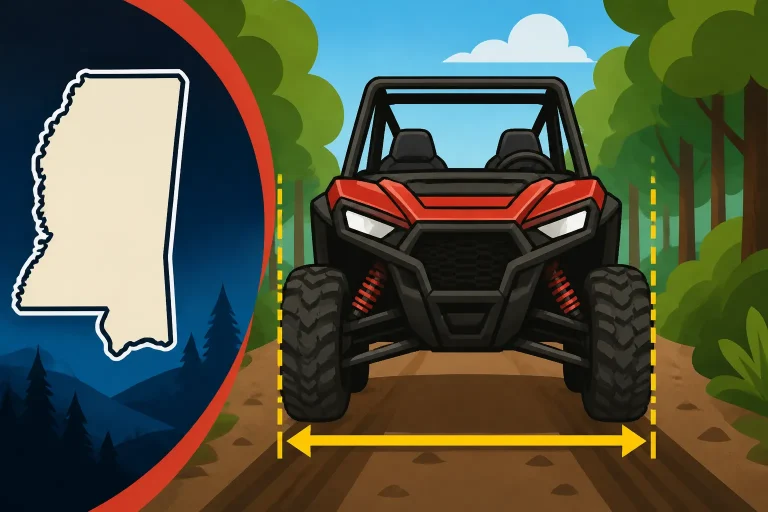
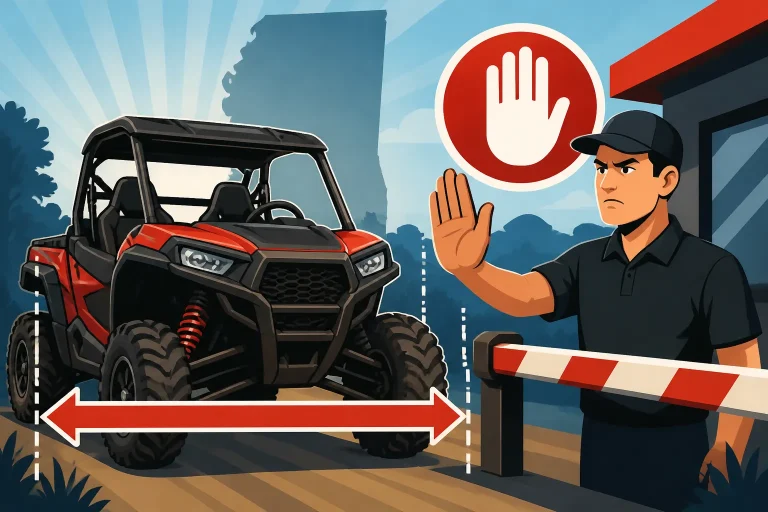
A permit does not make every machine eligible for every trail. Ask about width restrictions, vehicle categories and any other limits that might rule out your ATV or UTV. Measure the machine as it is configured for riding, including accessories that could affect its overall width. A side-by-side with added parts may not fit within the same limit as a narrower stock model. The pass and route may have separate eligibility conditions, so ask about both.
Be specific about what you ride. “It’s a UTV” may not tell the office enough to determine eligibility. Share the machine’s width and whether it is a side-by-side, quad or another type of off-highway vehicle. If there is a published limit, ask how the office measures width and whether the figure refers to the vehicle as equipped. The references The 50-Inch Width Limit Written Into the Pass and Mississippi Trails That Allow Side-by-Sides cover questions worth checking for a particular riding area.
Also ask which rules apply to the rider, not just the vehicle. A forest trail may have requirements involving a driver’s license, a safety certificate for younger riders, helmets or passengers. Do not assume that a state rule, a private-park rule and a National Forest rule are identical. Ask the office to specify who needs which document and whether a parent or supervising adult must be present. Mississippi Forest Rules for Riders Under 16 and The Safety Certificate a Young Rider Must Carry provide related context.
For a group, describe the youngest rider and the number of passengers you expect to carry. Ask whether passengers are allowed on your machine and whether each passenger must have a proper seat. A two-seat UTV and a single-seat ATV present different questions; a passenger should not ride simply because there is room on the machine. If the office is not the authority for a particular safety requirement, ask where to verify it.
Equipment rules are another reason to call before leaving. Ask whether the trail system checks for spark arrestors, noise limits, lighting or other equipment. Do not assume that equipment accepted at a private mud park will meet requirements on public land. If you are unsure what to bring, ask whether the rules are set by the forest, the designated trail system or a separate state requirement. Mississippi Spark Arrestor Requirements and Mississippi Sound Limits on Public Land can help you frame those questions.
Keep the answer practical: ask what you need to have with you, what must be installed on the machine and what could result in being turned away. A quick equipment check at home is easier than discovering at the gate that a machine or rider does not meet the trail’s requirements.
Check conditions, closures and boundaries on the day you ride
A route that is normally open can be temporarily closed. Heavy rain, trail damage, maintenance, fire restrictions, hunting activity or another management decision may affect access. Ask whether the route is open on the day you plan to ride and where the office posts updates. If your trip is several days away, check again before loading the trailer. A call made well in advance can answer permit questions, but it cannot guarantee that conditions will remain unchanged.
Ask how the office describes a closure. Is a gate closed? Is there a posted sign? Are some trails open while others are closed? Can riders use a detour, or does the closure apply to the whole route? Never treat a gap in a gate, an unmarked track or another rider’s tire marks as permission. Follow signs and barriers even when a road looks passable.
Hunting season and wildlife management also deserve a direct question. National Forest access rules and WMA rules are not necessarily the same, and a road that crosses or borders another management area may have different restrictions. Ask whether the route is on forest land for its entire length and whether any nearby boundary changes the rules. If you plan to ride on a Wildlife Management Area, contact the relevant manager and verify its designated-road requirements rather than relying on a National Forest answer. Mississippi WMA Riding Rules explains why that distinction matters.
Ask about practical trip details too: where to park a trailer, whether there is a day-use area, whether camping is allowed nearby and whether facilities or services are available. These questions help you avoid blocking a gate or arriving at a trailhead that cannot accommodate your rig. Cell service may be limited in forest areas, so ask whether there is a printed map or an official map download and save it before leaving. How to Read a Forest Service Trail Map and Checking Trail Conditions Before You Load the Trailer are useful preparation.
Before ending the call, repeat the key details back to the staff member:
- Name the trailhead and route you intend to use.
- Confirm that your ATV or UTV is eligible for that route.
- Repeat the pass or permit requirement and how to carry or display it.
- Confirm any rider, passenger or equipment requirements.
- Ask where to check for last-minute closure notices.
- Confirm the contact to use if the route or land boundary remains uncertain.
Keep in mind that an office answer is guidance about a particular place and set of conditions, not permission to ignore signs or enter land outside the route. At the trailhead, read posted notices before unloading. If a sign conflicts with what you understood from an earlier call, stop and ask for clarification. It is better to miss a ride than to cross a closed route or trespass onto land managed by someone else.
Disclaimer
This article is for general informational purposes only and does not constitute professional advice. Laws, prices and regulations vary by location and change over time. Consult a qualified professional for guidance on your specific situation.