Bethel OHV Trails in Mississippi
Bethel OHV Trails offer a rare place in Mississippi for a dedicated off-highway ride, but arriving with the wrong machine, missing a required pass, or overlooking a rain closure can spoil the day before it starts. This guide explains what to check, how to prepare, and how to ride responsibly on Bethel’s forest trails.
What to know before riding Bethel OHV Trails
Where Bethel is and what kind of riding to expect
Bethel OHV Trail is in north Mississippi, in the Holly Springs National Forest area near Ashland. It is a designated off-highway riding area, not a general invitation to drive a quad or side-by-side anywhere in the forest. That distinction matters: a road that looks rideable on a map may not be open to motorized recreation, and a trail shown in an old online post may have since been closed or changed.
The riding experience is shaped by forest terrain, weather, and the trail system’s machine restrictions. Expect natural-surface routes rather than a groomed, purpose-built track with predictable footing all the way around. Conditions can vary between dry, firm sections and wet, slick patches, and recent rain can change what a route feels like even if it was easy on your last visit. Plan for a ride where careful line choice and moderate speed matter more than simply covering ground quickly.
Bethel is known for a trail network described as about 43 miles, but that figure should not be treated as a guarantee that every mile will be open on the day you arrive. Temporary closures, maintenance, weather, and management decisions can affect access. Before towing from Oxford, Tupelo, Memphis, or elsewhere in the region, check current Forest Service information and trailhead notices. For broader context on access and the difference between trails and forest roads, see [Mississippi National Forest Riding Explained].
What Bethel is not
Bethel is not a public road-riding loophole. A forest location does not automatically make a trail legal for an ATV, and riding an unmarked road, closed spur, or nearby public road can create a safety and legal problem. Stay within routes designated for the vehicle you are operating. If a route is closed, gated, signed against motorized use, or unclear on the official map, do not assume it is open because tire tracks are visible.
It is also not a place where every machine size can be accommodated. The trail system is associated with a 50-inch width limit, so many full-size side-by-sides will not qualify. Measure the machine itself rather than relying on a model name, a sales description, or what another rider says fits. Accessories, wheels, tires, and aftermarket modifications can affect the actual width. The practical rule is simple: confirm the park’s measurement method and current restriction before loading the trailer.
Finally, Bethel is not a substitute for checking the weather and trail status. Heavy rain can make riding unpleasant, damage trail surfaces, or lead to a temporary closure. A low area that looked harmless during a dry spell may hold water after a storm. If you are looking for other nearby options or want to compare the riding style and access rules at different locations, [Mississippi ATV Trails: Where to Ride] is a useful next step.
Choosing a machine and checking the limits
Confirm the 50-inch width restriction
The 50-inch limit is one of the most important details to check before making plans for Bethel. It can rule out a machine that seems perfectly reasonable for general trail riding. Some compact side-by-sides may meet the limit, while many wider utility and multi-passenger models do not. ATVs are more likely to fit, but their width should still be checked rather than assumed.
Measure from the widest points of the machine as it will actually be ridden. Depending on the model and local measurement practice, that may include tires or other protruding parts. A set of wider aftermarket wheels, a tire change, or an added accessory can turn an otherwise compliant machine into one that exceeds the restriction. If the measurement is close, contact the managing office before the trip and ask exactly how they measure. A tape measure in the garage is easier to deal with than a machine turned away at the trailhead.
Restrictions help protect both the trails and the people using them. Narrow routes, trees, turns, and drainage features may not safely accommodate a wider vehicle. The limit also helps riders avoid damaging trail edges when trying to squeeze through a tight section. For more detail on the system’s dimension rules, review [Bethel's Width Limit in Mississippi] and [Bethel's 43 Miles Are Built for 50-Inch Machines].
Match the machine to the terrain and your group
Even a machine that meets the width rule may not be the right choice for every rider in your group. A beginner on a large, heavy machine may find tight turns and slick ground more demanding than expected. A smaller ATV can be easier to place on a narrow route, but it still requires safe riding habits, protective gear, and a rider who understands the controls. Choose equipment for the least experienced person, not only for the most confident driver.
Before leaving home, inspect the machine’s tires, brakes, throttle, steering, lights, and fuel level. Check for loose fasteners and damage from the previous ride. Bring a basic tool kit and recovery equipment suitable for the vehicle, but do not use a winch or tow strap in a way that endangers another rider or damages trees and trail features. If your group includes more than one type of machine, verify that every machine is allowed and that the group can stay together without pressuring slower riders.
A wider side-by-side is not made suitable by being driven carefully if it exceeds the posted limit. In that situation, select another riding area that permits the machine or choose an eligible vehicle. The same principle applies to any other restriction posted at the trailhead: do not treat it as a suggestion because the trailer is already packed. Use [Mississippi Trails That Allow Side-by-Sides] to explore the broader question of where a UTV may be permitted, and confirm each location’s current rules separately.
| Before you load | What to verify | Why it matters |
|---|---|---|
| Machine width | Measure the vehicle and ask how Bethel applies its limit | A machine over the limit may not be allowed on the trails |
| Trail status | Check for weather closures and maintenance notices | A previously open route may be temporarily unavailable |
| Pass and access requirements | Confirm the current pass or fee process | Requirements can differ by land manager and access point |
| Trail map | Use current official information and trailhead signs | Old maps and user tracks may show closed or unsuitable routes |
| Rider readiness | Check experience, gear, and passenger setup | The group can ride at a safe pace without unnecessary risk |
Passes, trailhead checks, and maps
Confirm the pass and day-use requirements
Do not assume that a Mississippi registration sticker, an out-of-state permit, or a pass from another riding property replaces Bethel’s access requirements. The forest trail system has its own rules, and the pass or fee process may depend on the type of visit and the current management arrangements. Confirm the details with the appropriate Forest Service office before traveling, especially if this is your first ride at Bethel.
Keep any required proof of payment or access with you during the ride. Trail systems may require visitors to carry a day-use ticket stub or other proof that the appropriate fee has been paid. Put it somewhere secure and accessible, rather than leaving it under a seat or buried in a trailer compartment. If the system uses a windshield tag, ticket, or another form of proof, follow the instructions given at purchase and displayed at the trailhead.
It is worth checking what a pass actually covers. A pass that provides access to one designated trail system does not necessarily authorize riding on every forest road or every nearby public land area. It also does not cancel vehicle restrictions, seasonal closures, or posted signs. For details about permits and the limits of forest access, read [Mississippi National Forest OHV Passes] and [What a Mississippi Forest Pass Does Not Cover]. If the fee or purchase method is unclear, call the managing office rather than relying on an old social media post.
Use current maps without treating them as permission
A trail map is a planning tool, not a substitute for on-site instructions. Use the current official map or information from the land manager to understand the designated routes, access points, and restrictions. At the trailhead, read the posted sign board before unloading. Signs can explain temporary closures, route direction, machine limits, or other rules that are more current than a saved map.
Mapping apps can help with general orientation, route planning, and keeping track of where your group has traveled. A tool such as onX Offroad may be useful for organizing a trip and reviewing available map layers, but app data should not override official signs or management guidance. Before leaving cell service, save the map information you expect to need and make sure you know how to use it without a connection. Do not count on your phone to load a map after you have entered a forest dead zone.
It is helpful to carry a paper map or written route notes as a backup. A phone can run out of battery, become damaged by mud or water, or lose signal when you need it most. Agree on a simple plan: know the trailhead, the intended loop or turnaround point, and what everyone should do if the group gets separated. See [Mississippi ATV Trail Map Downloads] and [How to Read a Forest Service Trail Map] for more on planning with maps while respecting closures.
Weather, closures, and trail conditions
Check conditions before the drive
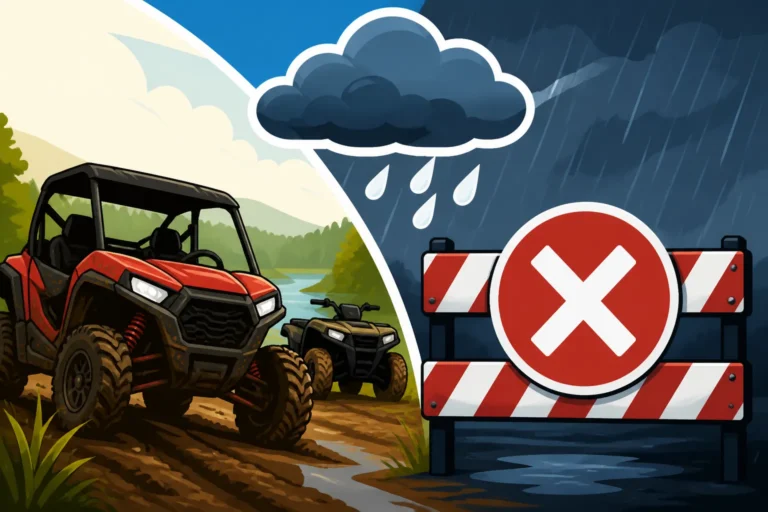
Rain can change the trail surface quickly. Soil that feels firm when dry may become slippery, rutted, or difficult to cross after a storm. Low spots and drainage areas can hold water, while exposed roots and slopes may become harder to navigate. The conditions may also differ across the trail system; one section can be rideable while another has standing water or damage.
Check trail conditions shortly before departure, not only when you first decide to go. If you are driving several hours, make another check before you leave home and, where possible, before turning onto the final access road. Look for official closure updates and notices from the managing office. Do not rely on a forum post from a previous weekend to determine whether the trails are open today.
When the trail is wet, ask whether riding is permitted before you go. If the system is closed, respect the closure. Riding on a closed route can worsen erosion, damage drainage features, and make it harder for the area to reopen. Even if a trail appears passable, a closure may reflect damage that is not obvious from the entrance. The guide [Bethel's Wet Weather Closures in Mississippi] explains why weather closures should be treated as an access rule, not merely a suggestion.
Adjust the ride to what you find
If the trails are open but soft or slick, lower your speed and leave more room between machines. A rider who brakes sharply on loose ground can slide or lose control, and a following rider may not have enough time to respond. Keep a steady pace that allows you to stop within the distance you can see. Avoid sudden turns, aggressive acceleration, and unnecessary spinning of the tires.
Do not create a new route to get around mud, a puddle, or a blocked section. Going around a wet patch can widen the trail, damage vegetation, or push riders onto an unauthorized route. If the obstacle cannot be crossed safely, turn back or follow a clearly marked alternative that is open to your vehicle. If you are unsure, stop in a safe place and consult the map or trailhead information rather than following another person’s tracks.
The best decision may be to shorten the ride or leave. That can be frustrating when everyone has already loaded the machines, but it is better than getting stuck, injuring someone, or damaging the trail. Build flexibility into the day: bring food and water, let your group know that conditions can change the plan, and avoid scheduling a tight return that makes people feel pressured to take risks. Before setting out, check [Checking Trail Conditions Before You Load the Trailer] and [Bethel Closes on Short Notice When It Rains].
Planning a safe and comfortable ride
Prepare for a forest day, not just a trail loop
A day at Bethel can involve more time in the woods and at the trailhead than riders expect. Pack water, food, weather-appropriate layers, basic first-aid supplies, and any medications someone in the group may need. Keep the supplies in a secure container that will stay attached to the machine or in a support vehicle. Mississippi heat and humidity can make even a moderate ride tiring, so plan water breaks instead of waiting until someone feels unwell.
Wear a properly fitted helmet and protective clothing suited to off-road riding. Gloves, eye protection, long sleeves, sturdy footwear, and clothing that can handle mud and brush can make the ride more comfortable and reduce the severity of common scrapes. Check the rules for the specific riding area and any additional requirements for children or passengers. A vehicle’s factory seating and passenger setup matter; do not carry someone in a position the manufacturer did not design for a passenger.
Tell someone outside the group where you are riding and when you expect to return. Cell coverage may be limited, so do not make a phone call your only emergency plan. Carry a charged phone, consider a backup power source, and establish a meeting point in case riders become separated. If the group splits, agree in advance on whether everyone returns to the trailhead or waits at a known location. The planning advice in [First Aid on a Long Southern Loop] and [Packing for Southern Humidity] applies well to a full day at Bethel.
Ride with a group that can stay together
A mixed-experience group should set expectations before the first machine moves. Pick a lead rider who knows the plan and a sweep rider who stays behind the group. Agree on a pace that lets the least experienced rider travel comfortably. The lead should stop at junctions and other decision points rather than disappearing around a bend and assuming everyone will follow the correct route.
Leave enough space between machines for dust, branches, and sudden stops. On narrow trails, do not crowd the rider ahead or pass without clear permission and visibility. If someone needs to stop, signal the group and choose a safe place out of the main travel line. Keep conversations and adjustments off the trail wherever possible, so other riders can pass without encountering a blocked route.
Riding with children or teenagers requires extra planning. Check age and safety requirements that apply to the land and the activity, make sure the machine fits the young rider, and supervise closely. A smaller rider may become tired sooner or need more frequent breaks. The adult’s job is not simply to lead the ride but to recognize when the child is losing focus, becoming overheated, or struggling to control the machine. Review [Mississippi Rules for Riders Under 16] and [Mississippi Safety Courses Through Extension] before taking a young rider onto public riding land.
Riding etiquette and protecting the trail
Stay on designated routes and respect other users
Follow the marked trail and obey signs, gates, and closures. A route that appears to continue beyond a barrier may be closed for maintenance, environmental protection, or another management reason. Do not ride around a gate, cut through vegetation, or use an unmarked road because it seems to lead back to the parking area. If you are uncertain about a junction, stop and check the official map rather than guessing.
Be considerate when you encounter another rider, a hiker, a worker, or someone managing the property. Slow down well before reaching them, keep your machine under control, and give people room. Dust and engine noise carry farther through quiet forest areas than they may seem to from the seat. Avoid unnecessary revving, wheelspin, and high-speed passes near the trailhead, parking area, or other people.
Leave the area as you found it. Secure loose trash, food wrappers, and broken straps rather than dropping them along the trail. Do not dump oil, fuel, or other fluids. If a machine leaks or breaks down, move it safely out of the way if possible and prevent any spill from spreading. A tidy trailhead and low-impact riding help preserve access for the next group, including local families who may return throughout the season.
Understand seasonal use and nearby restrictions
Trail use can overlap with other activities, including hunting and forest work. During hunting season, some access or riding conditions may change, and riding may be discouraged in certain circumstances. Check current notices before planning a trip, particularly if the ride falls during a busy hunting period. Wear visible clothing where appropriate, stay on designated routes, and never assume that a quiet-looking area is unused.
A map app can show roads or user-recorded tracks that are not open for your machine. That is why navigation needs to be paired with the official rules. For instance, onX Offroad may help with route orientation, but it cannot grant permission to use a closed trail or a route not designated for OHV travel. Treat the official trail map and signs as the authority for permitted access.
If a route is closed or an area is restricted, do not use local custom or another rider’s behavior as evidence that the rules do not apply. Regulations and access decisions can differ between national forest land, wildlife management areas, private parks, and town property. For guidance about the seasonal and land-management context, review [Mississippi Hunting Season Trail Advice] and [Mississippi WMA Riding Rules]. Those rules address different kinds of public land, so confirm which land manager governs the place you plan to ride.
Making the day work from arrival to departure
Set up at the trailhead carefully
When you arrive, park and unload in the spaces provided, keeping the access road and other vehicles clear. Read the posted information before starting the machines. Confirm that the trail system is open, that your vehicle fits the requirements, and that you have the correct proof of access. If any point is unclear, pause and ask the managing office or follow the posted instructions instead of improvising.
Do a short pre-ride check after unloading. Look for loose tie-downs, a damaged tire, a leaking fluid line, or an accessory that has shifted during the drive. Make sure helmets and protective gear fit, passengers are seated properly, and the group knows the first stop and turnaround plan. A quick check can prevent the frustrating experience of discovering a mechanical problem after the group has traveled deep into the trail system.
Be mindful of other visitors who are arriving, leaving, or preparing to ride. Keep machines at a controlled speed in the parking area, and avoid blocking the entrance while taking photos or adjusting equipment. Store keys and important papers securely, and take anything valuable with you if you leave the vehicle unattended. A calm, organized departure helps everyone begin the ride in a better frame of mind.
Finish the ride with a safe return
Give yourself enough time to return before fatigue sets in. If the ride is taking longer than expected, turn around while the group is still comfortable rather than pushing on because the trail looks close to the end. Tired riders make poorer decisions, especially after a day of vibration, heat, mud, and concentration. Keep checking in with the group, not just the person at the front.
After the ride, inspect the machines before loading. Remove debris from the tires and undercarriage, check for obvious damage, and look for leaks or loose parts. Mud and water can hide a problem until the vehicle is back on the trailer or stored at home. If you find damage, make a note of it and handle repairs before the next ride instead of assuming the machine will be fine.
Leave the trailhead clean, follow any posted departure instructions, and secure your machine properly for the drive. If you experienced a closure, damaged route, or other issue, report it through the appropriate land-management channel rather than returning to the trail to investigate on your own. On your next trip, repeat the same checks: current conditions, machine eligibility, access requirements, and the day’s map. Bethel is best enjoyed when the ride is planned around the rules and the conditions actually on the ground.
Disclaimer
This article is for general informational purposes only and does not constitute professional advice. Laws, prices and regulations vary by location and change over time. Consult a qualified professional for guidance on your specific situation.