Showing a Safety Certificate at a State Park Gate
A safety certificate can be easy to overlook while packing for a ride, especially when an adult is handling the paperwork for a young rider. At a Mississippi state park gate, staff may ask for proof that a rider meets applicable safety requirements. Confirm the park’s rules before leaving, bring the certificate in a form you can show, and keep it separate from the waiver and entry documents.
What a safety certificate proves at the gate
A safety certificate is evidence that a rider completed an accepted safety course. It is not the same thing as a park admission pass, a signed liability waiver, proof of ownership, or permission to ride a particular trail. Each document answers a different question, so having one does not automatically replace the others.
For a young rider, a certificate may matter because age-related requirements can apply on public land. The details can depend on where the machine will be ridden and which rules apply there. A state park may also have its own procedures for checking riders and machines. Do not assume that a certificate used on one kind of public land will satisfy every requirement at every park.
Before your visit, check the park’s current rules and ask specifically whether a safety certificate is required for the rider in your group. Also ask who must show it: the rider, a parent or guardian, or the adult supervising the ride. That small clarification can prevent a long conversation at the entrance. For a wider overview of park requirements, see Mississippi State Park ATV Rules and Which Mississippi State Parks Allow Machines.
A certificate can be relevant even when the adult accompanying a child has a driver’s license. Those documents show different things. A license identifies driving authority; a course certificate shows completion of safety training. Do not assume one will be accepted in place of the other unless the park or responsible authority confirms it. [Mississippi Rules for Riders Under 16] covers the broader age-related questions, while Mississippi Safety Course Certificates explains the certificate issue in more detail.
| Document | What it generally helps establish | What it does not replace |
|---|---|---|
| Safety certificate | Completion of an accepted safety course | Park entry, a waiver, proof of ownership, or permission to ride |
| Parent or guardian identification | The adult’s identity and role with a minor | The rider’s course completion |
| Liability waiver | Agreement to the park’s required conditions | A safety certificate or trail access approval |
| Machine paperwork | Ownership or other requested proof about the machine | Rider eligibility or park admission |
| Park pass or admission documentation | Payment or authorization for entry, as applicable | Safety training or age requirements |
A certificate is best treated as one part of a small document packet. If a park asks to see it, having it ready can help staff verify the rider without delaying the rest of your group. If the park does not require it for your particular rider or activity, carrying it may still be useful when rules or circumstances are not clear.
Confirm the park’s rules before you travel
State park policies are not necessarily identical from one location to another. Some parks may not allow the type of machine or riding activity you have in mind, and requirements may vary by age, riding area, or park procedure. First make sure the park allows your machine and the intended use. Then ask what documents each rider needs to carry or present. Mississippi State Park Waiver Steps and Mississippi State Park Age Proof can help you identify other questions to settle before arrival.
When contacting the park, be specific. “Do I need a safety certificate?” may not give staff enough information to answer accurately. Instead, explain the rider’s age, who will accompany them, what kind of machine they will use, and whether the plan is to ride on a designated area or trail. Ask whether the certificate must be presented at the entrance or kept with the rider while riding.
Useful questions include:
- Is this machine type allowed at this park?
- Does this rider need a safety certificate under the park’s rules?
- Which courses or certificate formats are accepted?
- Should the rider carry the certificate, or can an adult present it?
- Will staff need to see an original, or is a clear copy acceptable?
- Are there separate age, helmet, passenger, or supervision rules?
- Do we also need to complete a waiver or show identification?
- What should we do if the certificate is lost or the name on it differs from the rider’s current name?
A park employee’s answer about one requirement should not be treated as confirmation of every other requirement. For example, knowing that a certificate is accepted does not establish that the machine is permitted, that the rider meets the age rules, or that a waiver has been completed. Review the full set of requirements, including Mississippi State Park Helmet Requirements, rather than relying on a single document check.
If you cannot reach the park, look for its current posted instructions and any official park information about machine access, waivers, and rider age. If the rules are unclear, the safest practical choice is to delay the trip until you can confirm them. Driving to a gate with an uncertain answer can cost time and leave your group with no option to ride.
Prepare the certificate and other documents
Before the trip, check the certificate itself. Make sure the rider’s name is readable and that the document appears complete. If the certificate is digital, download it to a device that will be available at the park, rather than relying on a message or online account that may be difficult to access. A printed copy is a sensible backup when available.
Keep the certificate easy to reach but protected from rain, mud, and damage. A folder, document sleeve, or waterproof pouch can keep it together with identification and waiver paperwork. If you are carrying documents for several riders, separate them by person. That makes it easier to show the right certificate without mixing up names.
A simple preparation process:
- Confirm that the park allows the machine and activity you are planning.
- Ask whether the rider needs a safety certificate and which proof the park accepts.
- Check the certificate for legibility and the correct rider’s name.
- Save an offline digital copy or print a backup if practical.
- Gather any separate waiver, identification, or entry documents the park requests.
- Tell the young rider where the certificate is kept and who will present it.
- Recheck the park’s directions before departure in case its procedures have changed.
Do not alter a certificate to make it appear more current or to correct a mismatch. If there is a spelling issue, a name change, or a lost document, ask the course provider or park what proof they will accept. A parent’s explanation may help staff understand the situation, but it is not a substitute for the proof the park requires.
The certificate also does not authorize a rider to use any machine or trail. A park can set separate conditions for machine width, passenger seating, protective gear, or where riding is permitted. Make sure you understand those conditions independently. A signed waiver, where required, likewise does not erase age limits or expand the areas open to riding.
What to expect at the gate and if there is a problem
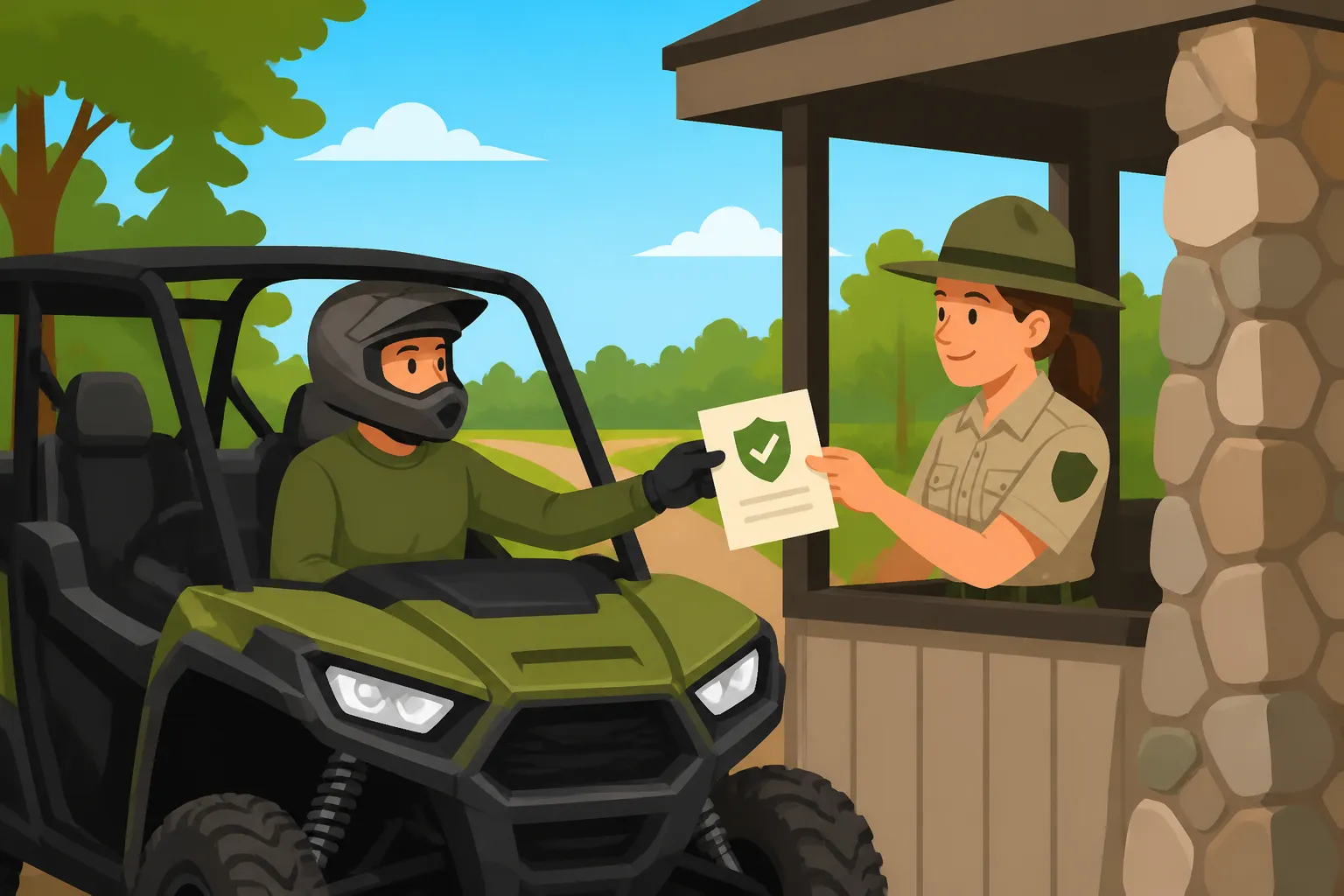
At the entrance, follow the instructions of park staff. If asked for the safety certificate, show the document for the rider concerned and allow staff to check the name and details. The adult accompanying a minor should be ready to answer basic questions about who the rider is and which machine they will use. Keep the interaction straightforward: present the requested paperwork, answer accurately, and ask for clarification if a rule is not clear.
Avoid handing over a phone with private messages, photos, or unrelated information visible. If the certificate is digital, open the file before reaching the front of the line and display only the relevant page. If staff cannot read it, offer a clearer copy rather than arguing that a blurry image should be accepted.
If the certificate is missing, do not assume that a photo of it, a parent’s statement, or another rider’s certificate will be sufficient. Ask the gate staff what options are available. The park may decide that the rider cannot participate until acceptable proof is shown. If that happens, respect the decision and avoid taking the machine onto park property to ride without clearance.
If the document is present but staff are unsure whether it qualifies, calmly ask what detail needs verification. It may help to have the course provider’s contact information or a way to retrieve the certificate record. Do not expect the gate staff to resolve every issue instantly, particularly when the park is busy. If they cannot confirm acceptance, ask whether there is an official office or contact who can provide an answer before the group proceeds.
A mismatch between the certificate name and the rider’s current name can also slow down entry. Bring any supporting documentation the park has told you to provide, but do not assume that unrelated identification will resolve the discrepancy. The park’s requirements determine what evidence it can accept.
Finally, keep the certificate accessible while the group is inside the park if the rules say the rider must carry it. A check at the entrance does not necessarily mean the document can be left in a vehicle for the rest of the day. Follow the park’s instructions, and make sure the young rider knows how to reach the adult responsible for the paperwork.
The most reliable approach is to treat the gate check as one part of preparation, not as the moment to figure out the rules. Confirm the park’s requirements, bring clear proof for the specific rider, and keep separate documents for course completion, waivers, and entry. That makes it easier to handle the check and focus on whether the park and riding area are appropriate for your group.
Disclaimer
This article is for general informational purposes only and does not constitute professional advice. Laws, prices and regulations vary by location and change over time. Consult a qualified professional for guidance on your specific situation.