The 50-Inch Width Limit Written Into the Pass
A machine can look trail-ready and still fall outside the width limit attached to a Mississippi National Forest OHV pass. The key is understanding what the pass permits, which designated riding areas it covers, and what to verify before loading up. This article explains the 50-inch threshold and offers a practical way to check your machine and plans.
What the 50-inch limit means
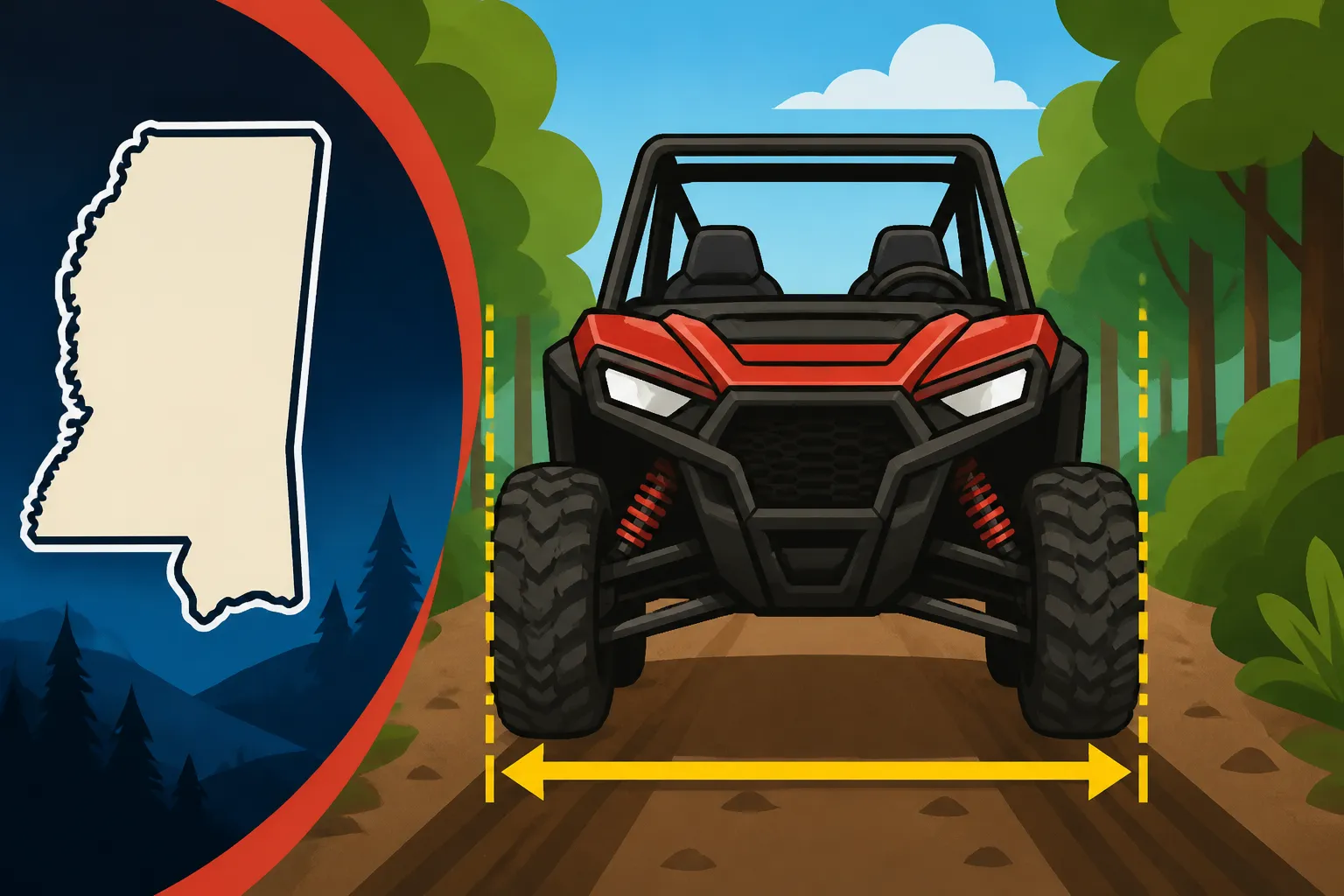
The Mississippi Annual Forest-wide OHV Pass has a specific width boundary. According to the Forest Service, the pass allows use of trails open to vehicles that are 50 inches wide or less. That makes width a practical eligibility check—not just a specification to glance at after you arrive.
The boundary is inclusive: a vehicle exactly 50 inches wide falls within the stated limit. A vehicle wider than 50 inches does not meet the pass’s width condition for those trails. That does not establish whether a wider machine has another permitted place to ride; ask the Forest Service about access options rather than assuming the pass covers it.
The Forest Service lists two special passes for the National Forests in Mississippi: the Mississippi Adventure Pass and the Mississippi Annual Forest-wide OHV Pass. The width rule discussed here belongs to the Annual Forest-wide OHV Pass. Do not assume that every pass has identical coverage or that buying a pass makes every forest road or trail available to every machine. For an overview of the pass options, see Mississippi National Forest OHV Passes and Mississippi Forest Pass Coverage.
| Question | What the Forest Service information says | Practical takeaway |
|---|---|---|
| Which pass has the width condition? | The Mississippi Annual Forest-wide OHV Pass | Check that you are reviewing the pass intended for OHV trail use. |
| What is the width limit? | Trails open to vehicles 50 inches wide or less | Verify your machine’s width before choosing a trail. |
| Does the limit include a machine exactly 50 inches wide? | Yes, the stated limit includes vehicles 50 inches wide | Compare the measured width with the boundary carefully. |
| Does a pass guarantee every trail is open? | No such guarantee is stated; trails can close in wet conditions | Confirm the specific route and its current status before leaving. |
The pass costs $60 as of November 2026, according to the Forest Service. Holders of the Interagency Senior Pass, Interagency Access Pass, Golden Age Passport, or Golden Access Passport can receive a 50% discount on any National Forests in Mississippi pass, according to the Forest Service. Confirm current pass details and how to claim a discount with the Forest Service before purchasing. More on coverage appears in Which Trails the $60 Forest Pass Opens.
A width limit is not the same thing as a general approval of the machine or a promise that a route is available. The pass information says that it allows use of trails open to vehicles within the stated width. You still need to identify a designated OHV riding area, check whether the route is open, and follow any applicable site rules. For a broader explanation of width limits at riding areas, see Mississippi Trails With Width Limits.
How to check your machine’s width
Before measuring, find the vehicle’s stated width in its owner’s manual or manufacturer specifications. That gives you a useful starting point, but do not assume that the published dimension and the Forest Service’s method for applying its limit are necessarily the same. The facts available here do not specify where or how width is measured, so ask the relevant Forest Service office if the result is near the boundary or if you are unsure what parts of the machine count.
A careful physical measurement can help you spot an obvious mismatch. Park the machine on level ground and measure across its widest point, keeping the measuring tool straight. If you need a tape measure, one from a local hardware store or Amazon can do the basic job; the important part is measuring consistently and not relying on a guess based on appearance.
Keep in mind that accessories or changes may affect the machine’s overall dimensions. If the machine has aftermarket wheels, tires, spacers, racks, or other parts that extend outward, compare the manufacturer’s published width with the current configuration. This is a reason to ask the Forest Service how it determines width—not a claim that a particular accessory is included in its measurement.
If your measurement is close to 50 inches, avoid rounding down or treating a borderline estimate as confirmation. Repeat the measurement, check the manual, and contact the Forest Service with the make, model, and any relevant modifications. Ask the office what measurement method it uses and whether the machine qualifies for the trail you plan to ride. The pass’s stated limit is clear; the measurement method is something to verify when your machine sits near it.
It can help to keep a note of the machine’s model and measured dimensions with your riding paperwork. That will not replace any official determination, but it makes it easier to ask a clear question before traveling. If you are shopping for a machine, check its width before buying if access to a particular trail matters to you. A machine that exceeds the threshold may not be suitable for trails covered by this pass, even if it performs well elsewhere.
For a route-specific comparison, see Bethel’s Width Limit in Mississippi. The general pass threshold and the details for a particular riding area are related, but they are not interchangeable. Confirm both the machine’s eligibility and the trail’s own access requirements.
Where the pass applies and when trails close
The Forest Service identifies designated OHV trail riding areas across several ranger districts in Mississippi. On the Chickasawhay Ranger District, the listed area is the Little Tiger ATV/Motorcycle Trail. On the De Soto Ranger District, the listed areas are the Bethel OHV Trails and Rattlesnake Bay ATV Trail. On the Tombigbee Ranger District, the listed area is the Chickasaw ATV/Motorcycle Trail.
These names help narrow down where to ask about access, but a pass and a trail name do not establish that a route is open on the day you want to ride. Contact the Forest Service or check its current trail information before departure. For more detail on specific locations, see Mississippi National Forest Riding Explained and Mississippi Coast and De Soto National Forest Riding.
Conditions can change the plan even when the machine meets the width threshold. According to the Forest Service, motorized vehicle trails close when conditions are wet to prevent trail damage and erosion into streams. A pass does not override a closure, and loading the machine before checking conditions can lead to a wasted trip.
Before you head out:
- Identify the district and designated OHV area you plan to visit.
- Check that your machine is within the pass’s stated width limit.
- Confirm that the route is currently open and ask about wet-weather closures.
- Verify which pass applies and whether you qualify for a discount.
- Follow instructions and signs at the trail area.
For a useful pre-departure routine, see Checking Trail Conditions Before You Load the Trailer. If rain or wet ground is affecting a route, do not treat an old status update or a paid pass as permission to ride there. Check for current information and choose an open alternative only if the Forest Service confirms it is available to your machine.
The simplest way to avoid confusion is to treat these as separate checks: the pass, the machine’s width, the designated route, and the route’s current condition. Passing one check does not settle the others. In particular, a machine that fits the width limit still needs a route that is open, and a named OHV area does not by itself confirm that all trails within it are open at a given time.
If your machine is wider than the limit, ask the Forest Service what options may be available rather than attempting to enter a trail covered by the pass. If your machine is at or below the limit, confirm the specific route and conditions before setting out. Those simple checks can help prevent a width surprise at the trailhead and reduce the risk of riding on a closed trail.
Sources
- Forest Service — National Forests in Mississippi | Passes | Forest Service (checked November 3, 2026)
Disclaimer
This article is for general informational purposes only and does not constitute professional advice. Laws, prices and regulations vary by location and change over time. Consult a qualified professional for guidance on your specific situation.