Mississippi Permit Questions Riders Ask
Mississippi riders often hear that a permit is required, but the answer depends on where you ride and what kind of access you mean. A state sticker, a national forest pass, a park waiver and a hunting-area rule are not interchangeable. Here’s how to sort out the requirements before you load up, including what visiting riders need to know.
First, identify what the permit is for
Mississippi does not issue a general ATV or UTV registration sticker that gives you statewide riding access. That does not mean every trail is free to use or that no paperwork is ever needed. A riding area can require its own pass, proof of age or safety training, or a signed waiver. Land rules may also limit where you can ride, regardless of the papers you carry.
The most useful first question is not “Do I need an ATV permit in Mississippi?” It is “Where am I riding, and what does that place require?” A national forest trail, a wildlife management area, a state park, private property and a public road are different settings with different rules.
| Where you plan to ride | What may be required | What the requirement does not do |
|---|---|---|
| National forest OHV trail | A forest pass or trail permit, plus any rider and machine requirements | It does not open every forest road or trail to OHVs |
| Bethel OHV Trails | The site’s day-use requirements and applicable rider requirements | It does not authorize riding on unrelated public land |
| Wildlife management area | Compliance with area rules and any required hunting or access credentials | It does not create permission to ride off designated roads |
| State park | A waiver and compliance with park-specific rules | A waiver is not a statewide registration or road permit |
| Private riding park | The park’s entry, waiver, age and equipment rules | The park’s approval applies only to that property |
| Public road | The road-use rules that apply to the machine and location | A trail pass does not make an ATV street-legal |
A permit is generally permission to use a particular place under stated conditions. It is not proof that a machine is titled, registered, insured or approved for public-road travel. Keep those issues separate. If you need help with where the state’s riding rules apply, see Mississippi Permit Questions Riders Ask is this article’s title and not appropriate to link to itself; do not use. Instead internal links Mississippi National Forest Riding Explained and Mississippi WMA Riding Rules clarify venue-specific rules.
Also distinguish a land manager’s pass from a state-issued registration. Mississippi does not have a broad state OHV registration system that visitors can bring from home and exchange for a Mississippi sticker. As explained in Mississippi Has No OHV Registration to Reciprocate, the more practical question for a visitor is whether the particular riding area recognizes the pass or documentation required by its own rules.
Before leaving home, write down the exact riding area and the name of the land manager or operator. Then check the current requirements directly with that office or park. A friend’s experience from a previous season can be helpful, but it may not reflect a changed closure, new waiver process or updated pass requirement.
National forest permits and OHV access
National forest access is one of the main reasons riders ask about permits. A forest pass or OHV permit is tied to authorized riding opportunities and does not turn the whole forest into an open riding area. Forests include roads and lands with different uses, and some routes are closed to motorized recreation or limited by signs, gates, seasonal restrictions or trail designation.
The practical approach is to treat the trail map, posted signs and current forest information as part of your permit. A pass does not override a closure. Nor does seeing tire tracks mean a route is open to your machine. If you are unsure whether a route is designated for OHVs, ask the relevant forest office before riding it.
What a forest pass covers
The pass is a land-access requirement for the specified OHV opportunities, not a general license for the rider or a registration plate for the machine. Check what the pass covers, who must carry or display it, whether it applies to the machine you plan to use, and how to obtain it. Confirm current cost and purchase options with the official forest office or pass provider rather than relying on an old post or receipt.
A pass also does not necessarily cover every fee at every recreation site. A private park may charge its own admission, and a separate activity or camping arrangement may have its own terms. For more on the difference between a pass and access, see Mississippi Forest Pass Coverage and What a Mississippi Forest Pass Does Not Cover.
Do not assume that a pass for one site, district or state works everywhere. Confirm the specific trail system and permitted vehicle category. A narrow trail system may not accept a wide side-by-side even if you have a valid pass. For example, the trail’s machine-width restrictions may be as important as the permit itself; review Mississippi Trails With Width Limits before hauling a larger machine.
Check conditions before you tow
Permit requirements are only one part of planning. Trails can close after heavy rain, during maintenance, or for other management reasons. Check the current trail status shortly before departure, especially if you are driving a long distance. Ask whether the route is open to your machine, whether the pass can be purchased at the site, and whether the gate or office operates on the day you intend to arrive.
Carry whatever proof the site says to bring. That could be a pass receipt, permit confirmation or other required document. If the permit is electronic, save the confirmation where you can access it without cell service, and keep a screenshot or printed copy if the operator allows or recommends it. A phone battery can die, and some trailheads have weak reception.
A permit does not replace basic trail preparation. Bring identification when required, know where the marked route begins, and keep a map or offline route information available. On public land, follow posted closures and stay on designated routes. The trail rules—not the fact that you have paid for access—determine where you may ride.
Bethel, state parks and wildlife management areas
Not every public riding area uses the same permit system. A forest pass, a day-use ticket, a park waiver and a wildlife management area rule can each apply in different ways. Don’t treat the word “permit” as if it names one statewide document.
Bethel OHV Trails
Bethel OHV Trails has its own trail access requirements. Check the site’s current operating information before you go, including any pass or day-use process, machine restrictions and rider eligibility rules. Do not assume that a national forest pass automatically serves as Bethel admission, or that a Bethel ticket lets you ride elsewhere.
Riders should also verify that their machine fits the trail system’s limits. Some trails are designed for narrower machines, and a permit cannot make an oversized vehicle suitable or allowed. For route length and machine fit, see Bethel OHV Trails in Mississippi and Bethel’s Width Limit in Mississippi.
If a rider is a minor, confirm the current age, supervision and safety-certificate requirements before traveling. Requirements can depend on the location and applicable public-land rules. Do not rely on a parent’s permit as a substitute for any document the young rider must carry.
State parks
A state park may require a signed liability waiver or other check-in steps before riding. That waiver is different from a state registration card. It does not authorize riding on a road, establish ownership of the machine or waive the park’s right to enforce its own restrictions.
Confirm which parks allow the kind of machine you plan to bring. Then ask what the rider must show at check-in, whether a parent or guardian needs to sign for a minor, and what equipment or passenger rules apply. Read the waiver before signing and follow park staff instructions. A waiver does not mean every route inside the park is open to every machine.
For details on park procedures, use Mississippi State Park Waiver Requirements and Which Mississippi State Parks Allow Machines. If you are transporting a child, check the age and helmet requirements separately; a waiver does not replace them.
Wildlife management areas
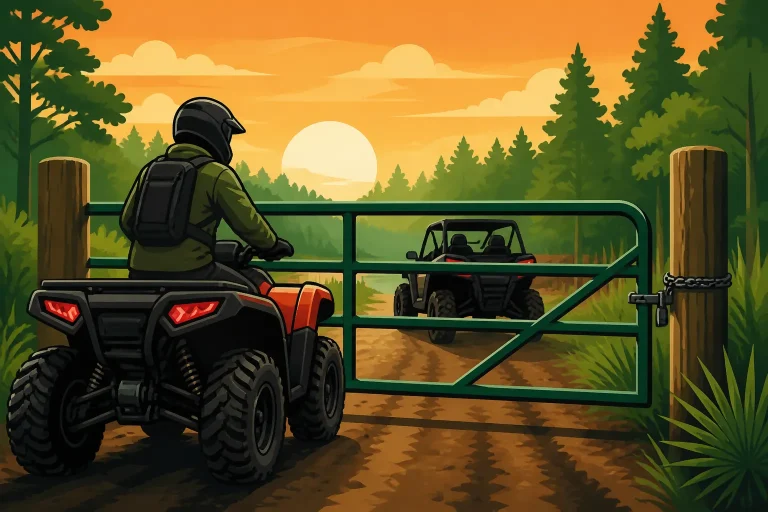
A wildlife management area is not automatically an ATV trail system. Riding may be limited to designated roads or allowed only for certain purposes under particular conditions. Gates, berms, signs and closures matter. A hunting credential or access document does not, by itself, grant permission to ride anywhere within the area.
Check the rules for the specific management area and the specific road. Ask whether motorized travel is allowed on the route, whether access is seasonal, and whether a hunting activity changes the rules. If a road is closed, do not go around a gate or berm. For a fuller breakdown, see Mississippi WMA Designated Roads Only and Mississippi WMA Riding Rules.
The same principle applies to private land. Permission from an owner or lease manager is necessary when the land is private, but that permission does not cancel public-road laws or rules imposed by another land manager. Get permission for the exact property and intended use, preferably in a form you can refer back to later.
Visiting riders and out-of-state permits
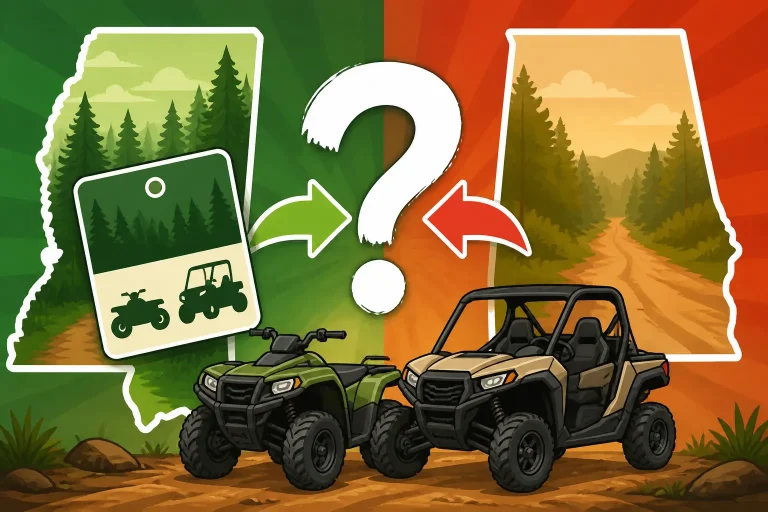
Visitors often want to know whether a home-state ATV registration, trail sticker or safety card will satisfy Mississippi requirements. The answer depends on the place they plan to ride. Mississippi does not issue a general ATV registration sticker that it can simply exchange for or reciprocate with another state’s sticker. A visitor should not assume an out-of-state registration is a substitute for a Mississippi forest pass, a park waiver or a local trail ticket.
At the same time, lack of a Mississippi state sticker does not mean a visitor must buy one at the border. The relevant requirement is usually set by the riding area. For a forest trail, check that forest’s pass and vehicle rules. For a private park, check its admissions and waiver process. For a state park, confirm whether the park allows the machine and what documentation riders must present.
Before traveling, contact the place you intend to ride and ask these questions:
- Is this exact trail or property open to ATVs, UTVs or both?
- Does the location require a pass, permit, day-use ticket or waiver?
- Does a pass from my home state have any role, or must I obtain the local pass?
- Are there machine-width, age, passenger or equipment restrictions?
- What documents must each rider carry?
- Are there seasonal closures, operating-hour limits or weather closures?
- Can I buy the required pass on site, or must I arrange it before arrival?
A home-state license, safety card or registration may help establish information about the rider or machine, but do not assume that it meets a Mississippi land manager’s requirement. Ask specifically whether the site accepts it. If you cross a state line to ride, see Mississippi Visitors From Alabama, Mississippi Visitors From Louisiana or Mississippi Visitors From Tennessee for visitor-focused considerations.
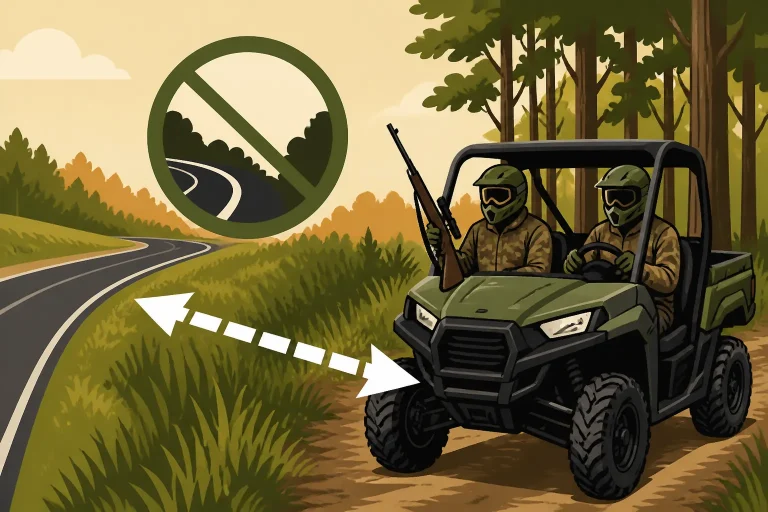
It is also important to separate a trail pass from permission to ride on public roads. A permit for an OHV trail does not make an ATV or UTV legal on a Mississippi street or county road. Road access is a separate legal question; start with Mississippi Bans ATVs on Public Roads and check whether any local ordinance applies to the particular place. A trail permit is not a road-use exception.
What to carry and how to avoid a permit problem
A little preparation can prevent a wasted trip or a dispute at a trail entrance. Keep the documents that apply to your destination together, and make sure the information matches the rider, machine and date of travel.
A practical pre-ride checklist:
- Confirm the destination. Identify the exact trail, park, management area or private property, not just the nearest town or forest.
- Check the official rules. Verify permits, operating days, closures, age rules, machine limits and check-in procedures with the land manager or operator.
- Confirm the machine is eligible. Compare width and other restrictions with your ATV or UTV’s actual specifications. Do not estimate from appearance.
- Prepare rider documents. Bring identification, required proof of age or safety training, and any permit confirmation the site asks for.
- Save proof offline. Keep electronic confirmations accessible without a signal. A printed copy can be useful if the site permits it.
- Keep documents dry and secure. Store them where they will not be soaked, mud-covered or left behind in the tow vehicle. A waterproof document sleeve, including an inexpensive option from a retailer such as Amazon, can help keep paper copies readable.
- Recheck before departure. Look for weather closures, changed hours or notices posted after you first made the plan.
Do not treat an old pass, a receipt from another rider or a screenshot of an outdated rule as current authorization. If the site’s staff gives you instructions, follow them and ask for clarification before entering a disputed route. If the answer is unclear, pause rather than assuming that a permit covers more than it says.
Common misunderstandings
“I have a title, so I can ride on public land.” A title is ownership documentation. It is not a trail permit, park waiver or road authorization. If your machine needs a title under Mississippi’s rules, handle that separately; see Mississippi Title Requirements for 2026.
“I paid a pass fee, so all trails are open.” A pass only applies to the access it covers. A closure, machine restriction or land boundary still applies.
“My home-state sticker should work everywhere.” Do not assume that. Ask the specific site whether it accepts it, and whether a local permit is still required.
“A park waiver is the permit.” A waiver may be one check-in requirement, but it does not replace any pass, age, equipment or route requirement.
“If a route is unmarked, it must be open.” Lack of a sign is not reliable proof of permission. Use an official map and ask the land manager if the route’s status is uncertain.
“A permit makes road riding legal.” It does not. Trail access and public-road use are separate matters.
Frequently Asked Questions
Does Mississippi require every ATV or UTV rider to buy a state permit?
There is no general statewide ATV registration sticker that serves as universal riding permission. A particular trail system, forest, park or private property may still require its own pass, ticket or waiver.
Can an out-of-state trail sticker be used in Mississippi?
Do not assume it will be accepted. Ask the specific riding area whether it recognizes the sticker and whether it also requires a local pass or other documentation.
Does a National Forest OHV pass let me ride anywhere in the forest?
No. A pass does not open every forest road or route to OHVs. Ride only where motorized use is authorized, and follow signs, maps and closures.
Is a park waiver the same as a permit?
No. A waiver is a separate check-in or liability document. It does not substitute for a trail pass or make a machine eligible for every route.
Does a riding permit let me take an ATV on a Mississippi public road?
No. A permit for off-road access does not establish that the machine may be used on a public road. Check the road rules and any applicable local ordinance separately.
Disclaimer
This article is for general informational purposes only and does not constitute professional advice. Laws, prices and regulations vary by location and change over time. Consult a qualified professional for guidance on your specific situation.