Why Levee Boards Keep ATVs Off the Banks
It's a familiar sight across our beautiful state: those long, earthen banks snaking along our rivers and waterways, just begging for a scenic ride on your ATV or side-by-side. You see them, envisioning a peaceful cruise, only to encounter signs or realize that riding on them is strictly prohibited. This can be incredibly frustrating for riders who just want to enjoy the outdoors, but those restrictions aren't arbitrary. There are very serious, vital reasons why Mississippi's levee boards steadfastly keep off-road vehicles off these critical structures, and understanding them is key to protecting our communities and finding legal, fun places to ride.
The Critical Role of Levees in Mississippi
In a state crisscrossed by rivers and prone to heavy rains, levees aren't just pretty hills; they are foundational infrastructure that literally keeps our communities, farms, and homes from being submerged. For many Mississippians, these earthen barriers are the difference between safety and catastrophic floodwaters.
More Than Just Dirt Mounds: Levees as Vital Infrastructure
When you look at a levee, you might just see a long, elevated stretch of dirt. But a levee is far more than that; it's a meticulously engineered flood control structure, designed and built to withstand immense pressure from rising waters. Their primary purpose is to protect low-lying areas from flooding by containing rivers and other bodies of water within their banks, especially during periods of heavy rainfall or prolonged wet seasons. Think about the agricultural heartland in the Mississippi Delta, or communities nestled along the Big Black River – without these levees, huge swathes of our state would be regularly inundated, making farming impossible and urban development precarious.
The construction of these levees involves specific soil compaction techniques, drainage considerations, and slope angles, all calculated to ensure their stability and effectiveness. They aren't just piled-up earth; they're complex systems designed to endure the force of nature. If a levee fails, the consequences can be devastating, leading to widespread property damage, agricultural losses, and even loss of life. Entire towns could be wiped out, and years of effort to rebuild could be washed away in a single event. The entire economy and safety of many regions literally rest on the integrity of these structures.
The Weight of Responsibility: Levee Boards' Mandate
Given the immense importance of levees, it's no surprise that specific entities are tasked with their oversight and maintenance. Across Mississippi, various levee boards, often local or regional governmental bodies, hold the crucial mandate of ensuring these protective barriers remain sound and operational. These boards are composed of dedicated individuals, often engineers, landowners, and community leaders, who understand the profound responsibility resting on their shoulders. Their primary legal and moral obligation is to maintain the integrity of the levee system, which includes everything from regular inspections and vegetation management to emergency repairs during flood events.
Levee boards operate under specific state guidelines and often coordinate with federal agencies like the U.S. Army Corps of Engineers. They are responsible for securing funding, hiring crews, and making critical decisions that directly impact public safety and economic stability. Because they bear such a heavy burden of responsibility, levee boards are extremely cautious about any activity that could compromise the structures they are sworn to protect. This means that when it comes to activities like off-road vehicle riding, their decisions are rooted in the fundamental need to prevent any action that could inadvertently weaken a levee or hinder their ability to respond to a crisis. You can dive deeper into these specific regulations by looking into [Mississippi Levee Board Rules].
Understanding the Physical Impact of ATV and UTV Traffic
While a casual ride might seem harmless, the truth is that ATVs and UTVs, by their very nature, can inflict significant, often unseen, damage on the delicate structure of a levee. These aren't rugged trails designed for high-impact use; they are engineered barriers that need consistent, gentle care.
Erosion and Soil Compaction: The Silent Damage
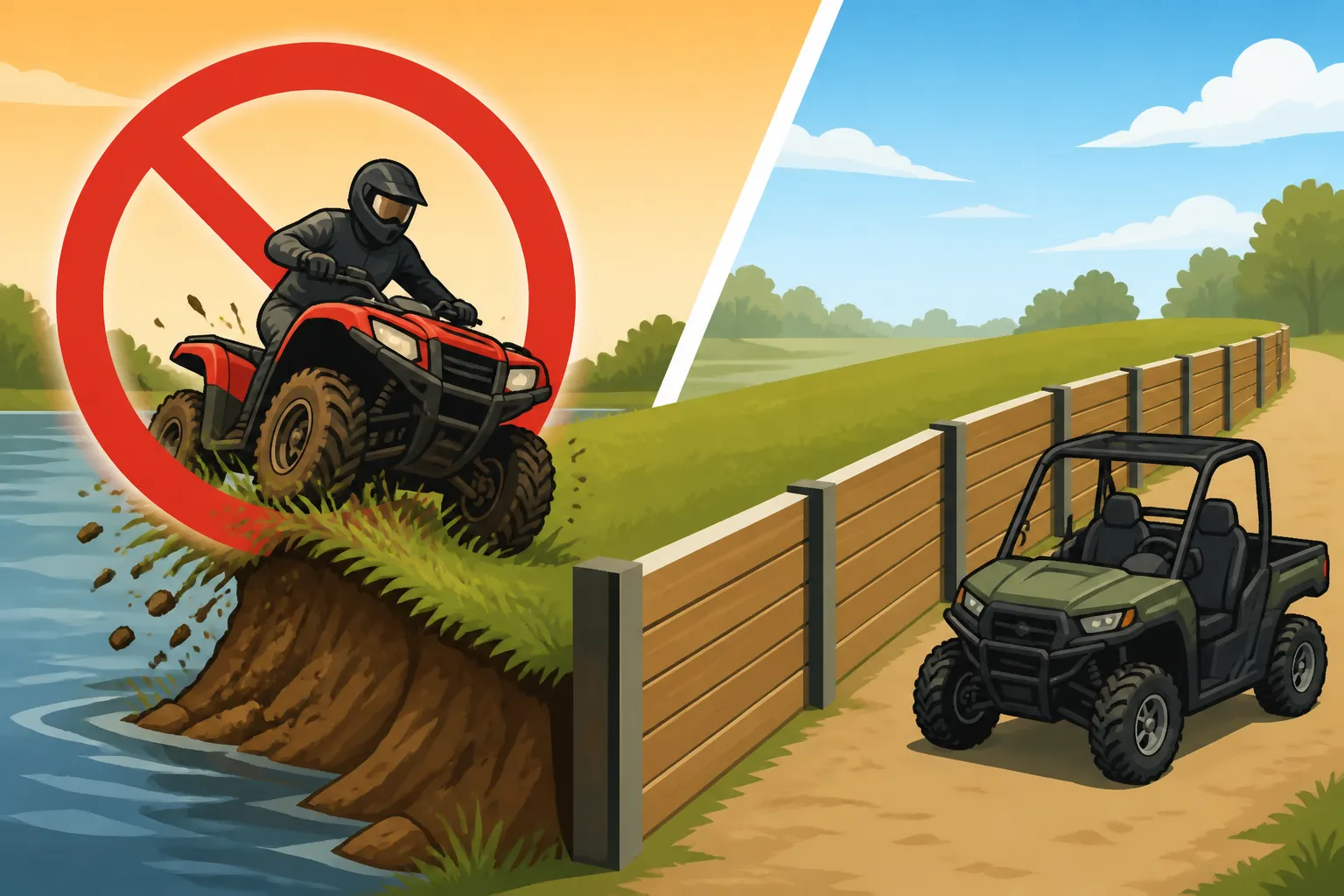
One of the most immediate and concerning impacts of ATV and UTV traffic on levee banks is the way their tires interact with the soil. Off-road tires are designed with aggressive treads to provide traction in challenging terrain – which is great for a mud park, but disastrous for a levee. These treads can quickly tear up the surface layer of the levee, displacing soil and creating ruts. Even light, infrequent use can start this process. Once the topsoil is disturbed, it becomes much more susceptible to erosion from wind and rain. A small rut can quickly turn into a gully, channeling water directly into the levee structure, eroding it from the inside out.
Beyond surface erosion, the sheer weight and repetitive passes of ATVs and UTVs cause significant soil compaction. When soil is compacted, its ability to absorb and drain water is severely reduced. This means that instead of rainwater soaking into the ground and supporting the levee's vegetation, it simply runs off, taking loose soil with it and exacerbating erosion. Furthermore, compacted soil can create impermeable layers within the levee, trapping water and potentially leading to hydrostatic pressure buildup, which can destabilize the levee's internal structure over time. This kind of damage is insidious; it often isn't visible until a problem becomes critical, at which point it's far more expensive and difficult to fix.
Vegetation Disturbance and Slope Stability
The seemingly innocent grass, weeds, and small shrubs growing on a levee bank are actually its first line of defense against erosion. Their root systems act like a natural mesh, holding the soil together and providing crucial stability to the levee's slopes. This vegetative cover also helps slow down rainwater runoff, allowing it to soak in rather than strip away the soil. When ATVs and UTVs traverse these banks, they inevitably destroy this vital vegetation. Tires rip up turf, expose bare earth, and prevent new growth from establishing itself. A machine from SuperATV, built for rugged trails, isn't designed for preserving delicate levee grasses.
Once the vegetative cover is gone, the levee's soil is left exposed and vulnerable. Rain can then directly hit the bare soil, dislodging particles and carrying them away. This not only weakens the surface but can also lead to more serious issues like shallow slides or slumping on the levee's slopes. The stability of the slope is directly dependent on the integrity of the soil and its protective vegetation. Disturbing this balance for recreational riding is a direct threat to the structural soundness of the levee. The law in Mississippi broadly defines what constitutes an off-road vehicle, including various ATVs and UTVs, and these definitions apply universally, even to machines that might seem small or light. For more on what counts as an off-road vehicle, check out [What the Law Counts as an Off-Road Vehicle].
Hidden Damage and Inspection Challenges
One of the most problematic aspects of off-road vehicle use on levees is the potential for hidden damage. While deep ruts are obvious, subtle cracks, minor shifts in soil, or compromised drainage pathways might not be immediately apparent to the untrained eye. These smaller forms of damage can accumulate over time, slowly weakening the levee's resistance to floodwaters. What looks like a fun track for your quad could, in reality, be a slow-motion disaster for the levee.
Furthermore, ATV tracks can make it incredibly difficult for levee maintenance crews to perform their regular inspections. Inspectors look for subtle signs of stress, erosion, animal burrows, or seepage, which can indicate underlying problems. A crisscross of tire tracks can obscure these crucial visual cues or even mimic them, leading to misinterpretations or missed red flags. If a levee board inspector sees a suspicious depression, they need to determine if it's natural erosion, an animal burrow, or simply an ATV track. This added layer of complexity in inspections means that valuable time and resources are diverted, and critical issues might be overlooked, jeopardizing the safety of the entire system.
Operational and Safety Concerns for Levee Boards
Beyond the direct physical damage, allowing ATVs on levee banks introduces a host of operational, safety, and liability challenges that levee boards simply cannot afford to shoulder. Their mandate is protection, not recreation, and these concerns reinforce their strict prohibitions.
Maintenance Interference and Emergency Access
Levees require constant, diligent maintenance to remain effective. This includes regular mowing to keep vegetation at an optimal height, preventing invasive species, monitoring for animal burrows, and making minor repairs as needed. When ATVs and UTVs create ruts, tear up the surface, or leave debris, they directly interfere with these routine maintenance activities. Mowers can get stuck, maintenance equipment can be damaged, and crews face a more difficult and time-consuming task to keep the levee in pristine condition. This increased workload translates to higher operational costs, diverting funds from other critical levee management activities.
More critically, during a flood event, levee banks become emergency access routes for monitoring, sandbagging operations, and rapid repairs. Every minute counts when floodwaters are rising. If the levee's surface is rutted, uneven, or obstructed by previous off-road vehicle use, it can severely impede the swift movement of emergency vehicles and equipment. Imagine trying to drive a heavy truck with sandbags along a severely damaged levee bank in the dark and rain. The delays and dangers posed by such conditions could have catastrophic consequences for the communities relying on that levee. Levee boards simply cannot risk anything that might compromise their ability to respond effectively in a crisis.
Liability and Risk Management
The question of liability is a huge factor in why levee boards prohibit ATVs. If a levee were to fail, and it could be demonstrated that recreational riding contributed to its weakening, the levee board could face immense legal and financial liability. This isn't a theoretical risk; it's a very real concern that shapes their policies. Levee boards are responsible for public safety, and allowing an activity that inherently increases risk is contrary to their core mission.
Moreover, if riders were permitted on levees, there's the added risk of accidents. Off-road vehicles can be inherently dangerous, and the uneven terrain of a levee bank, combined with potential blind spots or hidden hazards, could lead to serious injuries or even fatalities. If such an accident occurred, the levee board could be held responsible, even if they had posted warnings. The legal implications of trying to manage and mitigate these risks while still allowing recreational use would be a nightmare for any governmental entity. It's simply easier, safer, and legally more sound to maintain a blanket prohibition on activities that are incompatible with the levee's primary function and the board's liability exposure.
Conflicting Uses and Public Perception
Levee systems are not designed as recreational parks. Their primary and overriding purpose is flood protection. Allowing ATVs and UTVs on them creates a conflict of interest, changing their perceived function and potentially clashing with other, legitimate uses or adjacent private property rights. For instance, many levees might have service roads used by farmers, utility companies, or for legitimate maintenance access. Adding high-speed recreational traffic to these areas would create dangerous intersections and friction between different user groups.
Public perception also plays a role. When the public sees off-road vehicles tearing up levee banks, it can erode confidence in the levee board's ability to maintain these critical structures. It sends a message that the integrity of the levee might not be taken seriously, which can cause unnecessary alarm and reduce public trust. Levee boards need to project an image of diligent stewardship and unwavering commitment to flood protection, and allowing recreational ATV use, even if controlled, would run counter to that image. For these reasons, the “no access” policy is often the most straightforward and responsible approach.
Legal Framework and Enforcement in Mississippi
It's not just a suggestion; the prohibition against riding ATVs on levee banks in Mississippi is rooted in a clear legal framework that empowers levee boards to protect these vital structures. Understanding this legal underpinning clarifies why such restrictions are firmly enforced.
Mississippi Code and Levee Board Authority
While many riders might be aware of general state laws regarding ATVs, such as [Mississippi Code Section 63-31-1] and [Mississippi Code Section 63-31-3] which generally address off-road vehicles and their use, levee boards operate under their own specific legal authority. The Mississippi Code grants various levee districts and boards the power to manage, maintain, and protect the levees within their jurisdiction. This authority extends to establishing rules and regulations necessary for the preservation of these structures, including restricting activities that could cause damage or interfere with their operation.
These boards have the autonomy to create and enforce specific regulations that might be more stringent than general state laws, precisely because of the critical nature of the infrastructure they oversee. So, while Mississippi has a broader stance on ATVs, the specific rules of the levee board take precedence on levee property. This means that even if a general state law might not explicitly prohibit ATV riding on every piece of public land, a levee board's specific regulation will prohibit it on their banks, and that prohibition carries legal weight. For a closer look at the authority and specific rules, you'll want to review [Mississippi Levee Board Rules] directly.
Penalties for Illegal Levee Riding
Riding an ATV or UTV on a levee bank in Mississippi isn't just a minor trespass; it can carry significant penalties. Levee boards, in cooperation with local law enforcement, have the authority to issue citations, fines, and even pursue civil action for damages caused to the levee. The specific fines can vary depending on the local jurisdiction and the extent of the damage, but they are generally designed to be a deterrent, recognizing the serious nature of compromising flood control infrastructure.
In some cases, law enforcement might even have the authority to impound the offending off-road vehicle. Imagine showing up to retrieve your machine, only to find yourself facing not only impound fees but also fines for the violation and potentially a bill for any damage your riding caused. The costs can quickly escalate, turning what might have seemed like a harmless joyride into a very expensive lesson. These enforcement measures are not meant to be punitive for the sake of it, but rather to underscore the vital importance of respecting these protective barriers and to ensure their long-term integrity.
The "No Exceptions" Stance
Levee boards often adopt a "no exceptions" stance when it comes to recreational riding on their banks, and for very pragmatic reasons. Trying to differentiate between "safe" ATV use and "damaging" ATV use on a levee is virtually impossible to enforce fairly and effectively. How do you define "light" riding versus "heavy" riding? How do you monitor who is riding and for how long? Would certain types of tires be allowed, but not others? The administrative burden and logistical challenges of creating and enforcing such nuanced rules would be overwhelming, costly, and ultimately ineffective.
Furthermore, even seemingly minor or infrequent ATV traffic can contribute to the cumulative damage of the levee over time, as discussed earlier with soil compaction and erosion. A blanket prohibition simplifies enforcement, reduces ambiguity, and ensures that the levee's integrity is protected universally. It's a clear, unambiguous message that these structures are for flood control and maintenance access only, not for recreational activities. This clear rule helps levee boards fulfill their mandate to protect communities without having to make subjective judgments about individual rider behavior. It also reinforces the state's general position that [Mississippi Bans ATVs on Public Roads] in most contexts, with levees being a prime example where this principle is strictly upheld for critical infrastructure.
Finding Legal Riding Alternatives in Mississippi
While the news about levee banks might be disappointing, it's crucial to remember that Mississippi offers fantastic, legal opportunities for ATV and UTV riders. The key is knowing where to go and respecting the rules of those dedicated spaces.
Designated OHV Parks and Trails
The absolute best and safest place to ride your ATV or side-by-side in Mississippi is at a designated Off-Highway Vehicle (OHV) park or on an authorized trail system. These locations are specifically designed, maintained, and often monitored for off-road recreational use, providing a thrilling experience without the risk of damaging critical infrastructure or breaking the law. They often feature a variety of terrains, from beginner-friendly loops to challenging mud pits and technical climbs, ensuring there's something for every skill level.
For instance, you have excellent options like [Bethel OHV Trails in Mississippi], offering miles of diverse riding within the Bienville National Forest. Another popular spot is [Red Creek Off-Road in Mississippi], renowned for its expansive mud pits and lively atmosphere, which often has amenities like cabins and RV sites. Then there's [Meridian OHV Park in Mississippi], which provides another great option for varied terrain and family-friendly riding. These parks are not only legal but often provide services like wash stations, concessions, and even overnight camping, making for a full weekend adventure. Many of these parks are well-equipped with the kind of challenging terrain where a SuperATV lift kit or heavy-duty axles would truly shine, far away from delicate levee banks. Exploring [Mississippi Private Mud Parks] will reveal even more tailored experiences for those who love getting dirty.
Private Land with Permission
Beyond dedicated parks, riding on private land with explicit permission from the landowner is always a legal and excellent option. This is a time-honored tradition in Mississippi, allowing riders to enjoy vast stretches of woods, fields, and custom-built trails. The key, however, is the "explicit permission" part. Never assume access, even if gates are open or the land appears unused. A simple conversation can save you a lot of trouble.
When seeking permission, be respectful, offer to help maintain the property, and always leave no trace. It's also a good idea to get that permission in writing, especially if you plan to ride regularly. This protects both you and the landowner. Many landowners appreciate responsible riders who offer to assist with property management, such as clearing brush or helping with small tasks. For more details on this, make sure to review guidelines on [Written Permission From a Southern Landowner]. This approach fosters good relationships within the community and ensures you have a safe, legal spot to enjoy your machine.
Exploring Other Public Lands (with caveats)
Mississippi does have other public lands, such as National Forests and Wildlife Management Areas (WMAs), that might allow some limited off-road vehicle use, but these come with very strict rules and significant caveats. It is absolutely critical to understand that these areas are NOT free-for-all riding zones like dedicated OHV parks. Most often, ATV use is restricted to designated routes only, usually existing forest service roads or specific trails clearly marked for OHV access. Wandering off these designated routes is typically prohibited and can result in fines.
For example, the De Soto National Forest offers some riding opportunities, but you must have the appropriate pass and adhere to specific width limits and trail designations. You can find more comprehensive information on this topic in [Mississippi National Forest Riding Explained]. Similarly, Mississippi's WMAs have very strict regulations, generally limiting off-road vehicle use to designated roads for specific purposes like hunting access or game retrieval. Reviewing [Mississippi WMA Riding Rules] before you head out is non-negotiable. Always, always check with the specific ranger district or WMA office before heading out to ensure you are compliant with their current rules and regulations. Their primary purposes are conservation, timber management, or wildlife management, and recreation is often a secondary, highly regulated use.
| Riding Location Type | Primary Purpose | ATV/UTV Use | Key Restrictions/Considerations |
|---|---|---|---|
| Levee Banks | Flood Control | Prohibited | Damages integrity, safety risk, legal penalties. |
| OHV Parks/Trails | Recreation | Permitted | Specific fees, rules, hours. Designed for ATVs. |
| Private Land | Owner's Use | Permitted | Requires explicit landowner permission. |
| National Forests | Conservation/Timber | Limited | Designated trails/roads only, passes may be required, width limits. |
| WMAs | Wildlife Management | Limited | Designated roads only, specific seasons/purposes (e.g., hunting). |
Disclaimer
This article is for general informational purposes only and does not constitute professional advice. Laws, prices and regulations vary by location and change over time. Consult a qualified professional for guidance on your specific situation.