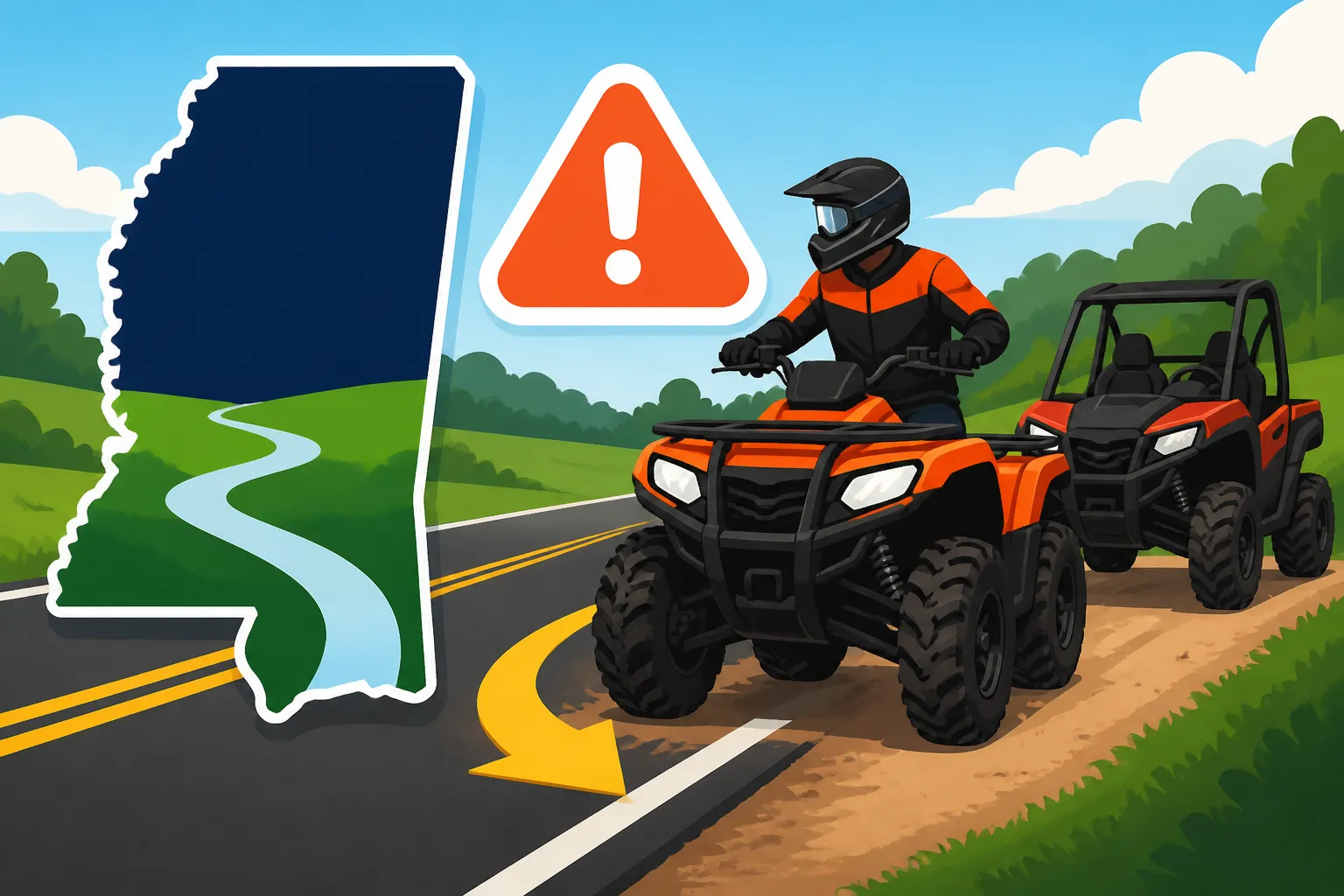
Mississippi Rules for Crossing a Highway
It’s a common frustration for ATV and UTV owners across Mississippi: you’re out enjoying a ride on private land or heading to a nearby trail, and suddenly, there’s a paved road or, even worse, a state highway between you and your destination. You might wonder, "Can I just dart across really quickly?" or "What's the absolute minimum I need to do to cross legally?" This guide is here to untangle the often confusing and surprisingly strict rules surrounding highway crossings on your off-road machine in Mississippi.
Mississippi's Strict Stance on ATVs on Public Roads
Let's get straight to it: Mississippi's laws are pretty unambiguous when it comes to riding ATVs and UTVs on public roads, including highways. The state largely prohibits it. This isn't just about cruising down Main Street; it extends to most paved surfaces that are maintained by the state, county, or municipality. It’s a common point of confusion and frustration for riders, especially if you’ve come from states with more lenient rules or if you’re just trying to get from one piece of private property to another.
The legal framework for ATVs and off-road vehicles in Mississippi is notably sparse compared to many other states, often leading to a feeling of ambiguity. However, what little law exists tends to be quite restrictive regarding public road use. The intent is to keep these machines off roadways designed for cars and trucks, primarily due to safety concerns given their design differences, lack of typical road safety features, and often lower visibility. This blanket prohibition means that even a short hop across a two-lane highway can put you in a sticky situation with law enforcement if you're not absolutely aware of the specific, narrow exceptions. Many riders have learned this the hard way, thinking a quick maneuver couldn't possibly be a problem, only to face a citation. You might even hear about [Mississippi's ATV Law Is Only Two Sections Long], which really highlights how little specific guidance there is beyond the outright ban.
Why the Ban? Safety First (Legally Speaking)
The primary reason behind Mississippi's stringent road laws for off-road vehicles isn't to be difficult; it's rooted in safety. ATVs and UTVs are engineered for off-road terrain – dirt, mud, rocks, and trails – not asphalt. Their tires are typically low-pressure and knobby, designed for traction off-road, which can make them unstable and handle poorly on hard surfaces, especially at higher speeds. The suspension systems are built for absorbing bumps and jumps, not for smooth, high-speed cornering on pavement.
Furthermore, most off-road machines lack essential safety features mandated for on-road vehicles, such as turn signals, rearview mirrors, proper headlights and taillights for road visibility, and often don't have the same crash protection as a car. Imagine a small quad, perhaps one equipped with some serious aftermarket SuperATV lift kits and tires for tackling deep mud pits, trying to safely merge with highway traffic. The risk of an accident, both for the rider and other motorists, dramatically increases. Lawmakers, by keeping these machines off the roads, aim to minimize these risks. While it might feel inconvenient when you're facing a short stretch of pavement, the state's position is firmly on the side of preventing severe accidents that could arise from mixing off-road vehicles with highway traffic.
Penalties for Illegal Road Riding
Disregarding Mississippi's public road ban, even for a quick crossing, can lead to more than just a stern warning. Law enforcement officers, whether it's a county deputy, a state trooper, or a city police officer, have the authority to issue citations. The exact penalty can vary by jurisdiction and the discretion of the officer, but generally, you're looking at fines. These fines might seem relatively low compared to other traffic violations, sometimes in the range of [Mississippi's Road Riding Fine Stops at $50], but they can quickly add up with court costs and fees.
Beyond the immediate financial hit, there can be other consequences. Your machine could potentially be impounded, leaving you with the hassle and expense of retrieving it from a tow lot. This can be a particularly nasty surprise if you're far from home or relying on your machine for transportation. Also, keep in mind that if an accident occurs while you're illegally operating your ATV on a public road, your insurance coverage could be significantly impacted, or even denied. Most ATV insurance policies are designed for off-road use and may have clauses that invalidate coverage if the machine is being operated unlawfully on public roads. It's a risk that far outweighs the convenience of a shortcut. For more on what happens if you get stopped, you can look into [What Happens When a Deputy Stops You Riding].
The Narrow "Crossing" Exception in Mississippi
Okay, so the general rule is "no ATVs on public roads." But there's a tiny, specific exception for crossing. This isn't a loophole to be exploited; it's a very limited allowance for specific circumstances. It’s critical to understand that this "crossing" is not permission to ride along the road, even for a short distance, or to make multiple passes. It is strictly about getting from one side of a road to the other, under very precise conditions.
The law typically states that an off-road vehicle may cross a public road, highway, or street at an angle of approximately ninety degrees to the roadway. This means you should be going straight across, not diagonally, not turning, and certainly not riding parallel to the traffic flow. The crossing must also be made at a place where it can be done safely and without unduly interfering with vehicular traffic. This implies good visibility, no blind curves, and yielding to all oncoming vehicles. It's a quick, direct maneuver designed to minimize the time your ATV is on the pavement and interacting with road traffic.
What "Ninety Degrees" Really Means
When the law talks about crossing "at an angle of approximately ninety degrees," it means you should approach the road, stop, check for traffic, and then proceed directly across, perpendicular to the flow of traffic. Think of it like a capital "T" where the top bar is the road and the vertical line is your ATV's path. You're not making a wide turn, you're not riding the shoulder, and you're not gradually merging. You are literally just crossing over.
This isn't always easy or practical in real-world scenarios, especially if you're on a trail that approaches a road at an awkward angle. However, the law provides little flexibility. If you can't make a ninety-degree crossing safely, then the crossing itself is not permitted. It forces riders to be incredibly cautious and, frankly, to often seek alternative routes that avoid public roads altogether. This specific language highlights how restrictive the exception truly is, underscoring the state's commitment to keeping these machines off paved surfaces.
Safety First: Visibility and Traffic Control
Even when executing a legal ninety-degree crossing, safety is paramount. You must be able to see clearly in both directions, and you must yield to all oncoming traffic. This means no blasting across without looking, and no assuming cars will stop for you. You're essentially a pedestrian crossing a busy street, but on a machine that takes up more space and can be harder for motorists to spot.
Consider adding aftermarket lighting or reflective tape to your machine, such as products from SuperATV, to increase your visibility to other drivers, especially if you might be crossing near dusk or dawn. While these accessories don't make the crossing legal if you don't follow the angle and safety rules, they can certainly make you more noticeable. It's also a good idea to scout out potential crossing points if you can, looking for areas with minimal traffic, clear sightlines, and perhaps even designated crossing points if any exist (though these are rare outside of specific trail systems). Remember, the burden is entirely on the ATV operator to ensure the crossing is safe and does not impede traffic. This isn't a "right-of-way" situation; it's a "yield to everything" situation.
Practical Strategies for Navigating Mississippi's Rules
Given Mississippi's stringent regulations, planning is key for any ATV or UTV rider who might encounter public roads. The best strategy is often to simply avoid them. However, if an encounter with a paved road is unavoidable, there are ways to minimize your risk and stay within the bounds of the law as much as possible, or at least avoid breaking it egregiously.
It's common for riders to own machines that are perfectly suited for the challenging terrain of Mississippi's forests and mud parks, maybe even outfitted with rugged components from SuperATV. But those very modifications often make them less suitable, and certainly not legal, for road use. Knowing this beforehand can save you a lot of grief. Don't assume a rural road is "less public" than a highway; the law often makes no such distinction.
Trailering: The Safest and Most Legal Option
When in doubt, trailer it out! The most effective way to cross highways, streets, or any public road with your ATV or UTV in Mississippi is to load it onto a trailer and transport it with a legal, road-worthy vehicle. This eliminates all risk of citations for illegal road use and ensures your safety and the safety of others. While it might add a few minutes to your journey, the peace of mind is invaluable.
If you’re traveling to a remote trail system or a friend’s property that requires crossing a major thoroughfare, investing in a reliable trailer is a necessity for Mississippi riders. This also applies if you're going to events at places like Red Creek Off-Road or Meridian OHV Park; almost everyone arrives via trailer. This completely sidesteps the complexities of [Mississippi's 2025 Road Access Bill That Passed 48-2] and then died, which sought to loosen some of these restrictions but ultimately failed. It’s also important to ensure your trailer is properly registered and your towing vehicle is capable and well-maintained.
Seeking Local Ordinances and Permissions
While state law is generally very restrictive, there can be rare instances where local ordinances might allow for limited road access for ATVs or UTVs within specific municipal boundaries or on certain county roads. This is highly uncommon for ATVs, which are generally barred, but is sometimes seen with golf carts or low-speed vehicles in certain towns. However, for a full-fledged ATV or side-by-side, it's almost always a "no."
It is absolutely crucial that you do not assume such an ordinance exists or applies to your machine. Always check with the local county sheriff's office, city police department, or board of aldermen before riding on any public road, even if it's just a short stretch. Getting written permission or seeing the actual ordinance can save you a lot of trouble. Never rely on hearsay from a friend or another rider, as laws and local interpretations can change. If you're asking about [Mississippi Rules for Riding a County Road] or [Mississippi Rules for Riding a City Street], expect the answer to be "no," unless you're specifically dealing with a designated crossing.
Comparing Legal vs. Illegal Highway Use
To make things a bit clearer, let's lay out the differences between a permissible action and what will likely get you in trouble when it comes to highways and ATVs in Mississippi.
| Action | Legality in Mississippi | Risk Level | Notes |
|---|---|---|---|
| Crossing a Highway at 90 degrees | Potentially Legal (with strict conditions) | Moderate (if conditions met), High (if not) | Must be a direct, perpendicular crossing. Must yield to all traffic. Must be done safely without interference. This is the narrowest exception. |
| Riding along the shoulder of a highway | Illegal | High | Even for a short distance to get to a crossing point or to another trail. The law generally prohibits riding on or along public roads. |
| Riding on a highway to access another trail | Illegal | High | This constitutes "operating on a public road" and is not covered by the crossing exception. You are explicitly riding on the highway, not just crossing it. |
| Riding on a county road (unpaved or paved) | Generally Illegal (unless explicitly exempted by local ordinance, which is rare for ATVs) | High | State law applies to "public roads." Some exceptions exist for farm use on certain roads, but this typically requires specialized farm equipment designation and is not a general ATV exemption. Check [Mississippi Has No Farm Road Exception]. |
| Trailering your ATV across a highway | Legal and Recommended | Very Low | The machine is being transported, not operated on the road. This is the safest and most legally sound method. |
| Riding within a designated OHV park | Legal | Low | These areas are specifically designed and approved for off-road vehicle use, often with their own internal rules and possibly requiring a Mississippi Forest Pass Cost or park fee. Examples include Bethel OHV Trails. |
This table really highlights how little leeway you have. The state has decided that for the most part, ATVs and UTVs simply don't belong on surfaces where cars and trucks travel at speed.
Final Thoughts for Mississippi Riders
The allure of just hopping across a highway to save time or connect trails is strong for many ATV and UTV enthusiasts. However, in Mississippi, it's a temptation that comes with significant legal risks. The state's laws are designed to keep off-road vehicles off public roads for safety reasons, and the "crossing" exception is incredibly narrow and must be executed with extreme caution and precision.
Before you ever consider taking your ATV or UTV onto a highway, even for a brief moment, remember the potential consequences: fines, impoundment, and jeopardized insurance coverage. Your best bet, and the safest course of action, is almost always to transport your machine on a trailer when public roads are involved. Planning your rides to avoid public roads entirely, or using legal transport methods, will ensure your adventures remain fun, safe, and free from legal headaches. Staying informed about [Mississippi ATV Road Rules Under 63-31-3] is crucial for every rider in the Magnolia State.
Disclaimer
This article is for general informational purposes only and does not constitute professional advice. Laws, prices and regulations vary by location and change over time. Consult a qualified professional for guidance on your specific situation.