Mississippi Rules for Riding a City Street
Riding your ATV or UTV feels freeing, and it’s natural to eye that paved road leading into town. For many riders in Mississippi, the dream of taking their off-road machine onto city streets crashes into a wall of regulations. This guide will walk you through the precise rules and often frustrating realities of riding your ATV or UTV on city streets in our state.
The Hard Truth About Mississippi's State Law
Let's get straight to it: the simple, overarching rule in Mississippi is that ATVs and UTVs are generally not permitted on public roads, and that includes city streets. This isn't just a suggestion; it's a fundamental aspect of state law designed to differentiate off-road vehicles from those built and regulated for highway use. Many riders, especially those new to the Magnolia State or those accustomed to different rules in other places, find this incredibly frustrating, and for good reason. You've invested in a powerful, versatile machine, and it feels counterintuitive to be so restricted.
Why State Law Shuts Down Street Riding
The core of the issue lies in Mississippi Code Section 63-31-3, which defines what an "all-terrain vehicle" or "off-road vehicle" is and, crucially, clarifies its legal status regarding public roads. Essentially, these machines are designed for, and limited to, off-highway use. The state legislature, in its wisdom, didn't create a framework for licensing, registering, or inspecting ATVs and UTVs for roadworthiness in the same way it does cars, trucks, or even motorcycles. This means your pride and joy, while perfectly capable of handling rough terrain, simply isn't recognized as a street-legal vehicle by the state itself.
This designation isn't about arbitrary restrictions; it's rooted in safety and equipment standards. Road-legal vehicles have specific requirements for headlights, taillights, turn signals, mirrors, braking systems, and even tire types that are often different from what's found on most stock ATVs and UTVs. While you might equip your machine with some fantastic aftermarket accessories – perhaps some robust A-arms or an upgraded lighting kit from SuperATV – these additions typically don't change the fundamental classification of your machine under state law. It's built for the trails, the fields, and the woods, not the paved streets of Jackson or Gulfport.
What the Law Counts as an Off-Road Vehicle
Mississippi's definition of an off-road vehicle (which includes most ATVs and UTVs) is quite broad. It generally covers any motorized vehicle manufactured for off-highway use, with a width typically under 70 inches, and that isn't primarily designed for conventional transportation on public streets. This legal distinction is critical because it dictates what type of vehicle can be registered, insured, and operated on public thoroughfares. If your machine falls under this "off-road" umbrella, it's essentially barred from public roads and highways unless a specific, rare exception applies.
This means that even if your UTV feels incredibly stable and capable on asphalt, the state sees it differently. It doesn't matter if it's a powerful side-by-side or a nimble sport quad; if it's manufactured as an off-road vehicle, it's treated as such. There’s no special category for machines that are "almost" street legal or "could be" street legal with a few modifications. The state's position is clear: these machines are not for public road use. This can be particularly frustrating when you just need to cross a short stretch of road to get to another trail or hunting ground.
No Exceptions for Errands or Short Crossings
One of the most common questions riders ask is about making quick runs – "Can I just cross the street?" or "What about a short ride to the gas station?" Unfortunately, under state law, there are generally no provisions for these types of incidental road uses for ATVs and UTVs. The prohibition is quite comprehensive. It doesn't typically matter if you're only going a block, riding on a dead-end street, or just trying to get to a friend's house a quarter-mile away. Public roads are public roads, and the ban applies.
This can feel incredibly inconvenient, especially in rural areas where the nearest gas station or supply store might be just a short distance down a paved road. Riders often find themselves having to trailer their machine for distances they could easily cover on four wheels, adding extra time, effort, and fuel costs to what should be a simple trip. It's a common point of frustration, and it often leads riders to seek out the extremely limited exceptions found in local ordinances, which we'll discuss next.
Navigating Local Ordinances: A Maze, Not a Path
While state law broadly prohibits ATVs and UTVs on public roads, there's a tiny glimmer of hope in the form of local ordinances. However, this is where things get truly complicated and frustrating for many riders. Some cities and towns in Mississippi have enacted specific ordinances that allow certain types of low-speed vehicles, like golf carts, on their streets. The critical distinction here is usually not for ATVs or UTVs, and often these ordinances will explicitly exclude off-road machines. It's a maze to navigate, and the rules can change dramatically from one municipality to the next.
Golf Cart vs. ATV: Why They're Not the Same in the Eyes of the Law
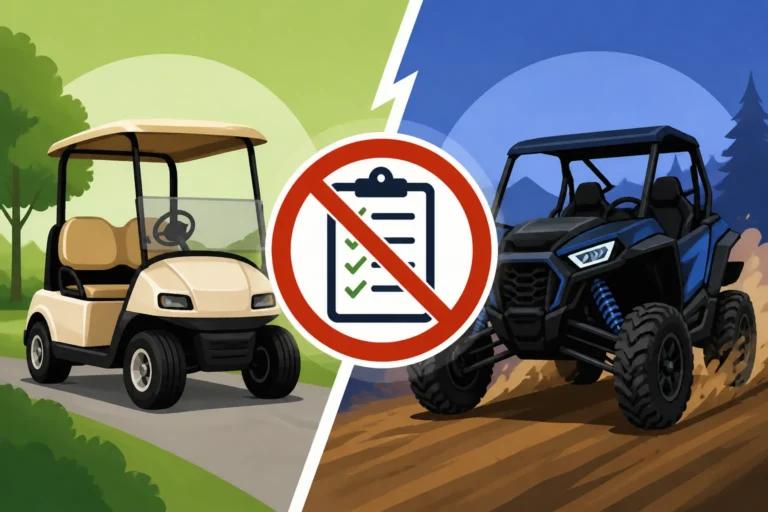
This is perhaps the biggest misconception. Many people see a golf cart on a city street and assume their UTV, which might even be slower and quieter, should also be allowed. However, cities that create ordinances for "street legal" vehicles almost invariably focus on golf carts or low-speed vehicles (LSVs), which have very specific definitions. These definitions typically include limitations on speed, weight, and sometimes even engine size, and critically, they are designed and manufactured specifically for low-speed public road use.
An ATV or UTV, regardless of how many turn signals or mirrors you add, rarely fits the legal definition of a golf cart or LSV within these ordinances. In fact, many municipal ordinances that permit golf carts will explicitly state that ATVs, UTVs, dirt bikes, and similar off-road vehicles are prohibited. This means that even in towns like Hattiesburg or Ocean Springs, which might have golf cart ordinances, your UTV is still likely out of luck. The physical appearance might be similar to some golf carts equipped with SuperATV accessories, but the underlying classification is entirely different. For a deeper dive into this distinction, check out [Why a Cart Ordinance Does Not Cover a UTV].
Checking Your Specific City's Rules
Because there's no statewide standard for local allowances, the burden falls entirely on you to research the specific rules for any city or town you wish to ride in. This means a call to the city clerk's office, checking the municipal code online, or even inquiring with the local police department. What's allowed in one small town in the Delta might be strictly forbidden in a neighboring community. This inconsistency is incredibly frustrating for riders who travel or live near municipal borders.
Imagine living just outside a town that does allow golf carts and thinking your UTV might be okay, only to find out their ordinance specifically excludes anything beyond a golf cart. Or perhaps you're visiting a town for a weekend and want to know if you can take your side-by-side to grab dinner. Without explicit, written permission from a valid local ordinance, you're better off assuming a "no." Asking your county supervisor or the sheriff's office might give you some general guidance, but only the specific city ordinance will hold true for city streets.
The Elusive "Street Legal" Conversion: Why Adding Turn Signals Isn't Enough
Many aftermarket companies, like SuperATV, offer fantastic kits to add lights, horns, mirrors, and even windshields to your ATV or UTV. These accessories significantly enhance safety and utility for off-road riding, but they very rarely make your machine "street legal" in Mississippi. The issue isn't just about having the right equipment; it's about the fundamental legal classification of the vehicle as an off-road machine by state law.
You can bolt on all the turn signals and reflective tape in the world, but if your vehicle's VIN identifies it as an ATV or UTV and state law prohibits these on public roads, those modifications don't override the law. It's a common misconception that simply meeting a checklist of equipment makes a vehicle road-ready. For a true street-legal conversion, you'd typically need to meet Department of Transportation (DOT) standards, undergo a rigorous inspection process, and often have the vehicle re-titled as a different class, like a low-speed vehicle or even a reconstructed vehicle, which is an extremely rare and complex process for ATVs/UTVs in Mississippi.
The Real Risks of Taking Your Machine to the Pavement
Ignoring the state ban and riding your ATV or UTV on city streets in Mississippi comes with very real and unpleasant consequences. It's not just a slap on the wrist; you're looking at fines, potential impoundment of your valuable machine, and significant headaches with your insurance. It's a risk that most experienced riders would strongly advise against, precisely because the downside is so much greater than any perceived convenience.
Fines, Tickets, and Court Costs
If a law enforcement officer catches you riding your ATV or UTV on a public street or road, you're likely going to get a citation. The specific penalties for illegal road riding can vary, but generally, you're looking at fines that might seem relatively small on paper, but they add up quickly with court costs and fees. While Mississippi's law for illegal road riding may not carry the same heavy fines as some traffic violations, it's still money out of your pocket that could be better spent on trail fees or upgrades for your machine. For more details on what these penalties can look like, consult [Mississippi Fines for Road Riding].
It's not just the initial fine. You might have to take time off work to appear in court, and if you have multiple infractions, it can become a pattern that law enforcement will notice. The hassle alone is often enough to deter riders once they've experienced it. Plus, these fines don't just disappear; they become a matter of public record.
The Threat of Impoundment
This is arguably the most severe consequence: your ATV or UTV could be impounded. If an officer determines you are operating your off-road vehicle illegally on a public road, they have the authority to have it towed and stored. Getting your machine back from impound can be a costly, frustrating, and time-consuming ordeal. You'll be responsible for towing fees, daily storage fees, and potentially other administrative charges. These costs can quickly escalate, sometimes even exceeding the value of an older machine.
Imagine having your machine, perhaps one you just bought and are eager to ride, sitting in an impound lot for days or weeks while you navigate the legal process to retrieve it. It's not a pleasant thought, and it's a very real possibility. This can also lead to issues if you relied on your ATV for work or critical tasks, suddenly finding yourself without your valuable tool.
Insurance Headaches and Liability
One of the biggest risks that riders often overlook is the impact on their insurance. While it's smart to have [Why Mississippi Riders Still Buy ATV Insurance] even though it's not legally mandated, most standard ATV/UTV insurance policies are written with the understanding that the machine will be operated off-road. If you have an accident while operating your ATV or UTV illegally on a public street, your insurance company may deny your claim. They could argue that you were operating the vehicle outside the terms of your policy, leaving you personally responsible for all damages, injuries, and legal fees.
This means if you hit a car, damage public property, or injure someone while riding illegally on a city street, you could be facing massive out-of-pocket expenses. Your personal assets could be at risk. This financial exposure is far greater than any fine and should be a significant deterrent. It's a sobering thought, but one that every rider needs to consider before deciding to take their machine onto the pavement.
Where You Can Legally Ride Your ATV or UTV in Mississippi
So, if city streets are largely off-limits, where can you actually ride your ATV or UTV in Mississippi without fear of fines, impoundment, or insurance nightmares? The good news is that Mississippi offers some fantastic opportunities for off-road adventure, as long as you know where to look and follow the rules. It's about enjoying your machine in the environments it was designed for.
Designated Trails and Parks
Mississippi is home to several excellent designated trail systems and private parks that cater specifically to ATV and UTV riders. These are the places where your machine can truly shine, offering everything from challenging mud pits to scenic forest trails. These areas are designed for off-road use, often have varying difficulty levels, and provide a safe, legal environment for riding.
- Public Lands: The National Forests in Mississippi, such as the De Soto National Forest, offer trails like [Bethel OHV Trails in Mississippi]. These trails are typically well-maintained and offer miles of riding enjoyment. Remember to check for day-use fees or annual passes, and be aware of any width restrictions, such as the 50-inch limit common on many forest trails.
- Private Mud Parks: If you love mud, Mississippi has several private parks that offer dedicated mud pits, obstacle courses, and often camping facilities. Places like [Red Creek Off-Road in Mississippi] or [Meridian OHV Park in Mississippi] provide controlled environments where you can push your machine to its limits. These parks often have their own specific rules regarding helmets, age, and passenger limits, so always check their websites or call ahead.
- WMA Designated Roads: While not for recreational trail riding, some Wildlife Management Areas (WMAs) may permit ATV or UTV use on designated administrative roads for hunting and game retrieval purposes. This is highly restricted, and you must adhere strictly to WMA rules, which often specify [Mississippi WMA Designated Roads Only] and prohibit recreational riding.
Private Property with Permission
One of the most common and versatile options for ATV and UTV riding is private property. If you own land, you're generally free to ride your machine on your own property as you see fit, as long as you're not creating a public nuisance or violating any local noise ordinances. If you don't own land, riding on private property is still an option, provided you have explicit permission from the landowner.
Always get written permission if possible, especially if you're riding on land frequently. This protects both you and the landowner. Many hunters and outdoors enthusiasts utilize their ATVs and UTVs extensively on private timberland or farmland, which is perfectly legal as long as they have the landowner's consent. This is where your SuperATV winch could really come in handy, pulling you out of a sticky situation on a remote hunting lease.
Trailering, Not Riding: The Safe Way to Get to Your Riding Spots
Since riding on city streets is largely out of the question, the most practical and legal way to get your ATV or UTV to its designated riding area is by trailering it. Investing in a good trailer and ensuring your machine is securely loaded is essential. This might seem like an extra step, but it ensures you avoid legal trouble and keep your machine safe from road hazards.
Many riders equip their trucks or SUVs with appropriate hitches and tow their ATVs or UTVs to trailheads, mud parks, or private land. This allows you to legally transport your machine across town or across the state to enjoy the fantastic off-road opportunities Mississippi has to offer. Consider accessories like sturdy tie-downs or a ramp kit for easy loading and unloading. This method allows you to enjoy the thrill of off-road riding without the constant worry of breaking the law on the pavement.
| Category | Street Legal on City Streets | Key Restrictions/Considerations | Examples |
|---|---|---|---|
| ATV/UTV | No (State Law Prohibition) | Generally prohibited statewide. Local ordinances rarely include ATVs/UTVs, even if they permit golf carts. | Sport quads, utility side-by-sides |
| Golf Carts | Yes (Local Ordinance Dependent) | Permitted only in cities/towns with specific ordinances; speed limits (often 25 mph), driver's license often required. | Electric or gas golf carts |
| Low-Speed Vehicles (LSV) | Yes (State Law & Local Ordinance) | Must meet federal safety standards (DOT), VIN, title, registration, lights, seatbelts, max 25 mph. | Small electric vehicles, purpose-built LSVs |
| Dirt Bikes | No (State Law Prohibition) | Like ATVs, designed for off-road use and not street legal in Mississippi. | Motocross bikes, enduro bikes (unless street-legal factory model) |
Disclaimer
This article is for general informational purposes only and does not constitute professional advice. Laws, prices and regulations vary by location and change over time. Consult a qualified professional for guidance on your specific situation.