Mississippi Hunting Season Trail Advice
Hunting season can change the feel of a Mississippi trail: familiar roads may be busier, gates may be closed, and hunters may be working nearby before daylight. This guide explains how to plan an ATV or UTV ride around hunting activity, check access before unloading, and share public and private land with care.
Plan Around Hunting Activity
Check the specific land rules before you leave
“Open for hunting” does not automatically mean “open for ATV riding.” Mississippi Wildlife Management Areas, national forests, state parks, and private hunting leases can each have different access rules. On a WMA, machine use may be limited to designated roads, and a road that appears on an old map may now be closed by a sign, gate, or barrier. A trail’s familiar appearance is not proof that it is legal to ride.
Start by identifying the exact property you plan to visit. Check the managing agency’s current maps and notices, then look for rules about motorized access, seasonal closures, parking, permits, and vehicle types. For WMAs, review [Mississippi WMA Riding Rules] and [Mississippi WMA Designated Roads Only]. For national forest riding, check the district and trail system you plan to use, not just a broad forest map.
This extra checking can feel tedious, especially when you have already loaded the trailer and driven across the county. But it is far better to discover a closed road at home than to arrive at a gate and have to improvise. If online information is unclear, call the land manager or local office before the trip. Ask about the specific road or trail, not just whether “ATVs are allowed.” A precise question is more likely to get you a useful answer.
Treat hunting seasons as changing access conditions
Rules may be permanent, seasonal, or tied to local conditions. A road could be open to vehicles most of the year but closed during a particular activity, or an area may restrict access around a managed hunt. Heavy rain, fire danger, timber work, or damage to a road can also change access. A map saved weeks ago does not necessarily show a closure posted yesterday.
Before each ride, check for current notices from the land manager and read every sign at the entrance. Pay special attention to signs at gates, trailheads, road junctions, and parking areas. A gate that is closed or a road marked “no motorized vehicles” should be treated as a clear stop, even if tire tracks suggest somebody rode there recently. Do not move a barrier or follow a route around it.
A map app can help you understand where you are, but it cannot replace posted signs or official access information. Some riders use onX Offroad to prepare a route and get a general sense of nearby roads, then compare that plan with the managing agency’s information. Keep the app in its proper role: a navigation aid, not permission to enter land or ride a closed road. [Mississippi WMA Road Closure Signs] is a useful reminder to check for closures on the ground, too.
Choose Routes With Hunters in Mind
Prefer established routes and avoid hunting setups
When hunting activity is nearby, stay on roads or trails that are clearly open to motorized travel. Avoid cutting across fields, slipping through a side gate, or taking an unmarked track simply because it connects two familiar roads. Those routes may cross private property, a hunting lease, or an area where people are positioned for a hunt. Even when a shortcut looks harmless, it can disturb wildlife or put a rider where someone is not expecting a vehicle.
Look for signs that a route is actively used for hunting: parked trucks, trail cameras, blinds, stands, fresh foot traffic, or people carrying equipment. None of these clues alone tells you the legal status of a road, but they are good reasons to slow down, give people space, and avoid pushing farther into the area. If the public route you planned passes close to a hunting setup, consider turning around and choosing another legal route rather than riding past repeatedly.
In places such as the De Soto National Forest, access can involve a mix of designated recreation routes, forest roads, and areas with different rules. Do not assume that every road within a national forest is an OHV trail. Review [Mississippi National Forest Riding Explained] and the relevant district information before choosing your route. A careful plan should identify the trailhead, approved route, turnaround point, and a backup option.
Build a ride plan with room to turn back
A hunting-season ride is not the best time to improvise a long loop as daylight fades. Mark a conservative route, estimate how long the group will take, and decide in advance what conditions will make you turn around. Those conditions might include seeing an active hunting party, reaching a closed gate, encountering a logging operation, losing reliable navigation, or noticing that rain has made the trail unsafe.
Share the plan with someone who is not riding with you. Include the trailhead or staging area, the general route, the machines in the group, and when you expect to be back. Keep a paper map or offline map available in case cellular service drops. Forested areas can have dead zones, and a phone that worked at the gas station may not connect once you are deep into the woods. onX Offroad may be useful for reviewing and saving a route, but carry a backup and follow official signs.
Make the group plan fit the least experienced rider and the machine least suited to the terrain. If one person has a two-wheel-drive utility ATV, limited recovery gear, or little experience in mud, do not build the day around deep ruts or remote crossings. A shorter, familiar ride on open routes is often the better call during busy hunting periods. For wider machines, check trail limits before driving out; [Mississippi Trails With Width Limits] can help you think through that part of the plan.
Share Roads and Trailheads Safely
Slow down near people, parked vehicles, and blind corners
A hunter walking from a truck to a stand may be hard to see in thick woods, particularly at dawn or dusk. Slow down near trailheads, road junctions, parked vehicles, and bends where you cannot see what is ahead. Keep enough distance to stop without skidding, and avoid revving, spinning tires, or accelerating hard near people. A loud, fast pass can startle someone even when you remain on the legal route.
If you meet a person on foot, stop at a safe distance and give them room. Let them move out of the way before proceeding, and do not pressure them to hurry. If a vehicle is parked on a narrow road, avoid squeezing through if doing so could damage the shoulder, brush, or a gate. When a route is too tight to pass safely, wait or turn around. Courtesy matters most when visibility is poor and people are carrying gear.
At a shared trailhead, park without blocking gates, road access, or a place another vehicle needs to turn around. Keep the staging area tidy and avoid leaving straps, food wrappers, or equipment where someone could trip. If the area is clearly being used by hunters, keep noise down and do not linger beside their vehicle. Guidance in [Mississippi Trail Etiquette Locals Expect] applies especially well when several kinds of outdoor users are sharing limited access.
Make your machine visible without assuming visibility makes access legal
Wear high-visibility clothing when practical, particularly if your route passes near a road or a busy trailhead. Use the machine’s lights when conditions require them, and keep lights and reflectors clean. Visibility does not give you permission to enter a closed area, and it does not make a fast approach safe. It simply gives other people a better chance of noticing you.
Avoid riding after dark unless the location and conditions allow it and you have the equipment and experience to do so safely. In wooded country, shadows, uneven ground, and branches can make night riding difficult. Hunting activity can also begin early or continue late, so do not assume that a quiet trail is empty. If your group is delayed, stop in a safe place, contact your designated person if service is available, and use your planned route back rather than searching for an unfamiliar shortcut.
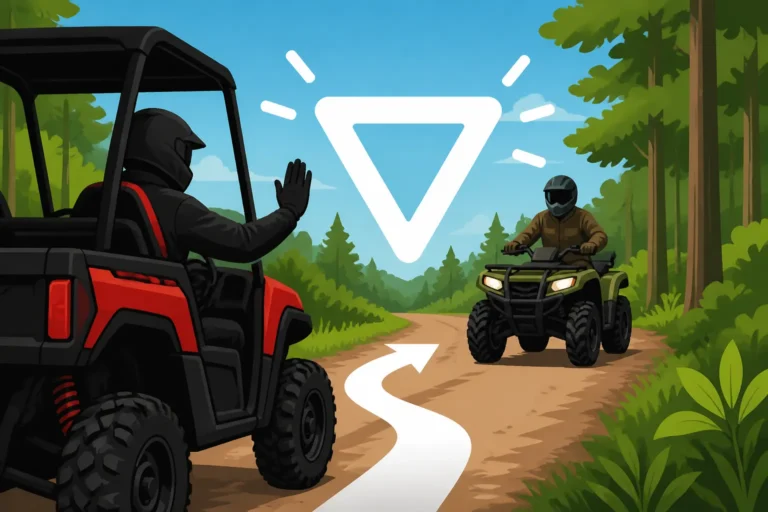
For a longer ride, agree on hand signals or a simple regrouping plan before the group spreads out. Keep riders close enough to communicate at junctions, and stop before making a turn so nobody follows the wrong branch. A route saved in an app can help riders stay oriented, but everyone should know the basic plan. Keep the phone accessible, not buried beneath wet gear, and use offline maps where coverage may be unreliable.
Understand the Difference Between Public and Private Land
Never treat a hunting lease as an open trail
A dirt road may look like a public route while actually crossing private timberland or a hunting lease. A gate, posted sign, painted mark, or landowner’s instruction should be taken seriously. Do not assume that a road is open because it appears on a digital map, because a neighbor rode it last month, or because there is no fence across the entrance. Property boundaries are not always obvious from the seat of a machine.
If you want to ride on private land, get clear permission from the owner or the person responsible for the lease. Ask which roads are open, what days or times are acceptable, whether passengers or guests are allowed, and whether hunting activity changes access. Permission to hunt does not necessarily include permission to bring an ATV, and permission from one lease member may not cover the entire property. For more on permissions and boundaries, see [Written Permission From a Southern Landowner] and [What a Hunting Lease Says About ATV Use].
A polite request can prevent a frustrating misunderstanding. For example, if you have permission to cross a farm lane to reach a legal trailhead, confirm whether the permission covers the return trip, whether you may park, and whether the route remains open during hunting season. Keep a written message or other clear record of the permission if the owner is comfortable with that. If the answer is no, respect it and choose a public or authorized riding area instead.
Stay off closed roads, levees, and sensitive areas
A road that seems convenient may be closed for safety, wildlife management, erosion control, or protection of public infrastructure. Do not ride around a locked gate or over an earthen berm. These barriers are not invitations to test whether the route is still passable; they communicate that access is restricted. On public land, follow the posted rule even if you see fresh tracks beyond the barrier.
Levees, riverbanks, and sandbars can be especially tempting when they look like open ground. But access rules may involve levee boards, local authorities, private ownership, water conditions, or other restrictions. A dry-looking surface is not evidence that riding is allowed. Before taking a route near the river, review [Mississippi Levee Riding Is Prohibited] and [Is It Legal to Ride a Mississippi River Sandbar?]. When the boundary or rule is unclear, stay out until you have confirmed access with the responsible authority.
Avoid damaging wet roads and trails. A deep rut created by one machine can channel water, worsen erosion, and make a route unsafe for everyone who follows. After heavy rain, choose a different legal area if the trail is soft, flooded, or visibly deteriorating. The same goes for a route with fresh logging activity or a washout. Do not try to “make it through” just because the trailer is already parked nearby. [Mississippi Trail Closures After a Storm] offers more context for planning around poor conditions.
Prepare Your Machine and Group for the Day
Pack for delays, recovery, and changing weather
A ride during hunting season can involve longer waits and more encounters with other users than a quiet weekday outing. Carry water, a basic first-aid kit, a charged phone, a way to navigate offline, and the tools needed for routine trouble such as a loose strap or minor tire issue. If you ride in a group, agree on who carries recovery gear and what the group will do if a machine becomes stuck. Avoid attempting a recovery that puts people in the path of a winch line or beneath an unstable machine.
Mississippi conditions can shift from hot and humid to wet and chilly, especially when a ride starts before sunrise and lasts into the afternoon. Pack clothing that can handle rain and temperature changes, and keep a dry layer protected in a bag. In warm weather, drink regularly rather than waiting until you feel thirsty. A rider who is tired, overheated, or uncomfortable is more likely to make a poor decision around a gate, road crossing, or unfamiliar trail.
Inspect the machine before leaving home. Check tires, brakes, steering, lights, fuel, and any straps or cargo that could come loose. Secure firearms and hunting gear according to applicable law and land rules; do not carry a weapon in a way that creates a handling hazard while riding. Never rely on a loaded firearm as ordinary trail equipment. Review [Mississippi WMA Weapon Restrictions] before riding on a management area, and check the land manager’s instructions for the particular property.
Use a simple pre-ride checklist
A checklist helps when the group is excited to get moving and someone is already waiting at the trailhead. It also makes it less likely that a forgotten detail turns into a long drive home. Use this as a starting point, then adjust it for the property, weather, machine, and riders in your group.
| Before you go | What to confirm |
|---|---|
| Access | The specific road or trail is open to your type of machine |
| Hunting activity | No posted closure or managed-use restriction affects the route |
| Land boundaries | You have permission for private roads or lease property |
| Route | The group knows the trailhead, turnaround point, and backup plan |
| Machine | Tires, brakes, steering, lights, fuel, and cargo are checked |
| Safety gear | Helmets and protective gear fit each rider |
| Navigation | You have a charged phone, offline map, and paper backup if useful |
| Group plan | Riders know how to regroup and what to do if separated |
| Return plan | Someone outside the group knows your route and expected return |
Before starting, walk or ride slowly through the trailhead area and read any notices that were not visible when you first parked. Confirm that the group understands which roads are open and where the planned route ends. If a sign contradicts your saved map, follow the sign and update the route. A small adjustment at the beginning is far easier than explaining an avoidable trespass or closure later.
If a hunter or land manager tells you a route is closed, stay calm, stop safely, and ask for directions back to an authorized road if needed. Do not argue from what an app displays or from what another rider supposedly said. Conditions can change, and the person responsible for the land may have information you do not. The safest response is to leave by the legal route and check the access rules again before returning.
Disclaimer
This article is for general informational purposes only and does not constitute professional advice. Laws, prices and regulations vary by location and change over time. Consult a qualified professional for guidance on your specific situation.