Yielding on a Narrow National Forest Road
A narrow National Forest road can turn tense when an ATV meets a pickup, a group of riders, or a loaded logging truck around a blind bend. The safest response is usually to slow early, make yourself visible, and find a stable place to let the other vehicle pass. This guide explains how to handle those encounters in Mississippi forests without assuming every road is open to riding.
Prepare before entering a narrow forest road
Confirm the route is open to your machine
A road appearing on a map does not automatically mean it is open to ATVs or side-by-sides. National Forest roads and trails can have different access rules, vehicle limits, seasonal closures, or restrictions posted at the entrance. Check the current forest information and look for signs at the trailhead before you ride. If a road is marked closed, blocked, or limited to certain users, do not treat it as an optional detour.
It helps to distinguish a designated OHV trail from a forest road. A route may be suitable for a full-size vehicle but still not be designated for off-highway vehicle use. The same goes for a route shown on an app: a mapped line is useful for planning, but it is not permission to ride. For broader background on Mississippi public-land access, see Mississippi National Forest Riding Explained and Forest Roads Closed by a Posted Sign.
Before leaving, check the route against official forest information and note any closures or conditions that could change your plan. A navigation app such as onX Offroad can help you review mapped routes and keep track of where you are, but use it as a planning aid alongside posted signs and land-management rules. If the route status is unclear, choose a confirmed open route rather than finding out at a gate.
Plan for limited visibility and communication
Narrow forest roads often have curves, dips, thick vegetation, and changes in surface that hide approaching traffic. Pine stands, brush, and uneven ground can block your view well before you reach a bend. Ride at a speed that lets you stop within the distance you can see, especially where the road narrows or the surface is loose.
Do not assume you will have reliable cell service throughout a ride. Download or carry useful route information before leaving, and tell someone where you plan to ride and when you expect to return. In parts of De Soto National Forest, gaps in coverage can make it difficult to call for help or check a route once you are already out. Keep the relevant map accessible offline, and consider carrying a paper backup. Cell Dead Zones in De Soto National Forest covers why a backup matters.
If your group is spread out, agree on a simple plan before starting: keep enough distance to stop, regroup at agreed safe places, and do not let the lead rider disappear around a bend without the rest knowing where to go. A navigation app such as onX Offroad may help riders follow the same planned route, but it does not replace clear group communication or careful attention to signs.
Yield safely when another vehicle approaches
Slow down and choose a visible place to stop
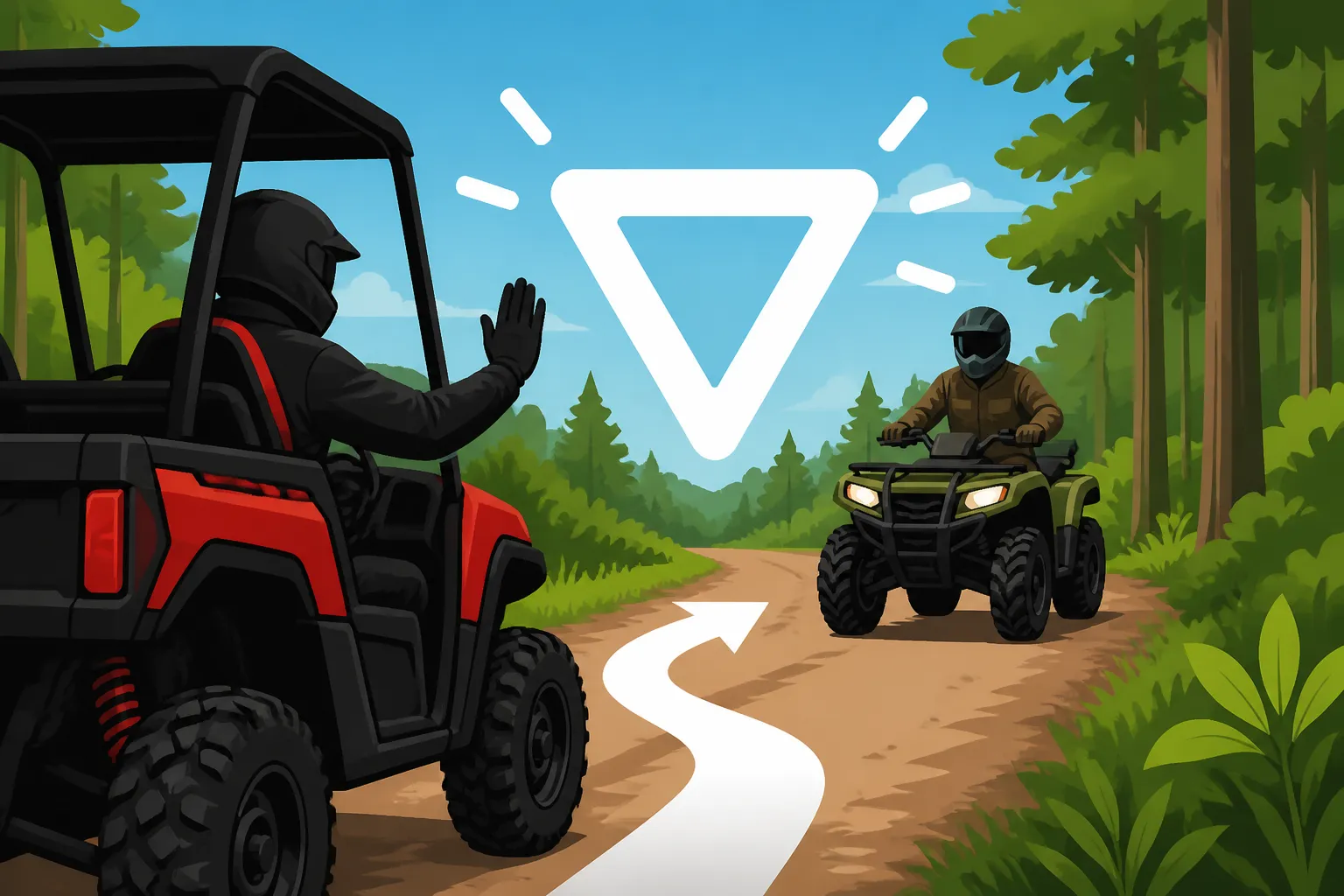
When you notice another vehicle, reduce speed early. Avoid waiting until you are close to a blind corner or a narrow pinch point to decide who will move. If you can see a broad, firm shoulder or turnout ahead, use it to give the other vehicle space. Stop on stable ground where you are not blocking the road, sliding toward a ditch, or forcing the other driver to squeeze past an unstable edge.
Try to make your machine easy to see. Keep headlights on where appropriate, stay alert for dust or engine noise, and avoid riding two or more abreast on a narrow road. If vegetation or a curve limits sight distance, slow before entering it rather than relying on a horn or another rider to warn you at the last moment. A short, deliberate stop is safer than a hurried maneuver onto soft ground.
If the road is too narrow for both vehicles to pass safely, one party may need to back up to a wider spot. Do not assume the other driver can see your machine or judge its position accurately. Use a calm signal when it is safe, and keep riders clear of moving vehicles. On a steep, muddy, or badly rutted section, avoid reversing if you do not have a stable line; move only when you can do so without putting a rider near a drop-off, ditch, or blind corner.
Give larger and less maneuverable vehicles room
An ATV or side-by-side can often move aside more easily than a pickup towing a trailer or a loaded work truck. A logging truck may need extra width, a wider turning path, or room to manage its load. Yielding early gives that driver more space and reduces the chance of a sudden stop or a risky pass. Never try to squeeze between a large vehicle and the roadside simply because the gap looks adequate from your seat.
Be especially cautious around working vehicles. A truck may be moving slowly because of its load, turning, or stopping to work. Dust can obscure what is ahead, and a vehicle that seems stationary may begin moving again. Keep well back until you can see that the road is clear, and do not pass where the driver may not be able to see you. For more on shared-road encounters, read Sharing a Gravel Road With Loaded Log Trucks.
A group of riders should yield as a group rather than leaving one person stopped in the travel path while others pass. The lead rider can signal the group to pull into a safe turnout, then make sure everyone is accounted for before continuing. Keep children and less experienced riders away from the outside edge of the road while traffic passes. Practical habits like these are part of Mississippi Trail Etiquette Locals Expect.
| Encounter | Safer response | Avoid |
|---|---|---|
| Oncoming ATV or side-by-side | Slow down, use a visible turnout, and leave room for both machines | Meeting at speed or squeezing past on a soft shoulder |
| Pickup or vehicle with a trailer | Stop early and give the longer vehicle space to maneuver | Passing beside the trailer or backing into a blind curve |
| Logging or other work truck | Yield, stay visible, and wait until the vehicle and its work area are clear | Following closely or entering an active work area |
| Riders traveling in a group | Pull over together where safe, then regroup before moving on | Splitting the group across a narrow section |
| Vehicle approaching on a blind bend | Reduce speed before the bend and be ready to stop | Assuming the road is empty because you hear nothing |
Handle tricky road conditions without rushing
Do not treat a shoulder as a safe passing lane
A shoulder that looks firm from a distance may be soft, steep, rutted, or covered with loose gravel. In Mississippi, recent rain can leave road edges slick or undermine the ground beside a ditch. If there is no safe place to pull aside, stop where you can be seen and work out a cautious way to reach a wider section. Do not drive into brush or around a barrier to make room.
If you need to reverse, do it slowly and only when you can see the route behind you. Ask a passenger or another rider to guide you from a safe position if visibility is limited. No one should stand directly behind the machine or between it and another vehicle. If conditions make backing unsafe, wait for the other driver to help coordinate a safe pass rather than trying to force one.
After heavy rain, roads can be more difficult to read: puddles may conceal ruts, and road edges can give way under the weight of a machine. Check conditions before setting out and be ready to turn around if the surface or route is unsafe. Mississippi Trail Closures After a Storm is useful background when weather has changed since you planned the ride.
Respect gates, signs, and active work areas
A gate or closure sign is not a place to improvise a detour. Do not ride around a locked gate, follow fresh tire tracks past a closure, or assume a road is open because it appears on your app. Restrictions can change, and a route may be closed for public safety, maintenance, weather, or land-management reasons. The map is a guide; the posted instruction at the site matters.
Active logging or road work calls for extra caution. A work zone may have trucks entering or leaving from places you cannot see, and workers may be focused on equipment rather than approaching riders. If you encounter an active operation, stop at a safe distance and follow posted directions. If access is not clearly permitted, turn around rather than entering the work area to ask questions.
For route planning, review How to Read a Forest Service Trail Map and Mississippi ATV Trail Map Downloads. onX Offroad can be helpful for seeing your planned route and your location in relation to mapped roads, but use it with official forest information and on-the-ground signs. If a map and a closure sign do not agree, follow the closure sign and find another confirmed route.
Build a simple routine for every ride
Agree on signals and spacing before you start
Before riding out, decide how your group will signal an approaching vehicle, a stop, or a hazard. Keep the signals simple enough that everyone understands them, including younger or less experienced riders. Agree on where the group will regroup if someone has to stop, and make sure nobody feels pressured to keep up at an unsafe speed.
Leave enough distance between machines for each rider to react if the person ahead brakes suddenly. On dusty roads, extra space also helps riders see the surface and avoid breathing another machine’s dust. Keep the group on the correct route and avoid spreading across the road where an oncoming vehicle may need room.
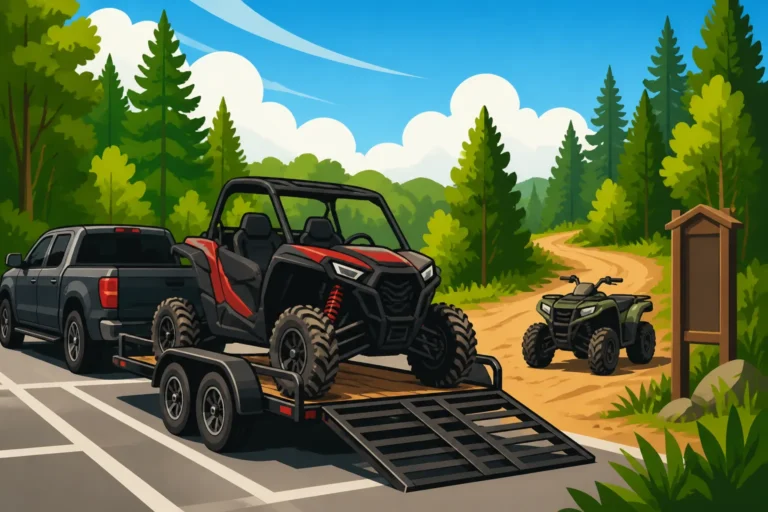
A quick briefing can prevent confusion later: who leads, who stays at the back, what to do if the group meets a truck, and which route to take if a road is closed. For a longer drive to the forest, it is also worth checking Checking Before a Long Southern Drive so a road closure or changed plan does not leave you searching for an alternative after unloading.
Use a repeatable approach at every blind section
Treat each blind bend, crest, and narrow stretch as a place where someone could be coming toward you. Reduce speed before you reach it, stay to a predictable line, and be prepared to stop. Avoid passing another rider at a point where an oncoming vehicle could appear, and never assume that a quiet road is an empty road.
If you meet another vehicle, focus on the next safe place to stop rather than trying to decide who has priority based on vehicle size, speed, or who arrived first. Make your machine visible, communicate calmly, and allow the less maneuverable vehicle room to pass. If the safest solution is not obvious, pause and coordinate rather than making a sudden move.
After the encounter, take a moment to confirm the group is together and the route remains open. If traffic, roadwork, or weather makes the planned route uncomfortable, turn around or choose another confirmed route. A good forest ride is not measured by how quickly you get through a narrow road; it is measured by reaching the trailhead and getting everyone home safely.
Disclaimer
This article is for general informational purposes only and does not constitute professional advice. Laws, prices and regulations vary by location and change over time. Consult a qualified professional for guidance on your specific situation.