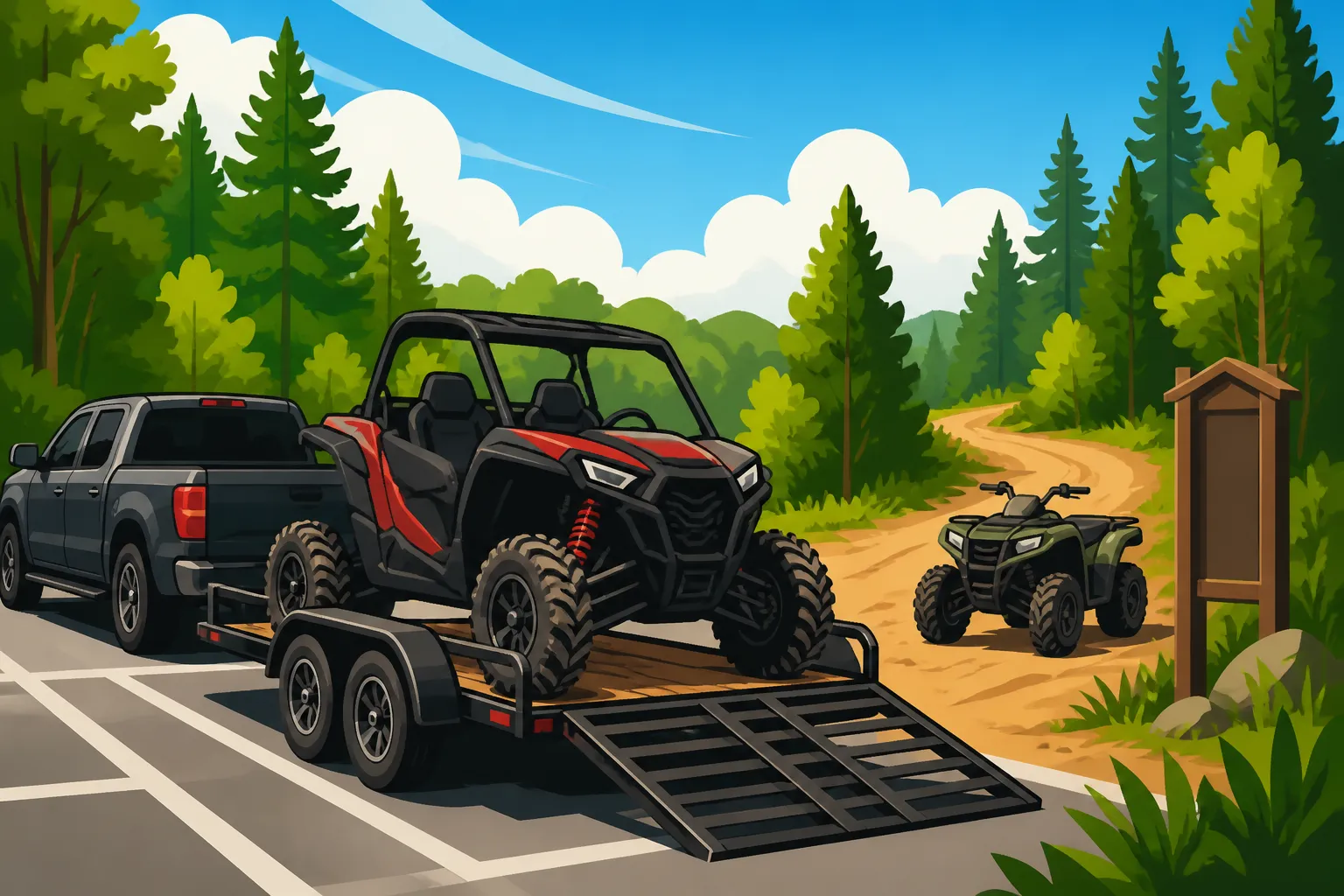
Mississippi Trailheads With Trailer Parking
Arriving at a Mississippi riding area with a trailer only to find a narrow entrance, a locked gate, or nowhere safe to unload can turn a fun day into a stressful one. This guide explains how to identify plausible trailheads and riding areas, confirm trailer parking before you leave, and plan for the space, access rules, and changing conditions your rig requires.
Where to look for trailer-friendly riding access
A trailhead that appears on a map is not automatically a place where you can park a truck and trailer. Some access points are simply gates or road entrances, and some public-land areas have no designated OHV trail open to the public. Start by separating established riding areas from roads and trailheads that may not permit ATV use.
Start with established OHV areas
Bethel OHV Trail is a useful place to begin researching public OHV access in Mississippi. Its trails have width limits, so check your machine’s measurements as well as parking arrangements before towing there. A wide side-by-side may not be eligible for every route even if you can fit your truck and trailer into the parking area. Review [Mississippi Trails With Width Limits] and [Bethel's Width Limit in Mississippi] before you plan around a particular machine.
Private riding parks are another option to investigate. Red Creek Off-Road and Meridian OHV Park are examples of Mississippi riding destinations, but their access arrangements, hours, parking capacity, and operating conditions can differ. Confirm details directly with the park before loading up. A business listing or a map pin is not a reliable substitute for asking whether a trailer can enter, where it can be left, and whether overnight parking is allowed.
National forest land can be confusing because the presence of forest roads, a trailhead, or a recreational pass does not necessarily mean there is an open OHV route from that location. Before treating a forest access point as a staging area, check the specific route and its current designation. [Mississippi National Forest Riding Explained] and [Mississippi Forests With No OHV Trail] can help clarify the difference between access to forest land and access to a designated riding trail.
Treat a map pin as a starting point, not permission
Mapping tools such as onX Offroad can help you compare possible access points, routes, and nearby roads while planning. Use the map to narrow your search, then verify the details with the land manager or park. A visible road leading to a trail does not establish that it is open to ATVs, that the public may use it, or that a trailer can be parked there.
This distinction matters on public land as well as private property. A gate, gravel pull-off, or broad shoulder may look like a convenient place to unload, but it could be on private land, within a restricted area, or in a spot where vehicles block access for other users. For a national forest trip, check the applicable trail information and pass requirements; [Mississippi National Forest OHV Passes] explains why a pass and an open trail are separate parts of the planning process.
When details are unclear, ask the property or agency a direct question: “Can I bring a truck and a trailer to the staging area for this trail, and where should I park while riding?” That question is more useful than asking only whether the trail is “open.” It prompts the person answering to address the part that can cause the most trouble on arrival.
How to confirm trailer parking before you go
Parking is not just a question of whether there is a place to stop. You need enough room to get in, unload safely, leave the trailer without blocking anyone, and get out again. A short phone call or message before departure can save a long, frustrating detour.
Ask specific questions about the access point
When you contact a park, land manager, or trail office, give a clear picture of your setup. Mention whether you will arrive with a pickup and a separate trailer, roughly how long the combination is, and whether the trailer is enclosed or open. If you are hauling a larger side-by-side, ask whether the parking area has room for a wider rig to turn around.
Confirm these points before leaving:
- Is trailer parking allowed at the exact trailhead or staging area? A general yes for the property may not apply to every entrance.
- Can you leave the trailer unattended while riding? Some places have designated parking; others may expect visitors to use a specific lot.
- Is there enough room to turn around and unload? A small pull-off may fit a truck but not a truck and trailer.
- Are there access hours, gates, or temporary closures? Weather, maintenance, hunting activity, or events may affect access.
- Are there restrictions on machine width or type? Parking availability does not mean every machine is allowed on every trail.
- Are there separate fees, passes, waivers, or check-in steps? Ask what must be completed before you unload.
For Bethel, call or check the official trail information before assuming that a particular entrance has room for your combination. For private parks, ask about their current parking arrangement and arrival procedure. If you are planning a larger group, explain how many trucks and trailers are coming; several rigs can fill a staging area that seems spacious for one vehicle.
Check access and conditions again on the day of travel
A plan made several days earlier can be undone by heavy rain, a closed gate, or a change in operating conditions. Before you hitch up, check the park or land manager’s latest updates and confirm that the trail is open to your type of machine. Bethel’s conditions can change with weather, so [Bethel Closes on Short Notice When It Rains] is worth reviewing before a long drive.
For a national forest trip, use the relevant district’s trail information rather than relying only on a general forest map. onX Offroad can be useful as a planning companion for reviewing route context, but it should not replace closure notices or permission from the agency responsible for the land. Save the phone number or contact details for the place you plan to ride in case conditions change while you are on the way.
If you cannot get a clear answer about trailer parking, treat that as a reason to pause and look for another confirmed staging option. Do not assume you can park along a road, in front of a gate, or on a nearby private driveway. A safe backup might be a different entrance approved by the land manager or a nearby private park that confirms its parking policy.
Comparing Mississippi staging options
Each type of riding area comes with different parking questions. The table below is a planning aid, not a guarantee that a specific lot is open or suitable for your trailer.
| Riding option | What to verify before towing | Common planning concern |
|---|---|---|
| Bethel OHV Trail | Exact parking area, trail access, machine width, and weather-related closures | A trailer may fit at one access point but not another |
| Private riding park such as Red Creek Off-Road | Current hours, trailer parking, check-in, fees, and any reservation requirements | Operating rules can vary by day and facility |
| Meridian OHV Park | Which entrance is open, parking arrangements, and machine eligibility | A map pin may not identify the correct staging area |
| National forest access | Whether the route is designated and open to OHVs, plus pass and parking rules | Forest access does not automatically mean an OHV trail is available |
| Private land or hunting property | Written permission, approved parking location, and permitted riding routes | A visible gate or road is not permission to enter |
Choose the access point around your trailer, not just the trail
The closest map pin is not always the best place to stage. A longer drive to a confirmed lot is often safer than attempting a tight turn at an unverified entrance. Think about the whole arrival sequence: where you can pull off the road, where the truck and trailer can wait, how the ATV or UTV will be unloaded, and whether another vehicle can pass while you do it.
If your trailer is long, enclosed, or difficult to back, say so when asking about parking. A narrow entrance may be manageable for a small utility trailer but uncomfortable with a larger enclosed trailer. Also ask whether the lot is firm enough for a heavy vehicle after rain. Mississippi’s wet ground can make an apparently solid shoulder or grassy staging area unreliable.
For a trip involving multiple machines, plan to arrive with enough space to unload without blocking the entrance. One person can check in or speak with staff while another stays with the vehicle, if the park allows that arrangement. Keep the group together until everyone knows where trailers should be parked and which routes are open.
Make the route and parking plan work together
Before you leave, confirm that your machine is allowed on the route you intend to ride. Width restrictions are especially important for side-by-sides. [Mississippi Trails That Allow Side-by-Sides] is a helpful starting point, but verify a specific trail’s rules rather than assuming that all Mississippi OHV areas accept the same vehicles.
Then save the practical details: the entrance address or directions, the contact number, the parking instructions, and any check-in steps. onX Offroad can help you keep route research organized alongside those details, while an official park or agency update should remain your reference for closures and access rules. If phone service may be unreliable, save the information before you leave.
Finally, give yourself extra time for backing, unloading, and securing the trailer. Bring the hitch lock, wheel chocks, tie-downs, and any equipment you need to unload without blocking the travel lane. If the lot is full or the surface is unsafe, do not improvise by leaving the trailer where it obstructs a gate or road. Contact the site and ask where they want you to stage.
A practical checklist for a smoother arrival
A little preparation prevents the most common trailhead parking problems: arriving at the wrong entrance, finding a closed route, or discovering that the only available space cannot accommodate your trailer. Use this checklist before each trip, even if you have ridden the area before.
Before you load the trailer
- Confirm that the riding area is open and that your machine is allowed on the intended route.
- Verify trailer parking at the specific entrance or staging area, not just somewhere on the property.
- Ask about turning space, unloading space, parking duration, and any overnight restrictions.
- Check width limits for your ATV or UTV, especially if you are taking a side-by-side.
- Review weather and closure updates, particularly after heavy rain.
- Save directions and contact information in case mobile service is poor.
- Check whether you need a pass, waiver, reservation, or check-in before unloading.
- Tell the property or agency if you are bringing a group or multiple trailers.
When you reach the trailhead
Take a moment to assess the entrance before committing the truck and trailer. Look for posted restrictions, signs directing visitors to another lot, soft shoulders, low branches, or a tight turn that could make it difficult to leave. If a gate is closed or the parking arrangement differs from what you were told, do not move barriers or assume the route remains open.
Park only where directed, keep access roads and gates clear, and secure the trailer before heading out. If you are unsure whether a spot is permitted, ask the site contact rather than relying on another visitor’s choice. A parking space that seems convenient can still create problems if it blocks emergency access or crosses onto private property.
The most dependable Mississippi trailhead plan is one that combines a confirmed riding route with confirmed trailer parking. Use maps to research, contact the people responsible for the land, and check conditions again before departure. That small bit of preparation can make the difference between unloading calmly and spending the first hour of your ride looking for somewhere to leave the trailer.
Disclaimer
This article is for general informational purposes only and does not constitute professional advice. Laws, prices and regulations vary by location and change over time. Consult a qualified professional for guidance on your specific situation.