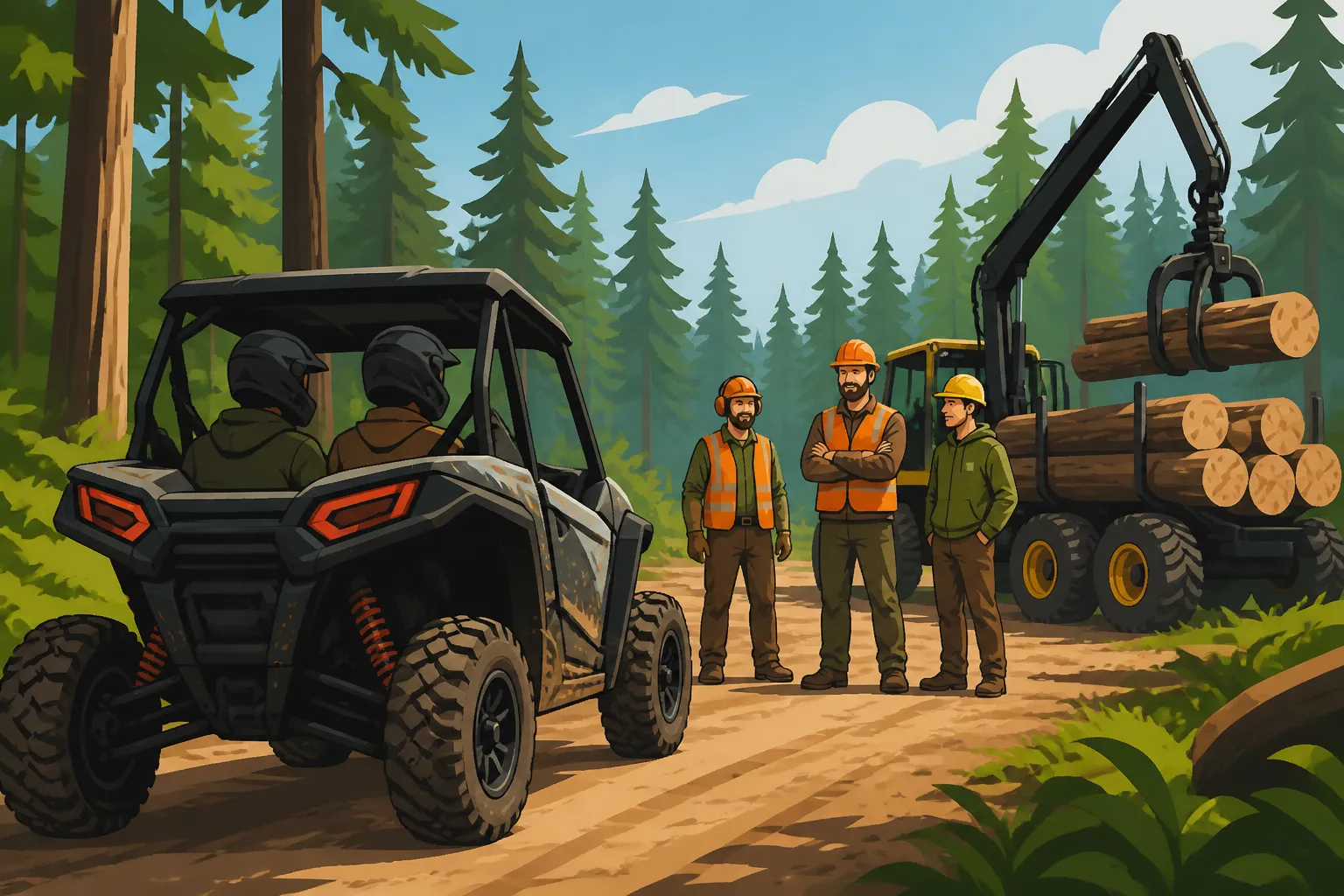
Meeting a Logging Crew on a Forest Road
A quiet gravel road in De Soto National Forest can change quickly when a loaded logging truck comes around a bend. The road may be narrow, dusty, and hard to see down, leaving little room to react. This guide explains how to prepare for logging traffic, what to do when you meet a crew, and when the safest choice is to turn around.
Prepare before riding a Mississippi forest road
Confirm that the road is open to your machine
A road that looks drivable is not necessarily open to ATV or UTV use. In Mississippi, riding access can depend on land ownership, posted signs, gates, designated routes, and local rules. National forest land, timber company land, and private property can sit close together, so don’t assume that permission or access on one stretch carries over to the next.
Before you unload, check the applicable forest map and current access information. A Forest Service motor vehicle use map can help identify roads designated for motor vehicle use, but it may not tell you whether a logging crew is working that day. Treat closures, temporary signs, and instructions from authorized staff as reasons to stop and reassess. For broader planning, see Mississippi National Forest Riding Explained and How to Read a Forest Service Trail Map.
The same caution applies around the De Soto National Forest, including areas near the Mississippi coast. A route that appears on a recreational map may cross a road that is restricted, closed, or not intended for your vehicle. Use a map app such as onX Offroad to plan and orient yourself, but don’t use a map display as proof that a road is open. Check official access information and signs on the ground, too. Mississippi Coast and De Soto National Forest Riding offers more context for planning in that region.
Look for signs of active logging
Logging work may be obvious: parked equipment, fresh tire tracks, cut timber, or a truck moving slowly with a load. It can also be less apparent. You might hear machinery beyond a tree line, notice dust hanging over a road, or encounter a freshly graded stretch with no crew in view.
Build in a moment to observe before entering a narrow road or crossing a ridge. Listen for engines and backup alarms, and look for dust moving across the road ahead. If you see a posted warning, a barricade, or a closed gate, don’t ride around it just because the route looks clear. A crew may be working farther along the road, outside your line of sight. For more on signs and closures, read Forest Roads Closed by a Posted Sign and [Gates on a Southern Forest Road].
A mapping app can be useful for keeping track of your planned route and recognizing when you’ve drifted away from it. Still, onX Offroad should be a planning aid, not a substitute for posted signs, current access rules, or local guidance. If you’re unsure whether a road is open or whether logging is active, choose a confirmed route instead of taking a chance.
Plan for poor visibility and weak phone service
Dust, tree cover, low light, and bends can all reduce the distance at which you see a truck. Cell service can also be unreliable in forested areas, so don’t count on calling someone for directions after you’ve reached a confusing junction. Download or carry the information you need before you leave service, and tell someone where you expect to ride and when you plan to return. See Cell Dead Zones in De Soto National Forest for related preparation advice.
A paper map can be a useful backup, especially if the screen on your phone is hard to read in bright sun or your battery runs low. Mark your intended route and a clear way back to a main access point. If the route depends on several uncertain turns, or you can’t establish whether a road is open, keep the ride closer to a known trailhead instead.
What to do when you meet a logging crew
Slow down and make yourself predictable
If you spot a logging truck, skidder, loader, or other work vehicle, ease off the throttle early. Avoid sudden turns, sharp braking, or weaving across the road. A logging truck may need space to turn or maneuver, and its driver may not see a small ATV or UTV immediately, particularly in dust or around a bend.
Keep a steady line and make yourself visible. If you have headlights, use them when conditions make it harder to see you, while avoiding high beams that could interfere with another driver’s vision. Don’t assume that the crew has noticed you just because you can see the equipment. A loaded truck can have substantial blind areas, and the crew may be focused on a work task.
If you’re riding with others, keep the group together without bunching up around the truck. Riders who are spread around a bend or hidden behind dust may be hard for the driver to track. Agree in advance on a simple plan: slow down, move to a safe place when there is room, and wait for a clear signal before proceeding. Sharing a Gravel Road With Loaded Log Trucks goes into more detail about sharing narrow roads with heavy vehicles.
Give the crew room to work
When there’s a safe, wide place to move aside, stop well clear of the truck’s path and wait. Don’t pull onto soft shoulders, ditches, or unstable edges just to get out of the way; a machine that sinks or tips can create another hazard. Avoid stopping where a driver needs room to turn, back up, load timber, or pass equipment.
If the road is too narrow to pass safely, don’t try to squeeze between a truck and roadside equipment. Wait at a safe distance, then follow the crew’s directions. If you can’t tell where the truck is headed or whether the crew has seen you, give them time and space rather than edging forward to find out.
When there is no safe place to wait, backing out may be the better option—but only if you can do it without placing yourself in the path of another vehicle or backing into a blind stretch. If the road is steep, soft, or too tight to maneuver, stop at a safe distance and seek guidance from the crew when it is safe to communicate. Don’t force a pass simply because you’ve already ridden some distance down the road.
Don’t enter a work zone without a clear signal
A logging operation is a workplace, not a place to explore around machinery. Don’t ride behind equipment, pass through a loading area, or cross a section where workers are cutting or moving timber unless the crew clearly indicates that it is safe and permitted. Keep children and passengers close, and don’t let anyone walk up to operating equipment to get a better look.
If a worker signals you to stop, stop. If the instruction is unclear, remain in a safe location and ask a brief question only when the worker is not operating machinery or handling a load. Don’t interpret a pause in work as permission to continue; the crew may be waiting for equipment, a spotter, or a change in conditions.
A practical rule is to choose the route that avoids the active work area whenever you can do so legally and safely. If the only way forward passes through a work zone and nobody can confirm that it is safe, turn around. The time lost by retracing your route is a much smaller problem than getting between moving equipment and a truck.
Choose a safe response for the situation
| What you encounter | Safer response | Avoid |
|---|---|---|
| A truck approaching on a narrow road | Slow early, find a stable place to wait, and follow crew directions | Racing for a gap or stopping on a blind bend |
| Dust or machinery ahead | Stop where you can be seen and assess the situation | Riding into the dust to see what is happening |
| A closed gate or road sign | Turn back and choose an open, confirmed route | Going around the barrier |
| A truck loading or backing | Stay well clear and wait for a clear signal | Passing close to the equipment |
| No safe passing space | Wait at a safe distance or retreat if you can do so safely | Squeezing between the truck and the roadside |
| Unclear access or crew instructions | Pause, ask when it is safe, or leave the area | Assuming a pause means the road is open |
Turn around when conditions are uncertain
Turning around is often the most sensible decision when visibility is poor, the road is blocked by equipment, or you cannot tell whether the crew is moving toward you. That can feel frustrating after you’ve driven a long way to the riding area, especially if you’ve planned a route on your phone. But a track that is temporarily unusable is not worth navigating through an active work zone.
Use a mapping tool to find your way back only if the alternate route is confirmed open and appropriate for your machine. onX Offroad may help you understand your position and retrace your planned route, but check signs and access information before taking an unfamiliar spur road. A shortcut on a screen may lead to private land, a closed gate, or another active haul road.
If you’re riding with a group, agree that anyone can call for a stop or turnaround when safety is uncertain. That keeps one rider from feeling pressured to follow a risky decision just because the rest of the group has already committed to the route. Check Checking Before a Long Southern Drive and Mississippi Trail Conditions After Rain for other ways to avoid arriving at a route that isn’t suitable for the day.
Ride with the road’s purpose in mind
Forest roads are shared spaces, and a route that is pleasant for a recreational ride may also support forestry, maintenance, or other necessary work. Keep speed modest where sightlines are limited, stay alert at junctions, and expect that road conditions may change after rain or heavy vehicle use. A road that was firm on the way in can become rutted or muddy by the time you return. Mississippi Trail Riding After Heavy Rain covers related conditions that can affect traction and visibility.
Don’t treat an established tire track as an invitation to continue. A tire-marked road can lead to a work area, a private access road, or a route closed to recreational riding. Stay on roads and trails where your use is allowed, and respect temporary closures even if you have ridden the same area before.
If you are unsure about a particular timber road, check the land manager’s access information or ask the appropriate office before riding. The rules for a designated national forest road may not apply to a private timber road nearby. For more route-specific context, see Mississippi Rules for Riding a Timber Road.
Make a simple plan for the ride
Brief the group before leaving the trailhead
A short conversation before starting can prevent confusion when a truck appears. Tell everyone to slow down early, stay visible, leave room for heavy vehicles, and never ride around a gate or sign. Set a regrouping point in case the group gets separated, and make sure each rider knows how to return to the trailhead or staging area.
For a family ride, explain the plan in plain language: if an adult stops, everyone stops; no one rides toward machinery; and nobody follows a truck into dust or around a blind corner. Young riders may want to keep moving when they see a clear-looking road ahead. Agree beforehand that stopping and waiting is the correct response.
Carry what you need to manage an unexpected delay: water, basic first-aid supplies, a charged phone, and enough fuel for a return route that might be longer than expected. Tell a person who is not riding with you where you’re going and when you expect to check in. These small steps matter when service is limited or the crew’s work blocks your planned route.
Leave space for changing conditions
Logging traffic can change a road’s surface, visibility, and available space. If a route looks different on the return trip, pause before continuing. Fresh ruts, newly moved equipment, a changed sign, or a line of trucks are all reasons to reassess rather than ride on autopilot.
Keep dust in mind when following another vehicle. Leave enough distance to see the road and react to hazards, and don’t follow so closely that you disappear into the dust cloud. If you can’t see clearly, slow down or stop somewhere safe until visibility improves. Mississippi Trail Etiquette Locals Expect offers additional guidance for sharing riding areas respectfully.
Most importantly, remember that reaching a planned destination is optional. When you encounter active logging, the safest choice may be to wait, take a confirmed alternate route, or head back. A flexible route plan makes that decision easier—and helps keep both riders and workers safer.
Disclaimer
This article is for general informational purposes only and does not constitute professional advice. Laws, prices and regulations vary by location and change over time. Consult a qualified professional for guidance on your specific situation.