Mississippi Has No OHV Registration to Reciprocate
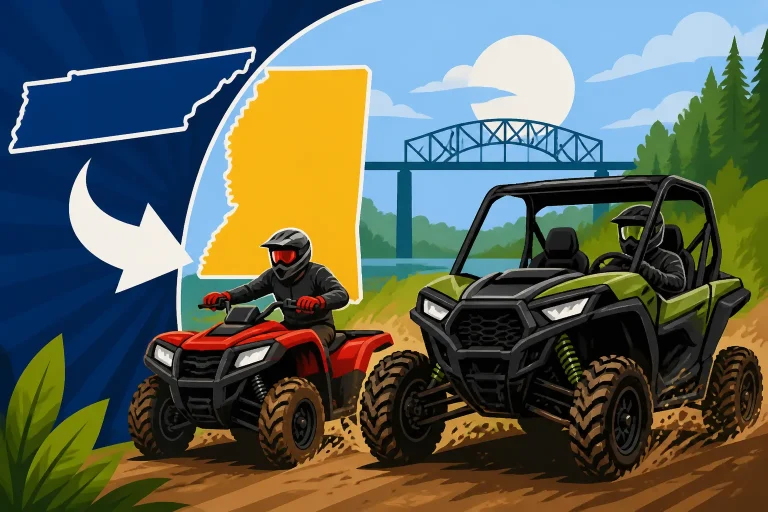
Mississippi’s lack of a statewide OHV registration sticker can make a trip feel more confusing than it should, especially if your home state requires one. The key distinction is that Mississippi has no state OHV registration for another state to recognize in return. This guide explains what that means for visitors, which separate permits may still apply, and what to check before unloading your ATV or UTV.
What “no OHV registration to reciprocate” means
Registration reciprocity depends on a credential
States use different systems to manage off-highway vehicles. One state may issue an OHV registration card or decal; another may require a trail permit; another may have no general statewide OHV registration at all. Reciprocity is the practice of recognizing a qualifying credential issued by another state, usually when a visitor rides temporarily outside their home state.
Mississippi does not issue a general statewide OHV registration sticker for ATVs and UTVs. That means there is no Mississippi OHV registration credential for another state to recognize, and no matching Mississippi registration sticker that a visitor must obtain merely because their machine is registered or identified under another state’s system. The phrase “nothing to reciprocate” describes that basic mismatch between systems.
It does not mean that every trail, public land, park, or private riding area is open without requirements. Registration is only one possible requirement. A land manager can require a separate pass, a private park can set its own entry conditions, and riding on a public road raises a different set of legal questions. Treat each layer separately rather than assuming that “no registration” means “no rules.”
The state does not issue a Mississippi OHV sticker for visitors
A visitor coming from a state with an OHV registration decal may be used to displaying it on the machine. Mississippi does not provide an equivalent statewide OHV sticker for that visitor to buy or obtain. For the state-sticker distinction, see Mississippi Has No Sticker for a Visiting Machine and Mississippi Visitors Need No State Sticker.
That narrow answer can be reassuring if you are hauling a quad from Alabama, Louisiana, Tennessee, or another nearby state and are trying to determine whether Mississippi requires an extra state registration decal. But it does not settle what you need to ride a particular trail. For example, a national forest trail system may have its own pass rules, while a privately operated mud park may require a waiver or proof that you meet its age and equipment rules.
If you are planning a weekend ride, write down the exact riding location before you start sorting paperwork. “We’re riding in Mississippi” is too broad to answer every permit question. “We’re riding a designated OHV trail in a national forest” or “we’re entering a private park near Hattiesburg” gives you a much more useful starting point.
Registration is not the same as title or ownership proof
A title, a registration, and a riding permit serve different purposes. A title is a document associated with ownership and the machine’s identity. Registration is a government-issued authorization or record that some states require for certain kinds of vehicle use. A trail pass or land-use permit gives access under the rules of a particular land manager or riding area.
That distinction matters in Mississippi because the absence of statewide OHV registration does not erase title requirements that may apply to a machine. Nor does a title automatically grant access to a trail. A titled machine can still need a site-specific pass, and an untitled machine is not automatically cleared to ride anywhere simply because Mississippi lacks general OHV registration.
A practical way to avoid mixing the terms is to ask three separate questions: What ownership paperwork should I carry? Does my home state require a credential for my machine? And does the place where I plan to ride require a separate pass or authorization? The answer to the first question does not automatically answer the other two.
What visiting riders should check before leaving home
Start with your home state’s requirements
If your home state issues an OHV registration, decal, or certificate, check what it requires for operating your machine at home and what it says about out-of-state riding. Keep any required home-state credential current and attached or carried as directed by that state. Mississippi’s lack of a matching registration program does not automatically cancel a requirement that applies to you at home.
It is easy to assume that a home-state registration sticker works like a universal travel pass. Usually, it is better to think of it as one part of your paperwork rather than a guarantee of access everywhere. A land manager may have its own rules about vehicle identification, passes, or permitted routes, even when the machine is properly documented where it is based.
Before a multi-state trip, check the rules for every jurisdiction where you expect to ride, not just the state where you sleep or park the trailer. A route may pass through more than one state, and requirements can change when you move from public land to a privately operated park. For Mississippi-specific visitor questions, see Mississippi Rules for an Out-of-State Machine.
Identify the land manager for the riding area
The place where you ride often determines which additional requirements matter. A national forest, wildlife management area, state park, private riding park, and privately owned hunting lease are not interchangeable. Each has a different manager and can set conditions within the rules that apply to that property.
For national forest riding, identify the specific trail or road system and check whether it is designated for OHV use. Do not assume that a forest road is open to ATVs just because it is unpaved, or that a pass for one area covers every road in the forest. Start with Mississippi National Forest OHV Passes and Mississippi Forest Pass Coverage, then confirm the rules for the actual trailhead or district you intend to visit.
For a wildlife management area, look for designated routes, seasonal closures, gates, and posted restrictions. Mississippi WMAs are not general-purpose trail parks. The machine-use rules can be tied to particular roads and land-management purposes, so check Mississippi WMA Designated Roads Only before making a route plan. On private property, get permission from the landowner or lease manager rather than relying on a state credential.
Make a trip-specific paperwork checklist
A simple checklist can prevent a frustrating scene at a gate or trailhead. Before leaving, confirm the machine’s home-state credential requirements, any trail or land-use pass, your proof of ownership, the riding area’s waiver or check-in requirements, and whether the trail is open to your vehicle type. If a rule is unclear, contact the land manager rather than relying on a friend’s recollection from a previous season.
Carry information in a way that survives rain, mud, and a long day in the trailer. Some riders keep paper copies in a waterproof document pouch and store digital copies on a phone. If you use Amazon to find a pouch or basic storage supplies, choose something that keeps documents readable and secured; the product itself does not substitute for required paperwork or a permit.
A compact checklist might look like this:
| Question | What to verify | Why it matters |
|---|---|---|
| Does my home state require OHV registration? | Credential, decal, or proof required by your home state | Mississippi’s system does not determine your home-state obligations |
| Where will I ride? | Exact trail, park, WMA, forest district, or private property | Rules depend on the land manager and location |
| Is a separate pass required? | Pass type, where it applies, and how to obtain it | A state OHV registration and a site pass are different things |
| Is the route open to my machine? | Vehicle type, width limits, closures, and posted signs | Some trails exclude certain machines or close temporarily |
| What should I carry? | Ownership documents, home-state credential if required, pass evidence, and ID | Helps answer questions during check-in or a stop |
Mississippi permits are separate from OHV registration
A forest pass is not a statewide registration sticker
A national forest pass, where required for a particular riding opportunity, is a land-use credential rather than a Mississippi OHV registration. It does not turn into a general registration for the machine, and it should not be treated as permission to ride every road or trail on public land. Its scope depends on the land manager’s rules and the specific area covered.
This difference is easy to miss because both a registration decal and a trail pass may be displayed on a vehicle or shown at an entrance. But they answer different questions. Registration is about a vehicle credential under a government system; a forest pass is about access under a land manager’s rules. A rider can have one without having the other.
Before traveling to a forest trail, verify the current pass instructions, the trail’s operating status, any vehicle-width limits, and whether the pass must be displayed or carried. Check the conditions close to departure, especially after heavy rain or during hunting seasons when access may change. A pass cannot override a closed gate or a posted restriction.
A WMA access rule is not a general riding permit
Wildlife management areas are managed for specific public uses, including hunting and wildlife management. An ATV or UTV may be permitted on designated roads under specified conditions, but that is not the same as an open invitation to explore the property. A road that appears usable may be closed, gated, or restricted to a particular activity or time.
Pay attention to signs at entrances and along roads. Do not move a gate, ride around a berm, or assume that an unmarked side trail is authorized. The safest habit is to stay on routes that the WMA identifies as open to your machine and check for seasonal or temporary changes before you go.
If your trip involves hunting access or retrieving game, confirm the separate rules for that activity instead of assuming that permission to hunt automatically authorizes every kind of machine use. [Mississippi WMA Rules for Riders] can help you distinguish designated-road access from other WMA restrictions. When the rule is not clear, contact the area manager before unloading.
Private parks and landowners set their own entry conditions
A private riding park may require a waiver, a day-use ticket, an age check, specific safety equipment, or compliance with vehicle limits. Those requirements are set by the facility and are separate from any state registration question. A visitor can arrive with every document their home state requires and still need to complete the park’s check-in process.
Likewise, permission to ride private property should be specific. A casual “you can ride sometime” may not resolve questions about which fields, roads, or dates are included. If the property is part of a hunting lease or timber operation, ask whether the agreement allows ATVs, whether gates must remain closed, and whether active work or hunting changes access.
When you call a park or landowner, ask direct questions: Is my machine type allowed? Is there a width or sound limit? Do riders need a pass or reservation? Are passengers allowed? What happens if weather closes the route? Those details are far more useful than asking only whether the place “allows ATVs.”
Proof of ownership, title, and documents on the trail
Carry useful documents without confusing them with permits
Even where Mississippi does not require a general OHV registration sticker, it is sensible to carry information that helps identify the machine and show that you have a legitimate connection to it. Depending on your circumstances, that could include a title, bill of sale, home-state credential, or other ownership record. The exact document that matters can vary with the situation, so do not assume that one piece of paper answers every question.
This is particularly helpful when the machine is borrowed, recently purchased, transported across state lines, or used by someone other than the named owner. If a machine is borrowed from a family member, ask the owner what paperwork is available and make sure you have permission to use it. If you bought it recently, keep the sale paperwork accessible instead of leaving it buried in a folder at home.
Some riders keep a paper copy with the trailer documents and a digital copy on a phone. A small waterproof pouch can help protect paper from rain or mud; Amazon is one place riders may look for basic storage supplies, but choose a format that fits your documents and keeps them secure. Avoid leaving original ownership documents loose on a machine where they can be lost or damaged.
A title does not grant trail access
A title can help establish ownership, but it does not authorize a rider to enter a closed trail, ride on private land, or use a road where OHVs are prohibited. Think of the title as an ownership record—not a ticket to ride. The same is true in reverse: the absence of a statewide registration sticker does not mean the machine has no ownership or identification questions attached to it.
A newly purchased machine is a common source of confusion. The buyer may have a bill of sale but not yet have a title in hand, or the title may still show a former owner. That paperwork situation is separate from trail access. If your machine is subject to Mississippi title requirements, resolve the title question through the appropriate process; do not treat a trail pass as a replacement for ownership paperwork.
For the related distinction between ownership proof and access, see Mississippi Proof of Ownership on the Trail. If you are buying, selling, or transporting a machine, keep the sale documents and identity information organized. It is easier to answer questions when the machine’s serial number and paperwork are legible and consistent.
Keep contact information and emergency details accessible
Paperwork is not only about enforcement. It can help if a machine is separated from its owner, there is an accident, or a group needs to contact someone. Keep an emergency contact accessible to the people in your riding group, and tell someone at home where you plan to ride and when you expect to return.
If you carry documents on a phone, consider what happens if the battery dies, the device gets wet, or there is no signal. A paper backup for key contact details can be useful in remote areas. At the same time, avoid carrying more personal information than you need, especially if documents will be left in an unattended vehicle or trailer.
A practical document setup might include an ownership record or bill of sale, a copy of any credential your home state requires, proof of the site-specific pass if applicable, and the contact details for the trail manager. Put the items in a place you can reach without unpacking the entire trailer. Before a group ride, agree on who has the documents and who will handle check-in.
Roads, public land, and the limits of reciprocity
A registration credential does not make a public road legal
One of the most important distinctions for visiting riders is that registration and road access are separate. A machine may be properly registered in its home state and still be prohibited from riding on a Mississippi public road. A trail pass does not change that, either. Do not use a public-road shoulder, county road, or town street as a shortcut unless the route is specifically lawful for your machine.
The rules can also differ between roads controlled by different authorities. A city ordinance may address certain low-speed vehicles without allowing ordinary ATVs or UTVs. A county road, a state highway, a forest road, and a private road may each have different conditions. The safest approach is not to infer permission from the road’s appearance or from the fact that other riders use it.
If your route requires crossing a road, check the rules for the specific crossing and follow posted directions. Do not treat a brief crossing as permission to travel along the road. For a broader overview, see Mississippi ATV Road Rules Under 63-31-3 and Mississippi Bans ATVs on Public Roads. When uncertain, choose a trailhead or route that avoids public-road travel.
Public land has boundaries and posted restrictions
Public ownership does not mean unrestricted access. National forest land, wildlife management areas, levees, and other public properties may have routes that are open to some uses and closed to others. Gates, signs, berms, seasonal notices, and temporary closures are meaningful—not obstacles to work around.
This can be frustrating when a route looks like a trail or when a map shows a road that is not currently open. But a mapped line is not always proof that OHV travel is authorized. Conditions may change because of erosion, maintenance, weather, wildlife management, hunting activity, or public safety concerns. Check official route information and read the signs at the entrance.
A good habit is to plan an alternate route before the trip. If a trail is closed or unsuitable for your machine, you will not feel pressured to improvise by taking an unmarked road. Keep a map or saved route information available; if you buy mapping or document supplies through Amazon, remember that a physical map or navigation device helps with orientation but does not establish legal access.
Local rules may be narrower than statewide rules
A town or park can have rules that are more specific than the broad statewide registration picture. A local ordinance might address certain vehicles on designated streets, set operating conditions, or prohibit particular types of machines. Those local rules do not create a statewide OHV registration system, and they should not be assumed to apply beyond the jurisdiction that adopted them.
The same caution applies to event rides. An organizer may arrange access to private property or a permitted route for a specific event, but that permission is not automatically transferable to a later solo ride. Follow the organizer’s route, timing, and check-in instructions, and do not leave the authorized route because another road looks convenient.
Before riding near a town, ask the relevant local office or park manager whether there is an ordinance or site rule that applies to your exact machine. If the answer is unclear, ask for the name of the rule or a written reference so you can review it. Local boundaries can be easy to cross without noticing, particularly near developed areas and trail connections.
A practical process for planning a Mississippi ride
Step one: define the machine and the trip
Start with the machine you are taking: ATV or side-by-side, its approximate width, whether it carries passengers, and whether it is borrowed or recently purchased. Those details may matter for a trail’s vehicle limits, a park’s admission policy, or the paperwork you can provide. Do not assume every OHV trail is suitable for every ATV and UTV.
Next, identify where you will ride. Write down the name of the forest, WMA, private park, or property owner and the specific trailhead or entrance. If you are meeting friends, confirm that everyone means the same place; similar-sounding trail names or nearby counties can lead to a long, unnecessary detour.
Then decide whether the trip includes public-road travel, a crossing, or only off-road riding on an authorized route. This step catches a common planning mistake: riders focus on registration and forget that the route from the trailer to the trail may involve a road with separate restrictions.
Step two: verify credentials and access requirements
Check the home-state rules for your machine and make sure any required credential is current. Then check the Mississippi riding location’s rules independently. If a national forest pass is required for the trail system you chose, confirm the pass’s coverage and how it must be carried or displayed. If you are going to a private park, check its entry requirements directly.
Use the land manager’s official information where possible, particularly for temporary closures or seasonal access. A forum post or a friend’s old advice may be helpful as a lead, but it may not reflect current trail conditions. When you contact an office or park, write down the date, the name of the person you spoke with if offered, and the details they provided.
For visitors, the key point is straightforward: Mississippi’s lack of a statewide OHV registration does not create a universal pass, and an out-of-state credential does not replace every local requirement. Mississippi Forest Pass Coverage and Your Driver’s License Is the Permit on Mississippi Trails address two separate access questions that are easy to blend together.
Step three: check route conditions and prepare for a stop
Check whether the route is open shortly before departure, especially if rain has affected the area. In Mississippi, wet conditions can make a trail difficult or prompt a closure. Bring a map or saved directions, plan for limited cell coverage, and make sure everyone in the group knows the correct trailhead and an agreed meeting point.
Keep important papers and pass evidence accessible, but protected from water and mud. A phone image can be a useful backup, while paper copies may help if a device fails. Amazon may be useful when looking for a document pouch or simple navigation accessories, but the most important preparation is confirming that the document or pass is actually the one required for your chosen location.
If an officer, ranger, park employee, or land manager asks about the machine, stay calm and answer the question asked. Be prepared to show identification or relevant ownership and access documents when required. Do not argue that a home-state registration grants access to a closed route; it does not. If you believe a rule has been misunderstood, ask politely which requirement applies and where you can review it.
Common misunderstandings about Mississippi reciprocity
“My home-state sticker means I can ride anywhere”
A home-state OHV sticker may show that you have met a requirement where the machine is based. It does not necessarily grant access to every Mississippi trail or property. A separate pass, a designated route, a waiver, or permission from a property owner may still be required.
The reverse mistake is assuming Mississippi must issue a matching sticker because your home state does. Mississippi’s lack of statewide OHV registration means there may be no Mississippi credential for that visitor to obtain. But that does not eliminate the visitor’s responsibility to follow the home state’s rules when applicable or the riding area’s local requirements.
Keep the two questions separate: “Is my machine properly documented under the rules that apply to me?” and “Am I allowed to ride this particular place today?” The first concerns the machine and its paperwork. The second concerns access.
“No registration means no paperwork”
This assumption can create trouble in a private sale, a borrowed-machine situation, or a trip where ownership is questioned. The absence of a statewide OHV registration sticker does not mean a rider should discard a bill of sale, title, or other ownership record. Those documents can matter for purposes other than registration.
If you have just bought a quad, keep a copy of the bill of sale and any title paperwork you received. If you are borrowing a UTV, get clear permission from the owner and know how to reach them. If the machine has a home-state credential, keep that information consistent with the machine’s identity and the owner’s records.
A tidy paperwork folder is a small effort that can save a lot of stress. It is also useful when selling later, because a buyer may want to understand the machine’s history and documentation. The paperwork does not replace trail permission, but the trail pass does not replace ownership proof either.
“A pass or permit is the same thing as registration”
Riders sometimes use “registration,” “sticker,” “permit,” and “pass” as if they all mean the same thing. In everyday conversation, the terms can blur together. For planning purposes, use the precise term from the agency or park and check what it authorizes.
A forest pass may cover designated riding opportunities under a land manager’s rules. A private park ticket may be valid only for a specific visit. A home-state registration may be an ongoing credential for the machine under that state’s program. None should be assumed to satisfy the others unless the responsible authority explicitly says so.
When you call to confirm requirements, ask what the credential is called, what land it covers, whether it is tied to the machine or the rider, and whether it needs to be carried or displayed. Those practical details make it much easier to avoid arriving at the gate with the wrong item.
Questions to ask before you ride
Questions for a forest, park, or land manager
Start with the exact location and machine description. Ask whether the area is open to ATVs, UTVs, or both, and whether there are width, passenger, sound, or equipment limits. If your side-by-side is wider than a standard ATV, do not rely on a general “OHVs are allowed” answer; ask about your machine’s category and dimensions.
Ask whether a separate pass is required, what routes it covers, and whether you need to buy or obtain it before arriving. Confirm how the pass must be carried or displayed and whether it is valid for the date of your trip. If there has been rain, ask about closures, muddy sections, and alternate routes.
Finally, ask what documents or check-in steps the site expects. A park may require a waiver or photo identification; a public-land trail may have a different process. A clear call before leaving home is usually less frustrating than discovering a restriction after the trailer is unloaded.
Questions for your home-state agency
If your state issues an OHV registration or decal, ask whether it must remain current while traveling and whether the state has any requirements for operating out of state. Ask what document proves compliance and whether the decal must be displayed. Keep the response focused on your machine type and how you plan to use it.
If you are a new resident of Mississippi rather than a short-term visitor, ask about obligations that may apply to ownership, title, or a change of residence. A temporary trip and a move are different situations. Do not assume that a visitor rule answers what a new resident must do with a machine they keep in Mississippi.
If the machine is financed, borrowed, inherited, or recently purchased, ask what paperwork is available and keep records that establish who owns it or has permission to use it. A lender’s interest, a seller’s incomplete paperwork, or a family transfer can create document questions that are unrelated to trail access.
Questions to ask yourself before loading the trailer
Before departure, confirm that you have identified the exact place you are going, checked the route’s status, and verified any pass or site-specific rules. Confirm that the machine fits the trail’s limits and that everyone riding understands the route and the rules. If the trip depends on a public-road connection, confirm that the route is allowed rather than assuming it is.
Check that your home-state paperwork is in order and that useful ownership documents are accessible. Tell someone at home where you expect to ride and when you plan to return. Pack for the conditions, including weather, mud, limited cell service, and the possibility that a planned route may close.
Most importantly, do not let the phrase “no OHV registration” carry more weight than it should. It answers a specific question about a statewide Mississippi registration system. It does not answer whether a forest pass is needed, whether a WMA road is open, whether a private park will admit your machine, or whether a public road is legal for your ride.
Disclaimer
This article is for general informational purposes only and does not constitute professional advice. Laws, prices and regulations vary by location and change over time. Consult a qualified professional for guidance on your specific situation.