Sharing a Forest Trail With Hunters
A quiet ride through Mississippi pine woods can feel very different when hunting season brings trucks, hunters, dogs, and gunfire to the same area. The safest approach is to plan around other users, confirm where riding is permitted, and be ready to turn back if conditions change. This guide explains how to share forest trails with hunters without creating avoidable risks.
Plan your ride around hunting activity
Check access rules before loading the trailer
“Forest trail” can mean several different things in Mississippi: a designated OHV route, a forest road, a Wildlife Management Area road, or a track crossing private timberland. Those places may have different access rules, and a route that is open for riding in one area may be closed or restricted in another. Start by identifying who manages the land and what kind of route you intend to use.
National forests and Wildlife Management Areas are not interchangeable. In a national forest, riding is generally limited to routes designated for motorized use, and seasonal or weather-related closures can affect access. On a WMA, machine use may be restricted to designated roads, with additional rules tied to hunting activity. Review Mississippi National Forest Riding Explained and Mississippi WMA Designated Roads Only before assuming a road shown on a map is open to your ATV or UTV.
This distinction matters when you’re planning a ride near places such as De Soto National Forest or another public-land area. A path may look wide enough for a side-by-side and still be closed to motorized use. Likewise, a route listed in an app or visible in satellite imagery is not proof that riding is allowed. Follow posted signs and verify access with the land manager when details are unclear.
Check the hunting calendar and local conditions
Hunting seasons vary by game, location, and year, so don’t rely on last season’s dates or a general assumption that hunting activity has ended. Before setting out, check the current regulations and land-manager notices for the specific area you’ll visit. Hunting pressure can be especially noticeable around access roads and parking areas in the early morning and late afternoon, but activity can occur at other times too.
A simple call or check of the managing office’s notices can help answer practical questions: Is the route open? Are any roads closed? Are there special restrictions during a hunt? Is there a designated parking area for riders? Keep the number for the relevant forest district or area office handy in case the trailhead signs leave you uncertain.
Also check recent rain and trail conditions. A wet road can become rutted or muddy, and hunters may be using the same access roads to reach a stand or retrieve equipment. Mississippi Hunting Season Trail Advice and Mississippi Trail Conditions After Rain can help you think through timing and conditions before you go. If the route is soft, visibility is poor, or closures are posted, postponing the ride is often the more considerate choice.
Ride so hunters can see and predict you
Make your machine visible without assuming visibility is enough
A hunter may be focused on the woods rather than expecting a vehicle to appear around a bend. That makes predictable riding essential. Keep headlights on where appropriate, stay on the authorized route, and slow down as you approach intersections, gates, bends, trail crossings, and areas where vehicles are parked. Avoid sudden turns off the road or weaving through brush.
Wear high-visibility clothing, especially when riding during daylight hours in busy hunting areas. Do not assume that a bright ATV or UTV will be easy to see through trees, brush, or low light. Dust, rain, shadows, and terrain can reduce visibility for everyone. A passenger should also wear visible clothing rather than blending into the background.
Use mapping as a planning aid, not as permission to ride. A tool such as onX Offroad can help you review routes and orient yourself before leaving home, but compare what you see with official land-management maps and signs at the trailhead. If a map and a posted closure appear to disagree, follow the posted restriction and ask the land manager to clarify. A screen cannot tell you whether a route has been temporarily closed or whether a local rule has changed.
Keep speed low and leave room to stop
Reduce speed before you reach a narrow stretch or a blind corner, not after you see someone. On a narrow forest road, a hunter may be walking, carrying gear, or standing near a parked vehicle. A slow approach gives you time to stop and gives the other person a chance to recognize what you’re doing. For more practical trail-sharing habits, see Yielding on a Narrow National Forest Road and Mississippi Trail Etiquette Locals Expect.
If you meet a person on foot, stop well short of them and wait for a clear signal that it’s safe to proceed. Don’t crowd a hunter, pass closely, or rev the engine to announce yourself. If a vehicle is parked partly on the route, stop and assess the space rather than squeezing by at speed. When the road is too narrow for a comfortable pass, wait or turn around if that is the safer option.
The same caution applies when riding in a group. Agree on a pace before you start, leave space between machines, and make sure the last rider knows the route. A lead rider who stops abruptly can cause a pile-up behind them, particularly on a muddy or uneven road. Hand signals or a radio can help the group communicate, but they do not replace slowing down and checking the trail ahead.
| Situation | Safer response |
|---|---|
| A person is walking near the route | Stop at a respectful distance and wait for a clear path |
| You approach a blind bend | Slow down before the bend and stay to the authorized route |
| A vehicle blocks part of the road | Stop and assess; don’t squeeze through at speed |
| You encounter a gate or closure sign | Do not go around it; turn back and confirm access |
| You hear gunfire nearby | Stop, stay on the route, and move away calmly if you can do so safely |
| Your group gets separated | Stop in a safe place and reunite before continuing |
Share space without creating a safety problem
Treat gunfire, dogs, and hunting activity as reasons to pause
If you hear gunfire nearby, don’t race toward it to find out what is happening. Stop in a safe place, keep your group together, and assess whether you can leave by the route you came in on. Avoid cutting through the woods or taking an unmarked shortcut. If you cannot tell whether the route is safe or open, contact the land manager or follow posted instructions.
Hunting dogs may be working in or near the area, depending on the type of hunt and local rules. Slow down immediately if you see a dog, and do not chase, honk at, or try to handle it. A dog may be difficult to see in brush or may move unpredictably across the road. Give it room and wait for its handler to direct you past.
If a hunter asks you to stop or wait, stay calm and do so when it is safe. A brief, courteous exchange can prevent a misunderstanding. You can explain that you are following the designated route and ask whether there is a safe way to continue. If the situation feels tense, don’t argue; leave the area by an authorized route and contact the land manager afterward if you need clarification.
Avoid riding beyond the route or around a closure
When a trail is blocked, it can be tempting to detour around a gate or ride through an opening in the trees. Don’t. An apparent workaround may cross a hunting area, private land, a sensitive habitat, or a route closed for safety. Gates and signs are there to guide access, and riding around them can put you in conflict with hunters, landowners, or enforcement staff.
On WMAs, follow the posted road designations and any area-specific restrictions. A road that appears open on a general map may have a closed gate, berm, or sign on the ground. How to Read a Forest Service Trail Map is useful for understanding map symbols, but always pair map information with current signage and official notices.
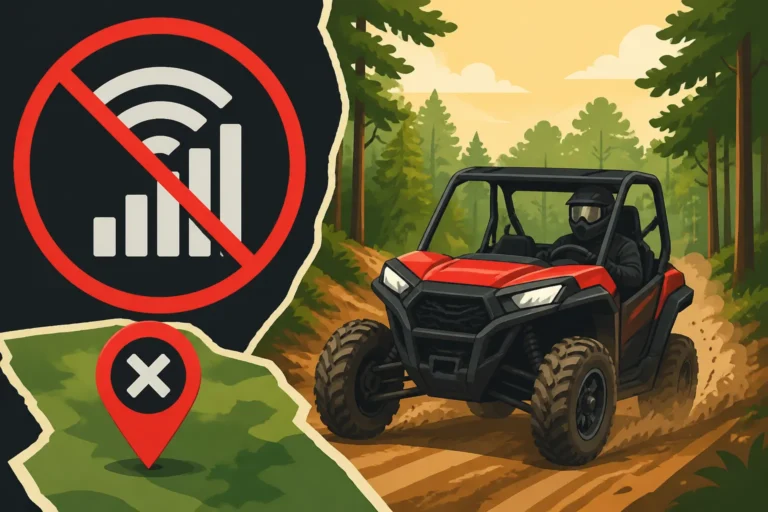
A route-planning app such as onX Offroad can be useful for keeping your group oriented, especially when trails branch or cell service is unreliable. Download or review the information you need before leaving, and carry a paper map as a backup. Use onX Offroad to support your planning—not to decide that an unmarked trail is fair game. If you reach a closure, turn back rather than trusting a route line to lead you around it.
Prepare your group for a respectful ride
Set expectations before leaving home
A short conversation at the trailer can prevent confusion later. Tell everyone where you plan to ride, what the turnaround point is, and what to do if the group gets separated. Agree that no one will leave the designated route, follow a hunting dog, approach a hunter without a reason, or pass a stopped machine without checking that the way is clear.
Make sure every rider knows how to stop safely and how to use the machine’s controls. Young or inexperienced riders may need extra supervision, particularly on narrow roads where stopping distance and visibility matter. Review Mississippi Safety Courses Through Extension if you’re looking for structured ATV safety training, and check the rules that apply to your group and riding area before departing.
Pack a charged phone, water, basic first-aid supplies, and a way to navigate if cell service drops. Let someone who is not riding know where you’re headed and when you expect to return. If the group includes several machines, choose a meeting point at the trailhead or another safe, permitted location in case riders become separated.
Make turning around part of the plan
A good ride plan includes conditions that mean it’s time to stop. Turn around if you encounter a closure, cannot confirm that a route is open, meet heavy hunting activity on a narrow road, or find that rain has made the trail unsafe. It’s frustrating to unload, drive out, and then change plans, but that is better than forcing a route that puts riders, hunters, or machines at risk.
Don’t let the effort of getting there make the decision for you. If the trailhead is crowded with hunting vehicles, choose another legal riding area or reschedule. If you discover a closure partway through the ride, retrace your route rather than improvising. And if a disagreement arises over access, leave the area calmly and ask the managing office to explain the rule.
Good trail sharing is mostly a matter of preparation and patience: verify access, ride visibly and slowly, respect hunters’ space, and follow signs even when the detour is inconvenient. A little flexibility helps everyone use Mississippi’s woods more safely.
Disclaimer
This article is for general informational purposes only and does not constitute professional advice. Laws, prices and regulations vary by location and change over time. Consult a qualified professional for guidance on your specific situation.