Trailering Down to the De Soto National Forest
A trailer trip to the De Soto National Forest can go sideways before the tires hit dirt: a route may be closed, a machine may not fit a designated trail, or the unloading spot may be too small for a truck and trailer. This guide walks through planning, hauling, unloading, and checking trail access so you can arrive prepared rather than sorting out surprises at the forest gate.
Plan your De Soto National Forest ride before you hitch up
Confirm the riding area and its rules
The De Soto National Forest covers a broad part of southern Mississippi, so “going to De Soto” is not a precise destination. Decide which riding area or designated route you intend to use, then check the latest information from the relevant Forest Service office before loading. Forest roads, OHV routes, and other public roads do not all have the same rules, and a road that appears on a map is not automatically open to ATV or UTV riding.
This distinction matters when you are hauling from places such as Gulfport, Hattiesburg, or Wiggins. A route that looks like a short detour on a phone may end at a closed gate, a restricted road, or a location that does not permit the type of machine you brought. Confirm that motorized riding is allowed on the specific route, and ask about any seasonal restrictions, temporary closures, pass requirements, width limits, or vehicle-use designations that apply.
If you are still comparing destinations, Mississippi Coast and De Soto National Forest Riding and Mississippi National Forest Riding Explained can help you frame the trip. Before leaving home, check Checking Trail Conditions Before You Load the Trailer. Treat an app or downloaded map as a navigation aid, not as proof that a route is open. For example, onX Offroad can help you review route options ahead of time, but you should still confirm access and closures with the land manager.
Match your machine to the route and the trailer
A trail that accommodates a narrow ATV may not accommodate a wide side-by-side. Before you commit to a destination, compare your machine’s width with the posted or published route restrictions. Measure the widest point, including accessories that stick out, rather than relying on the model name or a rough guess. If the machine has oversized tires, wheel spacers, a snowplow mount, or other modifications, its actual width may differ from the factory specification.
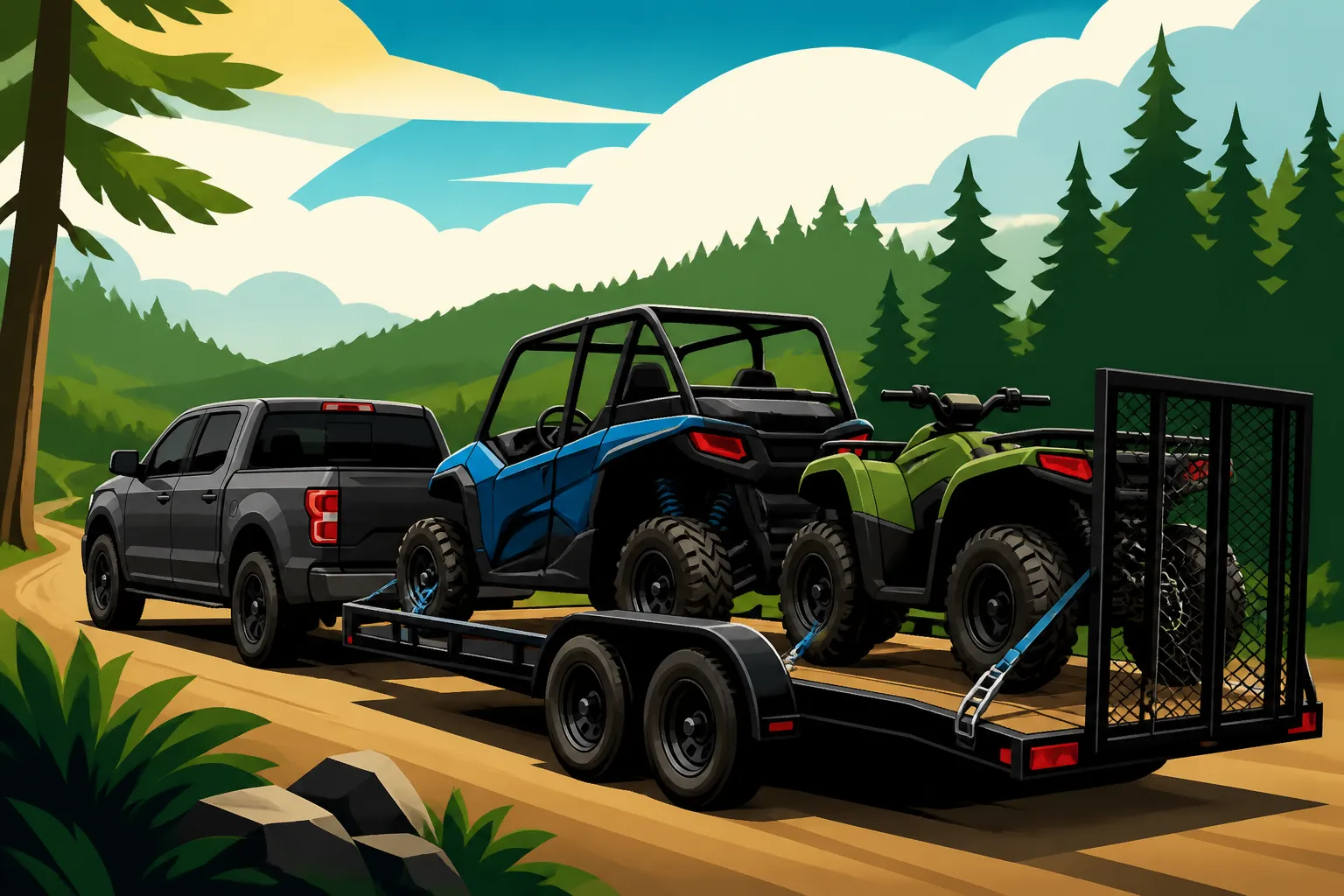
Also check your trailer’s usable deck length and width, tie-down points, ramp arrangement, and loaded capacity. A UTV with a roof, windshield, spare tire, and rear cargo box may need more room than the basic dimensions suggest. Leave enough space to position tie-downs without trapping straps against sharp edges or moving parts. If you are taking more than one machine, plan the layout before loading; a tight arrangement can make it difficult to secure one vehicle without loosening another.
| Check before departure | What to confirm | Why it matters |
|---|---|---|
| Route access | The specific route is open to motorized riding | A map line may not indicate current access |
| Machine fit | Width and vehicle type meet route restrictions | Narrow trails may exclude some UTVs |
| Trailer capacity | Loaded weight is within the trailer’s rating | Cargo, fuel, and accessories add weight |
| Parking and unloading | Space is suitable for a truck, trailer, and ramps | A narrow or soft shoulder can make unloading unsafe |
| Pass and paperwork | Any required pass, proof, or permit is ready | You may not be able to sort it out at the trail entrance |
| Weather and closures | Conditions and notices have been checked | Rain can make routes unsuitable or lead to closures |
For route width questions, see Mississippi Trails With Width Limits. Confirm the specific route’s rules rather than assuming that a machine accepted at one Mississippi riding area will be accepted everywhere.
Prepare the tow vehicle, trailer, and load
Inspect the trailer before the drive south
A trailer that behaved fine on a short local trip may reveal problems on a longer drive. Before departure, inspect the tires for visible damage and appropriate inflation, check that the wheel bearings and lights are in sound condition, and make sure the hitch and safety chains are properly connected. Confirm that the trailer brakes, if fitted, work as intended. Secure ramps so they cannot bounce loose, and stow the spare where it can be reached without unloading the machines.
Pay particular attention to the load as a whole. Heavy accessories and cargo can shift weight toward one end or one side of the trailer. Place machines so the trailer remains balanced and the tongue load is appropriate for the trailer and tow vehicle. If you are unsure about the setup, consult the trailer and vehicle manufacturers’ guidance or a qualified trailer professional. A trailer that sways, leans, or feels unstable is a reason to stop and reassess, not something to push through because the destination is close.
Make a quick inventory before leaving: tie-down straps, ramp hardware, tire tools, spare parts you routinely carry, a first-aid kit, drinking water, and a way to communicate if cell coverage drops. Keep essential items accessible instead of buried beneath coolers and riding gear. For riders headed into more remote portions of the forest, Cell Dead Zones in De Soto National Forest is a useful reminder to plan for limited service.
Secure each ATV or UTV with care
Load on firm, level ground whenever possible. Set the parking brake, use a spotter if you have one, and keep bystanders clear of the ramp path. Ramps should be properly attached to the trailer and positioned to suit the machine’s wheel spacing. If the ramp surface is wet, muddy, or unstable, pause and improve the setup before driving onto it. Walking a machine up under power is not a good substitute for a secure ramp and a controlled loading plan.
Once each machine is in place, use suitable tie-down points and straps in good condition. Secure the vehicle so it cannot roll, bounce, or shift forward and backward during braking or turns. Avoid attaching straps to components that can bend, rotate, or break, and do not route them where they can rub against hot, sharp, or moving parts. After tightening, press or rock the machine gently to check for movement. Recheck the straps after the first part of the drive and again at fuel or rest stops.
Secure loose gear separately. A riding pack, fuel container, recovery gear, or cooler that comes free can become a hazard on the road. Keep fuel containers upright, closed, and stored in a suitable position away from heat and sparks. If you carry a winch, jack, or heavy tool, fasten it so it cannot slide into a machine or fall from the trailer.
Arrive, park, and unload without rushing
Choose a safe place to stage
Do not assume the first wide spot beside a forest road is an appropriate unloading area. Look for a designated trailhead or an established parking and staging area, and follow posted signs. A shoulder that seems roomy when empty may be soft, sloped, or too narrow to allow a truck and trailer to maneuver safely. Avoid blocking a gate, road, driveway, emergency access, or space needed by other visitors.
Before turning into a narrow access road, consider the full length of your rig. A long trailer can be difficult to turn around in a tight space, and backing into a crowded area can put other visitors at risk. If you cannot confirm that the access road and parking area suit your setup, contact the appropriate forest office before making the drive. Ask specifically about trailer parking, turning room, and where unloading is allowed; “there is a trailhead” does not necessarily mean there is room for a large rig.
Keep the staging area orderly. Park so other vehicles can enter and leave, keep ramps and gear out of travel lanes, and avoid leaving a machine unattended while it blocks access. On a busy day, coordinate with your riding group before anyone begins unloading. One person can guide the tow vehicle while another watches the trailer clearance and nearby pedestrians.
Make unloading a deliberate process
Set the tow vehicle and trailer on stable, level ground, apply the parking brake, and make sure the trailer cannot roll. Attach the ramps securely and check that they sit evenly. Keep people out of the machine’s path and do not stand directly behind it. If conditions have changed since you loaded—rain, loose gravel, mud, or a sloped surface—take time to reposition before unloading.
Unload one machine at a time and move it clear of the trailer before taking down another, when space allows. Keep keys and controls with the person operating the machine, and make sure everyone understands where to stand. Avoid trying to steer a vehicle down a ramp while also handling loose gear or talking someone else through the process. A calm, repeatable routine is safer than trying to save a few minutes.
Before riding away, stow the ramps, straps, and tools so they cannot be left behind or scattered. Put any required pass or documentation where you can retrieve it if asked, and review the day’s route with the group. Carrying a Paper Map in a Southern Forest offers a practical backup idea: downloaded maps and paper navigation can help when phone service or battery life becomes an issue. onX Offroad may also be useful for reviewing your planned route, but do not rely on a phone map alone where reception is uncertain.
Ride responsibly and make the return trip easier
Recheck conditions and adapt your plan
Southern weather can change the character of a ride quickly. Heavy rain may leave low spots, sandy sections, and forest roads difficult to navigate; it can also prompt temporary restrictions or closures. Check conditions before leaving home and again before you unload. If a road is posted closed, blocked, or otherwise restricted, do not go around the barrier. Choose an open route or call it a day.
Carry enough water for the conditions, protect yourself from sun and insects, and bring basic first-aid supplies. In warm, humid weather, riders can underestimate how quickly heat and exertion add up, especially while wearing a helmet and protective gear. Take breaks, watch your group for signs of overheating, and avoid pressing on just to reach a planned destination. If a machine gets stuck or develops a problem, keep the group together and use recovery equipment only when everyone understands how to do so safely.
Stay on routes where riding is allowed, obey signs, and yield appropriately to other forest users. Do not assume that an unmarked track, pipeline cut, or timber road is open to public motorized use. Mississippi Trail Etiquette Locals Expect is a helpful companion for thinking about how to share a riding area without damaging the route or creating unnecessary conflict. For wet-weather planning, review Mississippi Trail Conditions After Rain.
Secure the machines before heading home
Before loading, inspect each machine for mud, branches, or debris caught around the wheels, suspension, radiator, or underbody. Remove loose material where practical, and check for obvious damage or leaks. A quick walk-around can catch a damaged strap point, a low tire, or a problem that is easier to handle at the staging area than during the drive home.
Load with the same care you used before the ride. Clear the ramps, keep people away from the loading path, and use a spotter when visibility is limited. Secure machines and loose gear, then check lights and connections before pulling out. After driving a short distance, stop somewhere safe and recheck the tie-downs. Mud, vibration, and the movement of a loaded trailer can reveal looseness that was not obvious at the trailhead.
Leave the staging area clean. Take back straps, packaging, food wrappers, broken parts, and any other items your group brought in. If conditions or access have changed during the day, note that for your next trip and confirm current information again before returning. A little preparation makes it much less likely that a good ride ends with a preventable trailer problem or a long, frustrating search for an open route.
Disclaimer
This article is for general informational purposes only and does not constitute professional advice. Laws, prices and regulations vary by location and change over time. Consult a qualified professional for guidance on your specific situation.