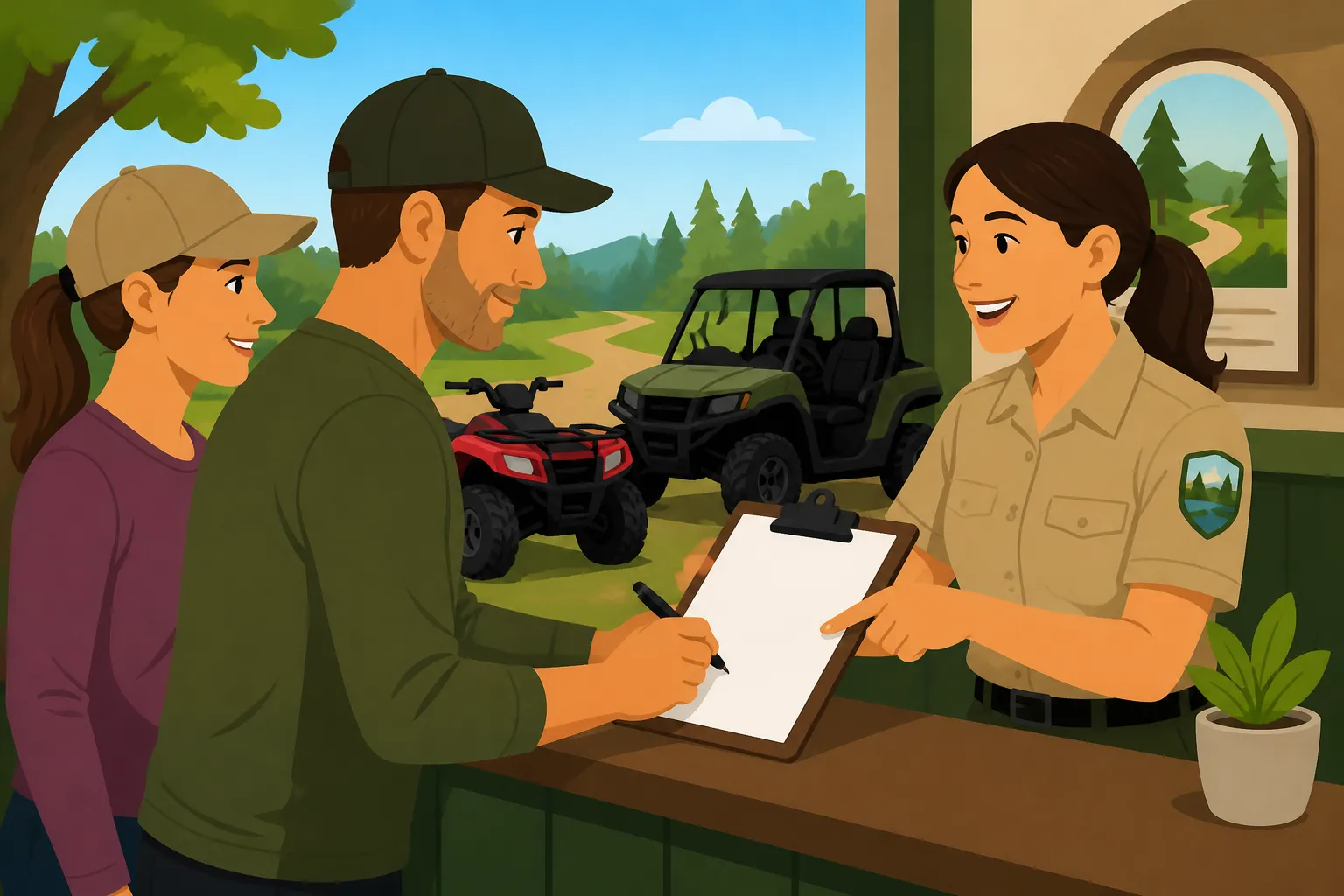
Signing a Liability Waiver at a State Park Office
A state park liability waiver can feel like routine paperwork, but signing it does not automatically authorize ATV or UTV access. Before you unload, confirm that the park allows your machine, find out who must sign, and ask what else the office needs. These steps help prevent a waiver, pass, or safety document from being mistaken for permission to ride.
What a State Park Waiver Does—and Does Not Do
A liability waiver is a document a park may require before allowing participation in a recreational activity. It typically asks a rider, and sometimes a parent or guardian, to acknowledge risks and accept stated responsibilities. Read the actual form: its terms, scope, and signing instructions matter more than assumptions about what a waiver usually says.
A waiver is not the same thing as an ATV permit, an access pass, or approval to ride on a particular trail. Signing one does not turn a closed route into an open route, make an ATV legal on a public road, or override a park’s machine, age, helmet, or passenger rules. Access depends on the rules for the particular park and riding area.
That distinction is important in Mississippi, where park rules and available riding opportunities may vary. Start by checking Which Mississippi State Parks Allow Machines before planning a trip. Confirm directly with the park that the activity and machine you have in mind are allowed on the date you plan to visit. A waiver cannot make an otherwise prohibited machine or use acceptable.
| Document or requirement | What it may address | What it does not establish by itself |
|---|---|---|
| Liability waiver | Acknowledgment of risks and agreement to stated terms | Permission to ride anywhere in the park |
| Park pass or fee receipt | Payment or access for a defined visit or area | That your machine meets park rules |
| Safety certificate | A rider’s completion of an accepted safety course, if required | That the rider has permission to enter a closed area |
| Proof of identity or age | Confirmation of who is checking in and whether age rules apply | A waiver signed by the appropriate person |
| Proof of ownership | Information about the machine, if requested | A right to ride on public or private land |
Treat the waiver as one part of check-in, not as a substitute for the rest of the park’s requirements. If you are unsure which paperwork applies, ask the park office before driving there. For questions about permits and access documents more broadly, see Mississippi Permit Questions Riders Ask.
Before You Go to the Office
A little preparation can save time at the gate and prevent confusion about who needs to sign. Call or otherwise contact the specific park before your visit, especially if you are bringing a child, a passenger, several machines, or a machine that may not fit the park’s usual categories.
Ask direct questions rather than relying on a general description of “ATV access.” State the type of machine you plan to bring, how many riders are in your group, and whether children will ride. A side-by-side and a single-rider quad may be treated differently under a park’s access or operating rules. Confirm whether the park allows your particular machine and where it may be operated.
Confirm what the park wants from each rider
Ask whether the waiver is required for every rider, only the person operating the machine, or both operators and passengers. Find out whether one waiver covers a visit or whether the park has a different process for repeat visits. Do not assume that a family member can sign for another adult or that a group leader can complete forms for everyone.
If minors are coming, ask whether a parent or legal guardian must sign in person. Also check what identification, age evidence, or safety-course documentation may be needed. The park’s instructions are the reliable source for its check-in process; a waiver signed by the wrong person may not satisfy the requirement.
For related preparation, Mississippi State Park Age Proof explains why it is worth confirming age documentation before you arrive. If a young rider may need a certificate, check the park’s accepted documents and requirements ahead of time rather than assuming any course card will qualify. You can review broader information in Mississippi Safety Certificates for Young Riders, but confirm the specific park’s instructions.
Ask how the waiver is handled
A park office may have a form available at check-in, or it may direct visitors to complete paperwork another way. Ask whether each rider needs an individual form, whether forms can be completed before arrival, and whether the park keeps signed waivers on file. Do not rely on a previously signed waiver unless the park confirms it is still valid for your visit and activity.
The park may ask to see identification or other documents while processing the waiver. Keep originals or acceptable copies available as instructed, and do not assume that a photo on a phone will be accepted. If the park asks for a signature at the office, allow time for the whole group to complete the process before unloading or riding.
Use Mississippi State Park Waiver Steps as a checklist for the questions to settle in advance, then verify current directions with the park itself. For a wider explanation of how park waivers fit into riding requirements, see Mississippi State Park Liability Waivers.
Signing at the Park Office
When you reach the office, follow the staff’s instructions and read the form before signing. If a statement is unclear, ask what it means in the context of your visit. Do not sign a blank form, skip sections without asking, or assume that the waiver is identical to one you signed at another park.
Check names and details before handing in the paperwork. Make sure the person signing is the person identified on the form, and confirm whether the form needs to list each rider, machine, or activity. If there is a place to identify the visit or riding area, enter accurate information. Ask staff to correct an error rather than trying to make an unclear alteration yourself.
If a child is included, the parent or guardian should follow the park’s stated process. A relative, family friend, or group organizer should not assume they can sign on a parent’s behalf. When custody or guardianship arrangements affect who may sign, contact the park beforehand and ask what documentation it accepts.
Before leaving the desk, clarify what happens next. The office may keep the form, provide a copy, issue a wristband or other check-in marker, or direct you to another station. These details can differ, so ask rather than expecting a particular system. If the park retains the waiver, ask whether you can receive a copy or confirmation for your records.
A signed waiver also does not replace operational rules. Before riding, make sure you understand where machines are allowed, how passengers are handled, and what equipment is required. Review Mississippi State Park Helmet Requirements and Mississippi State Park Passenger Rules if those issues apply to your group, then confirm the specific park’s current rules.
If staff say the park cannot accept your machine or paperwork, pause and ask what requirement is missing. Do not ride on the assumption that a signed waiver, a receipt, or a verbal conversation grants an exception. If access is denied, get clarification from the office or the appropriate park contact before deciding what to do.
After Check-In: Keep the Paperwork in Perspective
Once the waiver is signed, keep any copy or check-in record with your other trip documents. If the park retains the form, make a note of the date, park, and who in your group signed. This is especially useful when several riders are checking in or when you return on another visit. A record can help you remember what the staff instructed, but it is not proof that rules have stayed the same or that the waiver covers a later trip.
If your group changes after check-in, ask the office what to do. A new rider, substitute driver, or added passenger may need separate paperwork or approval. Likewise, do not assume that a waiver for one activity applies to another activity at the same park. Confirm the scope with staff before changing plans.
Pay attention to any limits explained at check-in. A waiver may address risk and responsibility, while separate park rules govern where and how you ride. Follow signs, staff directions, and closures even if you have already signed. If the route or area you planned to use is unavailable, ask which alternatives are permitted rather than treating the waiver as general park access.
If an incident occurs, report it as the park directs and give accurate information. Keep a copy of any report or follow-up instructions you receive. The waiver is not a replacement for the park’s incident-reporting process; see Mississippi State Park Incident Reporting for related information. If a question arises about what you signed or what a clause means, keep the form and consult a qualified professional rather than relying on a casual interpretation.
For a straightforward visit, use this sequence:
- Confirm the park allows the machine and planned riding activity.
- Ask which riders must sign and whether a parent or guardian must be present for minors.
- Confirm any identification, age, safety-course, pass, or ownership documents the park requires.
- Read the waiver carefully at the office and ask about unclear terms.
- Make sure every required rider has completed the process before riding.
- Keep any copy or check-in record and follow all posted limits afterward.
The main point is simple: sign the waiver only after understanding the form and completing the park’s check-in instructions, but treat riding permission as a separate question. Confirming both before you unload is the practical way to avoid a wasted trip or an accidental rule violation.
Disclaimer
This article is for general informational purposes only and does not constitute professional advice. Laws, prices and regulations vary by location and change over time. Consult a qualified professional for guidance on your specific situation.