Mississippi Proof of Ownership on the Trail
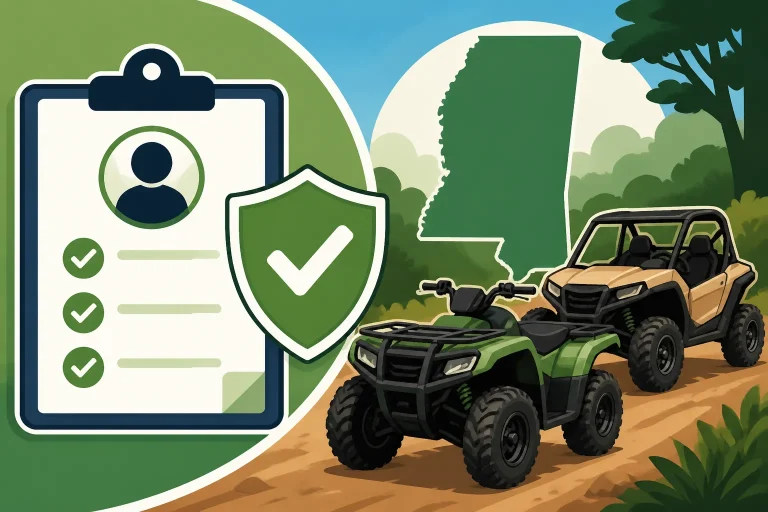
A title, bill of sale, or other ownership record can help show that an ATV or UTV is yours, but it does not automatically grant access to a Mississippi trail. What to carry depends on where you ride, who manages the land, and whether that place has its own pass or entry rules.
Proof of ownership is not a trail permit
Proof of ownership answers one question: who owns the machine? A title is the clearest ownership record when the ATV or UTV is required to have one. For a machine without a title, a bill of sale, manufacturer’s certificate of origin, or other purchase records may help explain how you acquired it.
A permit or trail pass answers a different question: are you allowed to ride at this location? Mississippi does not generally register ATVs in the way states register road vehicles, and owning a machine does not give you permission to use public or private land. A forest pass, park waiver, landowner permission, or other site-specific requirement may still apply.
That distinction matters during a stop. An officer, ranger, or land manager may want to establish who you are, whether you have permission to be there, and whether the machine meets the location’s rules. A title can help with ownership, but it does not replace your driver’s license, a required pass, or permission to ride.
Mississippi’s trail-access rules depend on the land manager. For example, national forest riding has its own pass and operating requirements; Wildlife Management Areas generally limit machine use to designated roads and applicable rules; and private riding parks set their own entry conditions. Start with the rules for the exact place you plan to ride. Mississippi National Forest OHV Passes explains the forest pass distinction, while Mississippi WMA Rules for Riders covers a different kind of public land.
| Item | What it helps establish | What it does not do |
|---|---|---|
| Title | Ownership and the machine’s recorded identity | Authorize riding on a trail or public road |
| Bill of sale | A purchase or transfer between people | Replace a required trail pass or landowner permission |
| Manufacturer’s certificate of origin | Original dealer or manufacturer paperwork | Serve as a general riding permit |
| Trail pass or entry receipt | Compliance with a specific location’s entry system | Prove ownership by itself |
| Driver’s license or required safety certificate | Rider identity or qualification, where required | Prove that the rider owns the machine |
| Written landowner permission | Permission to use the identified property, subject to its terms | Override public-land rules or local restrictions |
Mississippi’s lack of a general ATV registration system also means there may be no state registration card that functions as universal proof for every ride. That is different from having no paperwork at all. Keep available documents that fit your machine and destination, and check the rules before assuming a document accepted at one property will be accepted at another. For background, see Mississippi Has No OHV Registration to Reciprocate.
What to carry for different riding locations
There is no single paperwork bundle that suits every Mississippi ride. Carry the documents required by the property, plus enough information to identify yourself and the machine if questions come up.
National forest trails
Before riding a national forest trail, confirm that the route is open to your type of machine and that you have the required pass. Keep the pass, receipt, or other proof of purchase accessible in the form accepted by the managing office. A title does not replace a forest pass, and a pass does not prove ownership.
You may also need to meet rider-related requirements, such as having the appropriate license or safety documentation. Requirements can depend on the rider’s age and the specific area. Do not assume that carrying a title settles those questions. Check the current rules for the forest district and trail system you plan to visit. Your Driver’s License Is the Permit on Mississippi Trails discusses the distinction between rider credentials and vehicle paperwork.
Wildlife Management Areas
Wildlife Management Areas have their own access rules. A machine’s ownership records do not establish that a particular road is open to ATV use, or that riding is allowed at a particular time. Check the area’s current rules, signs, gates, and closures before entering. Keep any required hunting or access documents with you if the activity calls for them.
A paper map or saved copy of the relevant rules can help when cell service is weak, but it does not replace posted restrictions. A closed gate, berm, or sign should be treated as a boundary, not an invitation to find another way through.
State parks and private riding parks
State parks and private parks can require riders to complete waivers, show identification, meet equipment or age rules, or follow a park-specific check-in process. Some facilities may want ownership information if there is a safety incident, dispute, or question about a machine. Others may focus on the waiver, admission, and site rules.
Before leaving home, ask the park what it expects riders to bring and whether a phone image or photocopy is acceptable. See Mississippi State Park Waiver Requirements and Mississippi Private Park Waivers and Rules for the difference between park entry paperwork and ownership records.
Private land
On private property, permission is central. If you are riding on land you do not own, get permission from the owner or an authorized manager before entering. A text or written note can help clarify who gave permission, which property it covers, and whether the permission has limits, such as certain dates, routes, or machines.
A bill of sale or title does not grant access to another person’s land. Nor does a prior invitation necessarily cover a new visit or a different parcel. If the property is managed by a hunting club, timber company, or leaseholder, check who has authority to approve riding.
How to prepare ownership documents before a ride
A few practical steps can prevent a paperwork question from becoming a long delay. They are especially useful when buying a used machine, borrowing one, or riding somewhere far from home.
- Identify the machine. Record the VIN or serial number, make, model, and other identifying details. Confirm that the number on the machine matches the paperwork when possible. If the number is hard to read, resolve that before relying on the machine for a trip.
- Gather the best ownership record available. Use the title if the machine has one. If it does not, keep the bill of sale, manufacturer’s certificate of origin, dealer paperwork, or other documents showing the transfer or purchase.
- Check the trail’s requirements separately. Confirm pass, permit, waiver, age, equipment, and route rules with the land manager. Ask which proof must be carried and whether it needs to be displayed or simply available.
- Make a secure backup. Keep a clear digital image of relevant documents on your phone, and consider a paper copy in a waterproof pouch. A small document pouch sold through retailers such as Amazon can help keep copies dry, but do not leave sensitive originals exposed in a machine.
- Carry documents in a way you can access safely. Store papers where they will not be soaked, covered in mud, or lost during a rollover. Do not ride while trying to use a phone or search through loose paperwork.
- Review the paperwork before buying or borrowing. Make sure the seller’s name and transfer documents make sense, and get written permission from the owner if you are riding someone else’s machine.
For a newly purchased machine, paperwork may include a manufacturer’s certificate of origin or dealer documents rather than a state title, depending on the machine and applicable title rules. Mississippi’s title requirements have changed for some machines, so confirm what applies to the specific ATV or UTV and its manufacture date. The title process is separate from trail access; Mississippi Title Requirements for 2026 is a useful starting point for title questions.
For a used purchase, keep the bill of sale and a copy of any transfer documents. A bill of sale is more useful when it identifies the buyer and seller, describes the machine, includes its VIN or serial number, states the sale date, and records the agreed transaction. It should not be treated as a substitute for a title when a title is required. For more detail, see What Your Bill of Sale Must Show and Buying From a Private Seller in Mississippi.
What to do if someone asks for proof
Stay calm and ask what the person needs to verify. A ranger or park employee may be checking a pass or entry condition, while law enforcement may be asking about your identity, the machine, or your right to be on the property. Showing an ownership document can answer some questions, but it may not address the reason for the stop.
A practical response is to:
- Provide identification and the site-specific pass or entry record requested.
- Show the title or purchase paperwork if ownership is in question.
- Point out the machine’s VIN or serial number if asked, without altering or removing anything.
- Explain whether the machine belongs to you, is borrowed, or is part of a group.
- Avoid arguing that a title gives you permission to ride on a road, trail, or parcel.
- Ask how to verify the applicable rule if the request is unclear, and follow lawful directions while resolving it.
If you are riding a borrowed or shared machine, make sure the owner can be reached and that the land manager permits that arrangement. A friend’s title may show who owns the machine, but it does not necessarily show that you have permission to use it or take it onto a particular property.
If a title is being processed, a bill of sale or dealer paperwork may help explain the machine’s status, but do not assume every officer or property manager will accept the same substitute. Ask the relevant office before the ride. The same caution applies to photographs of documents: digital copies are convenient backups, but a site may require a particular pass, original document, or check-in procedure.
One final point: paperwork does not make an otherwise prohibited ride legal. A title, pass, or permission letter cannot override a road restriction, a closed trail, a landowner’s limit, or a machine-width rule. Check both the riding rules and the documents required for the destination. Why a Title Does Not Open Any Roads explains why ownership and road access are separate questions.
Disclaimer
This article is for general informational purposes only and does not constitute professional advice. Laws, prices and regulations vary by location and change over time. Consult a qualified professional for guidance on your specific situation.