Mississippi WMA Road Riding
Riding an ATV or UTV on a Mississippi Wildlife Management Area can be confusing: a visible dirt road is not automatically open to machines, and access may change with gates, signs, hunting seasons, or area-specific rules. This guide explains how to check where you can ride, what to confirm before unloading, and how to avoid mistakes that can spoil a day outdoors—or lead to a citation.
What WMA road riding means in Mississippi
A road on a WMA is not automatically an ATV route
A Wildlife Management Area, or WMA, is managed for wildlife and public recreation under rules that can differ from one property to another. Some areas have roads used for management, access, or hunting, but that does not mean every road is open to ATV and UTV traffic. A track visible on a map, a worn path, or a road another rider used last year is not proof that you may ride it now.
The safest starting point is to treat access as limited to roads specifically designated and open for the kind of machine you plan to use. Look for current signs and official area information, and pay attention to gates, barriers, and posted notices. A road that appears passable may still be closed to motorized traffic, reserved for authorized vehicles, or subject to a seasonal restriction.
This distinction matters because riding a WMA is not the same as exploring private timberland or using a dedicated off-highway vehicle park. The land’s public status does not create unrestricted motorized access. Before planning a route, review [Mississippi WMA Riding Rules] and the rules for the particular area you intend to visit.
WMA roads are different from public streets
A designated WMA road is not necessarily a public road where an ATV or UTV may travel as though it were on a county street. WMA access rules govern the land and its roads, while state and local road laws govern public-road use. A route that begins at a WMA entrance does not give you permission to ride on a nearby highway, road shoulder, or town street.
Plan your route so you can unload at an authorized access point and remain within the area’s permitted riding network. If a public road separates two parts of a route, do not assume you can cross or ride along it just because it would be convenient. Check the applicable road rules before you go, including [Mississippi Bans ATVs on Public Roads].
It also helps to separate “getting to the WMA” from “riding inside the WMA.” Your trailer route, the place where you park, the road you use to enter, and the roads you ride after unloading may all be subject to different requirements. If you are unsure whether a connection is allowed, ask the area office or managing agency rather than relying on a line drawn in a mapping app.
Access can change during the year
A road open during one visit may be closed on another. Management work, weather damage, hunting activity, fire danger, or other operational needs can affect access. A gate that was open on your last trip is not a promise that it will be open again, and a route shown in an older guide may no longer be available.
Seasonal changes can be especially easy to overlook when riders plan around familiar hunting or camping dates. An area may have different rules during a particular season, or certain roads may close temporarily to protect the land or manage access. Before every ride, check the current area-specific notices and look for new signs when you arrive.
Build flexibility into your plan. If the first road you intended to use is closed, do not ride around the barrier or make a new route through the woods. Have a legal alternate plan, or be ready to unload somewhere else only if that location is also authorized. For broader context about access and area restrictions, see [Mississippi WMA Access for a Quad].
How to check whether a WMA road is open
Start with the specific area, not a general map
First identify the exact WMA you plan to visit. Then look for that area’s official rules, maps, access notices, and contact information. General state-level guidance is useful for understanding the basic approach, but the details that affect your ride may be specific to the property: which roads are open, what vehicle types are allowed, where parking is permitted, and whether access changes during certain activities.
Read the map legend carefully. A line on a map might show a road, boundary, trail, or feature without indicating that it is open to ATV or UTV traffic. Pay attention to symbols, notes, dates, and limitations printed on the map. If the map is undated or unclear, contact the area office or the agency responsible for that property.
Digital tools can help with planning, but they should not be treated as permission. For example, onX Offroad may help you review terrain and organize a route, but a route line in an app does not override a closure sign or official WMA rule. Compare any digital map with current official information before you load the machine.
Confirm the vehicle rules, not just road access
A road may be open to some kinds of traffic without being open to every ATV or UTV. Check whether the rule distinguishes among ATVs, side-by-sides, motorcycles, trucks, or authorized management vehicles. If your machine is wide, has a passenger seat, or carries equipment that changes its dimensions, make sure the road’s restrictions fit your actual vehicle.
Do not rely on a seller’s description, a social-media post, or another rider’s recollection to determine whether your machine qualifies. Riders may be talking about a different WMA, a different season, or a route that has since closed. If the rule uses a width, equipment, or access category that you do not understand, ask the managing office before arriving.
It is also worth checking whether a pass, permit, license, or other documentation applies to your planned activity. Requirements can depend on what you are doing, where you are going, and whether you are hunting, fishing, camping, or simply riding a permitted road. Keep the relevant documents accessible, and review [Mississippi WMA Designated Roads Only] alongside the area’s own information.
Use mapping apps as planning aids
Mapping apps can make it easier to compare road networks, estimate distances, and mark a meeting point. onX Offroad can be useful for organizing a route and keeping track of your planned path, particularly when you are coordinating with a group or navigating an unfamiliar area. Use it as a planning tool—not as a substitute for current WMA rules, signs, or official closure information.
Before leaving home, save the information you may need without a dependable cell signal. Download or otherwise prepare the map features available to you, note the WMA entrance and parking location, and agree on a turnaround point. A screenshot or saved map can help you orient yourself, but it does not establish that a road is legally open.
When you reach the property, compare your plan with the signs and conditions on the ground. If a sign conflicts with what your app shows, follow the posted restriction and do not continue until you have clarified the situation with the responsible office. For more on handling maps and route information in forest settings, see [How to Read a Forest Service Trail Map].
| What to check | Why it matters | Practical next step |
|---|---|---|
| WMA-specific map and rules | General guidance may not show a property’s road restrictions | Find information for the exact area you plan to visit |
| Road status and closures | A road can close temporarily or seasonally | Check notices before departure and signs at the entrance |
| Vehicle type and dimensions | Access may differ for ATVs, UTVs, and other vehicles | Confirm that your machine fits the stated rules |
| Parking and unloading | A legal route does not make every roadside a legal staging area | Use only an authorized parking or access location |
| Hunting or recreation activity | Additional rules may apply to the activity, season, or location | Review the relevant area and activity requirements |
| Cell coverage and navigation | Service may be unreliable in remote areas | Prepare an offline plan and share it with your group |
Rules to follow while riding
Stay on roads that are specifically open
Once you are on the WMA, remain on the roads that are designated and open for your machine. Do not create a shortcut around a muddy section, ride down a road closed by a gate, or follow tire tracks that lead away from the authorized route. A visible path may be an access road for managers, a closed route, or a path made by someone who was not allowed to ride there.
The temptation to detour is understandable. A narrow road may be rutted, a puddle may look harmless, or a group ahead may have taken a side track. But a detour can cause damage to vegetation and soil, disturb wildlife, or put riders into a restricted area. If the designated road is not passable, turn around rather than widening it or making a new route.
Stay alert for signs along the way, not only at the main entrance. Restrictions may begin at an intersection, gate, or boundary. If you are uncertain whether a road continues into an authorized riding area, stop somewhere safe and verify before proceeding. The key principle is simple: do not treat physical access as legal access.
Respect gates, barriers, and posted closures
A closed gate is a clear signal to stop, even if it is not locked. Do not open it to pass through, ride around it, or squeeze beside it unless the sign or responsible agency explicitly tells you to do so. The barrier may protect habitat, prevent damage, keep riders away from work crews, or mark a boundary where public machine access ends.
The same caution applies to earthen berms, cables, barricades, and signs stating that a route is closed. These controls are not invitations to find a different way through. Riding around them can damage land and may take you into a place where motorized travel is prohibited. If you believe a closure sign is outdated or incorrectly placed, contact the managing office instead of testing it on the trail.
Roads can also be closed for reasons that are not obvious from the cab or seat. A route may be unsafe after heavy rain, used by maintenance crews, or restricted during a sensitive period. When a closure forces you to change plans, make the conservative choice: turn back, use a confirmed alternative, or end the ride.
Avoid cross-country riding and damage to the land
WMA road riding should not become cross-country riding. Do not leave a designated road to explore a creek bank, field edge, wooded area, or open patch of ground. Even when the surface looks durable, riding off route can cause erosion, disturb wildlife, and create new tracks that other riders may mistake for an approved path.
Take particular care around wet ground. Mississippi’s red clay and sandy soils can change quickly after rain, and repeated tire traffic can deepen ruts or spread damage beyond the road. If a puddle or soft section looks difficult, do not assume that spinning the tires through it is harmless. Slow down, keep to the established road, and turn around if the route cannot be traveled without leaving it or damaging the surface.
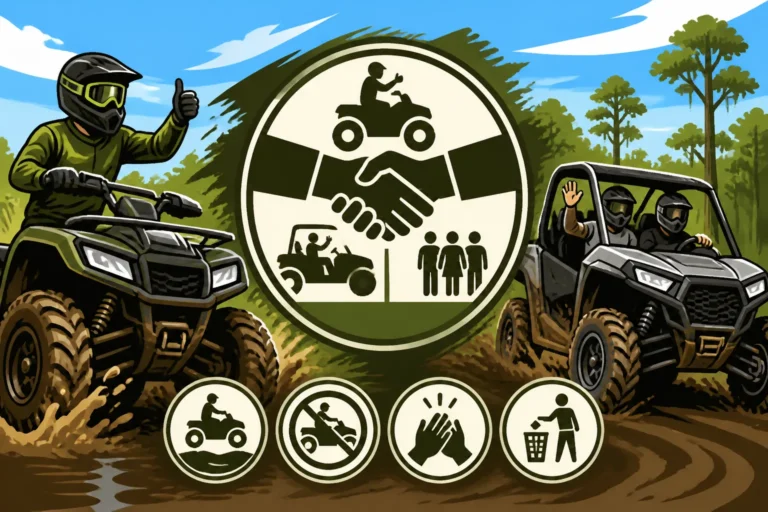
Good riding etiquette is part of protecting future access. Keep noise and speed appropriate for the conditions, give other visitors room, and leave gates as directed. Pack out trash and avoid disturbing wildlife or property. A WMA is a shared resource, and considerate behavior helps preserve the opportunity to visit.
Hunting seasons and other WMA activities
Hunting activity can change how you should plan
Many people visit WMAs for hunting, wildlife viewing, fishing, or other outdoor activities, so your ride may overlap with people who are focused on something other than trail recreation. A road that is open to permitted traffic may still be busy, narrow, or bordered by active hunting areas. Plan for slower travel and expect to meet people on foot or in vehicles.
Before riding during a hunting season, review the area’s rules for that season and activity. Do not assume that a road is available simply because you are not hunting. Some restrictions may apply to the property or particular roads regardless of your reason for visiting. If an access notice is unclear, call the managing office and ask how it affects non-hunting riders.
Wear visible clothing when appropriate, keep noise controlled, and avoid stopping where you block access or create confusion for other visitors. If you encounter hunters, give them room and do not ride toward a nearby group just to find out what they are doing. A little courtesy can prevent a tense encounter and make the area safer for everyone.
Do not assume a machine can be used for game retrieval
A rule allowing road travel does not automatically authorize riding off-road to retrieve game. Game retrieval rules can be specific about where a machine may travel, what roads may be used, and whether the activity is allowed in a particular area or season. Check the current WMA rules before using an ATV or UTV for that purpose.
This is an easy point to get wrong when a downed animal is out of sight from the road. The shortest route may cross a closed road, wet ground, or land where motorized travel is not permitted. Do not use a machine to cut across a field or woods unless the area’s rules clearly allow it. When in doubt, ask the area office about the specific retrieval situation.
Keep the general access rule in mind: authorization for one activity does not automatically grant permission for another. A rider may be allowed to travel on a designated road but still be restricted from leaving it, using the vehicle for retrieval, or entering a closed section. Read [Mississippi WMA Game Retrieval Rules] before relying on a machine for that purpose.
Pay attention to seasons, closures, and activity notices
WMA rules can change around hunting seasons and other scheduled activities. Road access may be limited to reduce conflicts, protect habitat, or support management work. A road that was quiet on a summer weekday might see different use during a busy hunting period, and an access point could have new instructions posted when you arrive.
Check dates and details rather than relying on a broad label such as “open season.” Look for the specific WMA, relevant dates, road names or boundaries, and any instructions about vehicle use. If notices are posted at an entrance or intersection, read them before continuing. A small change in wording can make a difference to where you may ride.
For an additional overview of restrictions that can affect access, see [Mississippi WMA Road Closure Signs]. Treat all closures as applying until the managing agency clarifies otherwise. If the information available to you is incomplete, postponing the ride is safer than guessing.
Planning a safe and comfortable ride
Prepare for remote conditions before you leave
Some WMA roads are remote, and cell service may be weak or unavailable. Do not make your entire plan depend on a phone map, live messaging, or being able to call for help. Tell someone where you plan to ride, when you expect to return, and whom to contact if you do not check in.
Bring water, basic first-aid supplies, a charged phone, and whatever repair items are sensible for your machine and route. Make sure your tires, lights, fuel, brakes, and steering are in good condition before leaving the staging area. A short road ride can still become a long walk if a tire goes flat or a machine will not restart.
Keep the route manageable for the least experienced rider in your group. If a road is rough or conditions are wet, do not let a faster rider set a pace that pressures everyone else to follow. Agree on regrouping points and a plan for turning back if weather, road conditions, or access changes make the route unsuitable.
Ride for the surface and the people around you
Road conditions can vary from firm gravel to loose sand, standing water, or deeply rutted clay. Reduce speed when visibility is limited, especially near bends, intersections, gates, and areas where pedestrians may be present. A road that feels easy in a truck can behave differently under an ATV or UTV’s tires.
Maintain enough space to stop safely, and avoid following another machine so closely that dust blocks your view. Slow down when you meet another visitor and pass only when it is safe and permitted. On narrow roads, be prepared to stop and let the other person move through rather than forcing a tight pass.
Protect your hearing, eyes, and skin from the conditions you will encounter. A helmet and appropriate protective gear are sensible choices even when a particular rule does not require them for every rider. In warm weather, take breaks and drink water regularly. In rain or after a storm, reconsider the route rather than assuming that four-wheel drive or aggressive tires make every road safe.
Make a group plan that accounts for access limits
Before unloading, tell everyone in the group which roads are confirmed open and what to do if the group becomes separated. Choose a lead rider and a sweep rider, and agree that nobody will take an unplanned side road. This prevents the common problem where one person follows a map line while the rest of the group assumes it is authorized.
If you are riding with people who have different machines, check that each vehicle meets the area’s requirements. A wide side-by-side may have different access constraints from a narrow ATV. Do not assume that a route suitable for one machine is suitable for the entire group.
A useful plan includes a clear turnaround point and an alternate route that has also been verified. If no legal alternative is available, agree that the group will return to the staging area together. Mapping tools, including onX Offroad, can help the group stay oriented, but the legal route still comes from current area rules and posted conditions.
Common mistakes that can lead to trouble
Treating a map line or tire track as permission
A line on a digital map can look like an official trail, and tire marks can make a route appear regularly used. Neither proves that the road is open to ATV or UTV traffic. Map data may show roads used by other vehicles, historic routes, private access, or features that are not intended for recreational riding.
This mistake is especially likely when riders are in an unfamiliar area and want to extend a short outing. One person sees a track leading toward a scenic spot, another says “people ride there,” and the group follows it without checking. The safer move is to pause, compare the location with official area information, and stay on the confirmed road network.
Keep your navigation app in its proper role. onX Offroad can help you understand terrain and plan where to go, but it cannot grant access or cancel a posted closure. If the official information and the app do not match, follow the restriction and contact the agency for clarification.
Assuming a public WMA means unrestricted public riding
“Public land” does not mean “open for every use.” WMA access exists within rules intended to balance public recreation, wildlife management, and land protection. Some activities may be allowed only in particular locations, during certain periods, or under specific conditions.
A rider may also confuse access for walking, hunting, or driving a highway-legal vehicle with access for an ATV or UTV. Those are not necessarily the same. Confirm the vehicle and activity rules separately, and do not infer a permission from the fact that another type of visitor is present.
The same caution applies to property boundaries. A road may pass near private land, a timber tract, or another managed property. Do not cross a fence or boundary to continue a route unless you have confirmed that access is permitted. For a broader look at where WMA rules fit into the state’s riding framework, see [Mississippi Rules for Riding a Timber Road].
Riding around barriers or ignoring seasonal signs
Some riders see a closed gate and think the restriction is temporary, inconvenient, or intended for larger vehicles. Unless the posted instructions explicitly allow your use, do not go around it. The fact that another machine has left tracks beyond the barrier does not make the route open.
Seasonal notices can also be easy to miss when they are posted away from the main entrance. Look at signs at intersections and road approaches, and make a habit of stopping to read them. If you are traveling with a group, make sure the lead rider communicates the restriction before anyone turns onto the road.
If an access restriction interrupts your plan, do not improvise a route through the woods or across a field. Turn back and use only an alternative that you have confirmed. A cautious decision may feel disappointing in the moment, but it is far better than damaging the property or creating a problem with the managing agency.
A practical pre-ride checklist
Before you load the trailer
Start by choosing the exact WMA and finding its current rules and map. Confirm that the area allows the kind of riding you intend to do, identify roads open to your machine, and check for seasonal or temporary closures. If the map and written rules leave a question unanswered, call the managing office before making the drive.
Check your vehicle against any relevant limitations, and make sure you know where you can legally park and unload. Review what documentation or permits may apply to your visit. Save your route information for offline use, but remember that a saved map is a navigation aid, not proof of authorization.
Tell someone outside the riding group where you are going and when you expect to be back. Pack basic supplies and inspect the machine. If rain or recent storms have affected the area, check for updates and be prepared to cancel or choose a different lawful destination.
At the WMA entrance
Stop and read all signs before unloading or riding beyond the entrance. Confirm that the road you plan to use is open, that your machine is allowed, and that you are not entering a closed or restricted section. If the signs differ from the information you reviewed at home, follow the signs and seek clarification.
Look at the ground and weather conditions. A road that is technically open may be unsafe or too soft for your group. Avoid creating ruts or leaving the established roadway, and do not treat a barrier as something to work around. If there is no clear place to park or unload, do not block a gate or access road while you decide what to do.
Make sure every rider understands the route plan, turnaround point, and group expectations. Confirm who is leading and who is riding last. A two-minute conversation at the entrance can prevent a long, stressful search for a separated rider later.
During and after the ride
Stay on the confirmed roads and watch for new signs, people, and changing conditions. Stop if you reach an uncertain intersection or closure rather than following the most tempting track. Keep your group together, ride at a speed that allows everyone to react, and turn back if the road cannot be traveled without leaving it or causing damage.
At the end of the ride, account for every person and machine before leaving the area. Pack out trash and report hazards or confusing signs to the managing agency when appropriate. If you discover that a map or route note is out of date, update your own trip plan and avoid passing along the old information as though it were still reliable.
For a final check on what to carry and how to stay oriented, review [Mississippi Proof of Ownership on the Trail] and [Mississippi Trail Etiquette Locals Expect]. Keep the main rule in view: ride only where the current area rules and posted conditions allow.
Disclaimer
This article is for general informational purposes only and does not constitute professional advice. Laws, prices and regulations vary by location and change over time. Consult a qualified professional for guidance on your specific situation.