Mississippi ROV Weight Limit of 2,000 Pounds
Understanding the ins and outs of off-road vehicle classifications in Mississippi can feel like navigating a maze, especially when seemingly arbitrary numbers like weight limits pop up. Many riders get frustrated trying to figure out if their beloved side-by-side even qualifies as an ROV in the eyes of the law, which has a big impact on future titling and how you interact with your machine. This guide will cut through the confusion, explaining exactly what Mississippi's 2,000-pound dry weight limit means for your Recreational Off-Highway Vehicle (ROV) and why this specific number is so important for owners across the state.
Understanding Mississippi's ROV Definition and Why Weight Matters So Much
When you invest in a side-by-side or UTV, you're not just buying a fun machine; you're also inheriting a set of regulations and definitions that dictate how you can use and own it within Mississippi. The state's classification system is designed to differentiate between various types of off-road vehicles, and the 2,000-pound dry weight limit is a cornerstone of how a Recreational Off-Highway Vehicle (ROV) is officially identified. This isn't just bureaucratic jargon; it directly influences everything from whether your machine qualifies for a title to where you can legally ride.
The Core Definition of an ROV in Mississippi Law
In Mississippi, an ROV, often commonly referred to as a side-by-side or UTV, has a specific legal definition that sets it apart from other types of off-road vehicles, like traditional ATVs. Generally, an ROV is characterized by having four or more wheels, a steering wheel, non-straddle seating (meaning you sit in seats like a car, not straddling the engine), and foot pedals for acceleration and braking. These features are what most people picture when they think of a side-by-side used for hunting, trail riding, or farm work.
The state carves out different rules for these different machine types, and the weight limit is a crucial part of that separation. While ATVs are typically smaller and lighter, ROVs are generally larger and more robust. However, there's a point at which a machine becomes so large or heavy that it no longer fits the ROV designation and might be considered something else entirely, like a utility vehicle not subject to the same titling or usage rules. Understanding these [Mississippi ATV and ROV Legal Definitions] is the first step toward responsible ownership. Without clarity on these definitions, you might inadvertently misclassify your machine, leading to confusion down the road.
The Significance of the 2,000-Pound Dry Weight Limit
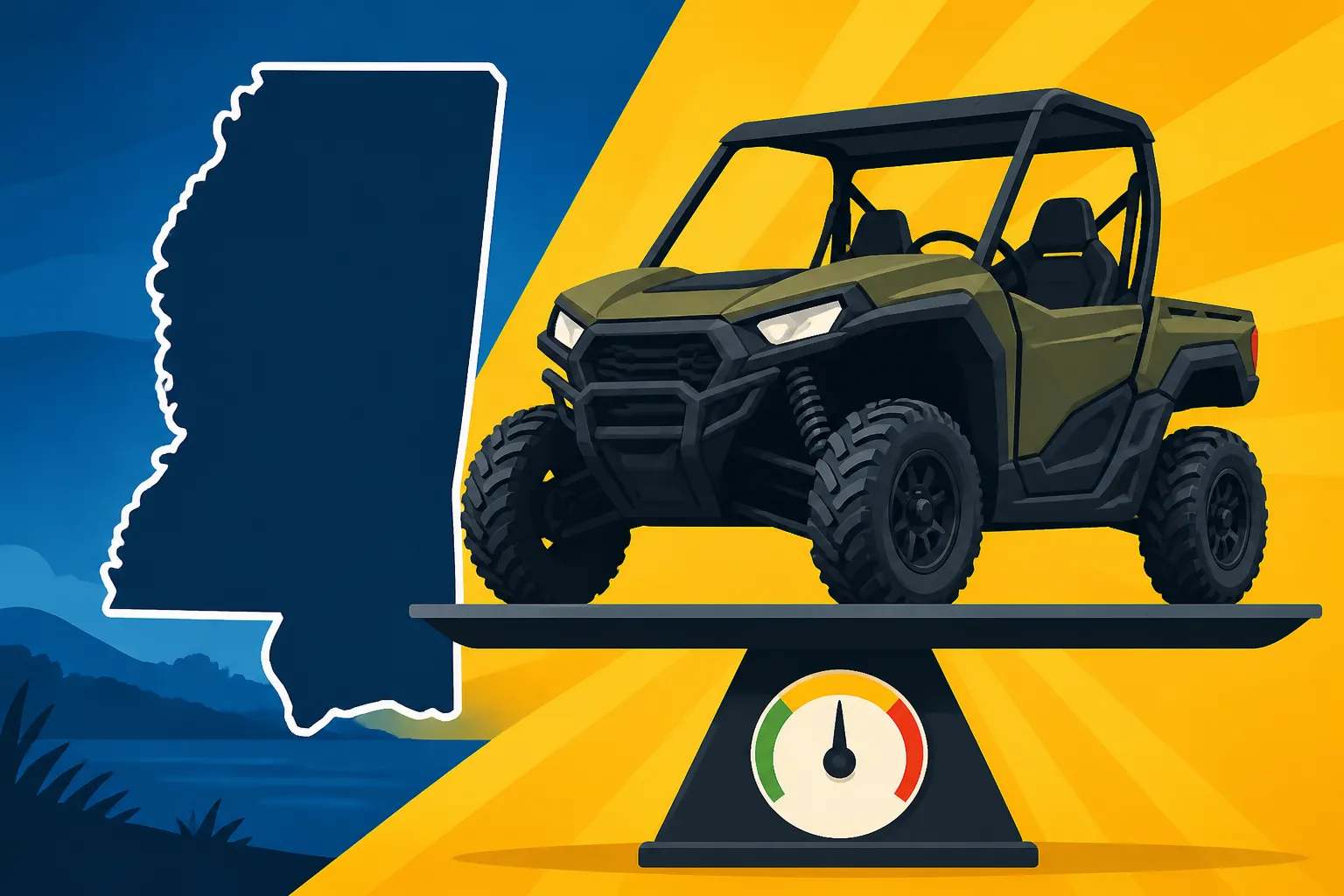
The 2,000-pound limit is specifically for the "dry weight" of your ROV. What exactly does "dry weight" mean in this context? It refers to the weight of the vehicle without any fuel, engine fluids (like oil or coolant), cargo, passengers, or accessories that weren't installed by the manufacturer at the factory. Essentially, it's the bare weight of the machine as it rolls off the assembly line. This distinction is vital because adding a full tank of gas, a cooler, tools, and a passenger or two can easily push your machine well over 2,000 pounds, but that doesn't change its dry weight classification.
So, why does this 2,000-pound dry weight limit exist? It's primarily for classification and regulatory purposes. This limit helps the state categorize vehicles for titling, insurance, and to some extent, even for safety guidelines. A machine that significantly exceeds this limit might present different safety profiles, require different manufacturing standards, or fall into a category of heavy equipment rather than a recreational off-highway vehicle. Even though ROVs are generally not street legal in Mississippi, this classification helps ensure consistency in how these machines are handled by various state agencies. If your machine's dry weight is above this threshold, it might not be considered a standard ROV by Mississippi law, which could complicate its titling process and how it's treated in official records.
How to Determine Your ROV's Dry Weight
Knowing your ROV's exact dry weight isn't just for trivia night; it's a practical necessity for Mississippi owners. Guessing or estimating can lead to problems later on, especially when dealing with titling or official paperwork. Fortunately, there are reliable ways to pinpoint this critical number, ensuring you're always operating within the state's definitions.
Checking Your Owner's Manual and Manufacturer Specifications
The absolute best place to start when trying to determine your ROV's dry weight is the owner's manual. Manufacturers include a wealth of technical specifications in these manuals, and dry weight is almost always among them. Look for a section titled "Specifications," "Technical Data," or "Dimensions and Weights." This information is typically found toward the back of the manual. The manufacturer's stated dry weight is the definitive figure for your specific model and year.
If you no longer have the physical manual (which is a common occurrence, let's be honest), don't despair! Most manufacturers make their owner's manuals and full specification sheets available online. A quick search on the manufacturer's official website, using your ROV's make, model, and year, should yield the exact data you need. It's crucial to ensure you're looking at the specifications for your specific trim level because sometimes optional accessories or different engine configurations can slightly alter the dry weight. Don't rely on generic online forums or secondhand information; go straight to the source to avoid any discrepancies.
Locating the Compliance Label on Your Machine
Another highly reliable source for your ROV's weight information is the compliance label, often found affixed directly to the machine itself. These labels, sometimes called VIN plates or data plates, are mandated by federal regulations and contain essential information about the vehicle, including its Vehicle Identification Number (VIN), Gross Vehicle Weight Rating (GVWR), and sometimes, the dry weight or curb weight.
You'll typically find these labels in a few common locations on an ROV. Check the frame, often near the front suspension, under the hood, or even on the inside of a door jamb if your side-by-side has doors. The label is usually a small metallic plate or a durable sticker. While the GVWR (which includes the maximum allowed weight of the vehicle, passengers, and cargo) is almost always present, you might need to look closely for the "dry weight" or "curb weight" figure. Remember, curb weight is slightly different, usually including a full tank of fuel and all standard fluids, but it can still give you a very close approximation if dry weight isn't explicitly listed. It's not uncommon for older machines to have faded or damaged labels, making them difficult to read. If you're struggling to find or decipher the label, your owner's manual or the manufacturer's website should be your next stop.
The Impact of the 2,000-Pound Limit on Titling and Ownership
The 2,000-pound dry weight limit isn't just a number to jot down; it has tangible consequences for how you own and officially recognize your ROV in Mississippi. Ignoring this detail can lead to headaches and delays when you're trying to get your machine properly documented. For many owners, the goal is to secure a title, and the weight classification directly impacts that process.
Titling Requirements for ROVs in Mississippi
Here's where the rubber meets the road: as of July 1, 2025, new ROVs manufactured on or after that date will generally be required to have a title in Mississippi. This is a significant change, and the state's definition of an ROV—including that critical 2,000-pound dry weight limit—will be central to whether your machine qualifies for a title under this new system. If your side-by-side falls within the ROV definition, including the weight and width limits, you'll proceed with the standard titling process. This typically involves submitting a Manufacturer's Certificate of Origin (MCO) for new machines or a [Mississippi Bill of Sale Must Show] for used ones, along with your application to the county tax collector.
However, if your "side-by-side" or UTV is heavier than the 2,000-pound dry weight limit, it might not be classified as a standard ROV under the new titling laws. This could mean a few things: either it falls into a different category of vehicle that isn't subject to ROV titling, or you might face additional hurdles because it deviates from the defined parameters. For instance, some larger, heavier utility machines might be viewed more like agricultural equipment or specialized industrial vehicles, which have different (or no) titling requirements. This specific limit ensures that the state isn't applying ROV titling procedures to machines that fundamentally differ in size and scope. So, understanding [Titling a Side-by-Side in Mississippi] means understanding its definition first.
Implications for Machines Exceeding the Weight Limit
What happens if your large, powerful side-by-side tips the scales at, say, 2,500 pounds dry weight? This is where things can get a bit more complicated. If your machine exceeds the 2,000-pound dry weight limit for an ROV, it technically doesn't fit Mississippi's legal definition of an ROV. This doesn't necessarily mean your machine is illegal, but it does mean it might not be covered by the specific ROV titling process set to begin for newer machines.
For such heavier machines, you might find yourself in a gray area where standard ROV titling doesn't apply, and there might not be a specific alternative titling process either. This can create challenges for proving ownership, especially if you ever need to sell it or claim it after theft. It might still be considered private property, but its legal classification could be less clear. This is why having accurate documentation for any off-road machine, regardless of its classification, is crucial. For any sale, particularly for machines that fall outside standard definitions, using a legal document service like LawDepot to create a comprehensive bill of sale can be incredibly helpful. It ensures all the unique specifications of your machine, including its actual weight, are clearly documented, which can prevent disputes or confusion later. This detailed approach provides an extra layer of protection, especially when dealing with machines that don't neatly fit into a state's defined categories.
Related Regulations and Considerations for ROVs
While the 2,000-pound dry weight limit is a primary definer for ROVs in Mississippi, it rarely stands alone. This figure is often paired with other physical dimensions and usage rules that collectively paint the full picture of what an ROV is and where it can legally go in the state. Understanding these interconnected regulations is essential for any responsible ROV owner.
The Width Limit Connection: 65 Inches for ROVs
Just as important as the weight limit for an ROV is its width. Mississippi law often defines an ROV not just by its dry weight but also by its maximum width, which is typically set at 65 inches. This means that a qualifying ROV must not exceed 2,000 pounds dry weight and must not be wider than 65 inches. These two dimensions, when considered together, create a comprehensive "envelope" that legally defines what an ROV is in Mississippi.
Why both a weight and a width limit? These parameters are generally set to manage the impact of these vehicles on trails, public lands, and potential interactions with other vehicles or infrastructure. A machine that exceeds either of these limits might be considered too large for certain trails, too wide for specific gates, or too heavy for particular bridges. For example, some trail systems, even in other states, have very strict width restrictions, often 50 inches for ATVs, to prevent damage and maintain trail integrity. The 65-inch width for ROVs acknowledges their larger footprint while still imposing a limit. Always be aware of [Mississippi ROV Width Limit of 65 Inches] in conjunction with the weight, as both are crucial.
Road Access, WMAs, and Private Land Rules
Even if your ROV perfectly meets the 2,000-pound dry weight and 65-inch width criteria, Mississippi has very stringent rules about where you can actually operate it. This is a common point of confusion and frustration for many riders who assume that owning a legal ROV means they can take it anywhere. The reality is that Mississippi law flatly bans ATVs and ROVs from public roads and highways. This means county roads, city streets, and state highways are generally off-limits for recreational riding. While there have been legislative attempts to create exceptions, such as [Mississippi's Failed 2025 Road Access Bill], the general rule remains. For more clarity, check out [Can You Ride an ATV on the Road in Mississippi?].
However, the weight and width limits can still impact access to other riding areas. For instance, Wildlife Management Areas (WMAs) or National Forests in Mississippi often have their own specific rules regarding vehicle types, sizes, and where they can be operated. While the state's ROV definition gets your foot in the door for some public lands, specific trails or areas might have further restrictions. It's crucial to check the specific regulations for any WMA or National Forest district you plan to visit, such as those detailed in [Mississippi National Forest Riding Explained]. On private land, the rules are set by the landowner. While a private landowner can grant you permission to ride, your machine's classification (including its weight) can still matter for insurance purposes, liability, or if you ever need to sell it. When buying or selling, a comprehensive [Mississippi Bill of Sale Must Show] all machine details, including weight and dimensions, to ensure all parties are aware of its legal classification. For any agreements involving private land access or co-ownership, especially when dealing with the nuances of ROV classification, leveraging a service like LawDepot to draft robust, legally sound documents can provide invaluable peace of mind for everyone involved.
Why Accurate Weight Information Protects You
You might be thinking, "It's just a few pounds, does it really matter that much?" When it comes to the legal and practical aspects of ROV ownership in Mississippi, yes, it absolutely does. Having accurate information about your machine's dry weight—and ensuring it aligns with the state's definition—is a protective measure that can save you significant trouble down the line.
Avoiding Legal and Titling Headaches
Imagine this scenario: you've just bought a new-to-you side-by-side, excited to hit the trails. You head to the county tax collector's office to get it titled, only to find out it's technically over the 2,000-pound dry weight limit for an ROV. Now you're stuck. The titling clerk can't process it as a standard ROV title because it doesn't meet the definition, and suddenly, you're facing delays, confusion, and possibly a lot of extra paperwork to figure out how to properly document your machine. This is a very real frustration that can arise from misclassifying your vehicle or not knowing its exact specifications.
Understating or simply guessing your machine's weight can lead to problems during any official process. If law enforcement ever stops you on permitted private land and asks to see your papers, or if there's an incident and your machine's classification comes into question, having accurate documentation that matches the state's definitions is crucial. Remember, [What a Mississippi Deputy Can Ask to See] often includes proof of ownership and the machine's identity. Accuracy here isn't about nitpicking; it's about compliance and ensuring a smooth ownership experience.
Insurance, Resale, and Liability Considerations
Beyond legal definitions, accurate weight information has practical implications for your ROV's insurance, its resale value, and potential liability issues. When you apply for insurance, the company will ask for your machine's make, model, year, and often its specific type and weight. They use this information to properly classify your vehicle and assess risk. If your machine is significantly heavier than what you've reported, or if its actual weight pushes it out of the "ROV" category, it could potentially jeopardize a claim in the event of an accident or theft. Insurance companies need accurate data to provide appropriate coverage.
When it comes time to sell your ROV, transparency and accuracy build trust with potential buyers. A buyer will likely want to know all the specifications, and if there's any discrepancy or confusion about whether the machine truly qualifies as an ROV under Mississippi law, it could deter a sale or reduce the machine's value. Having clear, documented proof of your machine's specifications, including its dry weight, makes the sales process smoother. This is especially true if you are [Selling a Titled Machine in Mississippi]. For any private sale, a detailed bill of sale is essential. Tools like LawDepot can help you draft a comprehensive bill of sale that clearly outlines your ROV's specifications, including its dry weight, ensuring both buyer and seller are on the same page and protected. Furthermore, in the unfortunate event of an incident where liability is determined, the legal classification and specifications of your machine could become relevant. Ensuring your ROV is correctly identified and documented can provide a layer of protection against unforeseen legal challenges.
Mississippi Off-Road Vehicle Comparison: ATV vs. ROV (Side-by-Side/UTV)
Understanding the distinctions between an ATV and an ROV in Mississippi is crucial, especially concerning the weight and width limits. Here's a quick comparison of their key defining characteristics under state law:
| Feature | ATV (All-Terrain Vehicle) | ROV (Recreational Off-Highway Vehicle) |
|---|---|---|
| Seating | Straddle-type seating (like a motorcycle) | Non-straddle seating (bucket seats, bench seats, like a car) |
| Steering | Handlebars | Steering wheel |
| Controls | Thumb throttle, hand brake lever | Foot pedals for acceleration and braking |
| Wheels | Generally three or four wheels | Four or more wheels |
| Max Dry Weight | 1,000 pounds (This is a general guideline for many states, often implied for smaller ATVs) | 2,000 pounds (Critical defining limit in Mississippi) |
| Max Width | 50 inches | 65 inches |
| Titling (Post-2025) | [ATVs Made After July 2025 Must Be Titled] | [Titling a Side-by-Side in Mississippi] (For machines meeting ROV definition after July 2025) |
| Road Use | Generally prohibited on public roads Mississippi Bans ATVs on Public Roads | Generally prohibited on public roads Mississippi Bans ATVs on Public Roads |
This table highlights the fundamental differences, making it clear that the 2,000-pound dry weight limit, coupled with the 65-inch width, is specific to ROVs, distinguishing them from their smaller ATV cousins.
Disclaimer
This article is for general informational purposes only and does not constitute professional advice. Laws, prices and regulations vary by location and change over time. Consult a qualified professional for guidance on your specific situation.