Mississippi WMA Rules for Riders
Mississippi wildlife management areas can look like open country, but that does not mean every road, trail, or field is open to ATV and UTV traffic. The key is to follow the rules for the specific area and use only routes open to motorized vehicles. This guide explains how to check access, handle hunting-related trips, and avoid common mistakes before unloading your machine.
Start With the Rule for the Specific WMA
A wildlife management area, or WMA, is not a general-purpose off-road park. It is managed for wildlife and public use under rules that can vary by location, season, road, and activity. A route that is open to a pickup may not be open to an ATV, and a route that was open on one visit may later be closed.
The practical starting point is simple: ride only on roads or routes that the current rules identify as open to your type of motorized vehicle. Do not treat an existing tire track, a cleared path, or another rider’s presence as permission. A route can look well used and still be closed to ATVs.
Before your trip, look up the WMA by its exact name and review its current area-specific regulations and notices from the Mississippi Department of Wildlife, Fisheries, and Parks (MDWFP). Pay attention to maps, seasonal information, posted restrictions, and any instructions for roads or gates. If the WMA is managed in coordination with another public agency, check that agency’s notices too. A general statewide summary may not capture a local closure or seasonal condition.
Public land is not one uniform system
Mississippi’s public riding opportunities include different kinds of land, each with its own access rules. WMA permission is separate from permission to ride on a national forest trail, a state park route, or a privately operated riding area. A pass or permission for one place does not automatically work somewhere else.
For example, national forest OHV access has its own rules and pass system. See Mississippi WMA Riding Rules only if you are comparing the WMA rules with that subject? Not in list we have this article own? The exact reference title “Mississippi National Forest Riding Explained”. Use that. A forest pass does not, by itself, grant permission to ride on a WMA. Likewise, a hunting license or WMA access permission should not be treated as a trail pass unless the current rules specifically say so.
If you are deciding between public land and a managed trail system, review Mississippi National Forest Riding Explained and Mississippi ATV Trails: Where to Ride. Those guides address different kinds of access, not substitutes for checking the rules at the site you plan to visit.
Read the map and the signs together
A map is useful, but it is not a promise that every line on it is open to motorized riding today. A road may be closed seasonally, blocked for habitat work, or restricted by a sign at the entrance. On arrival, stop and read the signs at the access point before unloading. Read them again at intersections and gates.
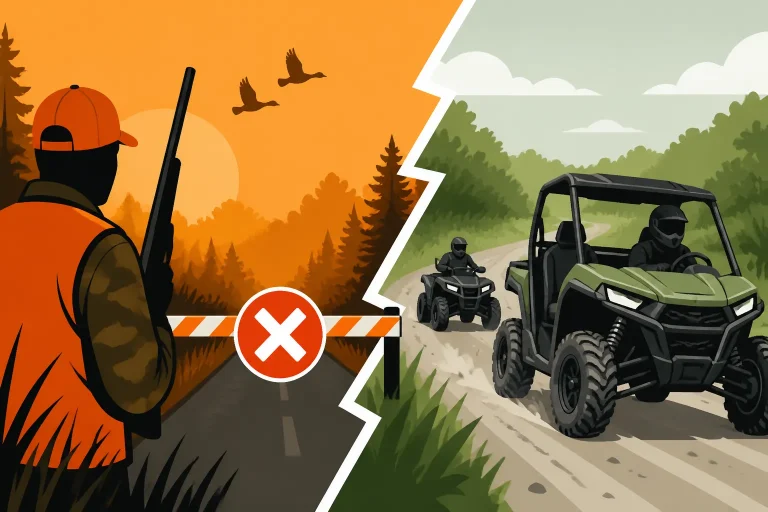
Treat a closed gate, berm, barricade, or posted closure as a clear stop. Do not go around it, lift it, or assume it was left in place by mistake. Road closures protect more than the riding surface: they can limit disturbance to wildlife, prevent damage to wet ground, and keep vehicles away from areas where public access is not allowed. The same caution applies when a road is washed out or appears impassable. A rough route is not an invitation to create a bypass.
If the sign and the map seem to disagree, follow the more restrictive instruction and contact the managing office for clarification. A quick call before the ride is much easier than explaining an avoidable violation afterward.
Where You May Ride and What to Do at a Closure
On a WMA, the important distinction is between riding a route that is open to motorized vehicles and using the machine to travel across the area. Permission to enter a WMA does not mean permission to cut across fields, woods, food plots, wetlands, levees, or other closed ground.
Stick to designated or otherwise clearly authorized roads. Do not make a new trail to avoid mud, a fallen tree, or a closed section. Even a short detour can damage vegetation or disturb habitat, and it may put you on land or a route that is not open to public vehicle use.
Do not infer access from the surface
A wide, graded road may be used by agency staff, timber crews, or other authorized vehicles. A narrow path may be a hiking route, a wildlife access lane, or an old road that is no longer open. A path that appears on a phone map may be private, closed, or outside the WMA boundary.
When in doubt, check the boundary and the current route information rather than relying on an app’s road line. If the route is not clearly open to your machine, do not ride it until you have confirmed access.
This is especially important near:
- Gates and barriers
- Wildlife food plots and planted areas
- Wetlands, creek crossings, and stream banks
- Levees and flood-control structures
- Utility corridors and timber roads
- Parking areas, campsites, and walking trails
- Property boundaries and roads that continue beyond the WMA
A road being physically passable does not establish a right to use it. A road can pass through the area and continue onto private property, or the public portion can end at a gate. Turn around at posted closures and avoid crossing into adjacent land unless you have separate permission.
Wet ground is a reason to stop, not to widen the route
Mississippi’s wet conditions can turn a manageable road into a damaging rut quickly. If the road is soft, standing water hides the depth, or your machine is beginning to spin, stop and reassess. Do not ride around a puddle or rut by widening the road into vegetation. Do not use a winch to drag a machine through a closed or sensitive area.
A closed route remains closed even if another way around looks easy. If the route is open but temporarily unsafe, turning back is the sensible choice. Check for updated notices before returning; closures may change as conditions improve or management work is completed.
The same approach applies to levees. A levee can be part of a public area without being open to ATV traffic. Follow the posted land-manager rules and do not assume that a levee road is an authorized riding route. For more on that issue, see Mississippi Levee Riding Is Prohibited.
Permits, Licenses, and Permission Are Different Things
One common source of confusion is the word “permit.” Riders may mean a hunting license, a WMA access authorization, an OHV trail pass, a safety certificate, or simply permission to enter the property. Those are not interchangeable.
A required hunting license does not necessarily authorize ATV riding on every road. Permission to use a WMA does not necessarily authorize hunting. A forest trail pass does not grant access to a WMA. And a machine’s title or proof of ownership does not make a closed route legal to ride.
Before traveling, answer these separate questions:
- May you enter this WMA for your planned activity? Check current access rules and any license or authorization requirements for the activity.
- May your ATV or UTV use the route you intend to ride? Confirm that the road is open to motorized vehicles and that any vehicle limits apply to your machine.
- Are there special rules for the season or time of day? Hunting periods, closures, and area-specific notices can change how a road may be used.
- Do you meet the rider requirements? Check age, supervision, license, and safety-course rules that apply to the land and activity.
- Are you carrying any required proof? Bring the documents or confirmations that apply to your trip, and keep them accessible.
Rules for other Mississippi public riding areas can differ. For instance, forest trail access has its own requirements, and a visitor’s out-of-state status does not automatically answer whether a particular WMA is open to them. See Mississippi Visitors Need No State Sticker for the separate question of state stickers, and Mississippi Has No Sticker for a Visiting Machine for more on that topic. Neither should be read as permission to ride a WMA road that is closed.
Confirm requirements for the actual activity
If you are visiting to hunt, fish, camp, scout, or retrieve game, check the requirements for that activity as well as the vehicle rules. An access rule can apply to everyone entering an area, while a hunting rule applies only to people hunting. A road-use rule may apply whether or not you have a hunting license.
Do not rely on an old permit, last season’s brochure, or a friend’s recollection. Regulations and area notices can change. If you cannot confirm a requirement from the current official information, contact the managing office before the trip. Ask the question in practical terms: “Can I ride this type of machine on this named road for this purpose on this date?” That is more useful than asking generally whether ATVs are allowed.
What your machine’s paperwork does and does not prove
Keep your ownership records and any required trail or land-use documents in order, but understand their limits. A title, bill of sale, or insurance card helps establish facts about the machine or your coverage; it does not authorize access to land. Mississippi’s title rules and public-land riding rules are separate topics. If you need to sort out the machine’s ownership documents, see How to Title an ATV in Mississippi.
A useful habit is to store a digital copy of relevant documents on your phone and keep essential items available offline. If you rely on a map app, download the map before entering an area where service may be limited. A paper map in a waterproof case is a useful backup. Riders looking for a case or map holder may compare options on Amazon, but the important part is choosing something that stays readable and protected in wet conditions.
Hunting, Game Retrieval, and Firearms
Riding to hunt or retrieve game involves more than finding a route. The rules for vehicle access, hunting, weapon possession, and game retrieval can overlap, but they are not the same rule. Check each one separately for the WMA, season, and activity.
Do not assume that a harvested deer, hog, or other animal gives you permission to drive anywhere across the area. Game retrieval may be limited by the roads you can use, the time or season, the method of retrieval, or area-specific restrictions. Follow current WMA rules and any directions from staff. If the rules do not clearly authorize vehicle retrieval by your planned route, ask before using the machine.
Keep the machine on authorized roads during retrieval
A common mistake is treating a downed animal as an emergency that cancels ordinary access restrictions. It does not. If the authorized road does not reach the location, do not ride through a food plot, across a wetland, around a gate, or through an unmarked area simply because it is the shortest path.
Check the current rules for retrieval, including whether a machine may be used, which roads are available, and whether additional restrictions apply. See Mississippi WMA Game Retrieval Rules and Mississippi WMA Deer Retrieval Rules for related guidance. For hog retrieval, see Mississippi WMA Hog Retrieval Rules. Always check the current rules for the specific area rather than assuming every WMA follows identical procedures.
If you are hunting with a group, agree in advance on who will operate the ATV or UTV and how the group will respond if an animal is down. Decide where the machine will remain while people track or recover game. A plan prevents the pressure of the moment from turning into an off-route ride.
Do not handle weapons casually while riding
Firearm rules on public hunting land can be specific, and unsafe transport can create serious danger even when a rider believes the machine is on an authorized road. Follow current instructions for unloading, securing, and transporting firearms. Do not ride with a loaded weapon unless the applicable rules explicitly allow the arrangement and it is safe and lawful. Treat an unloaded, properly secured firearm as the safer baseline while traveling.
Restrictions can also apply to shooting from roads, shooting across roads, or having a firearm near a road during particular hunting periods. These rules may use set distances or have exceptions, so do not rely on a general summary for a measurement. Check the current WMA regulations and look for posted instructions before hunting. Related guidance includes Mississippi WMA Weapon Restrictions and Mississippi WMA Firearm Setbacks.
A firearm should never be placed loose on a rack where it can fall, strike another object, or be handled by a child. Keep ammunition and firearms secured in a way that complies with the rules and does not create a hazard for the driver or passengers. If you are unsure whether a specific setup is permitted, do not use it until you have checked.
Separate hunting permission from driving permission
A person may be allowed to hunt in a particular place while being barred from driving off designated roads. Conversely, a road may be open to travel even when hunting is not permitted at that time or location. Never treat one kind of permission as proof of the other.
Check the area’s current hunting dates and weapon restrictions before carrying hunting equipment. If a road is closed during a particular period, do not assume that having the correct hunting license creates an exception. The same goes for a management-area road behind a gate: a hunting purpose does not make the closure optional.
Rider, Passenger, and Machine Safety
Even when a route is open, the trip can still go wrong if the rider, passenger, or machine is not suited to the conditions. WMA roads may be narrow, uneven, muddy, or shared with other users. They are not necessarily maintained like public streets or recreational park trails.
Match the machine to the route
Before leaving home, check whether the machine’s width, weight, or type is restricted for the route or area. Do not assume a full-size side-by-side can use a trail that accommodates a narrower ATV. A machine that fits between trees at the entrance may still exceed a posted limit or cause damage on a narrow road.
If a regulation or sign identifies a width or vehicle restriction, measure or confirm your machine rather than estimating from its appearance. A roof, mirrors, aftermarket tires, or other additions may affect the actual width. Relevant state-limit guidance is available in Mississippi ATV Width Limit of 50 Inches and Mississippi ROV Width Limit of 65 Inches, but a state definition does not override a more restrictive rule posted for a particular site.
Check the machine before each ride. Look at tires, brakes, steering, lights, and fuel. Secure cargo, firearms, tools, and recovery gear so they cannot shift. Carry a first-aid kit, water, and a way to contact your group. For a WMA where phone service may be unreliable, agree on a meeting point and a turnaround time before splitting up.
Ride at a pace that leaves room to react
Expect walkers, hunters, agency staff, wildlife, and other vehicles. Slow down where visibility is limited, near camps and parking areas, and when passing another person. Keep enough space to stop without sliding into another rider or leaving the road.
Dust can obscure visibility on dry roads; mud can reduce braking and steering control. Do not tailgate. If someone is walking or working ahead, stop or pass only when there is adequate room and it is safe to do so. Keep noise and disturbance under control, especially near camps, residences, or wildlife-management areas.
Do not carry more passengers than the machine is designed to hold. A passenger should have a proper seat and footrests, not ride on a rack or cargo bed. Secure loose items, and make sure everyone knows how to hold on and what to do if the machine stops. For child riders, check the rules that apply to the land and the specific machine, not only the child’s confidence or experience.
Prepare for heat, rain, and limited service
Mississippi weather can change the ride quickly. Bring drinking water, suitable clothing, and basic protection from sun and insects. A forecast does not tell you whether a particular road is passable, so check the area’s current notices too. After heavy rain, a route may be closed or unsafe even if it was open the previous day.
Do not count on a phone signal for navigation or emergency contact. Download the information you need while you have service, carry a paper map as a backup, and tell someone where you plan to go. A phone holder or waterproof pouch can be useful; Amazon is one place riders may browse for those items, but test any equipment before relying on it in the field.
If a machine becomes stuck, avoid damaging the road or surrounding land while trying to recover it. Use recovery gear only where you are allowed to be, and do not winch to a tree or structure if that could cause damage or violate site rules. If recovery would require leaving an authorized route, contact the managing office or emergency assistance as appropriate instead of making a new path.
Common Mistakes That Lead to Trouble
WMA access errors often happen because a rider applies a rule from another place, another season, or another kind of vehicle. The following assumptions are worth avoiding.
| Mistake | Why it can cause a problem | Better approach |
|---|---|---|
| “The road is on my map, so it must be open.” | The map may be old, incomplete, or show a road closed to ATVs. | Check current area rules and signs at the entrance. |
| “There are tire tracks, so riders are allowed.” | Tracks may be from staff, authorized users, or previous illegal use. | Use only routes confirmed open to your machine. |
| “A hunting license lets me drive anywhere I need to go.” | Hunting permission and motorized access are separate. | Confirm both hunting rules and vehicle-route rules. |
| “A gate is open, so the road is open.” | A gate’s position may not indicate authorization, and signs may still restrict use. | Follow posted instructions and current maps. |
| “My forest pass covers this WMA.” | Forest trail systems and WMAs have separate access rules. | Verify requirements for each property. |
| “I can go around the closure if the road is muddy.” | A bypass may leave the authorized route and damage habitat. | Turn back or choose another confirmed open route. |
| “Game retrieval is an automatic exception.” | Retrieval rules may limit routes, machines, or conditions. | Check the WMA’s current retrieval instructions first. |
| “My side-by-side fits, so it meets the limit.” | Site rules may impose width or vehicle restrictions. | Check the actual machine measurement and posted limits. |
Another frequent mistake is using information from a prior visit. A road can close after rain, during habitat work, or for a seasonal management reason. A familiar route is not necessarily open today. Check again before every trip, especially if there has been bad weather or a long gap since your last visit.
Riders sometimes confuse state rules with a specific WMA’s rules. Statewide definitions and requirements can help identify an ATV or ROV, but they do not establish access to every public route. Likewise, the absence of a state registration sticker requirement does not mean the machine may be operated anywhere. Property access, vehicle identification, titles, and road use are separate questions.
If you are stopped by an officer or land manager, be respectful and follow instructions. Ask what rule applies and where the permitted route begins, but do not argue by pointing to another rider or an old online map. If you believe a citation or access decision is mistaken, gather the relevant details and use the appropriate formal process afterward. Do not continue riding through a disputed closure.
A Practical Checklist Before You Unload
A short pre-trip check can prevent most avoidable WMA access problems. Use this sequence whenever you plan to ride.
- Identify the exact WMA. Confirm the official name, the entrance you intend to use, and the land manager responsible for that area.
- Read the current rules. Review the area-specific regulations, map, notices, and seasonal restrictions. Do not rely only on a search result or an old screenshot.
- Confirm your purpose. Check access requirements for riding, hunting, scouting, camping, fishing, or retrieval as separate activities.
- Choose an authorized route. Identify roads confirmed open to your machine. Do not plan to improvise around barriers, mud, or closures.
- Check the machine restrictions. Confirm that the vehicle type and dimensions are allowed. Consider installed accessories that change its width.
- Check the rider requirements. Verify age, supervision, license, and safety-course rules for the area and activity. If the requirement is unclear, contact the managing office.
- Review weapon and retrieval rules. If hunting, confirm firearm transport and road restrictions, plus any game-retrieval limits.
- Check conditions shortly before departure. Rain, work, or wildlife management may affect access. A rule that was accurate last week may not describe today’s conditions.
- Pack for limited service. Take water, basic repair and safety gear, a map you can access offline, and a backup plan for communication.
- Read signs at the site. Stop at the entrance and at decision points. If a sign conflicts with your plan, do not proceed until you have clarification.
For maps and records, a waterproof document sleeve can keep printed directions legible in a wet environment. Riders may find one through Amazon or another retailer, but choose gear based on fit and durability rather than assuming a product listing settles the access question. The map, posted signs, and current agency instructions are what matter.
If you are taking a group, share the rules before leaving the staging area. Make sure every rider knows which routes are open, where to turn around, and what to do if the group becomes separated. One rider taking a shortcut can create trouble for the whole party.
When a rule is ambiguous, the safest answer is not to test it on the ground. Call the WMA or responsible agency, describe the machine and intended route, and ask for a clear answer. Keep a note of the date and the office you contacted. That does not replace posted rules, but it can help you plan responsibly.
Disclaimer
This article is for general informational purposes only and does not constitute professional advice. Laws, prices and regulations vary by location and change over time. Consult a qualified professional for guidance on your specific situation.